On a test or quiz, inequalities can look familiar enough that it is tempting to solve them exactly like equations. We use many of the same algebra skills, and several of the steps do carry over. But inequalities have one important difference that can turn an otherwise correct solution into a wrong answer.
So how is solving an inequality different from solving an equation, and which steps can we handle the same way?
Today, our seasoned tutors will break down what an inequality is, how to solve one, and where the process differs from solving equations, so you can recognize the equation trap before it throws off your answer.

What Is an Inequality?
An inequality is a math statement that compares two values or expressions. It tells us that one value is greater than, less than, greater than or equal to, or less than or equal to another.
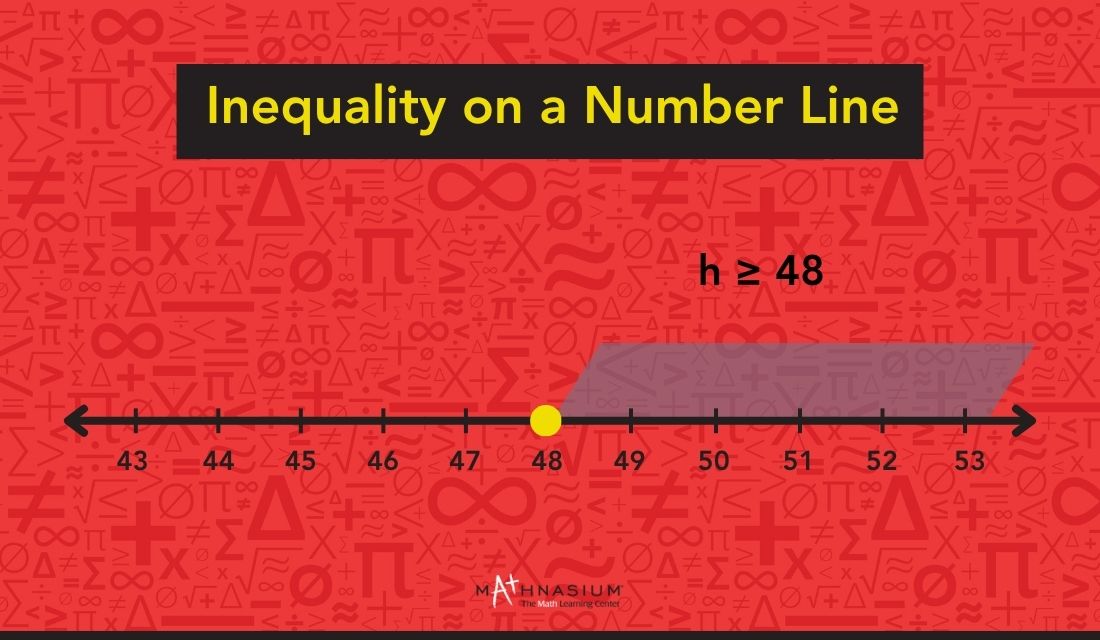
Imagine you’re getting on a roller coaster that requires riders to be at least 48 inches tall. If h stands for a rider’s height in inches, we can write that rule as:
h ≥ 48.
This inequality includes more than one possible height. A rider could be exactly 48 inches tall, 50 inches tall, or 60 inches tall and still meet the requirement.
The symbol tells us which values belong in the solution:
-
h ≥ 48 means 48 inches or taller, so 48 is included.
-
h > 48 means taller than 48 inches, so 48 is not included.
-
h ≤ 48 means 48 inches or shorter, so 48 is included.
-
h < 48 means shorter than 48 inches, so 48 is not included.
Since an inequality can describe a range of possible values, we often show its solutions on a number line. We use a dot to mark the endpoint, the number where the solution starts, and shading to show all the other values that work:
-
A closed dot (filled-in) means the endpoint is included, so we use it with ≤ or ≥.
-
An open dot (empty) means the endpoint is not included, so we use it with < or >.
-
The shading continues in the direction of all the values that satisfy the inequality.
For our roller coaster example, h ≥ 48, we place a closed dot at 48 because a height of exactly 48 inches counts. Then we shade to the right because every height greater than 48 also works.
You may also see an inequality with the variable on the right instead of the left. For example:
48 ≤ h.
This means the same thing as:
h ≥ 48.
Both tell us that h is at least 48. Before we graph, we can rewrite the inequality with the variable on the left if that makes the direction easier to read. If we switch the two sides, we also need to flip the inequality symbol so the statement keeps the same meaning.
Our tutors put together this table so you could connect each inequality symbol with its meaning, number-line dot, and solution direction.
| Inequality |
Read it as |
Endpoint dot |
Direction |
| x < 4 |
x is less than 4 |
Open |
Left |
| x ≤ 4 |
x is less than or equal to 4 |
Closed |
Left |
| x > 4 |
x is greater than 4 |
Open |
Right |
| x ≥ 4 |
x is greater than or equal to 4 |
Closed |
Right |

How to Solve a Linear Inequality
To solve a linear inequality, we can use the balance method. That means whatever we do to one side of the inequality, we do to the other side too, until the variable is by itself.
We can break the process into four steps:
-
Simplify the inequality, if needed.
-
Use inverse operations to get the variable by itself.
-
Reverse the inequality sign if we multiply or divide both sides by a negative number.
-
Show the solution on a number line.
Most of these steps will feel familiar if you have solved equations before. Step 3 is the one we need to watch most closely. When we add, subtract, multiply, or divide by a positive number, the inequality sign stays the same. But if we multiply or divide both sides by a negative number, we need to reverse the sign.
We’ll start with an inequality where the sign stays the same, then move to one where we need to reverse it.
Take this inequality:
2 x + 3 +1 ≤ 10.
-
Simplify the inequality: We combine 3 + 1 and get 2 x + 4 ≤ 10.
-
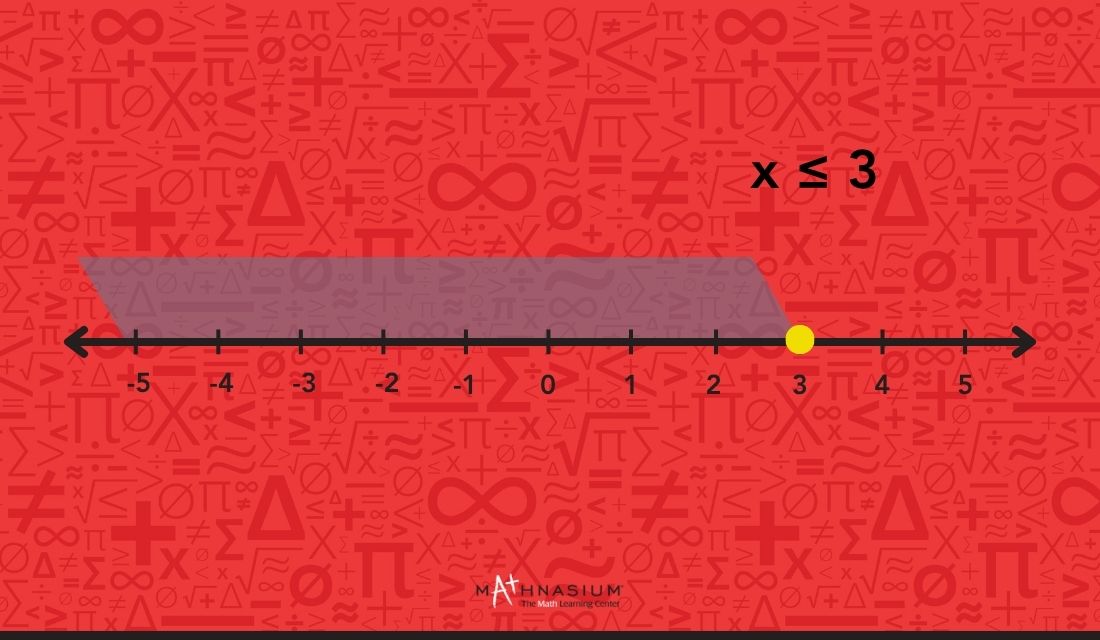
Use inverse operations to isolate the variable: First, we subtract 4 from both sides: 2 x + 4 - 4 ≤ 10 - 4. This gives us 2 x ≤ 6. Then, we need to divide both sides by 2, as 2 is positive, the sign stays the same: 2 x ÷ 2 ≤ 6 2. So: x ≤ 3.
-
Show the solution on a number line: We draw a closed dot at 3 and shade to the left.
Now let’s work through another example and see when we need to flip the inequality sign:
−2 x + 3 +1 ≤ 10.
1. Simplify the inequality if needed
First, we can make the left side simpler by combining the constants. Since 3 + 1 = 4, the inequality now looks like this:
−2 x + 4 ≤ 10.
2. Use inverse operations to isolate the variable
Next, we undo the +4. To keep the inequality balanced, we subtract 4 from both sides:
−2 x + 4 − 4 ≤ 10 −4
−2 x ≤ 6
The variable is not fully isolated yet because x is still being multiplied by −2. This means we need to divide both sides by −2.
3. Reverse the inequality sign if needed
To get x alone, we divide both sides by −2. This is the point where the inequality sign has to change, so let’s look at why this happens.
Why the inequality sign flips when we multiply or divide by a negative number
The inequality sign flips because dividing or multiplying by a negative number changes the direction we need to use to describe the same set of solutions.
Here is how this works.
For our inequality, −2 x ≤ 6, we want to find the values of x that make the statement true.
Start with x = −3. We substitute –3 into the inequality:
−2 (−3) ≤ 6
6 ≤ 6.
That is true, so −3 is part of the solution.
Now, we’ll try a value to the right of −3, such as 2:
−2 (2) ≤ 6
−4 ≤ 6.
That is also true.
So the values that work start at −3 and continue to the right on the number line:
x ≥ −3.
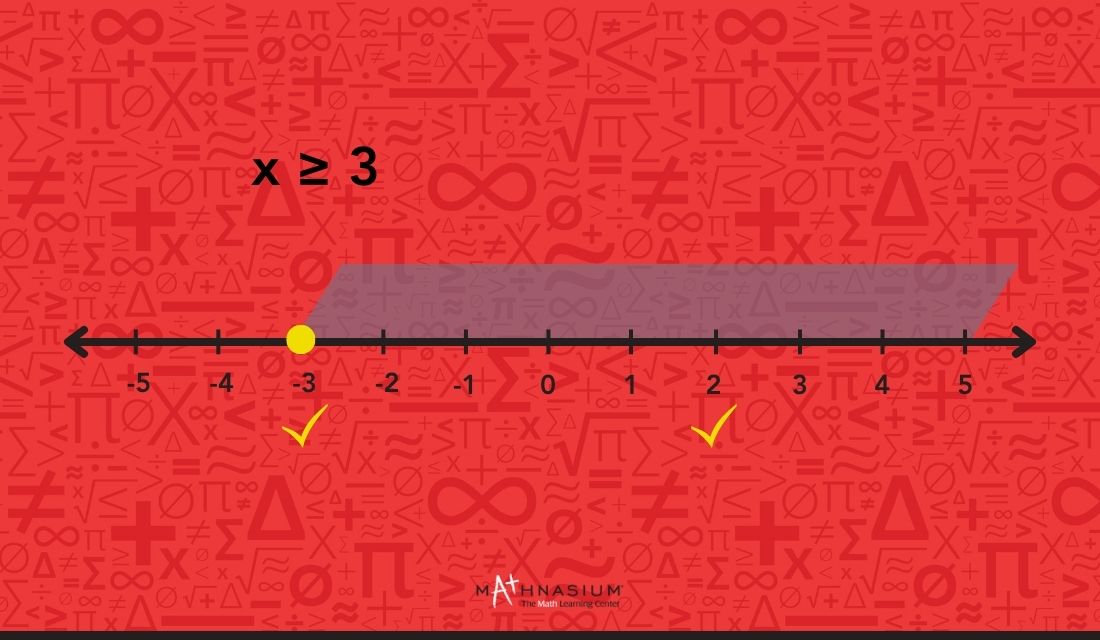
Notice that we are still describing the same set of values that made −2x ≤ 6 true. After we divide by −2, we just need a new way to write that same solution set. Because the solutions lie to the right of −3, we write:
x ≥ −3.
Now let’s see what would happen if we divided by −2 but did not flip the sign. We would get:
x ≤ −3.
That would tell us that values to the left of −3 should work. Let’s test one, such as x = −4:
−2 (−4) ≤ 6
8 ≤ 6.
That is false.
So −4 does not belong in the solution, even though x ≤ −3 would include it.
If we did not reverse the inequality sign, we would end up pointing to values that do not satisfy the original inequality. The reversed sign keeps us pointing to the correct solution set.
4. Show the solution on a number line
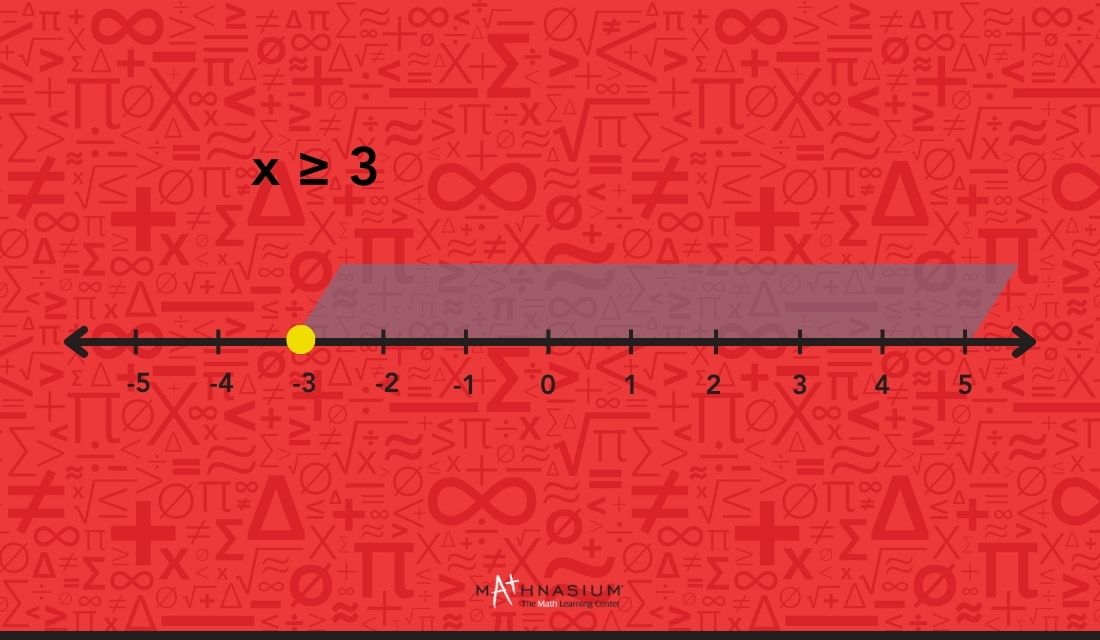
Then, we graph our solution, x ≥ −3:
-
Place a closed dot at −3 because −3 is included in the solution.
-
Shade to the right because every number greater than −3, such as −2, 0, and 5, works too.
Quick Reference: When to Flip the Sign in Inequalities
Need a quick recap before homework or a quiz? Use this table as a reminder of when the inequality sign reverses:
| What we do to both sides of inequality |
Example |
Does the sign reverse? |
Why? |
| Add or subtract a number |
x −5 < 3 → x < 8 |
No. |
The same values still keep their order. |
| Multiply or divide by a positive |
2 x ≤ 8 → x ≤ 4 |
No. |
The order of the values stays the same. |
| Multiply or divide by a negative |
−2 x ≤ 8 → x ≥ −4 |
Yes. |
Without reversing it, we would describe the wrong set of values. |
📕 You May Also Like: What Is Inequality in Math? Everything You Need to Know
Solving Inequality vs. Equation
If you already know how to solve equations, much of the work with inequalities will feel familiar. In both, we use inverse operations to get the variable by itself.
The main difference is that:
-
An equation usually gives us one or more specific values that make the two sides equal. On a number line, we can graph those solutions as specific points.
-
An inequality describes a range of values that make the comparison true. Its solutions extend across a continuous set of values on a number line instead of showing up as separate points.
And we also need to reverse the inequality sign whenever we multiply or divide both sides by a negative number.
Here’s how solving an equation and an inequality compare side by side:
| Solve the equation |
Solve the inequality |
| −2 x +7 = 17 |
−2 x + 7 ≤ 17 |
| Subtract 7: −2 x = 10 |
Subtract 7: −2 x ≤ 10 |
| Divide by −2: x = −5 |
Divide by −2 and reverse the sign: x ≥ −5 |
| One solution in this example |
A range of solutions: every number greater than or equal to −5 |
The sign flip keeps catching you on tests, or inequalities still feel confusing? Our algebra tutors at Mathnasium of North Frisco can help you build confidence with these and other math skills.
📕 You May Also Like: Solving Multi-Step Equations with Variables on Both Sides
Your Turn: Do We Reverse the Sign or Not for These Inequalities?
Try solving the inequalities below, graph each solution on a number line, and decide whether the inequality sign should reverse. You can check your answers at the bottom of the page.
Challenge 1
3 x − 4 > 11.
Challenge 2
−3 x − 4 > 11.
📕 You May Also Like: 5 Ways Math Practice Impacts Brain Development + Benefits
 Mathnasium tutors use different teaching techniques and hands-on activities to help students build a solid understanding of math concepts, such as inequalities.
How Mathnasium Helps Students Make Sense of Inequalities (and Any Other Math Topic)
Mathnasium is a math-only learning center dedicated to helping K–12 students of all skill levels excel in math.
We aim to help students understand how the method works instead of treating each new topic as a separate set of rules to memorize. With inequalities, for example, we make sure students understand why the inequality sign reverses when they multiply or divide by a negative number.
To help students build that kind of understanding, we use the Mathnasium Method™, our proprietary teaching approach, to meet students where they are and guide them forward step by step.
Each student begins with a diagnostic assessment that helps us understand their current skill level, knowledge gaps, goals, and how they think and feel about math.
Using these insights, we create a personalized learning plan focused on the skills the student needs most, whether that means reviewing integer operations, reinforcing inverse operations, practicing number lines, or preparing for more advanced algebra.
Our specially trained tutors follow the plan closely and provide live, face-to-face instruction in a caring and fun group environment. They use mental, verbal, visual, tactile, and written techniques to help students notice structure, explain their steps, and connect symbols to meaning.
Students also get room to think through problems before tutors step in. Instead of immediately pointing out a missed sign reversal, our tutors help students check their reasoning, catch mistakes, and build greater independence in math.
Fun is part of the approach, too. We use game-based activities, rewards, and consistent encouragement to keep students engaged as they work through equations, inequalities, and increasingly complex algebra problems.
The results speak for themselves:
-
94% of parents report an improvement in their child's math skills and understanding
-
93% of parents report their child's improved attitude toward math after attending Mathnasium
-
90% of students saw an improvement in their school grades
With over 1,100 learning centers across North America, there is likely a Mathnasium close to you.
For families in North Frisco and McKinney, TX, Mathnasium of North Frisco brings that same approach close to home, with specially trained tutors who help students make sense of inequalities, equations, and the algebra skills that build from them.
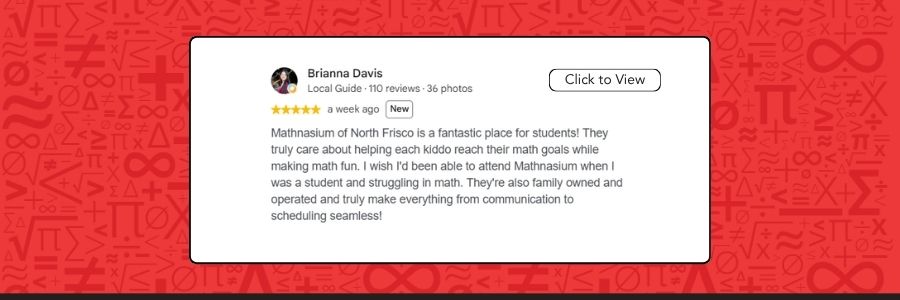
Here’s what one parent had to say about their Mathnasium experience:
If your child needs support with inequalities, equations, or any other math topic, a free diagnostic assessment is a great place to start. Using what we learn, we create a personalized learning plan that helps your child strengthen the skills they need next.
📅 Schedule a Free Assessment at Mathnasium of North Frisco
Not near North Frisco or McKinney?
📍 Find a Mathnasium Learning Center Near You
Check Your Answers Here!
Ready to see how you did? Here are the answers to the practice problems above:
Challenge 1
3 x − 4 > 11:
-
Simplify: No simplifying is needed.
-
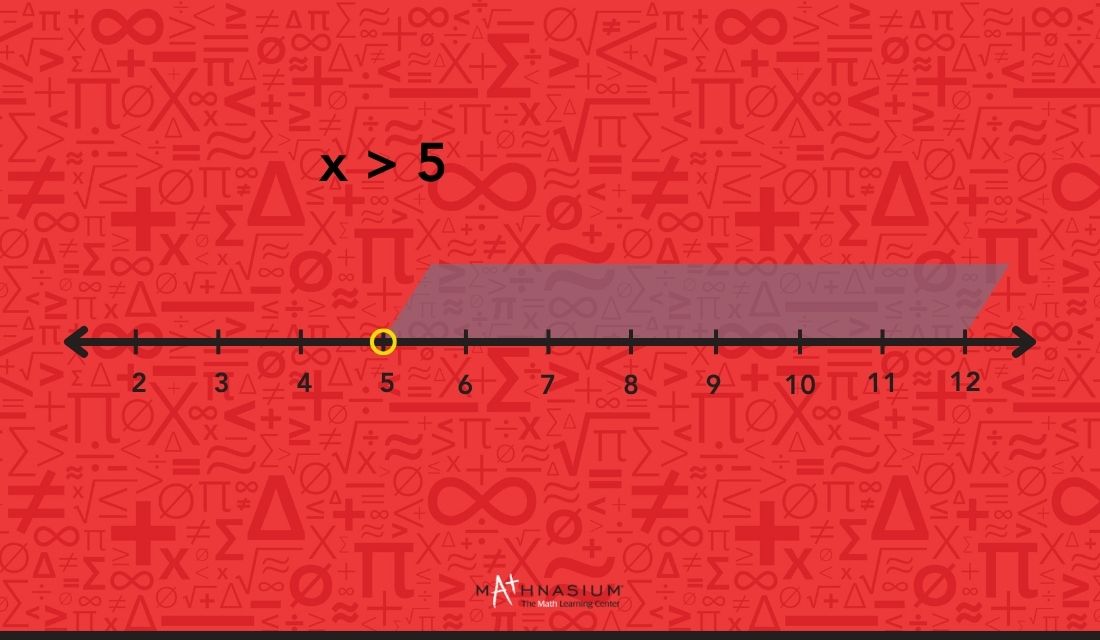
Use inverse operations: We add 4 to both sides: 3 x > 15. Then, we also need to divide by 3. It’s positive, so the sign stays: x > 5.
-
Graph: Here we use an open dot at 5, because 5 is not part of the solution, and shade to the right.
Challenge 2
−3x − 4 > 11:
-
Simplify: We don’t need to simplify.
-
Use inverse operations: We add 4 to both sides and get: −3 x > 15. Next, we divide by –3: −3 x ÷ (-3) > 15 ÷ (-3).
-
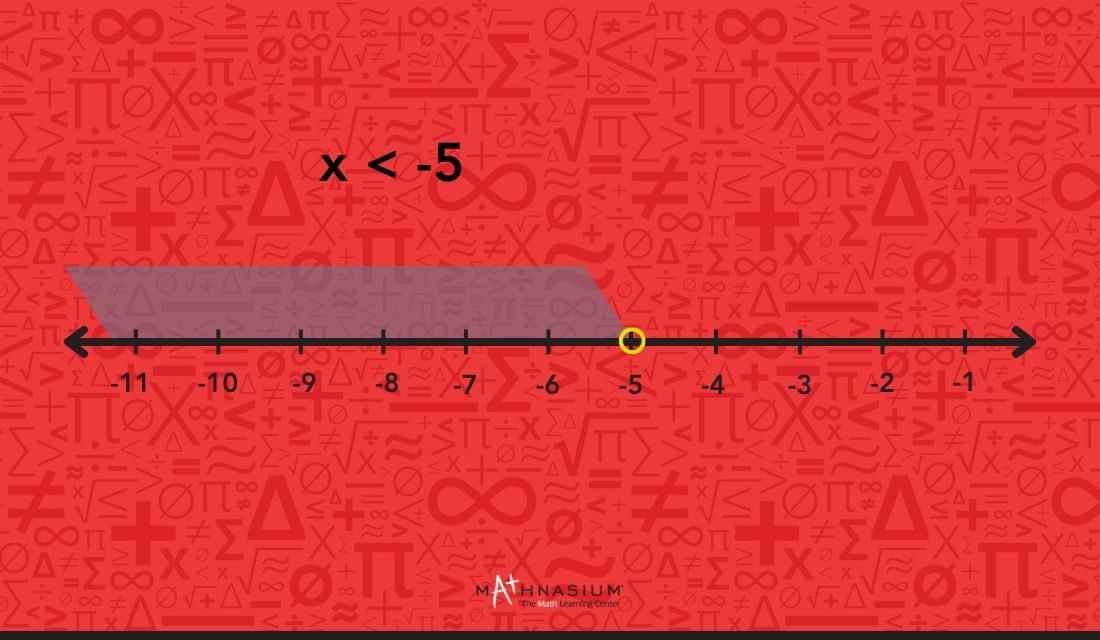
Reverse the inequality sign: As we divide by a negative number, the sign flips: x < −5.
-
Graph: On a number line, we show the solution with an open dot at −5 because −5 is not included, and we shade to the left.


 (469) 248-8844
 (469) 248-8844