The first equations students solve usually take just one or two steps. Multi-step equations add more to work through, such as parentheses, like terms, or a variable on both sides.
With more work to do, it is understandable that students might feel unsure about where to start. The questions arise. Do we deal with the parentheses first? Which terms can we combine? What happens if there’s an x on each side?
Today, our tutors will help you answer those questions. We’ll walk you through worked examples step by step and address common questions students may have. Then you can try a few practice equations on your own.

What Are Multi-Step Equations?
Multi-step equations are equations that require more than two steps to solve. Before we can find the value behind the variable, we often need to simplify one or both sides.
Think back to an equation such as x + 4 = 9. One subtraction gives us the answer. In 2x + 4 = 10, we subtract 4, then divide by 2. A multi-step equation adds more work, such as parentheses to expand or like terms to combine.
Let’s take a look at one example together:
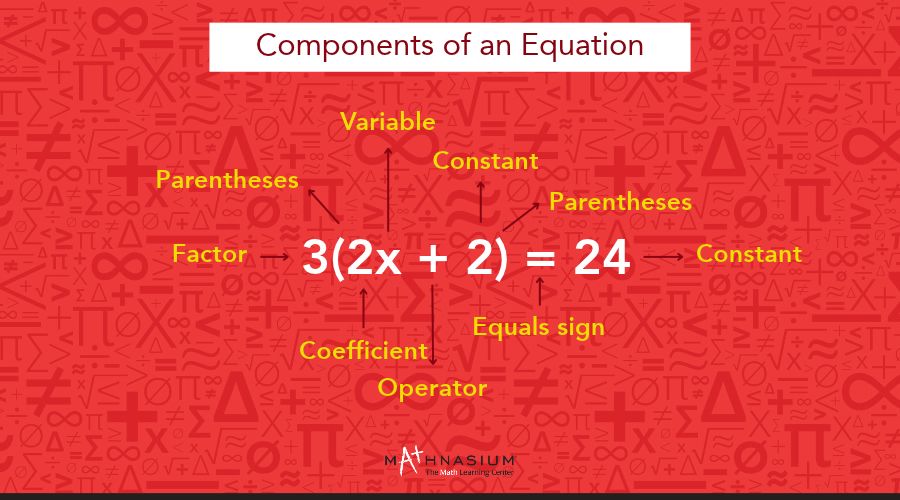
Each part tells us something about the equation:
-
The outside factor (3) multiplies the entire expression 2x + 2.
-
The variable (x) represents the unknown value we are looking to find. The variable can be any other letter than x, such as a, b, c, etc.
-
The coefficient (2) multiplies a variable in a term.
-
The constants are numbers without variables attached. Here, the constants are 2 inside the parentheses and 24 on the right side of the equals sign.
-
The parentheses group 2x + 2, so the 3 outside applies to both terms inside.
-
The equals sign tells us that the expressions on the left and right must have the same value.
While this example has the variable on one side only, multi-step equations can also have variables on both sides.

How to Solve Multi-Step Equations
As their name suggests, these equations require multiple steps to find the value of the variable. We’ll start with a multi-step equation that has a variable on one side only.
Example 1: A Multi-Step Equation With a Variable on One Side
Let’s try to find the value of x in 3(2x + 2) = 24.
Step 1: Distribute
We’ll start by distributing 3 to each term inside the parentheses.
3(2x) + 3(2) = 24
That gives us:
6x + 6 = 24
Step 2: Combine Like Terms on Each Side
With the parentheses gone, we check each side for like terms if there’s anything to combine.
Here’s a quick refresher: like terms have the same variable part. Numbers without variables (constants) are also like terms.
Here, 6x and 6 are not like terms, so we cannot combine them. The right side has just one term (24). The equation stays as is:
6x + 6 = 24
Step 3: Move Constants to One Side
In our current equation, we have 6x + 6 on the left and 24 on the right. What we need to do now is to isolate 6x on its own.
Which operation do we see? It’s addition. To isolate 6x, we need to undo it by subtracting 6 from both sides. This way we keep the equation balanced.
6x + 6 - 6 = 24 - 6
6x = 18
Now we have the variable term (6x) on one side and the constant (18) on the other.
Step 4: Isolate the Variable
There’s a single step that separates us from finding the value of x. It’s multiplication. What operation will undo multiplication by 6? It’s division. So, let’s divide both sides by 6.
6x ÷ 6 = 18 ÷ 6
x = 3
The value of x is 3.
Step 5: Check the Solution
In case we want to check our work, we can plug 3 back into our original equation 3(2x + 2) = 24 and see if both sides are balanced. If we do so, we get:
3(2 x 3 + 2) = 24
First, we need to multiply inside the parentheses, and then add.
3 (6+2) = 24
3 (8) = 24
With the parentheses done, we just multiply 3 by 8 on the left.
3 x 8 = 24
24 = 24
Since both sides are balanced, our answer x = 3 is correct.
📕 You May Also Like: What Are Inverse Operations? A Complete Overview
Example 2: A Multi-Step Equation With a Variable on Both Sides
With the steps for solving equations with a variable on one side established, let’s now solve an equation with variables on both sides to see if anything changes. What is the value of x in this equation?
4(2x−3) + 6 = 5x + 9
Step 1: Distribute
What is the first thing we see in this equation? It’s the parentheses on the left. We’ll start by distributing 4 to each term inside the parentheses. By doing so, our equation becomes:
8x − 12 + 6 = 5x +9
Step 2: Combine Like Terms on Each Side
Then, we scan both sides for like terms to see if we can combine anything together. On the left, we can combine the constants (−12 and +6). However, there are no like terms to combine on the right.
8x − 12 + 6 = 8x - 6
Our equation now looks like this:
8x - 6 = 5x + 9
Step 3: Move Constants to One Side
As we are dealing with both variables and constants on both sides, we can first move constants to the right side. To do that, we undo the subtraction by adding 6 to both sides and keep the equation balanced.
8x - 6 + 6 = 5x + 9 + 6
8x = 5x +15
Step 4: Move Variable Terms to One Side
With the constants on the right, we need to move the variable terms to the left. The operation we see on the right is addition, so we undo it by subtracting 5x from both sides.
8x - 5x = 5x + 15 - 5x
3x = 15
Step 5: Isolate the Variable
We are one step away from solving for x. As multiplication stands in our way, we divide by 3 to undo it.
3x ÷ 3= 15 ÷ 3
x = 5
The value behind the x is 5.
Step 6: Check the Solution
If we want to double-check the work we did, we just plug in the answer (5) back into our original equation.
Since both sides are equal (balanced), this confirms we did a great job.
📕 You May Also Like: Solving Multi-Step Equations with Variables on Both Sides
Your Turn! Check Your Knowledge of Multi-Step Equations
We created a few different examples of multi-step equations for you to try on your own. When you solve them, check the answers at the bottom of the guide.
Example 1: 2(x + 3) + 5 = 23
Example 2: 3x + 4 = 2(10 + 4)
Example 3: 3(x + 2) + 4 = 2x + 17
Example 4: 7x − 5 = 2(2x + 8) + 6
Example 5: 3(2x − 1) + 4x = 4x + 8
Frequently Asked Questions About Multi-Step Equations
As students progress from one- and two-step equations to multi-step ones, it’s common that some questions arise. From our daily work with students, we have collected a few questions we often hear with their answers.
1. If a number multiplies an expression in parentheses, do I have to distribute first?
We don’t always have to distribute first. If a number multiplies the entire expression on one side, we can divide both sides by that number instead. For example, in 3 (2x + 2) = 24, we can divide both sides by 3 to get 2x + 2 = 8.
However, the division doesn’t always give a whole number. In that case, we can still divide instead of distributing. For example, in 2(3x + 1) = 9, we can divide both sides by 2 and get
3x + 1 = \(\Large\frac{9}{2}\)
However, if we distribute first, we get 6x + 2 = 9, so we can continue working with whole numbers instead of fractions.
In conclusion, both approaches lead to the same answer. Choose the one that makes the arithmetic easier.
2. Does it matter which side I collect the variable terms on?
No. We can collect the variable terms on either side, but we need to apply the same operation to both sides to keep the equation balanced
Let’s illustrate that in 8x − 6 = 5x + 9. If we subtract 5x from both sides, we keep the variable terms on the left. If we decide to subtract 8x instead, we collect them on the right. Either approach works, but the first keeps the variable term’s coefficient positive.
3. What do I do if there’s a minus sign directly before the parentheses?
In that case, treat the minus sign as multiplication by −1. Distribute it to every term inside the parentheses.
−(2x − 3) = - 2x + 3
In the process, do not forget that both signs change:
-
2x becomes − 2x
-
− 3 becomes + 3
📕 You May Also Like: What Is the Distributive Property and Its Role in Algebra
4. What does it mean if the variable disappears while I’m solving an equation?
Multi-step equations don’t always have just one solution. It can also have no solution or infinitely many solutions.
If the variable terms cancel, look at the statement that remains:
-
No solution: In 2x + 3 = 2x + 7, if we subtract 2x from both sides, that leaves us with 3 = 7. That statement is false, so no value of x makes the original equation true.
-
Infinitely many solutions: In 2x + 3 = 2x + 3, if we subtract 2x from both sides, we continue working with 3 = 3. The original equation is true for every value of x, so it has infinitely many solutions.
 At Mathnasium, we use personalized learning plans and proven teaching techniques to help students master solving multi-step equations with confidence.
How Mathnasium Helps Students Master Multi-Step Equations (and Any Other Math Topic)
Mathnasium is a math-only learning center dedicated to helping K–12 students of all skill levels learn and master math.
We aim to help students understand how math works instead of treating each new topic as a separate set of rules to memorize. With multi-step equations, for example, we explain why each operation works and how applying it to both sides keeps the equation balanced.
To help students build that kind of understanding, we use the Mathnasium Method™, our proprietary teaching approach, to meet students where they are and guide them forward step by step.
Each student begins with a diagnostic assessment that helps us understand their current skill level, knowledge gaps, goals, and how they think and feel about math. These insights help us create a personalized learning plan focused on the skills the student needs most
Our specially trained tutors follow the plan closely and provide live, face-to-face instruction in a caring and fun group environment. They use mental, verbal, visual, tactile, and written techniques to help students understand each step in solving a multi-step equation and why it works.
Students also get room to think through problems before tutors step in. Our tutors guide them through the reasoning, which helps them build critical thinking, problem-solving skills, and greater independence they need both in math and beyond.
Fun is an important part of how we work. Sessions often include game-based and hands-on activities that keep students engaged and make learning more enjoyable. Students earn rewards along the way, and we celebrate every bit of progress, so confidence grows alongside mastery.
The results speak for themselves:
-
94% of parents report an improvement in their child's math skills and understanding
-
93% of parents report their child's improved attitude toward math after attending Mathnasium
-
90% of students saw an improvement in their school grades
With a network of over 1,200 learning centers, there is likely a Mathnasium close to you.
For families in North Frisco and McKinney, TX, Mathnasium of North Frisco brings that same approach close to home, with specially trained tutors who help students make sense of the math behind the equations.
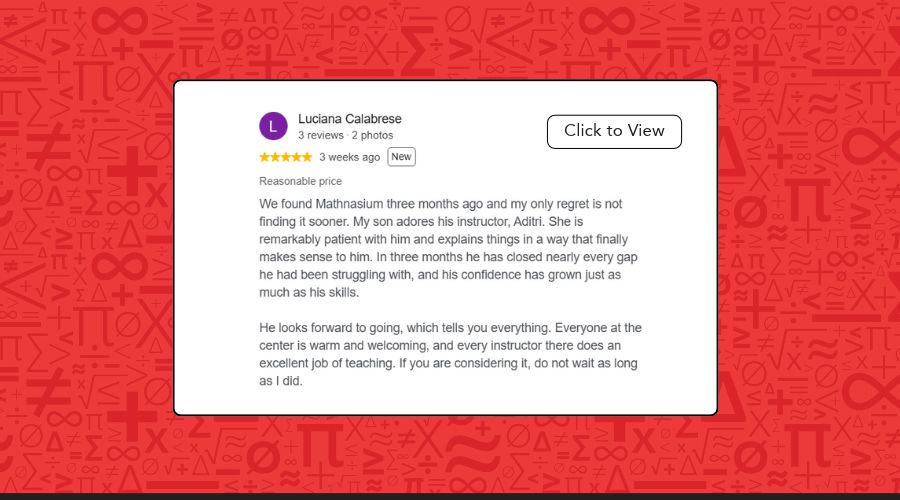
Here’s what one parent had to say about their Mathnasium experience:
If your child needs support with multi-step equations or any other math topic, a free diagnostic assessment is a great place to start. From what we learn, we create a personalized learning plan that helps your child sharpen the skills they need next.
📅 Schedule a Free Assessment at Mathnasium of North Frisco
Not near North Frisco or McKinney?
📍 Find a Mathnasium Learning Center Near You
Psst! Check Your Answers Here
How did the multi-step equations go? Here are the answers to the practice examples.
Example 1: x = 6
Example 2: x = 8
Example 3: x = 7
Example 4: x = 9
Example 5: x = \(\Large\frac{11}{6}\)
How did you do?


 (469) 248-8844
 (469) 248-8844