
 (302) 475-4444
 (302) 475-4444











Shreeya's Next Steps!
May 5, 2026 | North Wilmington


You probably noticed that your child processes information best when they see pictures, write things out, talk through the steps, or perhaps use tools and move objects. These different learning styles offer clues about how your child processes information and connects to new concepts.
Because kids make sense of math differently, finding support that adapts to their individual approach will play an important role in their progress.
Let’s look at how learning styles influence math success, how to choose tutoring options that adapt to your child’s needs, and how Mathnasium uses personalized instruction to help every learner make sense of math.

As students move beyond basic math into more complex topics, how they process information becomes increasingly important. You may have heard terms like “visual learner” or “kinesthetic learner” used to describe your child’s learning style, but these labels only scratch the surface.
The idea of learning styles comes from models like Dunn & Dunn and the VARK framework, which identify common preferences for how people absorb and retain information:
Visual learners benefit from diagrams, charts, and spatial models
Auditory learners understand best through listening and verbal explanation
Reading/Writing learners prefer written information and note-taking
Kinesthetic learners make sense of concepts through movement and hands-on interaction
But it’s important to highlight that these preferences are useful, not definitive. It’s a common myth that students fall into one single category. In reality:
Most kids use a blend of learning styles
Preferences can change depending on the math topic, the setting, or even the child’s mood
For example, a student might rely on visuals for geometry but prefer verbal explanations for solving equations
In other words, learning styles aren’t about fitting a child into a box; they’re about opening more doors. When tutors pay attention to how a student processes information, they can adjust their approach in real time and help students make sense of complex concepts.
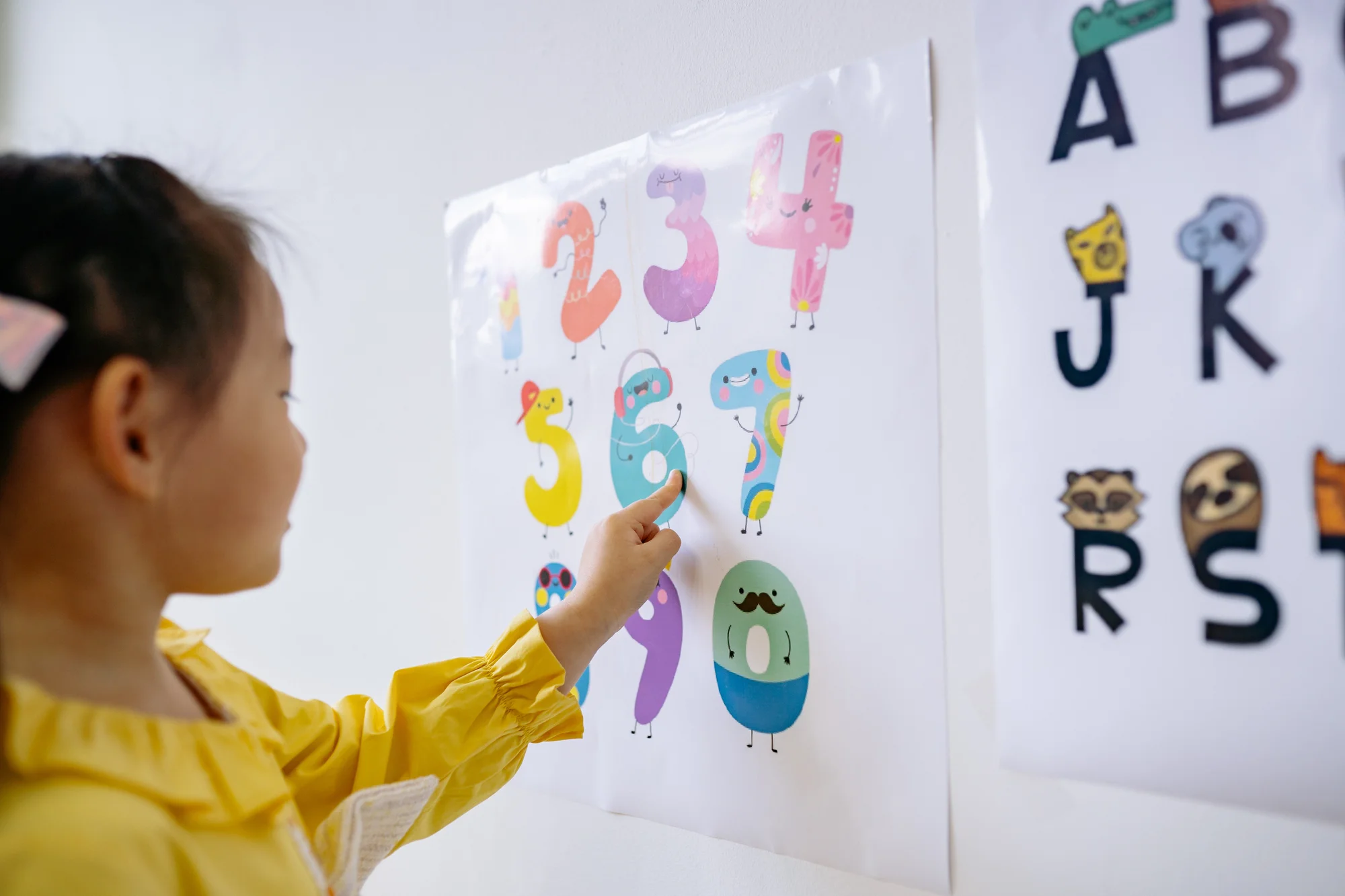
Visual learners connect with numbers through colorful, picture-based representations.
At Mathnasium, we don’t like to link math performance to ability or talent. Math is a skill, and as with any skill, we develop it at our own pace and in our own way.
By matching math instruction to how a student best processes information, we can make abstract concepts feel more intuitive and learning more efficient.
Here are four common learning styles and how each one benefits from specific math strategies and tools:
Students who lean toward visual learning often connect best with information they can see and organize spatially. Diagrams, number lines, color-coded steps, and fraction models help bring abstract concepts, like part-whole relationships or multi-step equations, into focus.
These students benefit when visuals are thoughtfully integrated as tools for revealing patterns and structure in math. That said, even visual learners often need verbal or tactile reinforcement to fully internalize new material.
📕 You May Also Like: How to Teach Math to Visual Learners with Pictures & Manipulatives
Auditory-oriented students tend to process new information more easily through sound. Listening to explanations, discussing problems out loud, or repeating steps in their own words can be effective tools for comprehension.
These learners thrive when they’re encouraged to talk through their reasoning, engage in guided math conversations, or explain a process before writing it down.
Students with kinesthetic tendencies make sense of math through hands-on exploration. Math manipulatives like algebra tiles, base-ten blocks, and measuring cups let them “feel” the math in motion.
They stay more engaged when they can move, build, or manipulate objects during lessons. While worksheets may not hold their attention, a well-timed interactive model can spark real understanding. These students also benefit from movement-based memory tricks or rhythm-based routines.
Students who prefer written communication often absorb math more effectively through clear notes, worked examples, and written instructions. They like to read explanations, make lists, and take notes to reinforce their thinking.
These learners excel when they’re asked to rewrite problems in their own words, journal their problem-solving steps, or create written guides for solving specific types of questions. Still, combining reading/writing with visual or verbal inputs often deepens retention.
Studies have shown that students perform better in math when instruction aligns with how they naturally learn.
Another study found that using learning-style-aligned strategies improved engagement and focus. Tailoring instruction to the student’s preferred learning style(s) predicted better focus and reduced procrastination.
These insights mirror what we as educators see every day: when children connect with the method of teaching (i.e. learning), they stay involved longer and build a more durable understanding of the material.
Effective math instruction weaves together multiple approaches, giving students different pathways to understand and truly own the concepts they’re learning.
📕 You May Also Like: What Is Multisensory Math? Engage All the Senses for Learning
Choosing the right math tutoring is less about evaluating tutors’ math competence and more about finding a learning environment that understands your child, how they think, how they tackle problems, and what helps them feel confident.
Here are five key things to look for when deciding whether a tutoring program truly adapts to different learning styles.
Whether you are considering a private tutor or a math learning center like Mathnasium, take the time to understand their approach: (How) do they tailor instruction to each student’s individual needs?
For example, Mathnasium’s approach begins with a diagnostic assessment designed to identify the student’s skill level, learning style, and needs.
We use these insights to create a personalized learning plan focused on (re)building the student’s foundational skills and growing their knowledge gradually, at their own pace.
A tutoring program that truly adapts to learning styles will use a variety of tools to make instruction both engaging and effective, such as:
Visual supports like drawings, number lines, and color-coding
Hands-on materials such as manipulatives or fraction models
Verbal explanation and discussion for auditory learners
Structured notes or written steps for reading/writing learners
Tutors that employ a variety of carefully selected teaching tools can transform how students think and feel about math.
If possible, sit in on a session. Pay attention to how tutors adjust their instruction:
Do they shift strategies when a student seems confused?
Offer visual aids, ask guiding questions, or change how the problem is framed?
Encourage students to explain their thinking, not just find the right answer?
Adaptability in the moment is one of the clearest signs of student-centered teaching.
A well-designed curriculum is important, but it shouldn’t come at the cost of flexibility.
Look for tutoring models that blend structure with personalization, allowing tutors to adapt lessons in real time and integrate tools like visuals, conversation, and manipulatives based on how each student learns best.
Memorization has its place in math, but real confidence and true progress come from understanding. Look for a center that values reasoning and problem-solving. Students who understand why a method works are more likely to apply it correctly in new situations.
Centers like Mathnasium emphasize conceptual clarity over drill-and-kill tactics, helping students become independent thinkers with a lasting grasp of math.
📕 You May Also Like: Comparing Math Tutoring Centers: A Parent’s Checklist

Face-to-face math guidance helps students build confidence in a supportive environment.
Families often turn to Mathnasium when their child feels confused, frustrated, or is beginning to fall behind in math. What they find is something more than just tutoring—they find a supportive learning environment built on clarity, confidence, and true personalization.
At the heart of our approach is the Mathnasium Method™, a proprietary teaching system that combines personalized learning plans with proven, face-to-face instruction in a caring and fun group setting. We teach math in a way that makes sense to each student—so they not only improve their skills but also feel more confident in their ability to learn.
The journey begins with a diagnostic assessment designed to help us understand how your child reasons through problems, where their knowledge gaps lie, and which learning strategies they naturally prefer.
These insights guide the creation of a customized learning plan focused on building foundational skills, reinforcing grade-level content, and preparing for what’s ahead.
During sessions, students follow their learning plan with the support of our specially trained tutors who adjust instruction in real time to match each student’s needs.
Whether your child thrives with visual models, verbal explanation, hands-on tools, or written steps, our tutors draw from a wide range of techniques to ensure every concept clicks.
And the results speak for themselves:
94% of parents report an improvement in their child’s math skills and understanding
90% of students see better grades at school
93% of families say their child has a more positive attitude toward math
Families in Wilmington, DE, and nearby communities are invited to visit Mathnasium of North Wilmington and launch their child’s journey to math mastery.
Curious about how your child learns best?
Schedule a diagnostic assessment at Mathnasium of North Wilmington and discover how personalized instruction can help math finally make sense.
Not close to Wilmington?
Mathnasium of North Wilmington is a math-only learning center for K-12 students in Wilmington, DE. Trusted by over a million parents, Mathnasium uses personalized learning plans and the proprietary Mathnasium Method™ to help students catch up, keep up, and get ahead on their math journey.
Our specially trained tutors deliver face-to-face instruction in a supportive and fun small-group environment, working with students both in center and online to develop a deep understanding of math, build confidence, and improve academic performance.
Schedule Free Assessment
