The Movie That Looks Like a Familiar Story—Until It Doesn’t
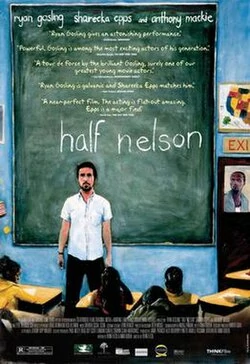
On paper, Half Nelson is easy to misread. A young teacher in a struggling public school forms an unlikely bond with a student. That’s the setup for a dozen Hollywood uplift dramas. But Ryan Fleck and Anna Boden’s film is built to resist the simple moral math that those movies depend on: good person + good intentions = redemption.
Here, the teacher—Dan Dunne (Ryan Gosling)—is magnetic in the classroom and collapsing everywhere else. His student—Drey (Shareeka Epps)—is perceptive, guarded, and already fluent in the compromises that adults call “real life.” Their friendship is the center of the film, but not the kind that ties a bow around anybody’s pain. It’s a relationship formed from recognition: she sees him clearly; he sees that she sees him; and both are forced to live with what that means.
The title itself hints at the film’s approach. A “half nelson” is a wrestling hold—control without total immobilization, a grip that can look like restraint but can also be the beginning of a choke. The film keeps asking: when does help become control, when does mentorship become dependence, and when does love become another form of need?
Origins: From a Short Film to a Feature With Teeth
Half Nelson didn’t begin as a feature-length screenplay built for studios. It grew out of a short film Fleck and Boden made in 2004 called Gowanus, Brooklyn, which became the seed that later expanded into the feature. Wikipedia
That origin matters because you can feel it in the finished movie: the intimacy, the small observational details, the refusal to over-explain. Even the way scenes end—often before you’re “ready,” often before someone says the clarifying thing a Hollywood script would demand—suggests filmmakers who came up through a world where mood and authenticity beat plot mechanics.
By the time Half Nelson premiered in competition at the 2006 Sundance Film Festival, it carried that indie DNA openly. Wikipedia The movie wasn’t trying to be “important.” It was trying to be true—and Sundance is exactly the kind of launchpad that can turn a small, honest film into a cultural whisper people lean in to hear.
Casting: Why These Faces Matter (And Why the Movie Wouldn’t Work Without Them)
Ryan Gosling as Dan Dunne: Charisma as a Mask, Not a Solution
Casting Ryan Gosling in 2005/2006 wasn’t the default “serious actor” choice it might feel like today. Yes, he already had visibility, but Half Nelson is the performance that locked him into a different category—one that led directly to his Academy Award nomination for Best Actor. Wikipedia
The genius of Gosling here is that he plays Dan’s charisma as something real—but also as something useful. In the classroom, it’s a gift. Outside it, it’s how he keeps people from looking too closely. Dan is the kind of guy who can hold a room, make kids feel seen, make colleagues laugh, make an ex feel nostalgic… and then disappear into a bathroom stall or a locker room to smoke crack.
What Gosling understands is that addiction isn’t always a monster that roars. Sometimes it’s a whisper that sounds like relief. His Dan isn’t a melodramatic wreck. He’s functional—until he isn’t.
Shareeka Epps as Drey: The Film’s Moral Center Without a Halo
Shareeka Epps is the key that makes the whole movie work. Drey could have been written as a “student saved by teacher” cliché. Instead, she’s written (and performed) as a person with her own mind, her own boundaries, her own quiet judgments.
Epps didn’t arrive as a polished child actor with a familiar Hollywood résumé. She was discovered while in junior high school, which is almost absurdly perfect given how authentic her presence feels. Wikipedia That discovery is one of those indie-film stories that sounds mythic—but it fits Half Nelson’s entire vibe: the movie looks like it found its people rather than hiring them.
Epps’ work was recognized loudly in the indie awards circuit, including winning the Independent Spirit Award for Best Female Lead. Wikipedia+1
Anthony Mackie as Frank: The Most Dangerous Character Is the One Who Feels Normal
Anthony Mackie plays Frank, a local drug dealer who isn’t the cartoon villain Dan wants him to be. Frank is calm, persuasive, almost gentle—he’s the guy who can talk to Drey like an adult, who can offer her money, who can offer her belonging. That’s the threat.
Dan sees Frank as poison. The film is more honest: Frank is one of the few consistent men in Drey’s orbit. That doesn’t make him good. It makes him real—and therefore harder to defeat with moral lectures.
Plot Summary: A Friendship Built on a Secret
Dan Dunne teaches history in a Brooklyn middle school. He rejects the standard curriculum and instead pushes his students toward dialectics—ideas clashing, truths colliding, history as argument rather than a list of dates. Wikipedia
He’s good at it. He’s alive in the classroom. The kids respond because he treats them like thinkers. But the film cuts from his teaching brilliance to his private life: Dan snorts and freebases cocaine. Wikipedia Not as a shocking twist, but as the other half of his daily rhythm.
The story truly ignites when Drey catches Dan freebasing in the school locker room. Wikipedia It’s the kind of moment that, in a more conventional movie, would trigger a chain of consequences: reporting, scandal, termination. Half Nelson chooses the uncomfortable route. Drey doesn’t turn him in. She watches. She processes. And slowly, an odd bond forms.
Drey’s home life is its own unstable ecosystem. Her mother is overworked. Her brother is in prison for selling drugs. A neighborhood dealer, Frank, circles the family like gravity, eventually trying to recruit Drey. Wikipedia Dan becomes a kind of refuge—not a savior, not a father, not a clean mentor, but a person who pays attention to her when the world mostly doesn’t.
As Dan and Drey grow closer, Dan tries to push Frank away from her life, and in doing so reveals a core contradiction: Dan wants to “save” Drey from drugs while he is actively being eaten alive by his own habit. Wikipedia He can articulate the politics of oppression and power in a classroom, but he can’t govern himself.
The film doesn’t build to a neat third-act turnaround. It builds to a reckoning: what does it mean for a child to hold an adult’s secret? What does it mean for a teacher to need a student emotionally? And what happens when “care” begins to feel like dependence?
Behind the Scenes: Brooklyn as a Character, Not a Backdrop
Shot in Brooklyn, Not “Brooklyn-ish”
The film was shot on location in Brooklyn, including the Gowanus area, and that choice matters. Filmmaker Magazine+1 The streets don’t look curated. The environments feel lived in: fluorescent school hallways, cramped apartments, corners where conversations happen because there’s nowhere else to go.
AFI’s catalog notes production took place in late June and early July 2005, and emphasizes the Brooklyn locations. AFI Catalog That summer-shoot texture shows up on screen: the sweaty stickiness of city heat, the sense that everyone’s a little exhausted before the scene even starts.
The Budget Was Tiny—And You Can Feel the Discipline
Half Nelson was made on a reported budget of about $700,000. Wikipedia+1 That’s not just a trivia point; it shapes the film’s aesthetic. There’s no room for excess. Every location has to do double duty. Every scene has to earn its place. The camera often feels like it’s standing in the room rather than staging the room.
Broken Social Scene: Music as Mood, Not Manipulation
One of the most quietly brilliant choices is the score by Broken Social Scene. Wikipedia+1 The music doesn’t swell to tell you what to feel. It drifts, pulses, and hangs in the air like a thought you can’t finish. AFI’s notes even mention that some scenes were inspired by the band’s music and that the group provides the film’s score. AFI Catalog
This matters because “teacher movies” often weaponize music—strings for inspiration, piano for sorrow, crescendos for victory. Half Nelson avoids that emotional bullying. The score feels like Dan’s inner weather: restless, beautiful, unfinished.
Distribution & Release: The Indie Path (Sundance to Limited Theatrical)
The film premiered at Sundance in 2006 and was distributed by ThinkFilm. Wikipedia+1 It received a limited theatrical release beginning August 11, 2006. Box Office Mojo+1
This rollout is part of why Half Nelson has always felt like a “found” film—one you hear about from a friend who insists you watch it, rather than one that ever had the cultural saturation of a studio drama. The limited release is also reflected in its theater counts and weekly expansion pattern tracked by box office databases. The Numbers+1
Box Office: Small Dollars, Big Afterlife
Financially, Half Nelson wasn’t a blockbuster, but it was never built to be. It grossed about $2.7 million domestically. Box Office Mojo+1 Worldwide totals are commonly reported around $4.9 million against that ~$700,000 budget. Wikipedia+1
The point isn’t that it “made money” like a studio hit; it’s that it broke through far enough to matter—enough for awards attention, enough for Gosling’s Oscar nomination, enough for the film to become a reference point in conversations about addiction onscreen and about the lies we tell with “helping.”
Reception: Critics Leaned In, Audiences Split (In a Meaningful Way)
Critical Response: Praise for Nuance, Not Comfort
Critically, Half Nelson landed hard. Rotten Tomatoes lists it with strong critical standing and includes box office figures and release details on its overview page. Rotten Tomatoes Metacritic’s listings show a high level of critical enthusiasm, with write-ups emphasizing performances and credibility. Metacritic+1
What critics responded to wasn’t “the message.” It was the lack of a simplistic message. The movie doesn’t let Dan become a martyr. It doesn’t let Drey become a symbol. It simply watches them—two people trying to survive the roles they’ve been assigned.
Audience Reception: The “Where’s the Payoff?” Problem
Audience reactions tend to divide along a predictable fault line:
-
Viewers who want narrative closure sometimes feel unsatisfied—because the movie doesn’t reward your investment with an obvious transformation.
-
Viewers who recognize the emotional realism often find it devastating—because the movie doesn’t lie.
Metacritic’s user review page captures that range, from strong admiration to critiques that the film isn’t as “complex” as it thinks—exactly the kind of disagreement you’d expect from a story that refuses to spoon-feed meaning. Metacritic
And that’s actually a compliment. Half Nelson is the kind of film where a mixed audience response isn’t a flaw—it’s evidence that the filmmakers didn’t sand down the rough edges to please everyone.
Why the Film Endures: The Honesty Is the Hook
It’s Not About a Teacher Saving a Kid—It’s About Two People Seeing Each Other
The most radical thing Half Nelson does is refuse to let Dan be Drey’s “solution.” He’s part of her world, not her rescue helicopter. And Drey isn’t Dan’s redemption project—she’s a mirror that forces him to confront what he’s become.
That dynamic is why the movie still gets recommended. It doesn’t hand you a moral. It hands you a relationship and asks you to sit with the discomfort.
It Shows Addiction Without Turning It Into a Villain Costume
Dan isn’t a stereotype. He’s not an “after school special” cautionary tale. His addiction is embedded in his identity—his intellect, his politics, his loneliness, his desire to matter. That’s what makes it frightening. The film suggests that self-awareness is not the same thing as self-control. Dan can explain the systems that trap people. He just can’t escape his own trap.
The Brooklyn Realism Keeps the Film From Floating Away
Because the film is so grounded in real locations and real textures, it doesn’t age like a trendy indie. The world feels consistent: the school, the apartments, the streets, the way kids talk, the way adults dodge accountability.
AFI’s documentation of the Brooklyn shoot and timing reinforces that this realism was intentional, not accidental. AFI Catalog
The Quiet Legacy: A Career Pivot and a Template for Modern Indie Drama
In retrospect, Half Nelson sits at a crossroads:
-
For Ryan Gosling, it’s a defining early performance that pushed him into serious awards territory with an Oscar nomination. Wikipedia
-
For Shareeka Epps, it’s a breakout that earned major indie recognition, including an Independent Spirit Award win. Wikipedia+1
-
For Fleck and Boden, it’s a calling card of what they do best: character-first storytelling that doesn’t flinch.
And for audiences, it’s a reminder that “inspiration” can be a lie if it demands tidy endings. Sometimes the most truthful movies end with the mess still on the table.
Final Take
Half Nelson is what happens when a film takes the familiar grammar of an uplifting drama and uses it to write something far more honest: a story where good intentions don’t protect you from your worst impulses, where kids are forced into adult knowledge too soon, and where connection can be both healing and dangerous.
It’s not a comfortable watch. That’s the point. It’s a movie that respects the audience enough to leave the wounds uncovered—and trusts you to recognize them.
If you want, I can also write a companion piece in the same long-form style on a “sibling” film (like Short Term 12, Fish Tank, or Blue Valentine) and compare how each one handles realism vs. catharsis.


 (618) 624-6402