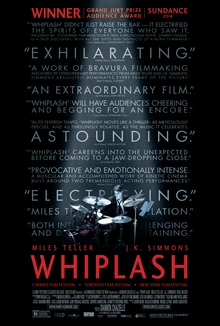
The hook: a sports movie disguised as a music movie
At a glance, Whiplash is “the young prodigy meets the ruthless coach” story—except the sport is jazz drumming, the arena is a top-tier music conservatory, and the victories come measured in tempo markings and humiliations instead of points. It’s a film that uses the grammar of boxing dramas and underdog triumphs, then twists it into something sharper: the pursuit itself becomes the antagonist.
Chazelle frames jazz not as background cool, but as high-stakes combat. The sticks are weapons. The metronome is a judge. The bandstand is a firing squad. And in the center is Andrew Neiman, a first-year drummer who wants to be “one of the greats,” and Terence Fletcher, a conductor who claims he can manufacture greatness—by force.
The result is a movie that feels like it’s always accelerating, always tightening its grip. Even when nothing “happens,” something is happening: a glance, a pause, a breath held too long. Whiplash is suspense built out of rhythm—an anxiety attack edited to swing time.
Casting: why the movie only works with these people
Miles Teller as Andrew Neiman: ambition with a pulse
Andrew is not written as charming. He’s not the lovable diamond in the rough. He’s intense, socially awkward, sometimes smug, sometimes pathetic, and increasingly obsessive. Casting Miles Teller was a risk that paid off because Teller could sell Andrew’s specific blend of vulnerability and stubbornness—he doesn’t just want greatness, he needs it to justify his existence.
A crucial part of Andrew’s believability is physical: the way he sits at the kit, the way he watches hands, the way he tries to look unbothered when he’s dying inside. Teller’s performance is athletic in the literal sense. And production-wise, he didn’t get to fake his way through it—he went through a jazz drumming “boot camp” with drummer/actor Nate Lang for nearly two months, practicing multiple days a week for hours at a time. ABC News+1
That training matters because Whiplash lives in close-ups. The camera is constantly inches from skin, cymbals, sweat, blood. If the drumming reads as pretend, the movie collapses. Teller’s commitment helps the film keep its illusion: this is a kid who would destroy his body to earn approval from the worst possible mentor.
J.K. Simmons as Terence Fletcher: charisma as a blunt instrument
The film’s most famous “casting choice” is also its most dangerous element: making the villain magnetic. Fletcher is monstrous, but he’s funny. He’s precise. He’s confident. He’s the kind of person who can make a room hate him and still obey him.
J.K. Simmons was the perfect instrument for that contradiction. He has the voice of authority and the face of a man who believes rules are physics. And he can pivot from calm to annihilating rage in half a second without losing credibility. Fletcher doesn’t feel like a movie villain; he feels like a real-world tyrant who learned how to call cruelty “standards.”
It’s also part of why the film created debate: Simmons makes Fletcher watchable. You’re horrified, but you’re leaning in.
The supporting cast: pressure needs an ecosystem
Paul Reiser’s presence is quietly essential. As Andrew’s father, he’s a warm contrast—an adult who cares, but doesn’t understand the specific pathology Andrew is building inside himself. Melissa Benoist (as Nicole) gives the film a brief window into what normal life could look like—until Andrew treats normal life like a distraction and burns it down.
And around them is a world of competitive musicians: players who speak the language of “chair placement,” “core ensemble,” and “not losing your spot.” Fletcher’s abuse doesn’t happen in a vacuum; it’s enabled by ambition, hierarchy, prestige, and the fear of being replaced.
Plot summary: a descent disguised as a rise
Andrew Neiman begins as a talented, hungry student at the Shaffer Conservatory (a fictionalized pressure-cooker version of elite music schools). He practices constantly, chasing speed and precision, and dreams of being a legend.
Enter Terence Fletcher, the feared studio-band conductor whose approval is treated like a golden ticket. Fletcher notices Andrew and invites him into the studio world—first as an alternate, then as someone with a real shot at the top chair.
What follows is not mentorship. It’s psychological warfare.
Fletcher’s methods are simple: publicly humiliate, privately manipulate, and constantly move the goalposts. He throws a chair. He slaps Andrew. He uses racist and homophobic insults as if they’re motivational tools. He pits drummers against each other in sadistic tempo battles—demanding “rushing” vs. “dragging” perfection, and refusing to clarify what he wants until someone breaks.
Andrew breaks—then adapts. He starts modeling Fletcher’s obsession: practicing until he bleeds, isolating himself, cutting off anything that might dilute the mission. His relationship with Nicole becomes collateral damage because it asks him to be human, and humanity is now weakness.
In one of the film’s most brutal sequences, Andrew is in a car accident on the way to a performance. He crawls out, bloodied, and still runs onstage to play. He fails anyway—collapse meets condemnation—and the fallout pushes Andrew into open rebellion. He attacks Fletcher on stage, gets expelled, and the story seems to end with the moral we expect: the abusive teacher finally faces consequences.
But Whiplash isn’t interested in that clean arc.
Later, Andrew learns Fletcher was fired after a student’s suicide—information delivered in a way that complicates the audience’s feelings without redeeming Fletcher. Fletcher resurfaces at a jazz club, oddly calm, telling stories about greatness and “the two most harmful words in the English language: ‘good job.’” He invites Andrew to play in a prestigious concert and implies reconciliation.
It’s a trap.
Onstage, Fletcher deliberately sabotages Andrew by calling a song Andrew doesn’t know—publicly setting him up to fail. For a moment, Andrew is humiliated, exposed, finished.
Then something flips: instead of running, Andrew takes control. He starts “Caravan” on his own terms, forcing the band to follow him. Fletcher resists—then recognizes the audacity—and the ending becomes the film’s signature ambiguity: Andrew achieves a kind of terrifying triumph, and Fletcher, after all the abuse, finally gives him a look that resembles approval.
The final shot isn’t comfort. It’s ignition.
Behind the scenes: the “proof-of-concept” that became a weapon
The short film that unlocked the feature
One of the most important facts about Whiplash is that it didn’t begin as a feature. It began as a short—essentially a demonstration of tone and intensity—that played Sundance in 2013 and helped convince funders the feature could work. sundance.org - sundance.org+1
That origin explains a lot. Whiplash has the compressed ferocity of something that had to prove itself. It doesn’t meander. It doesn’t over-explain. It grabs you by the throat and says, “Here’s the movie.”
Inspiration: rooted in reality, sharpened into myth
Chazelle has pointed to his own experiences as a young drummer as inspiration, while acknowledging the film heightens elements for dramatic effect. Vulture That matters because the movie feels emotionally true even when it becomes extreme. Many viewers—especially musicians—recognize the dynamics: the idolized tyrant, the culture of “earning” dignity, the idea that suffering is a down payment on greatness.
Made fast, made cheap, made precise
Whiplash is also famous for how efficiently it was produced. The film’s budget is widely reported around $3.3 million, and its worldwide gross ultimately landed around $50 million—a massive multiplier for a talky, intense drama about jazz drumming. Wikipedia+2The Numbers+2
That financial reality shaped the film’s aesthetic: tight locations, controlled environments, kinetic camerawork, and editing that functions like percussion. It also influenced the shoot pace—accounts from sound industry coverage emphasize that principal photography happened in only about nineteen days, an aggressive schedule for a performance-heavy movie. local695.com+1
When a film is shot that quickly, you don’t get endless takes to “find it.” You either have the tone in your bones, or you don’t. That pressure arguably mirrors the story: perform, or be replaced.
Music, editing, and the illusion of “live” intensity
A huge part of Whiplash’s impact is how it’s cut and how it sounds. The movie’s musical sequences feel like they’re happening right now—like the camera caught lightning. In reality, the construction is painstaking: performances are shaped through editorial rhythm, and the music is integrated in a way that preserves momentum and clarity.
Editor Tom Cross’s work became one of the film’s calling cards, and the movie’s technical acclaim wasn’t just critics being polite—Whiplash went on to win Oscars including Best Film Editing and Best Sound Mixing. Wikipedia+1 That combination is not accidental. The film’s editing is its heartbeat, and the sound mix is its adrenaline.
The Chazelle–Hurwitz partnership
Composer Justin Hurwitz—Chazelle’s longtime collaborator dating back to their Harvard days—helped shape the film’s identity by blending original scoring with jazz standards and performance-driven energy. Motion Picture Association In Whiplash, music isn’t decoration; it’s narrative force. The soundtrack choices (“Caravan,” “Whiplash,” “Upswingin’”) aren’t there to make you feel cool—they’re there to make you feel trapped in a contest where perfection is always one error away from humiliation.
Box office and awards: the rare indie that became a mainstream event
Whiplash premiered at the 2014 Sundance Film Festival and left with major momentum—winning both the Grand Jury Prize (U.S. Dramatic) and the Audience Award (U.S. Dramatic), a powerful double that signaled broad enthusiasm.
From there, it rolled into release through Sony Pictures Classics and built audience through word of mouth—helped by the fact that the film plays like a thriller even for people who don’t care about jazz.
Financially, its headline numbers tell the story:
Awards-wise, the movie became an Oscar player—nominated for Best Picture and more, while winning Best Supporting Actor (Simmons), Best Film Editing, and Best Sound Mixing. Wikipedia
That’s an unusually strong outcome for a movie this intense, this abrasive, and this uninterested in being “inspiring” in the traditional sense.
Audience and critical reception: admiration, controversy, obsession
Critics: near-universal praise for craft and performances
Critically, Whiplash was widely celebrated for its direction, performances, editing, and sound—essentially the full package of filmmaking disciplines working in lockstep. Wikipedia Reviewers often described it as electrifying, propulsive, and technically exhilarating—words usually reserved for action films, not conservatory dramas.
Simmons’s performance in particular became instantly iconic: quoted, memed, feared, admired. The character’s lines entered pop culture because they’re built like weapons—short, cutting, rhythmic.
Musicians: “this is real” vs. “this is fantasy”
Among musicians, the reaction often split into two camps:
-
People who recognized the emotional truth: the pressure, the competition, the obsession, the way art can become identity.
-
People who objected to the institutional reality: arguing the film exaggerates how elite jazz education works, and that the “abuse creates genius” idea is both inaccurate and harmful.
Even commentary that acknowledges Chazelle’s real inspiration also notes the film heightens elements for drama. Vulture That’s the point: Whiplash isn’t a documentary about music school. It’s a fable about ambition—told with the surface details of jazz.
General audiences: the ending that keeps starting arguments
For many viewers, the final sequence is the reason the film lives rent-free in their heads.
Is it a triumph?
Is it a tragedy?
Is Fletcher “right” in some monstrous way?
Or is Andrew simply becoming the next version of the same sickness?
The brilliance is that Chazelle doesn’t answer cleanly. The ending gives you the dopamine rush of victory while leaving the moral bruising intact. The last look between Andrew and Fletcher can be read as a coronation or a condemnation—and the film’s staying power comes from that ambiguity.
The real subject: what Whiplash is actually saying about greatness
If you strip away the drums, Whiplash is about a specific hunger: the belief that being exceptional is the only way to be safe from insignificance. Andrew doesn’t chase music because he loves it in a healthy way. He chases it like a man trying to outrun death.
Fletcher exploits that with surgical precision. He sells abuse as a shortcut to immortality. He frames cruelty as necessary pruning. And the most unsettling thing is that the film admits a difficult truth: abuse can produce results—at least in the short term. That doesn’t make it right. It makes it dangerous, because it creates evidence that the abuser can point to like a trophy.
The movie’s central horror isn’t that Fletcher is evil. It’s that Andrew is willing.
That’s why the title Whiplash fits on multiple levels:
-
The literal jazz standard.
-
The physical injuries.
-
The emotional snap between approval and punishment.
-
The violent speed of transformation: from student to obsessive, from talent to weapon.
Why it still hits: the movie is a metronome for modern life
A decade on, Whiplash continues to resonate because it’s not only about music. It’s about performance culture—about being judged constantly, about tying self-worth to output, about believing rest is weakness and pain is proof you’re doing it right.
It’s also, frankly, a film that understands addiction. Andrew’s addiction just happens to look like “discipline,” which is why it’s socially celebrated—until the cost becomes impossible to ignore.
And that may be the film’s final sting: Whiplash isn’t asking whether greatness is worth suffering. It’s asking why we keep confusing suffering with greatness in the first place.


 (618) 624-6402