Origins: From Diary Pages to Feature Film
“Freedom Writers” is a 2007 biographical drama written and directed by Richard LaGravenese, based on The Freedom Writers Diary, the real-life collection of journal entries by Erin Gruwell’s students at Woodrow Wilson Classical High School in Long Beach, California. (Wikipedia)
The book itself grew out of Gruwell’s early-1990s experience teaching English to a group of freshmen labeled “at-risk.” These were students living with gang violence, racial tension, poverty, and chronic instability. She gave them composition notebooks and told them they could write anything—uncensored, ungraded—and that she would read the pages only if they allowed her to. Many did, and their entries eventually became The Freedom Writers Diary (published 1999). (Grokipedia)
Hollywood came calling fairly quickly. MTV Films, Jersey Films, and 2S Films developed the adaptation, with LaGravenese—best known for screenplays like The Fisher King and The Bridges of Madison County—both writing and directing. Paramount Pictures distributed the film, which was produced by Danny DeVito, Michael Shamberg, and Stacey Sher. (Wikipedia)
Casting Choices: Building a Classroom on Screen
Hilary Swank as Erin Gruwell
The film is anchored by Hilary Swank, already a two-time Academy Award winner (Boys Don’t Cry, Million Dollar Baby). Casting Swank as Gruwell gives the story an immediate sense of prestige and gravitas. She plays Erin as relentlessly optimistic, almost naïve at first, but evolving into someone who learns as much from her students as they do from her.
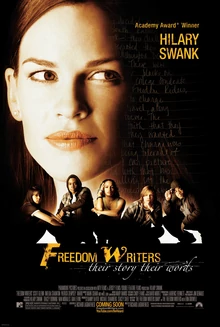
The marketing leaned heavily on Swank—her face dominates posters and promotional art, with the students relegated to smaller images at the bottom, which later became part of critical discussions about where the film places its emphasis. (Wikipedia)
The Adults Around Her
Several seasoned character actors surround Swank:
-
Imelda Staunton plays Margaret Campbell, the strict, skeptical department chair who represents institutional resistance. Staunton had just received major acclaim for Vera Drake and brings a sharp, clipped disapproval that makes Campbell feel like a real obstacle, not a cartoon villain. (Wikipedia)
-
Scott Glenn plays Erin’s father, Steve Gruwell, who doubts his daughter’s choices but gradually comes to support her. His arc mirrors the audience’s journey from skepticism to respect. (Wikipedia)
-
Patrick Dempsey, then in the middle of his post–Grey’s Anatomy resurgence, plays Scott Casey, Erin’s increasingly distant husband, giving the story a personal cost: Gruwell’s devotion to her classroom strains her marriage. (Wikipedia)
-
Pat Carroll appears as Miep Gies, the woman who helped hide Anne Frank and later preserved her diary. Gies’ presence (and Carroll’s performance) symbolically links the students’ writing project to the most famous diary in modern history. (Wikipedia)
The Students
The heart of Freedom Writers is the ensemble of students. Many are played by relative unknowns at the time, which helps the film feel less like star-vehicle melodrama and more like a genuine classroom. Key characters include: (Wikipedia)
-
April Lee Hernández as Eva Benitez, a Latina student deeply enmeshed in gang loyalty and generational trauma. She functions as the film’s emotional center and narrator for much of the story.
-
Mario (the R&B singer) as Andre Bryant, whose quiet demeanor hides grief and frustration about being written off by the system.
-
Jason Finn as Marcus, whose storyline involves homelessness and the pain of losing a younger sibling to gang violence.
-
Jaclyn Ngan as Sindy, a Cambodian refugee navigating both racial tension and the legacy of genocide.
-
Armand Jones as Grant Rice, wrongfully accused in a convenience-store shooting—an echo of real incidents that pushed the real students further into distrust of authority.
The casting mixes actors of different ethnic backgrounds—Latino, Black, Asian, Cambodian, and white—to mirror the real Long Beach classroom’s diversity. Several real “Freedom Writers” served as consultants to keep line readings, slang, and background details authentic, shaping performances with their own lived experiences. (Grokipedia)
Plot Summary: From Hostility to Community
Setting the Stage
The film opens in mid-1990s Long Beach, still simmering after the 1992 Los Angeles riots. Racial tensions between Black, Latino, Cambodian, and other communities are high, and violence is commonplace. Erin Gruwell, a new teacher, arrives at Woodrow Wilson High School optimistic and somewhat idealistic, carrying the traditional bundle of fresh teacher energy and naïve assumptions. (Wikipedia)
She soon learns that her freshman English class is essentially a dumping ground: students labeled “unteachable” are tracked into her room, while the honors classes remain overwhelmingly white and middle-class. Gruwell’s colleagues warn her not to try too hard; Staunton’s Campbell is especially dismissive.
First Contact: A Caricature and a Turning Point
Early on, Gruwell intercepts a racist caricature of a Black student passed among classmates. She explodes, comparing the drawing to Nazi propaganda used against Jews and explaining how those images helped fuel the Holocaust. When she realizes that almost none of the students have heard of the Holocaust, she’s stunned.
This leads to one of the movie’s key scenes: Gruwell has the students stand on a line of tape across the classroom if certain statements apply to them—if they’ve lost someone to gang violence, if they’ve been shot at, if they belong to a gang. As more and more students step forward, each begins to see that their trauma is not isolated to their racial or neighborhood clique. (Wikipedia)
The Journals
Gruwell gives each student a notebook and tells them they can write about anything, anonymously if they prefer. She promises to read every entry left in a locked cabinet. These journals become the spine of the film: we see voiceover excerpts about abused home lives, death, incarceration, and survival.
The act of writing becomes cathartic. Students who initially refuse to participate eventually use the journals to put words to experiences they’ve never been invited to share.
Connecting with History
Realizing that her students feel that nobody cares about them, Gruwell starts buying books out of her own pocket—most notably The Diary of Anne Frank and Zlata’s Diary: A Child’s Life in Sarajevo. She draws parallels between the students’ lives and those of young people in other times of violence and persecution. (Wikipedia)
Eventually she organizes a field trip to the Museum of Tolerance in Los Angeles and a dinner with Holocaust survivors, including Miep Gies. Hearing first-person stories of survival and moral courage deeply affects the students and reinforces the notion that their own stories matter. (Wikipedia)
Personal Costs
As Erin’s commitment to her students grows, her personal life frays. The evening job she takes to pay for books and trips, plus the emotional investment in the classroom, strains her marriage. Scott Casey feels increasingly sidelined and resentful, and eventually the relationship collapses.
Within the school, Gruwell faces administrative pushback. Campbell denies her request to continue working with the same cohort for junior and senior years, insisting that teachers can’t “cherry pick” students. Gruwell eventually secures support from the superintendent and moves to teach the students for multiple years, defying the usual structure and angering Campbell. (Wikipedia)
Eva, Justice, and Choice
The narrative climax centers on Eva’s court testimony in a murder case. Gang loyalty dictates that she lie on the stand to protect a fellow Latino gang member and implicate a Black student, Grant Rice. But through her experiences in Gruwell’s class, Eva begins to question those loyalties. In court, she tells the truth, knowing full well it brands her a traitor and puts her at risk.
Her decision parallels the students’ broader journey: choosing self-definition over the scripts handed down by gangs, racist structures, and even family expectations.
The Birth of “Freedom Writers”
The students collectively decide to compile their rewritten, polished diary entries into a book. They name themselves the “Freedom Writers,” riffing on the Freedom Riders of the Civil Rights Movement. The film ends with them moving toward graduation, having defied the odds stacked against them and transformed their classroom into a community. (Wikipedia)
Behind the Scenes: How the Film Took Shape
Balancing Fact and Fiction
Although marketed as a true story, Freedom Writers compresses timelines and heightens conflicts for dramatic effect. For instance, the racist caricature incident in the film is based on an event involving real student Sharaud Moore, but details are altered and events that in reality unfolded over several years are condensed into a couple of academic terms. (Grokipedia)
The movie also intensifies faculty opposition, portraying characters like Campbell and an honors teacher as almost uniformly dismissive or prejudiced. Some real Wilson High educators later argued that this misrepresented their collaborative work and unfairly cast the school as broadly hostile, whereas in reality there was both support and resistance to Gruwell’s methods. (Grokipedia)
Involvement of the Real Freedom Writers
Several of the original Freedom Writers served as consultants, helping LaGravenese and the actors accurately portray the students’ language, mannerisms, and backstories. Their input influenced specific lines of dialogue and classroom dynamics, ensuring that while the story was dramatized, the emotional core remained anchored in lived experience. (Grokipedia)
The production also brought in real Holocaust survivors for the dinner scenes, reenacting an encounter the students had in the 1990s. This choice gives those sequences a grounded, documentary-like feel and reinforces the film’s insistence that history is not abstract but embodied in living people. (Grokipedia)
Visual and Musical Choices
Cinematographer Jim Denault shoots the classroom with a lot of handheld work and close-ups, giving a sense of immediacy and emphasizing faces—particularly eyes—as students slowly open up. The color palette leans toward muted tones inside the school contrasted with the brighter, warmer textures of the museum and the survivors’ dinner, visually underscoring the movement from claustrophobic tension to widened horizons. (Wikipedia)
The soundtrack includes original score by Mark Isham as well as contributions from will.i.am and RZA, blending orchestral cues with hip-hop-influenced tracks that reflect the setting and the students’ cultural worlds. (Wikipedia)
Box Office Performance: Modest Budget, Solid Return
Freedom Writers was released in the U.S. on January 5, 2007. Its production budget is estimated at about $21 million. (Wikipedia)
Financially, it performed respectably:
-
Domestic gross (U.S. & Canada): about $36.6 million (Wikipedia)
-
International gross: about $6.5 million (Wikipedia)
-
Worldwide total: roughly $43.1 million, about 2.1 times its production budget. (Wikipedia)
-
Opening weekend: around $9.4 million, ranking fourth behind Night at the Museum, The Pursuit of Happyness, and Children of Men in its debut frame. (paramount.fandom.com)
Those numbers place it squarely in the “solid, mid-tier success” category: not a runaway hit, but profitable and especially strong considering its genre—an earnest classroom drama with no explosions and a lot of journal writing.
The film also demonstrated good “legs,” with a domestic multiple of almost 3.9 times its opening weekend, suggesting positive word of mouth and repeat viewings, especially among teachers, students, and church or community groups who often attended in organized outings. (The Numbers)
Critical Reception: Praise, Tears, and Skepticism
Mainstream Reviews
On review aggregators, Freedom Writers landed in the “generally favorable” zone. Metacritic assigns the film a score of 64/100 based on 29 mainstream critic reviews. (Wikipedia)
Rotten Tomatoes’ top critics’ capsule reviews reflect a mix of admiration and fatigue with the inspirational-teacher template. One BBC critic summed up the viewing experience by saying the film will leave you “embarrassed, sad, happy then exhausted,” capturing the emotional sweep many viewers reported. (Rotten Tomatoes)
Common Sense Media’s review called the film predictable and noted that the actors playing students often looked too old for high school, but still praised it as “a rare and close-to-wonderful thing” for the way it argues that adults should really listen to teenagers. (Wikipedia)
Other reviewers highlighted the sincerity of Swank’s performance and the compelling stories of the students, even while acknowledging that the film ticks off many familiar genre tropes: the skeptical faculty, the breakthrough moment in class, the “I will not give up on you” speech, and the triumphant end-of-year transformation. (Hollywood Reporter)
Audience Response
Audience reactions skewed more positive than critics. On platforms like IMDb, user reviews often describe the film as “inspirational,” “moving,” or “life-changing,” particularly from viewers who are teachers, students from rough schools, or people who work with youth. Many emphasize how the film validates the idea that one committed adult can make a huge difference in a teenager’s life. (IMDb)
For educators, the film quickly became a staple professional-development or “movie day” choice. Discussions following screenings often revolve around topics like:
-
How to build trust with students living with trauma
-
The ethics of sharing personal stories in class
-
The balance between teacher sacrifice and self-care
Some schools brought in Gruwell or the real Freedom Writers for speaking engagements, and the Freedom Writers Foundation grew as a training and advocacy organization in the wake of the film. (Rethinking Schools)
Critiques and the “White Savior” Conversation
While many viewers embraced the film’s inspirational arc, others criticized it as another example of the “white savior” narrative in American cinema. Scholars and educators have pointed out that Freedom Writers fits a familiar pattern: a well-meaning white teacher enters a classroom full of students of color, battles resistant colleagues and administrators, and single-handedly transforms her students’ lives. (Rethinking Schools)
In a critique published in Rethinking Schools, educators argued that the film frames the students largely as raw material for Gruwell’s heroism, even though the real diaries reveal a more complex story of collective effort, peer solidarity, and self-driven growth. (Rethinking Schools)
Sociologist Matthew Hughey’s broader analysis of “white savior films” notes that movies like Freedom Writers often center the racial progress story on white benevolence, thereby underplaying systemic issues and the agency of the people being “saved.” (JSTOR)
Specific criticisms include:
-
Marketing emphasis on Swank: The posters and trailers foreground Hilary Swank’s face and name far more than the students’, which undercuts the tagline “Their Story. Their Words. Their Future.” (Wikipedia)
-
Portrayal of other teachers: The film depicts most of Gruwell’s colleagues as indifferent, elitist, or outright hostile. Some real Wilson High staff have said this is unfair and erases the work of educators of color and allies who were also trying to improve conditions. (Grokipedia)
-
Simplified structural critique: Gang violence, housing segregation, and school funding inequalities are present in the background but rarely analyzed. The narrative solution is essentially: “Be more like Erin,” which risks implying that social crises persist mainly because teachers don’t care enough.
Even some critics who raised these concerns still acknowledged the film’s emotional power and its potential as a conversation starter about race, education, and youth voice. The consensus among many educators is that Freedom Writers can be useful in professional development—if it’s paired with critical discussion about what it gets right, what it simplifies, and what it leaves out. (Rethinking Schools)
Themes: Storytelling as Survival
Despite the debates, the film’s central theme is clear: telling your story—honestly, fully, and in community—can be a form of survival.
Voice and Visibility
The students in Gruwell’s class begin the film feeling unseen: the school tracks them into a “remedial” class, police profile them, and society assumes they will either end up dead or incarcerated. The journals quietly subvert that. To say “this is what happened to me” is to insist that your life is worth recording and remembering.
The connection to Anne Frank and Zlata Filipović isn’t just a clever curriculum move; it’s a statement that inner-city American teenagers’ lives are just as historically significant as those of children who lived through globally recognized atrocities. (Wikipedia)
Empathy Across Divides
By reading each other’s entries (with permission), the students discover that the kid they saw only as a rival gang member or a member of “another race” has gone through similar losses and fears. The line-walking exercise and the journal project both aim to collapse stereotypes and reveal shared pain and hopes.
The film sometimes leans heavily on this—there are a few “we’re not so different” speeches—but underneath the melodrama is a genuine argument: empathy isn’t automatic; it’s often built through structured opportunities to listen.
The Cost of Caring
One of the more interesting undercurrents is the cost of Gruwell’s dedication. She works extra jobs, sacrifices her marriage, and takes on emotional burdens that, in real life, can burn out teachers quickly. The film doesn’t really question whether this level of self-sacrifice is sustainable or fair to ask of educators, but the subtext is there for viewers who want to engage with it. (Wikipedia)
Legacy and Continuing Impact
Nearly two decades after its release, Freedom Writers still circulates in classrooms, teacher-training programs, and youth centers. The Freedom Writers Foundation continues to run institutes and workshops, training teachers to incorporate student storytelling and community-building techniques in their own schools. (Grokipedia)
In the broader cultural landscape, the film sits alongside titles like Stand and Deliver, Dangerous Minds, and Dead Poets Society as part of the “inspirational teacher movie” canon. Like those films, it’s both beloved and critiqued, functioning as:
-
A source of motivation for many teachers and students
-
A case study in how Hollywood dramatizes educational inequity
-
A flashpoint in ongoing conversations about race, savior narratives, and structural change
What keeps Freedom Writers from fading completely into cliché is the specificity of the students’ stories and the real diaries behind them. Even when the script veers into formula, the emotional truth of kids trying to make sense of chaos—and an adult insisting their voices matter—still lands.
Conclusion
Freedom Writers is not a perfect movie. It compresses complex realities into a tidy two-hour arc, leans heavily on the charisma of a white protagonist, and follows many familiar beats of the inspirational-teacher genre. Its portrayal of colleagues and institutions can be one-dimensional, and its solutions sometimes feel more individual than structural.
But it’s also a film that put the lived experiences of marginalized teenagers—gang violence, refugee trauma, systemic neglect—at the center of a mainstream studio drama, and that alone made it stand out in 2007. It argues, sometimes bluntly but often effectively, that listening to young people, giving them tools to tell their stories, and taking their pain seriously can change the trajectory of their lives.
At the end of the day, that mix—earnestness, emotional heft, and real historical roots—helps explain why Freedom Writers continues to resonate with audiences, spark debate among educators, and show up on syllabi and streaming queues years after its theatrical run.


 (618) 624-6402