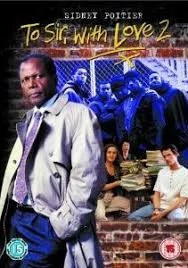
Setting the Stage: Why a Sequel in 1996?
The original To Sir, With Love (1967) was a small British drama that became a cultural touchstone. It paired Sidney Poitier’s Mark Thackeray with a class of working-class London teens and tackled race, class, and respect with a sentimental but powerful touch. The film was a surprise box-office hit, earning over $42 million in the U.S. alone on a tiny budget and helping cement Poitier as one of the defining screen icons of the 1960s. (Wikipedia)
By the 1990s, Poitier’s career had shifted largely to prestige television projects and miniseries such as Separate But Equal (1991) and Mandela and de Klerk (1997). To Sir, With Love II fits squarely in that phase of his work: a dignified TV movie built around his gravitas. (Wikipedia)
CBS positioned the film as a “Sunday movie event,” airing it on April 7, 1996. It was Bogdanovich’s first made-for-TV film, a notable pivot for a director best known for 1970s theatrical hits like The Last Picture Show. (Wikipedia) The idea was simple but potent from a marketing standpoint: take one of Poitier’s most beloved characters, age him into the 1990s, and see what happens when you drop him into a more dangerous, American inner-city school.
The sequel also arrived amid a wave of “teacher saves the tough class” stories—Stand and Deliver, Dangerous Minds, Lean on Me, and others. The original To Sir had helped set that template in the first place; now the sequel had to compete in a crowded field of descendants.
Casting Choices: Old Faces, New Generation
Sidney Poitier as Mark Thackeray
Everything in To Sir, With Love II orbits Sidney Poitier. He reprises Mark Thackeray, now at the end of his career in London, about to retire after decades in education. The sequel leans into Poitier’s screen persona as a moral authority figure—calm, controlled, uncompromising on principles—and uses his age as a narrative asset rather than something to hide. (Wikipedia)
Thackeray in 1996 is not a rookie teacher; he’s a veteran who has taught the children of his former students and spent ten years in administration. That long arc lets the film explore burnout, legacy, and the question that hangs over any teacher: what comes next, and did any of it matter?
Christian Payton, Dana Eskelson, and the Chicago Students
The film introduces a new crop of students at a Chicago high school, with two characters standing out:
-
Christian Payton as Wilsie Carrouthers – A gang leader who smuggles a gun into school and becomes the focal point of Thackeray’s moral stand. Payton plays Wilsie with a mix of swagger and fear—the bravado of a kid who knows violence, and the vulnerability of someone who can’t imagine a life outside of it. (Rotten Tomatoes)
-
Dana Eskelson as Evie Hillis – A student who carries her own trauma, hiding the fact she grew up without parents to avoid being placed in foster care. She works for a local newspaper and becomes instrumental in tracking down Thackeray’s long-lost love, Emily. (Wikipedia)
These characters are written less as gritty character studies and more as archetypes—“the gang kid,” “the wounded but resourceful girl”—but they’re central to how the sequel reframes Thackeray’s mission from classroom management to broader social intervention.
The Adults Around Him
A few key adult roles help anchor the world:
-
Daniel J. Travanti as Horace Weaver, the Chicago principal, is an old colleague of Thackeray’s. He represents an institutional mindset—tracking students into “A” (the good kids) and “H” for “horror,” the lost causes. His skepticism gives Thackeray something to push against. (TVGuide.com)
-
Saundra Santiago as Louisa Rodriguez, a fellow teacher, admires Thackeray’s old-school dedication and serves as a subtle romantic and intellectual ally, though nothing in the story becomes a romance. She’s more a symbol of the educators who still believe something better is possible inside a battered system. (TVGuide.com)
Returning Alumni: Lulu and Judy Geeson
In a move clearly designed to trigger audience nostalgia, the film brings back Lulu (Barbara Pegg) and Judy Geeson (Pamela Dare) in cameo roles at Thackeray’s London retirement celebration. (The Washington Post)
Their brief appearances do several things at once:
-
They connect the sequel directly to the original, not just in story but in faces.
-
They visually confirm that the teenagers from the 1967 film grew up into functioning adults—implied proof that Thackeray’s methods worked.
-
They set an emotional tone: this sequel isn’t just a new teacher drama; it’s about a life’s work coming full circle.
Plot Overview: From Retirement to Re-Engagement
Farewell to London
The film opens with Thackeray’s retirement after thirty years in London. He’s given the usual speeches and gifts, but the tone is less victory lap and more quiet melancholy. He’s taught multiple generations, seen societal changes, and watched education bureaucratize.
At the farewell gathering, his former students Pamela and Barbara appear, now adults with lives of their own. It’s a gentle echo of the original film’s dance sequence: the troubled kids we met in 1967 now stand as proof that Thackeray’s insistence on respect and responsibility meant something. (Wikipedia)
Then Thackeray drops his bombshell: he’s not retiring to rest. He has accepted a teaching job in Chicago’s South Side, at John Adams High School.
Arrival in Chicago: A New “Horror” Class
In Chicago, Thackeray reconnects with principal Horace Weaver, an old colleague. Weaver explains the school’s tracking system: the “A” class has the high achievers, and the “H” class—“H” for “horror”—contains the so-called “no-gooders,” students the system has quietly written off. (Wikipedia)
Thackeray, naturally, wants the H class. He explains that difficult students are what he does best. It’s an overt callback to the London class of 1967, but now the stakes are ratcheted up: these kids aren’t just disruptive—they’re involved with gangs, weapons, and street violence.
He starts the way he did in London: insisting on formal address (Mr./Ms. plus last names), demanding that students call him “Mr. Thackeray” or “Sir,” and refusing to be rattled by their taunts. The early classroom scenes walk a familiar path: they’re loud, hostile, and unimpressed by this soft-spoken older man with a British accent.
Personal Histories: Wilsie, Evie, and the Others
As Thackeray digs in, he gradually uncovers the lives behind the attitudes:
-
Wilsie leads a gang and protects his younger brother, Arch. His authority on the streets competes with Thackeray’s authority in the classroom. (Rotten Tomatoes)
-
A Black female student endures double prejudice for her race and gender, highlighting intersectional biases that weren’t as foregrounded in the 1967 film. (Wikipedia)
-
Evie tries to keep her family situation hidden; she fears being institutionalized or moved again if anyone knows how precarious her life really is. (Wikipedia)
Thackeray’s method, as before, is to treat them as adults—no shouting matches, no sarcasm, no pandering. He brings in lessons about non-violent resistance and civil-rights leaders, trying to show them models of strength that don’t require a gun.
The Gun, the Murder, and the Moral Line
The key plot engine arrives when Thackeray discovers Wilsie has smuggled a gun into the school. Thackeray confronts him privately and persuades him to surrender the weapon. Thackeray then turns the gun over to the police, presenting it as “found property” without naming its owner. (Wikipedia)
This becomes the moral hinge of the story. When the police discover that the gun was used in the murder of an officer, they pressure Thackeray to reveal who brought it in. Thackeray refuses. He views his promise to Wilsie and his commitment to protecting students as a sacred trust.
That refusal costs him dearly. He’s forced to leave the school, and his years of experience and authority don’t protect him from institutional backlash. In an era where “zero tolerance” policies were gaining traction, the sequence plays like an argument for a more human, relational approach to school discipline—and a critique of a system that often sees kids only as threats.
The Lost Love Thread
Interwoven with the school plot is a more personal storyline. We learn that as a young man in British Guiana, Thackeray fell in love with a girl from Chicago named Emily Taylor. They lost touch; he went off to study in Britain, married someone else, and eventually became the teacher we know. Now a widower, part of the draw of Chicago is the possibility—however faint—of finding Emily again. (Wikipedia)
Evie, leveraging her job with a local newspaper, helps investigate Emily’s whereabouts. She eventually locates her, and Thackeray discovers the truth: Emily did love him, but her father hid his letters because she was pregnant—with Thackeray’s child. He has a son he never knew about.
This subplot is melodramatic, to be sure, but it deepens Thackeray’s character. The man who has devoted his life to other people’s children discovers he has one of his own, and that his life might have gone very differently if an older generation hadn’t interfered.
Resolution: A Stand-In and a Stand Taken
Meanwhile, Wilsie is in hiding, afraid the police are coming for him. Thackeray convinces his brother to lead him to Wilsie’s hideout and urges the teen to abandon gang life and turn himself in. After confronting a rival gang, Thackeray persuades Wilsie and a friend—with access to more guns—to surrender. (Wikipedia)
Back at school, the students organize a “stand-in,” occupying the halls and refusing to go to class until Thackeray is reinstated. It’s a direct echo of the original film’s idea that respect, once earned, can turn into loyalty strong enough to challenge authority.
The film ends, fittingly, with a graduation ceremony and a dance, mirroring the climax of the 1967 movie. Thackeray announces that he will not return to Britain. Instead, he’s staying in Chicago to keep teaching the next generation.
Behind the Scenes: A TV Movie with Two Legends
Bogdanovich Meets Poitier
To Sir, With Love II was produced by TriStar Television and other partners for CBS, with a 92-minute runtime. It marked Peter Bogdanovich’s first foray into directing a television film. (Wikipedia)
The pairing of Bogdanovich and Poitier brought together two very different kinds of film history:
-
Bogdanovich, a New Hollywood auteur whose early critical and commercial success had long since faded by the 1990s.
-
Poitier, whose groundbreaking 1960s work—In the Heat of the Night, Guess Who’s Coming to Dinner, and the original To Sir, With Love—had made him a symbol of dignified Black masculinity on screen. (Wikipedia)
By 1996, both men were in a reflective phase of their careers. Bogdanovich’s direction on To Sir, With Love II is relatively straightforward—cleanly shot, focused on performance, with little of the stylistic experimentation of his early work. That simplicity arguably suits the material: the movie is built as a platform for Poitier’s presence, not as a visual showpiece.
A TV Project, Not a Theatrical Release
Unlike its predecessor, To Sir, With Love II was never intended for theatrical release, so there is no traditional box-office record. Contemporary write-ups and reference sources note that “no major awards or box-office metrics apply” because of its television format. (Grokipedia)
Instead, its success was measured in television ratings and later in home-video and cable/streaming exposure. In its original broadcast week, the film ranked 19th in the Nielsen listings, with an 11.4 rating and 19 share—solid numbers for a Sunday night movie. (UPI) It even outperformed ABC’s perennial Easter airing of The Ten Commandments in some comparisons, an impressive feat given that film’s holiday foothold. (Los Angeles Times)
Today, the movie lives on through DVD (often as a bonus feature paired with the original To Sir, With Love or in 4K collections) and digital rentals on platforms like Amazon and Apple TV. (ultrahd.highdefdigest.com)
Themes and Ideas: What Changes, What Doesn’t
Respect as Radical Pedagogy
Like the original, the sequel’s core principle is simple: if you treat students as adults worthy of respect, they may rise to that level. Thackeray’s insistence on formality, self-control, and mutual courtesy is old-fashioned even by 1967 standards; in a 1996 Chicago setting, it feels downright anachronistic.
The movie leans into that tension. The kids mock his accent and manners, but those very differences are what make him stand out. In an environment where adults often shout or write kids off, his calm and consistency are almost a provocation.
From Classroom Discipline to Social Work
One of the main criticisms of the film—both from contemporary and later reviewers—is that Thackeray spends less time teaching and more time playing detective, mediator, and quasi-social worker. (Grokipedia)
That shift reflects how audiences and writers in the 1990s thought about inner-city schools. The problems are no longer just classroom misbehavior or mild delinquency; they’re gang membership, gun violence, and systemic neglect. Thackeray’s methods expand accordingly: he’s not just helping kids pass exams, he’s trying to keep them alive long enough to have a future.
Depending on your perspective, this either enriches the character or blurs the story’s focus. Some viewers appreciate seeing Thackeray’s principles applied in a harsher context; others feel the film becomes a “cozy, low-stakes soap opera” that softens real urban problems into sentimental TV drama. (themoviebuff.net)
Nonviolence, Policing, and Moral Absolutes
The gun subplot puts Thackeray between two institutions: the police and the school. By refusing to name Wilsie, he affirms a belief that his duty as a teacher—to protect his students and preserve their trust—has limits that outside authorities don’t get to define.
It’s a striking stance, especially in the mid-1990s, when punitive responses to youth violence were widely embraced. The film argues that if teachers become extensions of law enforcement, the fragile space of trust between student and teacher breaks down.
At the same time, Thackeray doesn’t excuse Wilsie’s choices. He advocates non-violent resistance and personal responsibility, and he insists that Wilsie face consequences by turning himself in. His refusal to identify the gun owner isn’t about letting a crime go unpunished; it’s about insisting that transformation must involve voluntary choice, not just coercion.
Love, Loss, and the Cost of a Life’s Work
The Emily Taylor storyline, though melodramatic, thematically mirrors what Thackeray experiences with his students. In both cases, an older generation’s decisions—Emily’s father hiding Thackeray’s letters, school and police policies that treat kids as expendable—truncate young lives and relationships before they can fully blossom. (Wikipedia)
Thackeray’s discovery that he has a son he never knew complicates his own story. It asks a quiet, unsettling question: in devoting his life to “other people’s children,” what did he lose personally? The movie doesn’t turn this into a crisis, but it lingers enough to give Poitier moments of silent reflection that land deeper than some of the more overt speeches.
Reception: Mixed Reviews, Warm Nostalgia
Critical Response in 1996
Contemporary critics were generally lukewarm but respectful:
-
Variety noted that viewers could “anticipate most every turn and a good many lines” in Philip Rosenberg’s script, flagging the story as predictable but praising Poitier for anchoring the film. (Variety)
-
Scott Pierce of the Deseret News dismissed the film as essentially a remake of the original, but acknowledged that Poitier made it work through sheer talent. (Wikipedia)
-
John Leonard in New York Magazine called it “a bad idea that turned into a pretty good one,” applauding Bogdanovich and Rosenberg for finding a way to make a 1960s character resonate in the 1990s. (Wikipedia)
The consensus: dramatically safe, structurally familiar, but elevated by Poitier’s presence and a certain earnest charm.
Audience Reception and Legacy
On modern aggregate sites, To Sir, With Love II typically lands in “decent but not great” territory:
-
IMDb users rate it around 6.4/10. (IMDb)
-
Rotten Tomatoes lists an audience score around 60–61%, with no official critic score, reflecting its TV-movie status and relatively modest critical footprint. (Rotten Tomatoes)
User reviews often echo a similar refrain: the movie “covers a lot of the same ground as the original but still works,” largely because it’s “refreshingly good” to see Poitier in the role again, even if the script is formulaic. (Rotten Tomatoes)
More recent retrospectives describe it as:
-
“Predictable and defiantly charming,” emphasizing its cozy, sentimental tone. (themoviebuff.net)
-
“A decent remake of the original except set in the 90s with decidedly more difficult and dangerous students,” highlighting the escalation in stakes. (Thomas's Rant)
Its afterlife has been surprisingly durable for a TV movie. It appears as a bonus feature on Blu-ray releases of the original To Sir, With Love (including a Columbia Classics 4K set), where reviewers sometimes call it an “odd sequel” but appreciate having Poitier’s final take on Thackeray preserved. (ultrahd.highdefdigest.com)
How It Fits Beside the Original
Placed next to the 1967 film, To Sir, With Love II feels both smaller and bigger:
-
Smaller, because it doesn’t have the same cultural shockwave or box-office impact. The original was a theatrical phenomenon, with a hit title song that topped the charts; the sequel is a respectable CBS telepic with solid ratings and a respectable but modest afterlife. (Wikipedia)
-
Bigger, because it takes on heavier external problems—guns, gangs, police pressure—reflecting a 1990s reality in which “troubled students” are not just mouthy teens, but kids whose lives are entangled with lethal violence.
What ties them together is Poitier’s performance and the core idea that education is less about curriculum and more about character. In both films, Thackeray is a man who believes that respect, self-discipline, and moral courage aren’t old-fashioned—they’re survival tools.
If the original is the better film (and most would say it is), the sequel still offers something valuable: a late-career showcase for Poitier, an exploration of what happens when a once-idealistic teacher keeps showing up decades later, and a time capsule of 1990s TV’s attempt to wrestle with inner-city education through a comforting, familiar face.
Final Thoughts
To Sir, With Love II will probably never be enshrined alongside its predecessor in lists of great school dramas. It’s too tidy, too TV-safe, too reliant on plot coincidences and sentimental beats. But as a character piece—and as a coda to one of cinema’s most iconic teacher roles—it has a quiet, persistent appeal.
You watch it less to be surprised by the story and more to see how a man like Mark Thackeray—and an actor like Sidney Poitier—faces a world that has grown harsher without surrendering the values that defined him. On that front, the film delivers exactly what its title promises: once again, to Sir, with love.


 (618) 624-6402