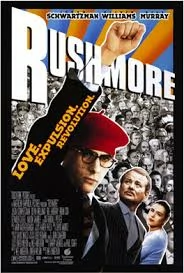
Introduction: A Small Film With a Long Shadow
When Rushmore arrived in theaters in early 1999 after premiering the previous fall, it didn’t roar into multiplexes with box-office thunder. Instead, it quietly announced itself as something different—oddly formal, emotionally raw, and fiercely specific. Directed by Wes Anderson and co-written with Owen Wilson, the film centered on Max Fischer, a hyper-articulate, overconfident teenager attending an elite private school he can’t academically survive. Max’s life is a swirl of extracurricular triumphs, romantic delusions, and theatrical productions, all of which collapse when reality intrudes.
In retrospect, Rushmore stands as a hinge point—not only in Anderson’s career, but in late-1990s American independent cinema. It bridged the quirky humanism of earlier indie films with a new, stylized emotional grammar that would soon dominate festival lineups. More than twenty-five years later, Rushmore endures because it understands something timeless: that adolescence doesn’t end when school does—it just gets better costumes.
Casting Choices: Risk, Reinvention, and Precision
Jason Schwartzman as Max Fischer
Perhaps the boldest decision in Rushmore was casting Jason Schwartzman—a complete unknown at the time—as Max Fischer. Schwartzman was only 17 during filming and had no professional acting experience. Yet Anderson saw something essential in him: a fast-talking confidence masking vulnerability, paired with an uncanny ability to deliver heightened dialogue without irony.
Max Fischer is a character who could have easily become insufferable. He is pretentious, manipulative, emotionally reckless, and convinced of his own genius. Schwartzman threads the needle by playing Max with total sincerity. Max doesn’t think he’s ridiculous—and that’s what makes him funny. Schwartzman’s performance anchors the film; without his precise balance of arrogance and heartbreak, Rushmore would collapse into affectation.
Bill Murray as Herman Blume
Bill Murray’s casting as Herman Blume was both surprising and transformative—for Murray and for Anderson. Prior to Rushmore, Murray was largely associated with broad comedy and sardonic charm. Here, he plays a wealthy industrialist mid-divorce, mid-depression, and drifting aimlessly through life.
Herman Blume is not a lovable rogue; he’s petty, cruel, insecure, and emotionally stunted. Murray leans into this with restraint, offering a performance built on pauses, exhaustion, and quiet resentment. His chemistry with Schwartzman—part rivalry, part surrogate fatherhood—gives the film its emotional gravity. The role marked the beginning of Murray’s long creative partnership with Anderson and redefined Murray’s late-career persona.
Olivia Williams as Rosemary Cross
Olivia Williams plays Rosemary Cross, a widowed first-grade teacher who becomes the romantic obsession of both Max and Herman. Williams brings warmth and restraint to a role that could easily have been reduced to a narrative device. Rosemary is not merely a love interest; she represents stability, maturity, and a life beyond performative identity.
Her calm presence acts as a counterweight to Max’s theatrical chaos and Herman’s bitterness. Williams’ understated performance grounds the film, reminding the audience that not everyone is operating inside the same heightened emotional register.
Supporting Cast and Character Actors
The supporting cast—including Seymour Cassel as Max’s barber father, Brian Cox as the intimidating headmaster Dr. Guggenheim, and a host of eccentric students—fills out Rushmore Academy with texture and authenticity. Each character feels specific, lived-in, and oddly dignified, even when playing against Anderson’s stylized tone.
Plot Summary: Ambition, Humiliation, and Redemption
Act I: The King of Extracurriculars
Max Fischer is introduced as Rushmore Academy’s most prolific student—founder of dozens of clubs, editor of the yearbook, captain of obscure teams, and producer of wildly ambitious school plays. What he is not is a good student. Max’s academic failures are ignored by the administration until they can no longer be overlooked.
Despite his shortcomings, Max moves through Rushmore with supreme confidence. He believes he belongs among the elite because he acts as though he does. His world begins to unravel when he meets Herman Blume, a wealthy industrialist and Rushmore benefactor who sees something of himself in Max’s bravado and loneliness.
Act II: Love, Betrayal, and Expulsion
Max falls hopelessly in love with Rosemary Cross, projecting onto her a fantasy of adult romance and emotional validation. Herman, drawn to Rosemary’s quiet kindness, develops feelings of his own. What begins as an awkward triangle turns toxic when Max discovers Herman’s romantic intentions.
Max’s schemes escalate—from petty sabotage to outright cruelty. His behavior leads to his expulsion from Rushmore, stripping him of the identity he has constructed. Forced to attend a public school, Max confronts the reality he’s been avoiding: he is not special because of titles or affiliations; he is special only if he chooses to be.
Act III: Humility and Self-Awareness
At his new school, Max begins to change. He learns to connect with peers without posturing, forms a genuine relationship with a classmate, and channels his creativity into a new theatrical production—this time without the trappings of status.
The film culminates in Max’s Vietnam War play, an absurdly elaborate production staged with sincerity and generosity. The final reconciliation between Max and Herman is quiet and earned. Neither has fully transformed, but both have softened. They have learned, if only slightly, how to live without illusions.
Behind the Scenes: Building a Style From Scratch
Writing the Script
Wes Anderson and Owen Wilson wrote Rushmore as a semi-autobiographical exploration of ambition, rejection, and identity. Both men drew from their experiences in private schools and social hierarchies. The dialogue—formal, precise, and rhythmically odd—was crafted to feel timeless rather than contemporary.
The script was meticulously structured, with Anderson emphasizing symmetry not only visually but narratively. Scenes often mirror one another, reinforcing themes of repetition and growth.
Visual Language and Direction
While Bottle Rocket hinted at Anderson’s emerging style, Rushmore solidified it. The film introduced many of his signature techniques: centered compositions, slow-motion walkaways, chapter-like narrative segments, and carefully curated production design.
Anderson worked closely with cinematographer Robert Yeoman to create a visual world that felt theatrical but grounded. Rushmore Academy itself becomes a character—its halls, fields, and classrooms arranged like sets in a play.
Music as Emotional Architecture
The soundtrack of Rushmore is integral to its identity. Featuring British Invasion bands like The Kinks, The Who, and Faces, the music functions as emotional punctuation rather than background noise. Each needle drop underscores Max’s internal state, elevating scenes into operatic moments of teenage intensity.
This approach to music supervision would become one of Anderson’s trademarks, influencing countless filmmakers in the decades that followed.
Box Office Performance: A Modest Success With Lasting Impact
Rushmore was produced on a relatively modest budget (approximately $9 million) and grossed just under $18 million worldwide. While not a blockbuster, it performed well within the indie market, particularly during its platform release strategy.
More importantly, the film’s success established Wes Anderson as a director with a distinct, marketable voice. Studios took notice—not because Rushmore made enormous profits, but because it demonstrated cultural longevity.
Audience and Critical Reception: From Cult Favorite to Canon
Initial Reception
Upon release, Rushmore received strong critical acclaim. Reviewers praised its originality, performances, and emotional intelligence. Bill Murray, in particular, earned numerous awards and nominations, including a Golden Globe nomination, signaling his reinvention as a dramatic actor.
Some critics, however, found the film overly stylized or emotionally distant—a critique that would follow Anderson throughout his career.
Long-Term Legacy
Over time, Rushmore has only grown in stature. It is frequently cited as one of the defining films of late-1990s American independent cinema. Max Fischer has become an archetype—the overconfident outsider whose verbosity masks deep insecurity.
The film’s influence can be seen in everything from indie comedy-dramas to television shows centered on precocious but flawed protagonists. For many viewers, Rushmore was their introduction to a new kind of storytelling—one that allowed characters to be ridiculous and sincere at the same time.
Themes and Interpretation: What Rushmore Is Really About
At its core, Rushmore is about identity—how we construct it, defend it, and eventually outgrow it. Max Fischer believes he is defined by his affiliations and achievements. Herman Blume believes he is defined by his wealth. Both men are wrong.
The film argues—quietly but firmly—that growth begins when we let go of the stories we tell ourselves. Success, status, and admiration are fragile substitutes for self-knowledge. Only through failure do Max and Herman begin to understand who they actually are.
Conclusion: Why Rushmore Still Matters
Rushmore endures because it refuses to condescend to youth or romanticize adulthood. It understands that insecurity doesn’t disappear with age—it simply finds better disguises. Wes Anderson’s film captures that truth with humor, discipline, and surprising emotional generosity.
More than a launching pad for a singular career, Rushmore is a reminder that style and substance are not opposites. When wielded with intention, precision can deepen feeling rather than obscure it. In that sense, Rushmore remains exactly what it was in 1998: confident, awkward, deeply human—and quietly revolutionary.


 (618) 624-6402