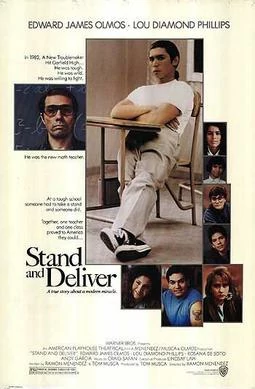
When people talk about “teacher movies,” a few titles always come up: Dead Poets Society, Dangerous Minds, Freedom Writers. But before all of those, there was Stand and Deliver (1988), a modestly budgeted independent drama about a middle-aged Bolivian-American math teacher in East L.A. who decides that his students can handle calculus—and then proves it.
On paper, this sounds like the least “Hollywood” premise imaginable: no sports, no gunfights, no big romantic subplot—just AP Calculus, poverty, and a lot of chalk dust. But the film hit a nerve. It turned its lead actor into an Oscar nominee, pushed its real-life subject into national prominence, and became a staple in American classrooms. In 2011, the Library of Congress added Stand and Deliver to the National Film Registry, calling it “culturally, historically, or aesthetically significant.” (Wikipedia)
Let’s take a deep dive into how the film came together, why the casting choices matter so much, how the story plays out on screen, what really happened behind the scenes, and how audiences and critics received it then—and now.
The Real Story Behind the Movie
Stand and Deliver is based on the life and work of Jaime Escalante, a Bolivian-born teacher at James A. Garfield High School in East Los Angeles. Escalante arrived at Garfield in 1974 and proceeded to do something most people in the system thought was impossible: build a functioning, high-level math pipeline in a school where students were overwhelmingly low-income, Latino, and written off as “not academic.” (Wikipedia)
By 1982, Escalante’s students were taking and passing the AP Calculus exam in numbers that shocked the College Board. That year, 18 of his students passed, an astonishing achievement given the context. Suspicion followed: test officials flagged patterns in the exams as potential cheating, and several Garfield students were required to retake the test—then passed again. (Wikipedia)
The controversy drew the attention of the Los Angeles Times, which ran an article about Escalante and his students. That story eventually caught the eye of writer-director Ramón Menéndez, a recent UCLA film school grad, who was looking for a project. He and producer-co-writer Tom Musca tracked down Escalante and spent months persuading him to sign over the rights to his story—for a symbolic fee of one dollar. (Wikipedia)
This is important context: Stand and Deliver is not a glossy studio-created “issue movie” manufactured from a trend. It’s a small, independent project built around a very specific teacher at a very specific school, anchored in real reporting and in Escalante’s own willingness to let his story be told.
Casting Choices: Why This Ensemble Works
Edward James Olmos as Jaime Escalante
The film’s heartbeat is Edward James Olmos as Jaime Escalante. At the time, Olmos was best known for his Emmy- and Golden Globe-winning work as Lt. Castillo on Miami Vice. Taking on Escalante meant doing something radically different: he gained weight, altered his posture, and adopted Escalante’s accent and mannerisms with almost obsessive detail. (Wikipedia)
The role was originally offered to Raul Julia, who initially passed and later changed his mind—but by then the filmmakers had already turned to Olmos, who also brought his production company into the project and became a key force in getting the movie actually made. (Wikipedia)
Olmos’s performance is not “cool teacher” wish fulfillment. His Escalante is stubborn, abrasive, sometimes manipulative, and occasionally wrong. But he’s also relentless, funny, and deeply invested in his students. That layered portrayal earned him an Academy Award nomination for Best Actor—one of the very few Latino actors ever nominated in that category—as well as Golden Globe and Independent Spirit Award recognition. (Wikipedia)
Lou Diamond Phillips and the Students
While Olmos anchors the film, it’s the students who give it texture and emotional range.
-
Lou Diamond Phillips plays Angel Guzman, the tough, cholo-styled student who hides his intelligence behind a gang persona and a carefully cultivated scowl. By 1988, Phillips was already known for La Bamba, but here he plays against that romantic-hero image as a defensive, volatile kid who slowly buys into Escalante’s “ganas” philosophy. He earned a Golden Globe nomination for Best Supporting Actor. (Teach with Movies)
-
Rosanna DeSoto plays Fabiola, Escalante’s wife, who quietly embodies the cost of his obsession: long hours, health problems, and a home life constantly put on the back burner.
-
Vanessa Marquez as Ana Delgado, the studious young woman whose parents want her to leave school to work in the family restaurant, gives the film some of its most poignant moments about gender, class, and parental expectations. Her character is the only student closely based on a real person, though her name was changed. (Wikipedia)
-
Will Gotay, Ingrid Oliu, Mark Eliot, and others fill out the class with distinct, specific personalities rather than a generic “group of kids.” Each of them gets at least one beat where you feel the weight of their circumstances.
On the adult side, Andy García appears in an early career role as an ETS investigator, and Carmen Argenziano plays an administrator caught between admiration for Escalante and institutional caution. (Wikipedia)
The casting is significant beyond just performance quality: this is a mainstream American feature centered on Latino characters played overwhelmingly by Latino actors—something relatively rare in the 1980s. That representation, especially in a story about academic achievement, is a big reason the film has had such long legs in classrooms and communities.
Plot Summary: From “Basic Math” to AP Calculus
The movie compresses years of real history into one intense narrative arc, but the emotional beats are clear and powerful.
Act I: A New Teacher, a Low Bar
We meet Jaime Escalante arriving at Garfield High School in the early 1980s. The school is under-resourced, chaotic, and labeled a “loser” in terms of academic performance. Students drift in late, teachers are demoralized, and administrators worry about accreditation. (Wikipedia)
Escalante is hired to teach basic math and computer science, but the computer lab turns out to be just empty space and a promise. He’s thrown into a regular math classroom packed with students who assume it’s just another class to sleep through.
Right away, he’s different. He uses humor, street-level Spanish, and offbeat tricks—like the famous finger-multiplication method for the nines tables—to hook their attention. But he’s also demanding, calling his students “burros” and confronting their laziness head-on. The key idea he introduces is ganas—desire, the internal drive to push past limits.
Act II: Raising the Stakes
At a faculty meeting, Escalante learns the school may lose its accreditation because of low test scores. He argues that the problem isn’t the kids’ ability, but the system’s low expectations. If they’re challenged, he insists, they’ll rise to meet the bar. (Wikipedia)
Escalante proposes something radical: he wants to build an AP Calculus class—something unheard of at Garfield. The administration is skeptical; his colleagues outright mock the idea. But he pushes forward anyway, starting with algebra and working upward.
This middle section of the film plays like a training montage extended over years:
-
Morning quizzes to drill fundamentals.
-
After-school sessions and summer classes.
-
Group study sessions that test friendships and family patience.
-
Parents who don’t see the point of calculus when there’s work to be done in restaurants, garages, and shops.
The kids push back. Angel’s gang friends mock him for letting a teacher “own” him. Ana’s parents are furious that she chooses class over the family business. Others just feel overwhelmed by the workload. But little by little, you see transformation. The students start arguing about math problems in the cafeteria. They tease each other for wrong answers and cheer when someone finally gets a concept.
Meanwhile, Escalante’s health deteriorates. The long hours and stress lead to what the film presents as a heart attack. In reality, Escalante later clarified it was a gallbladder issue, not a heart attack—a good example of the “10% drama” he said was added to an otherwise “90%” accurate story. (Wikipedia)
Act III: The AP Exam and the Accusation
By the time the AP Calculus exam rolls around, the class has been through the wringer. They sit for the test in a tense, quiet sequence that treats the exam like a high-stakes sporting event. When the results arrive, they’ve done it: the students pass. Celebration erupts.
But the triumph is short-lived. The Educational Testing Service flags their exam results for irregularities—specifically, similar incorrect answers on certain questions—suggesting possible cheating. Investigators arrive and grill the students. Their accomplishments are suddenly framed as suspicious rather than impressive. (Wikipedia)
This is the film’s most bitter point: poor Latino kids from East L.A. can’t just be good at calculus; they must have cheated. Escalante is outraged, and the students are crushed. The ETS offers a compromise: retake the exam. Escalante advises them not to do it—on principle, they shouldn’t have to prove themselves twice. But the students, wanting their achievements vindicated, choose to retest.
The retake sequence mirrors the first exam—but now there’s rage under the focus. When the new scores arrive, the students have passed again, validating what Escalante knew all along. The film ends without flashy epilogues. Instead, a simple text card tells us that more and more Garfield students went on to take and pass AP Calculus in the years that followed. (Wikipedia)
Behind the Scenes: A Grassroots Movie About Grassroots Education
Development: From Newspaper Article to PBS to Warner Bros.
The path from Escalante’s classroom to the big screen was anything but straightforward.
After that Los Angeles Times article, Menéndez and Musca spent six months convincing Escalante to let them adapt his story. Once he agreed, they ran smack into the realities of Hollywood in the mid-’80s: almost no one wanted to finance a movie about Latino kids doing math. (Wikipedia)
The project survived thanks to a patchwork of institutional and public-interest funding:
-
A small grant (around $12,000) from PBS’s American Playhouse anthology series.
-
Support from the National Science Foundation.
-
Sponsorship from the Corporation for Public Broadcasting and the Atlantic Richfield Company (ARCO). (Wikipedia)
The film’s budget is typically cited at about $1.6 million, a tiny sum by studio standards even in 1988. (Wikipedia)
Once a rough cut existed and started to get attention at festivals (notably the Mill Valley Film Festival), major studios suddenly became interested. Warner Bros. eventually bought the worldwide distribution rights for a reported $3.5–$5 million—more than double the production budget. (Wikipedia)
Casting and Authenticity
The filmmakers leaned heavily on authenticity:
-
They shot in and around real schools in East Los Angeles to capture the neighborhood’s look and feel.
-
Escalante himself provided stories, phrases, and classroom dynamics that were incorporated directly into the script. Lines like “You burros have math in your blood” reportedly came straight from his real lectures. (Wikipedia)
One particularly revealing behind-the-scenes anecdote: when the production needed a quick location for a scene involving Angel and his grandmother, producer Tom Musca found a poor family willing to vacate their cramped apartment in exchange for money to stay at a motel. Instead of leaving, they pocketed the money and hid in a closet during filming—until the crew found them. Rather than throw them out angrily, Musca and Menéndez invited them to watch the shoot and eat with the crew, in line with the film’s broader respect for the community it portrays. (Wikipedia)
Title, Music, and Postproduction
Originally titled “Walking on Water,” the film was renamed Stand and Deliver after the Mr. Mister song of the same name, which plays over the end credits. Warner Bros. reportedly suggested aligning the new title with an Easter-week release. (Wikipedia)
The music, composed by Craig Safan, blends synth-driven 1980s textures with more traditional orchestral elements, underlining the film’s mix of gritty contemporary realism and timeless underdog story. Editor Nancy Richardson, in her first feature editing job, gives the film a propulsive rhythm without losing the smaller, character-based moments. (Wikipedia)
Box Office: A Quiet but Significant Success
Stand and Deliver opened in Los Angeles on March 11, 1988, in just 30 theaters, earning around $411,884 its first weekend—a strong per-screen average for such a limited release. (Box Office Mojo)
Word-of-mouth grew, especially in Latino communities and among educators. The film expanded:
-
To New York a week later.
-
Then to hundreds of theaters nationwide, eventually playing on up to 472 screens. (Box Office Mojo)
Domestically, it ultimately grossed just under $14 million, all in the U.S. market. (The Numbers)
For comparison, that total ranked it around the mid-60s among 1988 releases, edging out films like My Stepmother is an Alien and landing close to modest studio titles such as The Milagro Beanfield War. (The Numbers)
But context matters: this was a low-budget, largely Spanish-accented drama about math and Latino students—not the sort of product conventional wisdom said could make any money. Turning a profit and reaching a wide audience on that premise was a real achievement.
Edward James Olmos later emphasized that community screenings, school outreach, and grassroots promotion (sometimes led by him personally) were critical to the film’s performance. (Wikipedia)
Critical and Awards Reception
Critics at the Time
Critical reception was “largely positive,” according to the American Film Institute’s catalog, which quoted The Hollywood Reporter calling it a “gutty little underdog film” and praising the performances of Olmos, Phillips, and Will Gotay. (AFI Catalog)
Roger Ebert gave the film a mostly favorable review, highlighting how it made math emotionally compelling and praising Olmos’s deeply committed performance. At the same time, he noted that some of the story beats felt “contrived” or overly streamlined—fair criticism given the complex, multi-year reality the movie compresses into one school year.
Retrospectively, the film holds:
-
An 89% critics’ score on Rotten Tomatoes, with the consensus noting that it “pulls off the unlikely feat of making math class the stuff of underdog drama” while paying tribute to an inspirational real-life figure. (Rotten Tomatoes)
-
A Metacritic score of 77/100, signaling “generally favorable reviews.” (Wikipedia)
Awards and Honors
The awards trajectory is impressive for such a modest project:
-
Academy Awards: Edward James Olmos was nominated for Best Actor at the 61st Oscars. (Wikipedia)
-
Independent Spirit Awards: The film won Best Feature, and Olmos and Menéndez both took home major awards. (Wikipedia)
-
Golden Globes: Nominations for Olmos (Best Actor, Drama) and Lou Diamond Phillips (Best Supporting Actor). (Teach with Movies)
-
Christopher Award and other honors for positive, uplifting media. (IMDb)
Then there’s the long-term recognition: being selected for the National Film Registry in 2011 officially enshrined Stand and Deliver as one of the films the U.S. considers worth preserving for future generations. (Wikipedia)
Historical Accuracy and Controversies
Escalante himself famously said the movie was “90% truth, 10% drama.” That feels about right.
Some key differences between film and reality:
-
Timeline compression: The movie suggests Escalante parachuted into Garfield, transformed a single class, and produced a wave of AP Calculus passes in one year. In reality, he spent years building a pipeline—starting with algebra in the mid-1970s, adding summer programs through East L.A. College, and gradually building up to large AP Calculus cohorts by the early 1980s. (Wikipedia)
-
Student preparation: In the film, Escalante seems almost to drag students from basic math into calculus via sheer force of will. In reality, students went through years of increasingly advanced math, including summer intensives, before reaching AP level. (Reason.com)
-
Health scare: As noted earlier, the film dramatizes his health crisis as a heart attack. It was actually a gallbladder problem. (Reason.com)
-
The cheating scandal: Jay Mathews, who later wrote Escalante: The Best Teacher in America, investigated the 1982 exam controversy. He found evidence that some students did, in fact, share answers on one question—a piece of paper was passed around—but also concluded that they demonstrated enough mastery that they likely would have passed anyway. The movie simplifies this into a pure “false accusation” narrative with a clean vindication at the end. (Reason.com)
Critics of the film’s legacy sometimes worry that its heroic narrative puts too much of the burden on one “super-teacher” rather than the broader systems and support structures needed to scale success. But even these critics usually acknowledge that the movie brought attention and respect to Escalante’s work that might otherwise have been lost. (Reason.com)
Audience Impact: Teachers, Students, and Representation
In the Classroom
For decades, Stand and Deliver has been a go-to film for teachers—especially math teachers—who want to show students that:
-
People like them can master challenging subjects.
-
Effort, persistence, and community matter as much as “innate” talent.
Teacher resources sites list it as a major film for discussions about perseverance, educational equity, and stereotype threat. (Teach with Movies)
For many students, especially Latino kids in under-resourced schools, this is one of the first films they see where people who look like them are not gang members or bit players, but academics—driven, funny, flawed, and brilliant. That alone gives the movie a weight far beyond its box-office number.
For Latino Representation in Hollywood
In 1988, mainstream American film rarely put Latino characters at the center of serious drama without leaning heavily on criminality or caricature. Stand and Deliver doesn’t pretend gangs don’t exist, but it refuses to let them define the community.
The film:
-
Centers a Bolivian-American teacher, played by a Mexican-American actor, as a complex hero.
-
Gives Latino students full humanity and intellectual depth.
-
Presents Spanish and Spanglish as normal, lived language, not comic relief.
That combination is one big reason you still see the film referenced in discussions about Latino representation more than three decades later. (Los Angeles Times)
For the Teaching Profession
Alongside later films like Dead Poets Society (1989), Dangerous Minds (1995), and Freedom Writers (2007), Stand and Deliver helped codify the “inspirational teacher” movie template:
-
A burned-out or low-expectation environment.
-
One teacher who believes more is possible.
-
A group of students written off by the system.
-
A climactic demonstration (performance, test, moot court, etc.) that proves the kids’ capabilities.
The difference is that Stand and Deliver is unusually grounded in real practice: daily quizzes, concept scaffolding, summer classes, and the grind required to master calculus. It also does not pretend Escalante’s approach was sustainable or easy. His family life suffers; his health suffers; he clashes with colleagues and administrators.
That complexity is part of why many teachers still see it less as a fantasy and more as an aspirational but recognizable portrait of what happens when one educator decides to push hard against a system’s low expectations.
Why Stand and Deliver Still Matters
More than 35 years after its release, Stand and Deliver still gets shown in classrooms, still gets referenced in articles about education reform, and still shows up on lists of the best “math movies” and teacher films. (Encyclopedia Britannica)
A few reasons it endures:
-
It treats students’ intelligence as real, not symbolic. The math isn’t just wallpaper; the film takes seriously the idea that understanding calculus can transform how students see themselves and their futures.
-
It respects community. The movie doesn’t depict East L.A. as a place to escape from, but as a place where family, culture, and grit coexist with hardship. That nuance makes the stakes feel real.
-
It shows both the power and limits of a “hero teacher.” Escalante is charismatic and inspiring, but he’s also human—stubborn, flawed, and trapped in a system that both needs and exploits him.
-
It’s one of the rare films where Latinos win intellectually on center stage. Not by rejecting their identities, but by leaning into them—language, humor, and all.
If you strip away the 1980s hair and synths, what’s left is a story about expectations. Stand and Deliver insists that when we expect more—from students, from schools, from ourselves—we may not always get the Hollywood ending, but we get closer to justice than if we accept the status quo.
For a small film born from a newspaper article, a $1.6 million budget, and a lot of ganas, that’s a legacy that more than delivers.


 (618) 624-6402