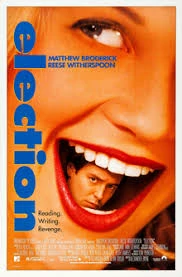
The elevator pitch that lies to you (in a good way)
If you describe Election as “a dark comedy about a student body election,” you’re technically correct—and also missing the point. The movie is a character study disguised as a teen comedy, and a political satire disguised as a school story. It’s about how power works when the stakes are supposedly small. It’s about the stories people tell themselves to rationalize control. And it’s about the uniquely American tension between merit and likability—between someone who wants it too much and someone who can’t stand that they do.
Released by Paramount in 1999, directed by Alexander Payne and co-written with Jim Taylor, Election adapts Tom Perrotta’s novel into something leaner, meaner, and more cinematic—an early mission statement for Payne’s career-long obsession with respectable people behaving badly while insisting they’re decent. (Wikipedia)
Casting choices: why the movie works because the actors don’t “wink”
Reese Witherspoon as Tracy Flick: the defining performance
Tracy Flick is one of those characters who becomes a cultural reference point: the overachiever, the grinder, the person whose ambition makes other people irrationally furious. Reese Witherspoon plays her with bright-eyed intensity and a smile that can feel either inspiring or terrifying depending on who’s watching. The genius is that she doesn’t soften Tracy into a lovable underdog or turn her into a cartoon villain. She plays her as right—or at least as someone who has built her whole identity on being right.
Witherspoon’s performance was widely recognized at the time (including major awards attention) and has only grown in reputation over the decades. (Wikipedia)
Matthew Broderick as Jim McAllister: weaponized “niceness”
Matthew Broderick’s Jim McAllister is the film’s masterstroke of misdirection: a friendly teacher, community-approved, seemingly stable. Broderick uses that clean-cut familiarity as camouflage for something uglier—pettiness, insecurity, and a need to be the one who decides what “fair” means.
If Tracy is ambition without apology, Jim is self-righteousness with a smile. He doesn’t think he’s a villain. That’s the point.
Chris Klein, Jessica Campbell, and the supporting cast as the “electorate”
Chris Klein plays Paul Metzler, the sweet, popular football guy who gets recruited to run against Tracy. He’s not dumb; he’s just agreeable—an ideal candidate for people who want to stop someone else without saying so out loud. Jessica Campbell’s Tammy Metzler is the film’s wild card—someone who sees the whole system as nonsense and decides to burn it down with truth.
Around them, Payne fills the school with administrators, parents, and students who all represent a familiar civic reality: most people don’t want power, but they’re happy to vote for whoever makes them least uncomfortable.
Plot summary: a simple election that turns into moral combat (spoilers)
The setup: Tracy runs, and Jim takes it personally
At Carver High School in Omaha, Nebraska, Tracy Flick is running unopposed for student body president. She’s the kind of student teachers “should” admire—driven, organized, relentlessly involved. But Jim McAllister can’t stand her. Not because she’s incompetent, but because she’s too competent, too certain, too eager. Something about her ambition reads to him as a threat to the natural order.
So Jim—who teaches civics, which is the joke and the tragedy—decides to “restore balance” by convincing Paul Metzler to run against her.
The campaign: optics beat substance, and everyone knows it
Tracy campaigns like a professional. She works the rooms, builds visibility, speaks in polished slogans. Paul, meanwhile, is warm and effortless. He doesn’t want the job, which makes him attractive. He’s also pliable, which makes him useful.
The race becomes less about leadership and more about the community’s emotional reaction to Tracy’s energy. People don’t merely disagree with her; they resent her. And Jim, the adult in the room, fans that resentment while believing he’s protecting the institution.
Tammy Metzler enters: the election becomes a referendum on the system itself
Tammy joins the race in a way that exposes the hypocrisy underneath it. She’s blunt, chaotic, and unwilling to perform the expected social scripts. Where Tracy wants to win within the rules, Tammy questions why the rules deserve respect at all.
Her presence pushes the election from a popularity contest into something more volatile: a public argument about sincerity, conformity, and who gets punished for wanting something.
The crime: Jim crosses the line and calls it “principle”
When Tracy still appears likely to win, Jim escalates. In a moment of anger and self-justification, he tampers with the ballots—an act that is both absurdly small-stakes and ethically enormous. This is the film’s thesis crystallized: people will break the very rules they claim to protect if they feel “forced” by someone else’s ambition.
The results flip. Tracy loses. Jim congratulates himself.
The fallout: accountability is not evenly distributed
The film doesn’t hand out consequences like a morality play. Instead, it shows how institutions protect certain people and punish others—often based on image and narrative rather than facts.
Jim’s attempt to control the outcome boomerangs into personal and professional collapse. Tracy’s defeat doesn’t destroy her; it hardens her. The closing movement of the movie suggests what makes Election endure: this wasn’t a one-time school drama. It was training for adulthood.
Behind the scenes: Payne’s “local” realism and the choice to make it feel lived-in
Omaha as a character
Like several of Alexander Payne’s films, Election is rooted in Nebraska, and that grounded Midwestern specificity is a big part of why the satire hits. The school exteriors and many school scenes were filmed at Papillion-La Vista High School in the Omaha area, standing in for the fictional Carver High. (Film Locations Guide)
That choice matters: the movie doesn’t look like a glossy “movie high school.” It looks like a place you could have actually attended—hallways, cafeterias, parking lots, all shot with the casual familiarity of real institutions where small power struggles happen daily.
Adaptation choices: less “teen movie,” more civic horror story
Perrotta’s source novel gives the story its spine, but the film version tightens the perspective and sharpens the satire. Payne and Taylor make Jim’s narration and subjectivity a central weapon: we spend enough time inside his head to understand how he rationalizes himself into corruption, while the visuals quietly contradict him.
The direction also emphasizes tiny humiliations—awkward pauses, forced smiles, polite cruelty—because that’s where social power actually lives.
Box office: a critical darling that didn’t become a mainstream hit (at first)
Election wasn’t a breakout commercial success in its initial run. Box office reporting varies slightly by source, but the consistent story is the same: it performed modestly relative to its costs.
-
Box Office Mojo lists a domestic gross of about $14.9 million and a $25 million budget. (Box Office Mojo)
-
The Numbers lists a production budget of $8.5 million (and also provides release-pattern details like a limited opening and later expansion). (The Numbers)
-
Wikipedia aggregates the range (reflecting the public uncertainty you often see with 1990s budget reporting) and cites a worldwide gross around $17.2 million. (Wikipedia)
The important takeaway isn’t the exact dollar figure—it’s that Election was the kind of movie that found its “win” over time: through critical canonization, home video, and the slow build of cultural influence.
Audience reception: critics loved it, audiences weren’t sure what to do with it
Critics: “bracing,” “nasty,” and smart—said as compliments
The film received widespread critical acclaim and remains highly rated among critics. Aggregators have long reflected that strength, and the movie’s reputation has only improved with age. (Wikipedia)
The critical praise makes sense: Election doesn’t just make jokes—it builds an argument. It’s a comedy with teeth, and it doesn’t apologize for being uncomfortable.
General audiences: darker than expected
Mainstream audiences often approach teen-adjacent movies expecting uplift, romance, or at least an easy moral. Election offers none of that. It’s not cynical for sport; it’s cynical as diagnosis. That tonal mismatch likely contributed to its modest box office, but it also explains why it became a favorite for people who later discovered it and thought, Wait… how did they get away with this in 1999?
Legacy: Tracy Flick as a cultural archetype
Over the years, Tracy Flick has been cited and echoed in political and pop-culture commentary—less as a “character” and more as shorthand for a type of driven woman people feel entitled to mock or punish. Retrospectives and interviews around the film’s anniversaries regularly return to that idea: Tracy didn’t change—we did, or at least we became more aware of what we project onto female ambition. (People.com)
Why Election still lands in 2025: it’s about narrative control
The core conflict isn’t Tracy vs. Paul. It isn’t teacher vs. student. It’s who gets to tell the story about what’s happening.
-
Tracy believes the story is: I earned this.
-
Jim believes the story is: I’m saving everyone from her.
-
The school believes the story is: Keep things calm.
-
The voters believe the story is: Don’t make us feel bad.
And that, more than any single joke, is why the movie lasts. The mechanisms of reputation, resentment, and “concern” haven’t changed. They’ve just migrated from hallways to feeds.


 (618) 624-6402