The elevator pitch that isn’t really an elevator pitch
On paper, a “historical drama about a debate team” sounds niche. The Great Debaters gets around that problem by treating debate the way sports movies treat the big game: as a public arena where identity, pride, fear, and status collide—only the weapon is not speed or strength, but clarity.
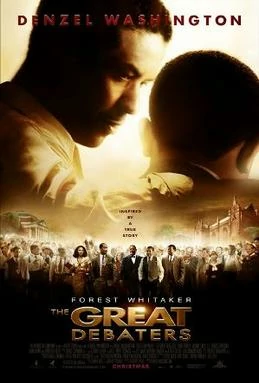
Directed by Denzel Washington and released on December 25, 2007, the film dramatizes the rise of the Wiley College debate team in 1935, led by professor Melvin B. Tolson. (Wikipedia) The team’s victories aren’t framed as trophies; they’re framed as proof—proof that Black intellect cannot be quarantined by Jim Crow, and proof that courage can look like a student standing up and saying, “I disagree,” in a world that punishes disagreement.
The story is inspired by a 1997 article for American Legacy (as credited in the film’s background), which is a crucial detail because it explains the movie’s tone. (Wikipedia) This isn’t a documentary reconstruction; it’s a prestige, mainstream drama that uses a true story as a launchpad for something broader: a cinematic sermon on self-respect, mental discipline, and the power of language.
And if that sounds lofty, the movie keeps pulling it down to earth—into classrooms, dorm rooms, church spaces, and dusty Texas roads—so the ideals always have a human body attached to them.
Why this story mattered in 2007—and why it still lands
The 1930s setting does a lot of heavy lifting. It’s the Great Depression. It’s the Jim Crow South. The threat of racial violence is not abstract; it’s ambient. The film doesn’t pretend that education is a magical shield. Instead, it presents learning as a torch: it doesn’t stop the darkness from existing, but it changes what people can do inside it.
That’s why the film’s debates don’t play like polite academic exercises. They play like confrontations with consequences. When a character speaks well, it’s not simply impressive—it’s dangerous, because brilliance disrupts the hierarchy.
In that sense, the film is also about the politics of “who gets to sound certain.” The act of speaking in complete sentences, refusing to shrink, refusing to apologize for intelligence—those choices become acts of defiance.
Casting choices: star gravity + young fire
Denzel Washington as Mel Tolson
Washington directs and stars as Tolson, and his performance is built on a deliberate contradiction: Tolson is both inspiring and demanding. He isn’t the soft mentor who affirms every student’s feelings. He’s the kind of teacher who expects you to rise to the level of your potential—because, in his world, mediocrity isn’t just disappointing; it’s vulnerable.
That’s why Washington works so well here. He can play warmth without turning sentimental, and authority without turning into a caricature. He also understands when to withhold emotion—letting the students carry scenes rather than stealing them.
Forest Whitaker as Dr. James Farmer Sr.
Forest Whitaker plays Dr. Farmer Sr. as a man who embodies another kind of power: institutional credibility. He’s principled, cautious in ways Tolson is not, and deeply aware of how quickly progress can provoke backlash. The dynamic between Washington and Whitaker becomes one of the film’s quiet engines—two leaders with overlapping goals but different appetites for risk. (IMDb)
The student debaters: Nate Parker, Jurnee Smollett, Denzel Whitaker
The young ensemble is where the movie earns its heart. Nate Parker plays Henry Lowe (the volatile genius energy), Jurnee Smollett plays Samantha Booke (the sharp equal who refuses to be ornamental), and Denzel Whitaker plays James Farmer Jr. (intellectual seriousness with a young man’s uncertainty). (IMDb)
It’s a smart lineup because each represents a different “argument” about survival:
-
One student is anger sharpened into logic.
-
One is discipline sharpened into authority.
-
One is ambition sharpened into identity.
The movie doesn’t treat them as interchangeable underdogs. It treats them as different forms of becoming.
Plot summary: the rise, the road, the risk
1) A professor builds more than a team
We meet Wiley College as a historically Black institution in Texas, where the stakes of learning are constantly heightened by the reality outside campus. Tolson isn’t just teaching rhetoric; he’s teaching posture—how to stand, how to think, how to hold your ground.
His debate program isn’t treated like an extracurricular. It’s treated like a mission. He recruits talent, pushes them hard, and builds them into something disciplined enough to enter rooms that were never built for them.
2) The “real world” is never offscreen
The film does something important early: it refuses to let the debate storyline float in a safe bubble. Jim Crow isn’t “background flavor.” It intrudes. The students encounter racism not as insults but as structural force—sheriffs, threats, and the broader culture of fear.
That choice matters because it prevents the movie from becoming a clean sports narrative where “hard work solves everything.” Hard work helps here, but it doesn’t erase danger.
3) Debate as combat—without turning it into parody
As the team begins competing, the film stages debates with escalating pressure. Each match becomes more than winning points; it becomes symbolic proof that these students belong in intellectual arenas that have historically excluded them.
The story builds toward a culminating showdown that, in the film’s version, carries the weight of representation: not just “can they win,” but “what does it mean if they do?”
4) Resolution with uplift, but not naïveté
The ending delivers the satisfaction you want from this kind of film: earned triumph, emotional release, and a sense of forward motion. But the story’s deeper message is subtler: one victory doesn’t redeem a system. It simply proves that resistance can be articulate—and that articulation can travel.
Behind the scenes: how the film was made to feel lived-in
Inspired by real history, shaped for mainstream storytelling
The film is based on real people and real institutional history, but it also compresses and dramatizes events for narrative momentum (as most historical dramas do). Its aim is less “every date exact” and more “the spirit and stakes made visible.”
That’s also why it feels “old-school” in structure: it’s built like a classic studio uplift drama—training, setbacks, road tests, big final confrontation—because that structure is a delivery vehicle for a story many audiences may not know.
Where it was shot: grounding the world in real places
Production included filming connected to Wiley College in Marshall, Texas (which is central to the story), along with other locations. (IMDb) And notable sequences were filmed in Louisiana settings; Oprah.com’s behind-the-scenes coverage mentions filming at a school in Grand Cane, Louisiana, and describes location contributions and builds created specifically for the production. (oprah.com)
Those choices matter because the movie’s atmosphere—humid, rural, close to the earth—keeps it from feeling like a museum piece. The South here isn’t a “period backdrop.” It’s a pressure system.
The Oprah factor
Oprah Winfrey is credited as a producer, and the film was produced through Harpo Productions. (Wikipedia) That pairing—Washington’s directorial seriousness plus Oprah’s long-running interest in stories about education, uplift, and Black achievement—helps explain why the film feels both inspirational and purposeful, without being cynical.
Box office: modest by blockbuster standards, meaningful by prestige-drama standards
The Great Debaters was made on a reported $15 million budget and earned about $30.2 million domestically. (Wikipedia) It opened on December 25, 2007 and debuted around the low teens in its first weekend, bringing in just over $6 million from 1,171 venues (a typical platform-to-wider strategy profile for prestige releases). (Box Office Mojo)
In other words: it wasn’t a phenomenon, but it clearly found an audience—especially for a PG-13 historical drama anchored in dialogue rather than spectacle.
Audience and critical reception: warmly received, with a familiar critique
Critics: mostly positive, with “formula” as the main complaint
Rotten Tomatoes’ critic score has been reported around the 80% range, with the general consensus praising performances and script while noting a familiar inspirational template. (Wikipedia) Metacritic’s score sits in the mid-60s, a classic “generally favorable” zone. (Wikipedia)
That split tells you exactly what kind of movie this is:
-
It’s well-made, well-acted, and emotionally effective.
-
It’s also structurally traditional—so some critics wanted more bite, more complexity, or more danger in the storytelling.
Even Wikipedia’s reception summary preserves that tension, noting praise alongside criticism that the film can “play it safe.” (Wikipedia)
Awards attention: respected, not dominant
The film picked up meaningful recognition, including a Golden Globe nomination for Best Motion Picture – Drama and multiple NAACP Image Awards wins. (Wikipedia) It also received the Producers Guild of America’s Stanley Kramer Award and other honors tied to socially conscious filmmaking. (Wikipedia)
That awards profile fits the movie’s lane: a prestige crowd-pleaser with a mission, anchored by a major star, and aimed at both inspiration and legacy.
What the movie gets right about debate—even when it’s dramatized
Debate movies often fall into one of two traps:
-
turning debate into a nerdy joke, or
-
turning it into a magical superpower where one speech fixes everything.
The Great Debaters avoids both by emphasizing discipline. The students don’t become great because they’re “naturally gifted” (even when they are). They become great because they learn to structure thought, to research, to anticipate counterarguments, and to speak with calm under pressure.
That’s why the debates feel dramatic: not because the movie pretends words are bullets, but because it shows how words are built—brick by brick—into something that can hold weight.
The film’s lasting reputation
Nearly two decades later, The Great Debaters still occupies a specific and valuable space: a historically rooted, accessible, inspirational drama about Black excellence that doesn’t require the audience to already be interested in debate to care.
It’s also a film that quietly honors teachers—especially the difficult kind. Tolson isn’t inspirational because he’s always kind. He’s inspirational because he insists his students are capable of more than the world will ever demand of them.
And maybe that’s the movie’s most enduring argument:
that the ability to reason clearly—and to speak that reasoning out loud—can be both a personal liberation and a public threat to injustice.
If you want, I can also add a “historical accuracy vs. dramatization” section that compares the film’s key events with what’s known about Wiley College’s debaters and Melvin B. Tolson.


 (618) 624-6402