What do a 90° corner and a 180° straight angle have in common? We can split both into two smaller angles. For example, a 90° angle can become 34° and 56°, while a 180° angle can become 115° and 65°. We call the first pair complementary angles and the second pair supplementary angles.
Today, we'll take a closer look at how to tell them apart and practice finding missing angles through worked examples before putting our skills to the test with practice problems.

What Is the Difference Between Complementary and Supplementary Angles?
Complementary and supplementary angles are both pairs of angles, but we distinguish them by the sum of their measures.
Complementary angles are two angles whose measures add up to 90°. For example, two 45° angles are complementary because 45° + 45° = 90°.
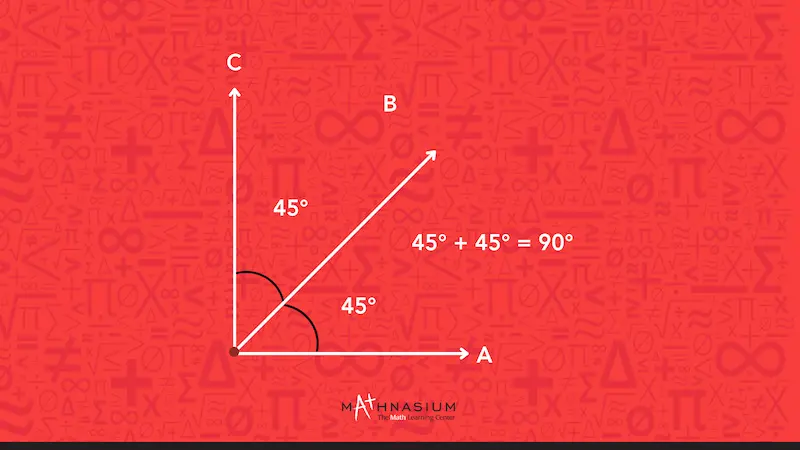
When complementary angles share a vertex and a side without overlapping, we call them adjacent angles, and together they form a right angle. They can also be separate (non-adjacent) angles, as long as their measures add up to 90°.
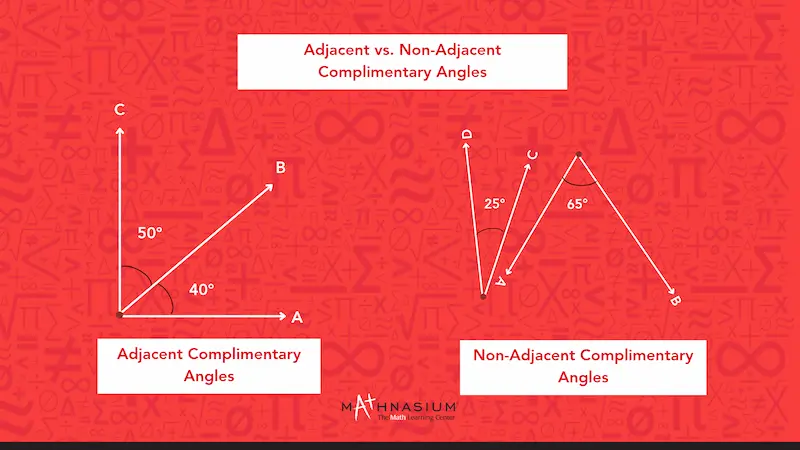
On the left, 50° and 40° form a right angle. On the right, 25° and 65° are separate angles, but both pairs still add up to 90°.
Supplementary angles have a combined measure of 180°. For instance, two 90° angles are supplementary because 90° + 90° = 180°.
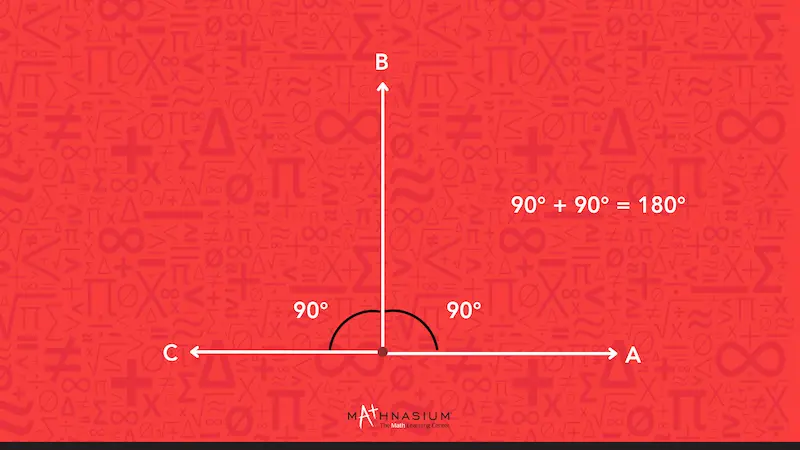
When supplementary angles are adjacent, they form a straight angle, although they can also be separate angles as long as their measures add up to 180°.
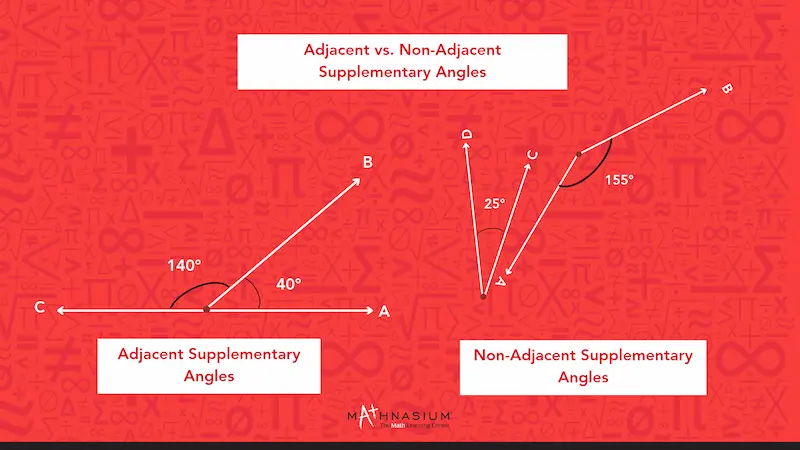
On the left, 140° and 40° form a straight angle. On the right, 25° and 155° have separate vertices, but both pairs still add up to 180°.
Here's a quick summary of how both types of angle pairs compare, along with a couple of memory tricks to help us tell them apart.
|
|
Complementary angles
|
Supplementary angles
|
|
Sum
|
90°
|
180°
|
|
When adjacent
|
Form a right angle
|
Form a straight angle
|
|
Memory trick
|
C for Corner (90°)
|
S for Straight (180°)
|
|
Find a missing angle
|
Subtract from 90°
|
Subtract from 180°
|
If the C and S memory tricks caught your attention, here's another hack to remember which total goes with each angle type. C for complementary comes before S for supplementary in the alphabet, just as 90° comes before 180°.

How to Find Missing Complementary Angles
Since complementary angles always add up to 90°, we can find a missing angle by subtracting the known angle from 90°. If both angles are represented by algebraic expressions, we can use their sum of 90° to form an equation and solve for the unknown value.
Let's work through both types of problems step by step.
1. Calculate a Missing Angle
Suppose one of two complementary angles measures 38°. We already know their total, so we can find the missing measure in two steps:
The missing complementary angle measures 52°.
2. Solve for Unknown Angles with Algebra
Now, consider two complementary angles measuring (x + 6)° and (4x − 1)°. We need to find the value of x before we can calculate their individual measures.
Here's how we can find both angles:
-
Set up the equation. Since the angles are complementary, their measures must add up to 90°. We write (x + 6) + (4x − 1) = 90.
-
Combine like terms. Add x and 4x, then combine 6 and −1. We get 5x + 5 = 90.
-
Solve for x. Subtract 5 from both sides to get 5x = 85, then divide by 5. So, x = 17.
-
Calculate both angles. Substitute x = 17 into the original expressions. The first angle is 17 + 6 = 23°, while the second is 4 × 17 − 1 = 67°.
We can check our solution by adding 23° + 67° = 90°. Both measures satisfy the complementary relationship.
📕 You May Also Like: What Are Complementary Angles? A Complete Guide
How to Find Missing Supplementary Angles
Now, we can use subtraction and algebra to find missing supplementary angles, just as we did with complementary angles. The difference is that supplementary angles add up to 180°, so we use that total in our calculations.
Ready for two more worked examples? Let's solve them step by step.
1. Calculate a Missing Angle
Imagine we need to find the supplement of 124°. We can calculate the missing measure in two steps:
So, the missing supplementary angle measures 56°.
2. Solve for Unknown Angles with Algebra
Let's try an algebra problem involving two supplementary angles whose measures are (x + 17)° and (2x + 7)°. We'll first solve for x, then use its value to calculate both angles.
We can solve the problem in four steps:
-
Set up the equation. Add the two expressions and set their sum equal to 180°. We get (x + 17) + (2x + 7) = 180.
-
Combine like terms. Add x and 2x, then combine 17 and 7. We get 3x + 24 = 180.
-
Solve for x. Subtract 24 from both sides to get 3x = 156, then divide by 3. So, x = 52.
-
Calculate both angles. Substitute x = 52 into the original expressions. The first angle is 52 + 17 = 69°, while the second is 2 × 52 + 7 = 111°.
Now we can check our solution by adding 69° + 111° = 180°. Both measures satisfy the supplementary relationship.
📕 You May Also Like: What Are Supplementary Angles? A Kid-Friendly Guide
Practice Problems: Complementary and Supplementary Angles
It's your turn to put those angle skills to work! We've reviewed the differences between complementary and supplementary angles and practiced finding missing measures. Now, let's see how you can use those skills to tackle some new challenges.
Try these 15 practice problems, starting with simple angle relationships and working your way up to algebra and reasoning. You can check your answers in the solution section at the end of the article.
Level 1: Recognize the Relationship
-
Are 21° and 69° complementary, supplementary, or neither?
-
Are 133° and 49° complementary, supplementary, or neither?
-
Are 99° and 81° complementary, supplementary, or neither?
-
Two separate angles measure 17° and 73°. Are they complementary even though they don't share a vertex?
Level 2: Calculate a Missing Angle
-
What is the complement of 19°?
-
What is the supplement of 151°?
-
Two angles are supplementary. One measures 96°. What is the measure of the other angle?
-
What is the complement of 28.5°?
Level 3: Apply the Relationships
-
Two complementary angles differ by 24°. What are the measures of both angles?
-
Two supplementary angles differ by 28°. What are the measures of both angles?
-
Angle P is supplementary to 118°, while angle Q is complementary to 24°. Which angle is larger, and by how many degrees?
-
One acute angle in a right triangle measures 31°. Find the other acute angle and explain why the two are complementary.
Level 4: Algebra and Reasoning
-
Two complementary angles measure (x + 20)° and (4x − 10)°. Find x and both angle measures.
-
Two supplementary angles measure (2x + 8)° and (4x + 4)°. Find x and both angle measures.
-
Angles A and B are each supplementary to an angle measuring 79°. What can you conclude about the measures of A and B? Explain your reasoning.
📕 You May Also Like: When Should My Child Take Algebra? What Parents Need to Know

At Mathnasium, we help students of any skill level build a solid foundation for math mastery while transforming how they think and feel about math.
How Mathnasium Helps Students with Geometry and Beyond
Mathnasium is a math-only learning center dedicated to helping K–12 students of all skill levels excel in math.
Whether your child is learning how complementary and supplementary angles work or preparing for more advanced geometry, our specially trained geometry tutors can help. We support students from foundational middle school geometry through high school and advanced topics, including triangles, transformations, congruence, and geometric proofs.
No matter what your child is working toward, we support their progress through the Mathnasium Method™, our proprietary teaching approach, which is designed around each student's needs and learning style. Our approach includes:
-
Assessment and Personalized Learning Plans: Each student begins their Mathnasium journey with a diagnostic assessment that identifies current skills, strengths, and gaps. From those findings, we build a personalized learning plan tailored to their goals.
-
Teaching for Understanding: Our specially trained tutors use natural language and a mix of verbal, visual, mental, tactile, and written techniques so each concept lands before we move forward.
-
Problem-Solving and Critical Thinking: We give students time to work through problems independently. That productive struggle helps them learn to trust their own reasoning. When we do step in, we explain both the how and the why behind each answer, so students build problem-solving and critical thinking skills they can use in math and beyond.
-
An Engaging and Fun Learning Environment: Sessions include games, earned rewards, and consistent celebration of progress. Students build confidence alongside fluency, and many develop a more positive relationship with math over time.
The impact extends beyond the classroom:
-
94% of parents report an improvement in their child's math skills and understanding
-
93% of parents report their child's improved attitude toward math after attending Mathnasium
-
90% of students saw an improvement in their school grades
With over 1,200 learning centers across North America, there is likely a Mathnasium close to you.
Families throughout Pembroke Pines and nearby communities, including Miramar, Salt Lakes, and Town Gate, trust Mathnasium of Pembroke Pines to help their children build lasting confidence in math.
If geometry or any other math concept is giving your child trouble, our team is ready to help.
📅 Schedule a Free Assessment at Mathnasium of Pembroke Pines
Not near Pembroke Pines?
📍 Find a Mathnasium Learning Center Near You
Pssst! Check Your Answers Here
How did you do? Let's check your answers!
Level 1: Recognize the Relationship
-
Add the two angles: 21° + 69° = 90°. Since their measures add up to 90°, they are complementary.
-
Add the measures: 133° + 49° = 182°. Since the sum is neither 90° nor 180°, the angles are neither complementary nor supplementary.
-
Calculate the sum: 99° + 81° = 180°. Since their measures add up to 180°, they are supplementary.
-
Add the measures: 17° + 73° = 90°. Complementary angles don't need to share a vertex, as long as their measures add up to 90°. Yes, the angles are complementary.
Level 2: Calculate a Missing Angle
-
Subtract 19° from 90° to find the complement: 90° − 19° = 71°.
-
Subtract 151° from 180° to find the supplement: 180° − 151° = 29°.
-
Supplementary angles add up to 180°, so subtract the known angle: 180° − 96° = 84°.
-
Subtract 28.5° from 90° to find the complement: 90° − 28.5° = 61.5°.
Level 3: Apply the Relationships
-
Let x represent the smaller angle. Since the larger angle is 24° more and complementary angles add up to 90°, we write x + (x + 24) = 90. Combine like terms to get 2x + 24 = 90, then subtract 24 from both sides to get 2x = 66. Divide by 2 to find x = 33. The larger angle measures 33° + 24° = 57°, so the two angles measure 33° and 57°.
-
Let x represent the smaller angle. Since the larger angle is 28° more and supplementary angles add up to 180°, we write x + (x + 28) = 180. Combine like terms to get 2x + 28 = 180, then subtract 28 from both sides to get 2x = 152. Divide by 2 to find x = 76. The larger angle measures 76° + 28° = 104°, so the two angles measure 76° and 104°.
-
First, find angle P by subtracting 180° − 118° = 62°. Next, find angle Q by subtracting 90° − 24° = 66°. Compare their measures using 66° − 62° = 4°. Therefore, angle Q is larger by 4°.
-
All three interior angles of a triangle add up to 180°. Since a right triangle contains a 90° angle, its other two angles must add up to 180° − 90° = 90°. Subtract the known acute angle to get 90° − 31° = 59°. Since 31° + 59° = 90°, the two acute angles are complementary. The missing angle measures 59°.
Level 4: Algebra and Reasoning
-
Complementary angles add up to 90°, so we write (x + 20) + (4x − 10) = 90. Combine like terms to get 5x + 10 = 90. Subtract 10 from both sides to get 5x = 80, then divide by 5 to find x = 16. Substitute this value into both expressions to get 16 + 20 = 36° and 4 × 16 − 10 = 54°. Since 36° + 54° = 90°, x = 16 and the angles measure 36° and 54°.
-
Supplementary angles add up to 180°, so we write (2x + 8) + (4x + 4) = 180. Combine like terms to get 6x + 12 = 180. Subtract 12 from both sides to get 6x = 168, then divide by 6 to find x = 28. Substitute this value into both expressions to get 2 × 28 + 8 = 64° and 4 × 28 + 4 = 116°. Since 64° + 116° = 180°, x = 28 and the angles measure 64° and 116°.
-
Both angles are supplementary to an angle measuring 79°, so each must add up to 180° with that angle. For angle A, we calculate 180° − 79° = 101°. We use the same calculation for angle B because it is also supplementary to a 79° angle. Since both calculations give 101°, angles A and B have equal measures of 101°, even if they don't share a vertex.


 (954) 441-6284