One of the biggest concerns parents of middle schoolers we teach come to us with is algebra, or specifically, algebra readiness.
” Other kids seem to be taking it in 7th grade. The school is suggesting 8th. What do we do?”
The concern here is whether getting ahead on algebra will open doors or whether pushing too soon might actually close them.
Having worked with thousands of middle schoolers of all skill levels, we know that any student can build the foundations necessary for algebra, but not everyone gets there at the same time. Today, we'll walk you through:
-
What the research says about algebra readiness
-
What foundational skills your child needs first
-
How to make a confident, informed decision for your family

Why Starting Algebra Too Early Can Hold Your Child Back
Algebra has long been called the gateway to higher math. It unlocks the path to geometry, precalculus, statistics, and the STEM fields that drive today's economy.
Research also shows that completing a math course beyond Algebra 2 more than doubles the likelihood that a student will pursue and earn a college degree.
So yes, algebra plays an enormous role. The real question for each parent is simply one of timing: When is their child truly ready?
Beginning in the 1980s, a push to move algebra into 8th grade, and even 7th grade, gained momentum across the country. It was driven by a desire to improve international competitiveness and produce more advanced math students. But while the intent was sound, the results have been mixed.
However, studies in California and North Carolina found that placing students in algebra before they had mastered foundational skills:
-
Did not improve their performance on state math assessments
-
Significantly hurt their grade point averages
-
Reduced the likelihood that they would take and pass higher-level math courses in high school
Even more telling: students who took algebra in 9th grade rather than 8th were more likely to complete four years of high school math and continue taking math in college.
The defining factor, according to researchers, is prior knowledge.
📕 You May Also Like: How to Make Sure Your Child Is Ready for Algebra?
What "Algebra Too Soon" Actually Means
Linda Gojak, former President of the National Council of Teachers of Mathematics, offered a memorable analogy in her article titled ‘’Algebra: Not 'If' but 'When'’’. She compared rushing a child into algebra to handing a young student a copy of Gone with the Wind, a novel technically written at a 6th-grade reading level.
"Just because a student can read the sentences doesn't mean she has the experience or maturity to deeply understand what she is reading,” wrote Gojak. “The same is true in mathematics. Just because a student can mimic steps shown by the teacher doesn't ensure that he has the sophistication to deeply understand the mathematics."
Algebra introduces abstract concepts, such as variables, expressions, equations, and functions, that require a higher level of mathematical maturity.
To be truly ready, students need to have already mastered:
When those foundations are solid, algebra becomes a natural next step. When they aren't, students are asked to build on ground that hasn't fully settled, and knowledge gaps show up quickly.
As many high school math teachers have expressed, when kids struggle, they often begin to dread math, and eventually, we lose thousands of students who could be the scientists and engineers of tomorrow. If we held back and took more time to ground them in the basics, we could turn them on to math.
Math learning is linear by nature. Each concept becomes the building block for the next, and without mastery of the prerequisites, the risk of falling behind grows with every level. Simply passing math should never be the goal for any student.
True understanding at each stage is what keeps the path forward open.
📕 You May Also Like: What Is Number Sense & Why It Matters in Early Math Education
Signs Your Student Is Ready for Algebra
Each student reaches algebra readiness at a different age, and that's perfectly okay. What plays a key role is whether the right foundations are in place. The clearest signs to look for are:
-
They can work confidently with fractions, decimals, and percentages. These are the building blocks algebra builds directly on. If your child can add, subtract, multiply, and divide fractions without major difficulty, that's a strong indicator.
-
They understand ratios and proportional thinking. Algebra relies heavily on the ability to recognize relationships between quantities. A student who can set up and solve a simple proportion is already thinking algebraically.
-
They're comfortable with negative numbers. Working with integers, including adding, subtracting, and multiplying negatives, is essential in algebra and trips up many students who move forward too soon.
-
They can solve multi-step word problems. This signals mathematical maturity, the ability to read a problem, break it into parts, and work through it logically rather than looking for a single-step shortcut.
-
They can identify patterns and think abstractly. Algebra introduces variables and expressions. A student who can spot a pattern in a sequence or describe a rule in general terms is showing early algebraic thinking.
If most of these are solidly in place, your child is likely ready. If several are shaky, a little more time spent strengthening those foundations will make algebra significantly easier and more rewarding when the time comes.
📕 You May Also Like: 4 Tips to Help Your Student Get Better in Algebra This Year

From number sense to algebra readiness, Mathnasium's specially trained tutors guide students every step of the way.
How Mathnasium Helps Your Child Get Algebra-Ready
Mathnasium is a math-only learning center dedicated to helping K-12 students of all skill levels excel in math.
At Mathnasium, rather than following a one-size-fits-all timeline, we focus on building the foundational skills that make algebra click, at the right pace, for each individual student.
The framework behind our approach is the Mathnasium Method™, our proprietary teaching approach designed to ensure students are genuinely ready for algebra before they take that step. Here is how it works:
-
Each student begins with a diagnostic assessment that pinpoints their current skills and knowledge gaps. From there, we build a personalized learning plan tailored to their specific needs, pace, and goals so no student moves forward before they're truly ready.
-
Our specially trained tutors teach for understanding, not memorization, using a blend of visual, verbal, written, and hands-on techniques. They know how to support a discouraged student and how to challenge one who's ready to move faster, meeting each student exactly where they are.
-
Sessions are designed to build independent problem-solving and critical thinking, with students working through challenges on their own before reviewing the how and why with their tutor.
With a math-only focus and a rewarding, encouraging environment, every session is a step toward greater confidence.
The results speak for themselves:
-
94% of parents report an improvement in their child's math skills and understanding
-
93% of parents report their child's improved attitude toward math after attending Mathnasium
-
90% of students saw an improvement in their school grades
With a network of more than 1,100 centers, Mathnasium brings top-rated instruction close to your home.
With 100+ glowing Google reviews, Mathnasium of Littleton has earned the trust of families throughout the community, serving as your local partner to build the foundations your child needs before algebra and beyond.
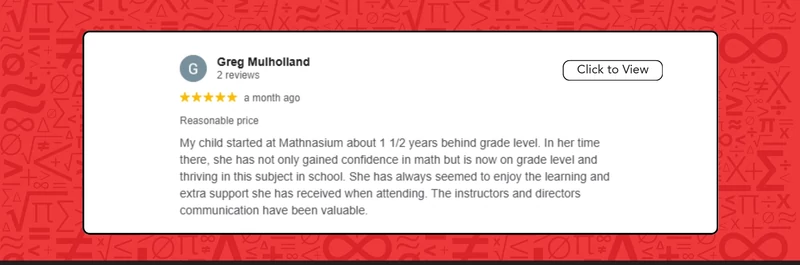
Here's what one parent had to share about our center:
Whether your child is looking to catch up, keep up, or get ahead in math, we're here to help!
Ready to get started?
📅 Schedule a Free Diagnostic Assessment at Mathnasium of Littleton
Not near Littleton?
📍 Find a Mathnasium Learning Center Near You


 (303) 979-9077
 (303) 979-9077