As students move through their math journey, they often reach points where they need to adapt to a different way of thinking.
New topics, and sometimes entire areas of math, may ask them to make more abstract connections or change how they visualize numbers. That is where confusion can begin. We’ll call these moments math roadblocks.
For Richardson ISD students, many of these shifts reflect the Texas Essential Knowledge and Skills (TEKS), which outline the math knowledge and problem-solving skills students are expected to develop from grade to grade.
At Mathnasium of Richardson West, our tutors often help students work through these roadblocks by identifying what is causing the difficulty and building the understanding needed to move forward. Based on that experience, we’ll highlight four common math roadblocks students may encounter and share practical ways Richardson parents can support their child.
Based on that experience, we’ll highlight four common math roadblocks students may encounter and share practical ways Richardson parents can support their child.

1. Fractions—A New Way of Thinking About Numbers
In Texas, formal fraction instruction begins in Grade 3. Students learn to represent fractions using physical objects, visual models, and number lines, master unit fractions, and recognize equivalent fractions.
As they move through later grades, that foundation expands to comparing fractions, connecting them with decimals and percents, and performing fraction operations.
So, where does the confusion start?
With whole numbers, larger digits usually signal a larger amount. For example, eight is greater than five (8 > 5). Fractions break that pattern entirely. In \(\Large\frac{1}{8}\) and \(\Large\frac{1}{5}\), the larger denominator does not mean the piece is larger. On the contrary, it means the exact same whole has been divided into more equal pieces, leaving each individual piece smaller.
In other words, fractions ask students to build a brand new mental model.
If they do not fully understand a fraction as a number with its own value and position on the number line, later work with equivalence, comparison, decimals, percents, and fraction operations can quickly turn into a stressful collection of rules to memorize.
In fact, research from the United States and the United Kingdom shows that elementary students' foundational knowledge of fractions and division strongly predicts algebra success and overall mathematics achievement five to six years later.
Put simply, if fraction logic doesn't click early on, it can create a domino effect down the road.
When students struggle with fractions at Mathnasium of Richardson West, we usually notice a few patterns:
-
They treat the denominator as an independent whole number rather than a piece of a total.
-
They assume a larger denominator always means a larger fraction (e.g., thinking \(\Large\frac{1}{8}\) is bigger than \(\Large\frac{1}{4}\)).
-
They struggle to recognize that different-looking fractions can represent the exact same value (missing that \(\Large\frac{2}{4}\) = \(\Large\frac{1}{2}\)).
-
They use familiar whole-number rules for fraction operations, such as adding straight across denominators (adding \(\Large\frac{1}{4}\) + \(\Large\frac{1}{4}\) to get \(\Large\frac{1}{8}\)).
📕 You May Also Like: Adding and Subtracting Fractions with Unlike Denominators
How to Help Your Child Build Solid Fraction Sense
Fractions are one of the most common pain points for the students we work with. We can tell you from experience that the goal isn't to pile on more memorized rules but to help your child truly see what a fraction represents.
Here are a few approaches you can use at home with your child:
-
Ask your child to compare fractions before calculating. Try asking, "Is \(\Large\frac{3}{4}\) closer to 0, \(\Large\frac{1}{2}\), or 1?" If they estimate first, it helps them focus on the size of a fraction and catch answers that do not make sense.
-
Use visual models to explain, not just check, an answer. Have your child draw fraction bars or place fractions on a number line, then ask them to explain what the model shows. This is especially useful for equivalent fractions and comparisons such as \(\Large\frac{3}{4}\) vs. \(\Large\frac{5}{8}\).
-
Connect procedures to meaning. If your child is adding fractions, ask what the denominator tells them before they begin. The big idea is that fractions can only be combined directly when the pieces are the same size; finding a common denominator creates matching-sized pieces.
-
Focus on one misunderstanding at a time. If a student adds both numerators and denominators, for example, pause there rather than moving on to more problems. Ask them to use a model to test whether the result is reasonable, then rebuild the concept before practicing the procedure.
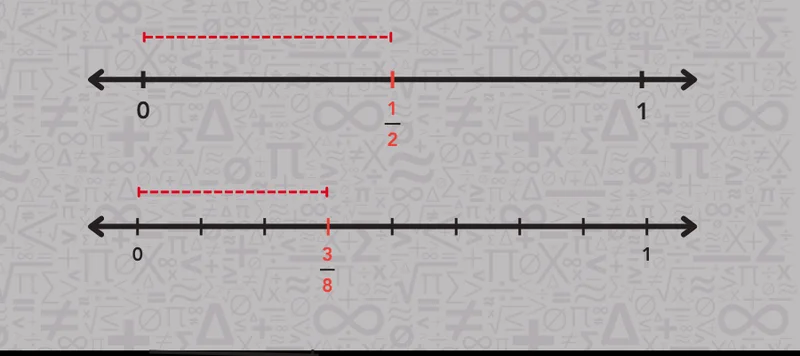
When your child places fractions on a number line, they visualize the value and move toward true fraction sense.
2. Ratios, Rates, and Percents
As our students enter middle-school math, they begin working more systematically with ratios, rates, unit rates, percents, and proportional relationships.
Fortunately, their earlier work with fractions provides important groundwork. After all, a ratio can be written as a fraction, a rate compares two different quantities with distinct units, and a percent represents a quantity out of 100.
But proportional reasoning adds something new. Students must now think about how two quantities change together in tandem.
Now, here is where a student may lose their footing. A student may be able to calculate comfortably with fractions or decimals, but still struggle to determine whether a given situation is truly proportional, find a unit rate, or decide what operation actually makes sense in a word problem.
The challenge moves away from simply completing a calculation and becomes about identifying the underlying relationship first.
The confusion students have around proportional reasoning may look like:
-
Treating every ratio problem as an addition or subtraction problem rather than a multiplicative relationship (e.g., adding 2 to both quantities instead of scaling them up)
-
Mixing up the order of quantities in a ratio or rate, leading to backward answers
-
Using cross-multiplication as a blindly memorized procedure without understanding when it actually applies
-
Struggling to connect a real-world situation to its matching table, graph, equation, or unit rate
How to Guide Your Child Through Proportional Reasoning
If your child struggles with ratios, rates, percents, or proportional word problems, extra worksheets alone may not address the real issue. Before they calculate, help them pause and identify how the two quantities are connected.
-
Ask “What is true for one?” In a problem such as “3 notebooks cost $6,” ask, “How much does one notebook cost?” Have your child find the unit rate first: $2 per notebook. Then they can use that relationship to reason about any number of notebooks.
-
Use a ratio table to make the pattern visible. Instead of jumping straight to cross-multiplication, have your child make two labeled columns. For example, notebooks and cost. Fill in known pairs, then ask, “What happens to the cost when the number of notebooks doubles?” This helps them see whether both quantities change by the same multiplicative factor.
-
Ask for an estimate before the exact answer. If an item costs $4 each, ask whether 10 items should cost closer to $4, $14, or $40. A quick estimate encourages students to think about the relationship and gives them a way to catch unreasonable answers.
-
Have them explain the relationship in words. After solving, prompt: “How would you describe this pattern without using the numbers from the problem?” For example: “The total cost is always two times the number of notebooks.” Saying it aloud connects the context, table, and equation.
📕 You May Also Like: Ratio to Percentage: How to Convert Between the Two
3. The Move From Arithmetic to Algebra
Arithmetic asks students to work with known numbers: add, subtract, multiply, divide, and find a final answer (such as 7 + 8 x 4). A problem may have several steps, but students generally know exactly what the numbers represent and what they are trying to calculate.
Algebra changes that. Students now use variables to stand for unknown or changing quantities, expressions to represent mathematical ideas, and equations to show that two quantities have the same value (such as 3x + 5 = 20).
Instead of only calculating an answer, they may need to describe a pattern, translate a situation into symbols, or determine what value makes an equation true.
That adjustment does not always go smoothly. Students frequently carry over assumptions that worked reliably in arithmetic but do not fully apply in algebra.
Our tutors usually notice a few specific errors:
-
Students see the equals sign as a signal to "write the answer" rather than a balanced statement that both sides hold the exact same value.
-
They may also confuse expressions and equations. For example, they mix up an expression (such as 3x + 5) with an equation (such as 3x + 5 = 20).
-
They combine unlike terms, such as treating 3x + 5 as 8x.
-
They execute equation-solving steps purely by memory without understanding that the exact same operation must always be applied to both sides to keep the balance.
Tips to Build a Solid Algebra Foundation
To help your child build a solid foundation in algebra, focus on meaning before procedures. At Mathnasium of Richardson West, tutors help students understand what variables, expressions, and equations represent before asking them to memorize steps.
Parents can mimic that approach with a few thoughtful exercises:
-
Ask what each symbol means. In 3x + 5 = 20, ask your child what x represents and what the equation says in words. This reinforces that algebra symbols communicate a real relationship.
-
Use a balance analogy for equations. Ask, “If we add 4 to one side of a balance, what must happen to the other side?” Then connect that idea to solving an equation. Whatever operation is used on one side must also be used on the other.
-
Turn simple situations into equations. Say, “You have $12 and earn $5 each week. How could we write the total after w weeks?” Let your child explain why 12 + 5w represents the situation before calculating any value.
-
Sort expressions and equations. Write examples such as 4x - 1, y = 7, and 2a + 3 = 15. Ask your child to sort them into “has an equals sign” and “does not have an equals sign,” then explain what can be done with each type.
These activities help students see algebra as a way to describe patterns and relationships, not just as arithmetic with letters added in.
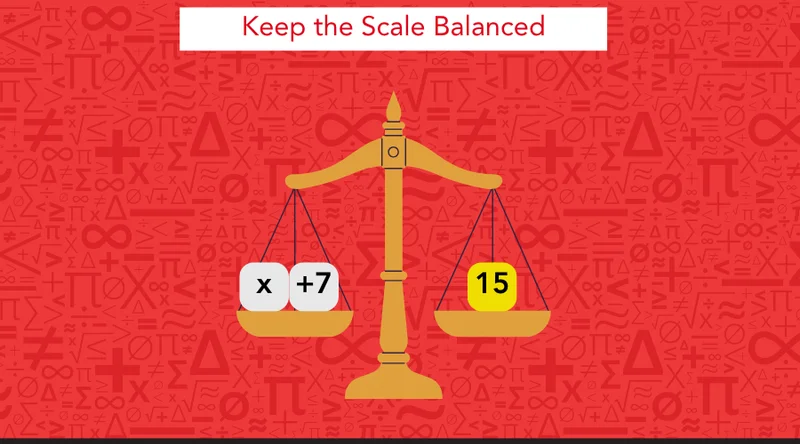
Use the balance scale analogy to show that both sides of an equation must always stay equal.
4. Working With Negative Numbers
Another major change can occur in Grade 6, when Texas math standards extend students’ number knowledge beyond positive numbers. Students are expected to identify opposites and absolute value, locate and compare integers on a number line, and add, subtract, multiply, and divide integers.
Before this point, students have mostly worked with amounts they can count or measure: 6 apples, 10 dollars, or 24 students.
Negative numbers require a different idea. A number can now describe a position below zero, such as a temperature of -4 degrees, a debt of -$15, or a location below sea level. Students must also learn that a number’s value depends entirely on its location relative to zero, not just the size of its digits.
This change can bring predictable confusion. Research on integer operations shows that students often have more difficulty with subtraction than addition, especially in problems involving two negative numbers.
Common difficulties include:
-
Assuming the number with the larger digit is always greater. For example, thinking -9 is greater than -3 because 9 is greater than 3.
-
Confusing the negative sign with the subtraction symbol. In -5 - 3, the first negative sign describes the number itself, while the second symbol tells students to subtract.
-
Memorizing phrases like “two negatives make a positive” without understanding when it actually applies, which often leads students to misuse the rule during addition or subtraction.
How to Make Sense of Negative Numbers
When students struggle with negative numbers, we usually slow down and return to the meaning behind the signs before practicing rules or procedures. You can take a similar approach at home by helping your child connect negative numbers to direction, distance, and everyday situations.
-
Start with a number line. Draw a line with zero in the middle and ask your child to show where -4, 3, and -7 belong. Then ask which is greater and why. This reinforces that numbers farther to the right are greater—even when both numbers are negative.
-
Use a context that shows change. Say: “The temperature is 2 degrees, then drops by 5 degrees. Where does it land?” Have your child start at 2 on the number line and move five spaces left. This connects subtraction to actual movement rather than a blind rule to memorize.
-
Separate the two meanings of the minus sign. In a problem such as -5 - 3, ask your child to circle the negative sign attached to 5 and underline the subtraction sign. One tells them what kind of number -5 is; the other tells them to subtract 3.
-
Ask for a prediction before solving. For -2 - (-5), ask, “Should the answer be to the left or right of -2 on the number line?” A prediction makes students think about the direction and reasonableness of the answer before applying any procedure.
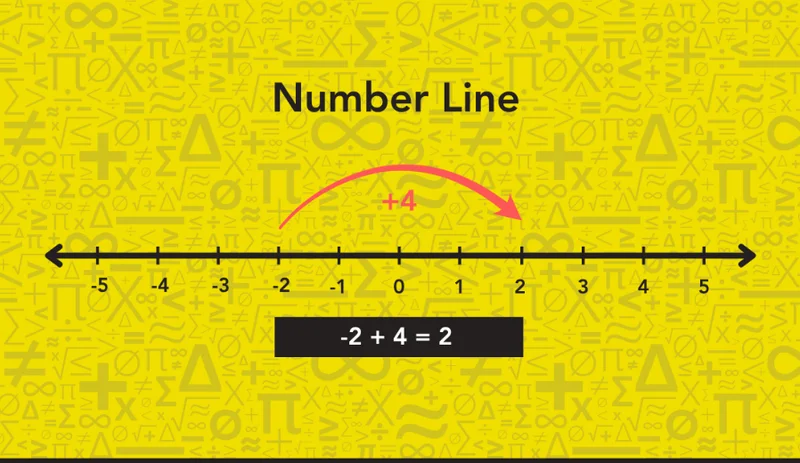
A number line helps students move from abstract rules to visual movement, turning math operations into clear steps they can see.
How Mathnasium of Richardson West Supports Students Through Math Roadblocks
Mathnasium of Richardson West is a math-only learning center based in Richardson, Texas, proudly serving as part of a network of over 1,100 learning centers.
We work with local students of all skill levels, whether they need support rebuilding foundational number sense, keeping up with demanding TEKS curriculum standards, or moving smoothly into advanced math topics.
Our center personalizes each student’s learning experience through the Mathnasium Method™, a proprietary teaching approach designed around individual student needs and learning styles.
Here’s how it works.
Each student begins with a diagnostic assessment that allows us to see their current skills and learning gaps. From there, we build a personalized learning plan tailored to their needs, pace, and goals.
Our specially trained tutors follow the plan closely, delivering face-to-face math instruction in a caring and fun small-group environment.
We teach math for understanding, using natural language and a combination of mental, verbal, visual, tactile, and written techniques.
If a concept feels tricky, we break it down into manageable steps, showing students both the how and the why behind the answer. In time, they develop problem-solving skills and critical thinking tools to use in math and beyond.
Fun is an important part of the Mathnasium Method™. Our activities are often game-based and hands-on. We let students earn their rewards and celebrate each step of progress together, so their confidence grows with each session.
The results speak for themselves:
-
94% of parents report an improvement in their child's math skills and understanding
-
93% of parents report an improved attitude toward math
-
90% of students saw an improvement in their school grades
In addition to over 100 five-star Google reviews, Mathnasium of Richardson West has been recognized by Living Magazine’s Best of Richardson and Murphy Reader’s Choice Awards, including:
Whether your student is looking to catch up, keep up, or get ahead on their math journey, our local team is happy to help!
Start by scheduling a free diagnostic assessment with our center. We’ll use it to create a personalized learning plan for your student and set them on the best path to math mastery.
📅 Schedule a Free Assessment at Mathnasium of Richardson West
Not located near Richardson?
📍 Find a Mathnasium Learning Center Near You


 (972) 231-6284
 (972) 231-6284