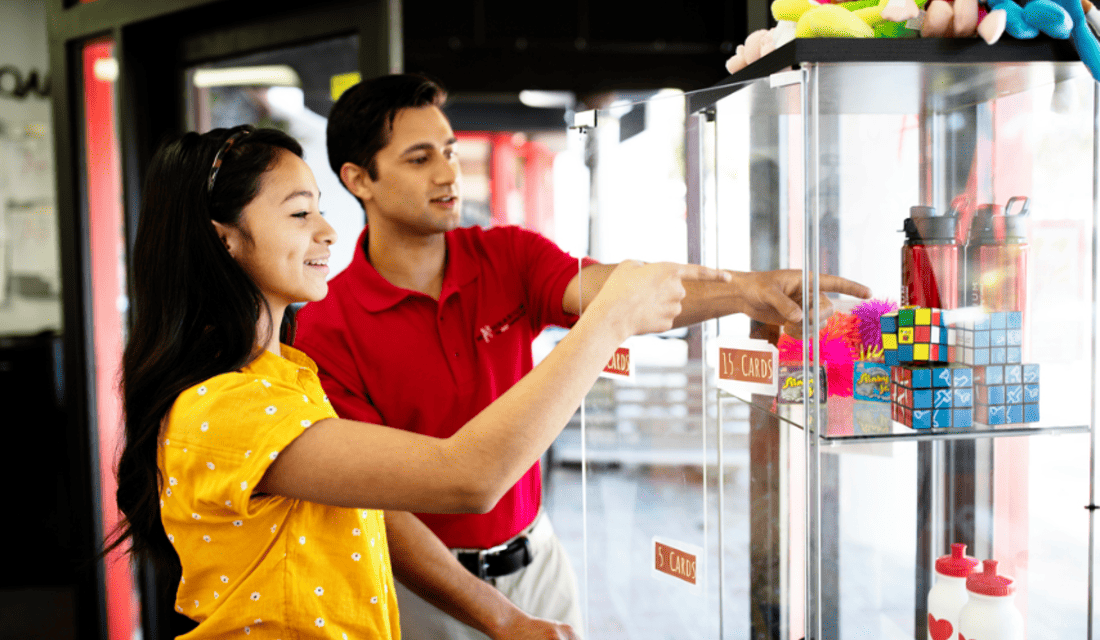
Parents and kids alike may often see math practice as something that happens with worksheets, notebooks, a pencil, and a set time to work. It can feel separate from the rest of the day and, at times, more like a chore than an opportunity to explore.
What if we told you it does not have to be that way? Everyday items and familiar moments can give your child a reason to use math without making home feel like another classroom.
Today, we show you six fun activities that make that same math feel like play at home.
1. Card-Deck Number Challenge
If you are looking for a quick math game before dinner or during a quiet afternoon at home, we recommend a standard deck of cards. Remove the face cards and let Aces count as 1. Before you deal, choose a target number.
Each player receives four cards and tries to reach the number or get as close as possible. For example, if your child draws 6, 4, 3, and 2, they can make 10 with 6 and 4. We also recommend adjusting the difficulty based on your learner’s grade level:
-
Set the target at 10 or 20 if your child is in kindergarten through Grade 2. Keep the first rounds to addition and allow players to use any of their four cards.
-
If they are in Grades 3–5, they can use addition, subtraction, and multiplication with bigger target numbers. Players may use any of their cards.
-
For Grades 6–8, allow all four operations and ask your middle schooler to use every card in their equation once.
-
Your high school student needs to use all four cards in their equation. Allow parentheses, negative numbers, fractions, exponents, or a time limit. For example, if they draw 6, 4, 3, and 2 and the target is 1, they can write 6 − 4 − (3 − 2) = 1.
Ask them to say their equation aloud before claiming the round. As children explain their steps, they practice mathematical reasoning and communication. If they compare different solutions, it shows that a problem can often be solved in more than one way.
A standard deck keeps the challenge unpredictable, so they have to work with the numbers in front of them instead of repeating a method they memorized.
📕 You May Also Like: 5 Fun Math Card Games You Can Play with a Standard Deck
2. Dice Race: Build the Best Number
For this activity, you need one standard six-sided die, paper, and a pencil. Each player draws empty place-value boxes, then rolls one die at a time. After every roll, they must decide where that digit belongs. The moment a digit goes in a box, it stays there.
Let’s say your child’s first roll is 6. They may put it in the hundreds place and hope smaller digits appear later. Or they may save that space and risk rolling a higher number on the next turn. After all the boxes are full, players compare their numbers. The largest number wins the round.
To match your child’s grade, we suggest:
-
For kindergarteners through Grade 2, draw two boxes for tens and ones. Roll twice and build the largest two-digit number. Rolls of 3 and 6 can make 63 or 36.
-
If your child is in Grades 3–5, use three or four boxes to build the greatest or smallest number possible. Ask players to read the completed number aloud before comparing it.
-
For Grades 6–8, draw boxes for ones, tenths, and hundredths. Roll three times and place each digit to make a decimal number as close to 7 as possible without going over. For example, rolls of 6, 2, and 5 could make 6.25, 6.52, or 5.62, where 6.52 is the closest to 7.
-
If you have a high schooler in Grades 9–12, draw this template: a.bc × 10n. Roll four times. Put the first three digits in the first three slots (a, b, or c) to make a decimal between 1 and 10, then use the last roll as the exponent (n). For example, rolls of 6, 2, 5, and 3 make 6.25 × 10³. Players then compare their values to see who built the greatest number.
This game helps children build place-value understanding, compare numbers, and think strategically about how each digit’s position changes its value.
Before players compare their final numbers, ask your child why they placed each digit where they did. If your child puts a 6 in the tens place, they may have a perfectly reasonable explanation, even if another player ends the round with the larger number.
3. Estimate, Check, and Explain
Choose something around the house to estimate before measuring it. Have everyone make a prediction before using a ruler, measuring cup, scale, or timer. For example, you can ask:
Write each estimate down and then test it.
You should not ask for a perfect guess. Your child can learn more from explaining the estimate than from landing on the exact number. They may say, “The pitcher looks like it holds four cups because it is about twice as big as our two-cup measuring cup.” That gives you something to discuss after the measurement.
Estimation helps children build number sense by using familiar units and reference points to judge whether a measurement or answer makes sense. As your child grows, this game can extend from comparing objects to using benchmarks, calculating differences, and analyzing percent error.
-
Start with a simple comparison for kindergarten through Grade 2. Ask your child which object is longer, heavier, or holds more, then check with a ruler, balance scale, or measuring cup.
-
If your child is in Grades 3–5, they can make an estimate for a length, mass, capacity, or amount of time. Have them write their estimate beside the actual measurement and work out the difference.
-
For your middle schooler, add a benchmark before the guess. To estimate the mass of a backpack, for example, they could think about how many full water bottles would weigh about the same. To estimate the height of a wall, they could use the height of a door as a rough guide.
-
Your high school student can calculate percent error, compare several estimates, and decide which strategy produced the closest result.
While a measuring tape can settle the question, the conversation before it comes out is where the game takes shape. Estimation before measuring asks students to think about units, reference points, and reasonable size.
📕 You May Also Like: How Estimation and Rounding Support Number Sense in Math
4. Math Scavenger Hunt
Turn your home into a math scavenger hunt, then take the game outside if you want a change of scenery. Write five math clues before you begin, then see who can find, draw, or photograph each answer first. Keep the clues specific.
For example, a coffee table might count as a rectangle, while a cereal box can represent a rectangular prism. If an answer is not obvious, ask your child to explain why it fits the clue.
-
For kindergarten through Grade 2, write familiar shape and comparison clues, such as “Find three circles,” “Find a rectangle,” or “Find something longer than your hand.” Your child can point to, draw, or photograph each answer.
-
If your learner is in Grades 3–5, ask them to find geometric features or arrays around the house. Try clues such as “Find two parallel lines,” “Find a right angle,” or “Find an array with at least 12 objects.” A window frame may show parallel lines and right angles, while an egg carton or tiled floor can show an array.
-
For your middle schooler, use clues that involve ratios or scale. For example, ask your child to find the ratio of chairs to place settings at the table, or use a map or floor plan to compare a scaled distance with the real space.
-
If you have a high schooler, ask them to measure a rectangular part of a room, building, or sports court and calculate its area. They can also use a map scale to estimate the distance between two places.
 Math scavenger hunt moves math away from paper into places your student already knows and gives them a reason to look closely at spaces they pass through every day.
5. Which One Doesn’t Belong?
Put four math examples on a sheet of paper and ask your child to choose the one that does not belong and explain why. More than one answer can work, as long as they can explain the math rule behind the choice.
In this set (4, 9, 16, 18), for example, your child can choose 18 because it is the only number that is not a perfect square. Or, they can choose 9 because it is the only odd square.
Your child does not need to guess the answer you had in mind. Give them a point when they can explain what the other three numbers have in common and why their choice is different.
Choose the type of set based on the math your child knows:
-
If your child is in Kindergarten through Grade 2, use four familiar shapes or objects. Keep the differences easy to see, such as the number of sides or whether the shape has curved edges.
-
If they are in Grades 3–5, use one type of math per round, such as four whole numbers or four fractions. Look for patterns involving odd and even numbers, multiples, or equivalent fractions.
-
For your middle schooler, try four ratios, coordinates, graphs, or geometric figures. Choose examples your child has already studied.
-
For your high school student, you can use four equations, functions, data displays, or transformations from a current or recent unit.
Let your child share their reasoning before you comment. If their explanation needs more detail, you can ask something like “What do the other three have in common?” That question directs them back to the pattern they noticed without giving them an answer.
📕 You May Also Like: Help Your Child Build Math Confidence Through Patterns
6. Recipe Remix Challenge
Choose a simple recipe that makes a known number of servings, such as four smoothies, four sandwiches, or four pancakes. You do not need to make the food. The recipe simply becomes the math problem.
Write down the original recipe and choose a new number of servings. Then ask your child to adjust every ingredient by the same amount.
For example, a smoothie recipe for 4 people might use 2 cups of milk, 1 cup of yogurt, and 4 bananas.
-
To make 8 servings, your child needs to double each amount to 4 cups of milk, 2 cups of yogurt, and 8 bananas.
-
For 2 servings, they need to halve each amount to 1 cup of milk, \(\Large\frac{1}{2}\) cup of yogurt, and 2 bananas.
Here’s one way to adjust the challenge for your child’s grade level:
-
If they are in kindergarten through Grade 2, use whole-number amounts and ask your child to double or halve a recipe. For example, double 2 bananas to make 4 bananas.
-
If they are in Grades 3–5, include simple fractions. Ask what happens when they double \(\Large\frac{1}{2}\) cup or halve 1 cup.
-
If your child is in middle school, choose a serving size that is not simply double or half. If a recipe serves 4, ask how much is needed for 6 people. Your child must multiply each amount by \(\Large\frac{6}{4}\), or 1\(\Large\frac{1}{2}\).
-
If you have a high schooler, ask them to write a proportion for one ingredient, such as \(\Large\frac{2 cups}{4 servings}\) = \(\Large\frac{x cups}{6 servings}\), then solve for x.
If the number of servings changes, your child must scale every ingredient by the same factor. This preserves the recipe’s ratios and gives children practice with multiplication, division, fractions, ratios, and proportional reasoning.
 At Mathnasium, games are part of how we teach. The Mathnasium Method™ uses hands-on activities to help our students build math skills that last both in the classroom and beyond.
How Mathnasium Makes Math Learning Fun
Mathnasium is a math-only learning center empowering students of all skill levels to excel in math.
Some students come to our centers thinking math isn’t fun. Through our proprietary teaching approach, the Mathnasium Method™, we work to transform how they think and feel about math.
Each student starts with a diagnostic assessment that helps us identify their skills and knowledge gaps and how they naturally think through problems. With those insights, we build a personalized learning plan tailored to their needs and goals.
We phrase math in everyday language instead of heavy jargon, with a mix of verbal, visual, mental, tactile, and written techniques so each concept truly lands.
Our tutors are trained in both math and the emotional side of teaching, so they know how to support a student who feels overwhelmed and how to challenge one who's ready to move ahead.
We also give students room for productive struggle before stepping back in to check their reasoning. That way we teach both the how and the why behind the math so they build critical-thinking skills that carry into future courses and beyond.
Fun is a core part of how we work. Parents often tell us our sessions feel nothing like lectures, and that is by design. We use game-based activities, hands-on materials, and earned rewards, and we celebrate every milestone because confidence grows when progress gets noticed.
Our method brings measurable results:
-
94% of parents report an improvement in their child's math skills and understanding
-
93% of parents report their child's improved attitude toward math after attending Mathnasium
-
90% of students saw an improvement in their school grades
With over 1,100 centers, Mathnasium brings top-rated instruction close to your home.
For families in Westminster and Broomfield, Mathnasium of South Westminster is a trusted center with years of experience transforming how children think and feel about math.
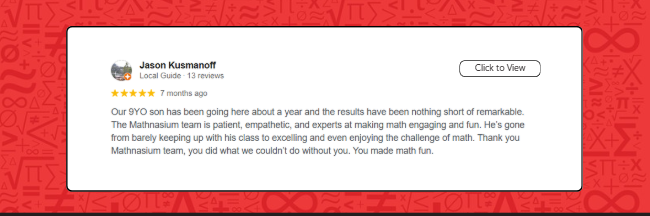
Here is what one parent had to say about their child's experience at Mathnasium:
Ready to get started?
📅 Schedule a Free Diagnostic Assessment at Mathnasium of South Westminster
Not near South Westminster?
📍 Find Mathnasium Learning Centers Near You


 (720) 524-4533
 (720) 524-4533