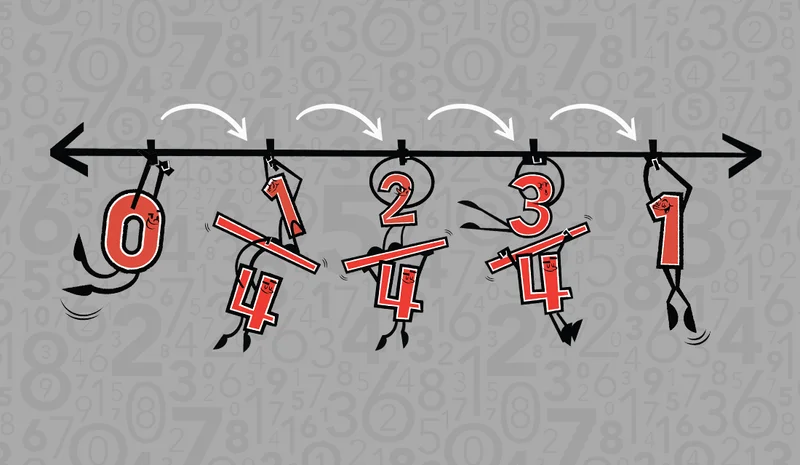
Fractions can trip up even the most confident math students because the jump from counting whole things to understanding parts of a whole is a big one. That's exactly where a visual can make all the difference.
We love number lines here at Mathnasium. And today, we'll show you why.
Our tutors will walk you through what a fraction on a number line is, why it helps you understand fractions more deeply, how to plot them, and give you a chance to try it yourself.

What Do We Mean By a Fraction on a Number Line?
A fraction on a number line is a fraction we plot as a point on a number line.
Just like whole numbers have their own place on the line, fractions do too. They sit between the whole numbers, marking parts of the distance between them.
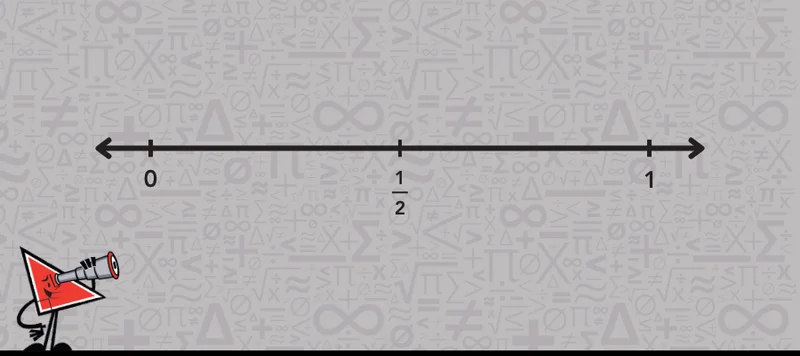
If we have a number line that goes from 0 to 1, where do we place \(\Large\frac{1}{2}\)?
Exactly halfway between 0 and 1, like so:
Why Do We Place Fractions on a Number Line?
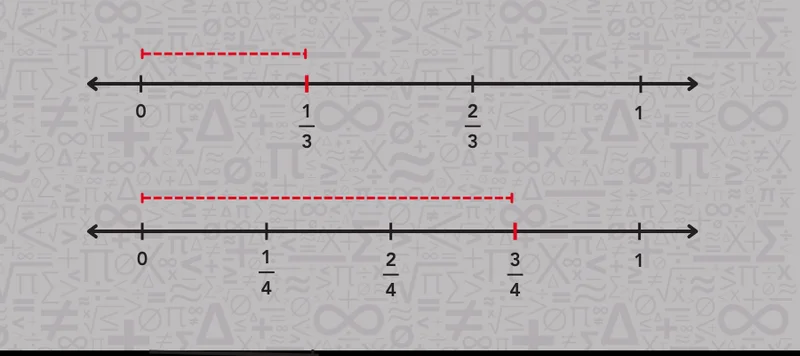
Putting fractions on a number line helps us:
-
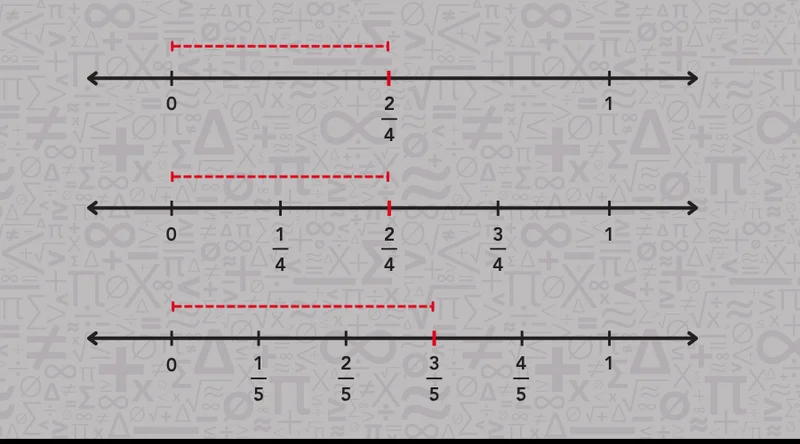
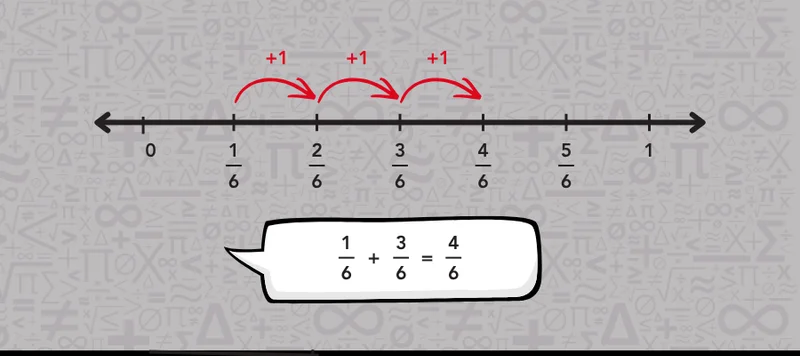
Compare and order: Lining up fractions like \(\Large\frac{1}{2}\), \(\Large\frac{2}{4}\), and \(\Large\frac{3}{5}\) on the same number line makes it easy for us to spot which are equivalent and which are further apart.
📕 You May Also Like: How to Compare Fractions? A Kid-Friendly Guide
How to Plot Fractions on a Number Line
Every fraction type has its own approach, but they all start the same way: we draw a number line and divide it into equal parts based on the denominator.
Working with fifths? We divide into 5 equal parts.
Working with eighths? We divide into 8.
From there, the approach varies slightly depending on the type of fraction. Let's go through each one.
Proper Fractions on a Number Line
A proper fraction is one where the numerator is smaller than the denominator, like \(\Large\frac{3}{5}\) or \(\Large\frac{2}{7}\). That means it always sits between 0 and 1 on the number line.
Here's how we plot one. Let's use \(\Large\frac{3}{5}\).
The denominator is 5, so we divide the space between 0 and 1 into 5 equal parts.
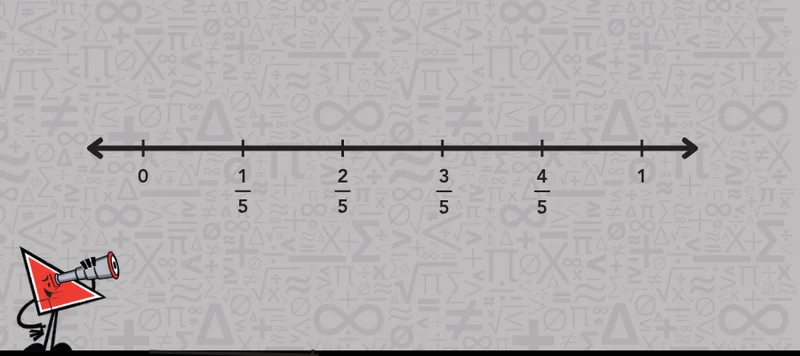
Now we count 3 parts from 0 and place our point there.
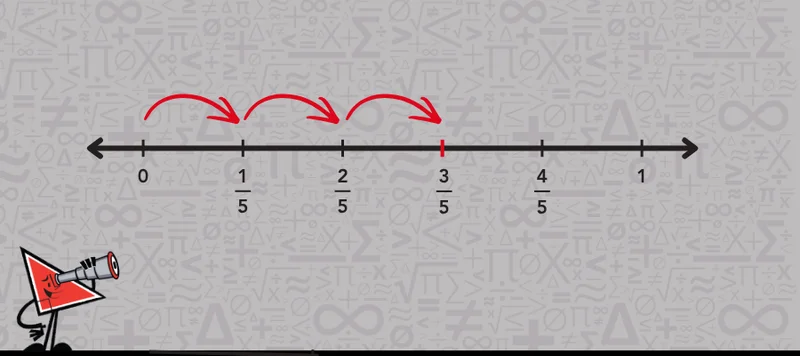
Every proper fraction works the same way: divide by the denominator, count to the numerator, mark the point. Simple as that!
Equivalent Fractions on a Number Line
Equivalent fractions are fractions that look different but have the same value, like 23 and 46. On a number line, they land on the exact same point.
Here's how we show that. Let's plot both \(\Large\frac{2}{3}\) and \(\Large\frac{4}{6}\) on the number line.
First, we draw two number lines from 0 to 1, one divided into 3 equal parts, one into 6.
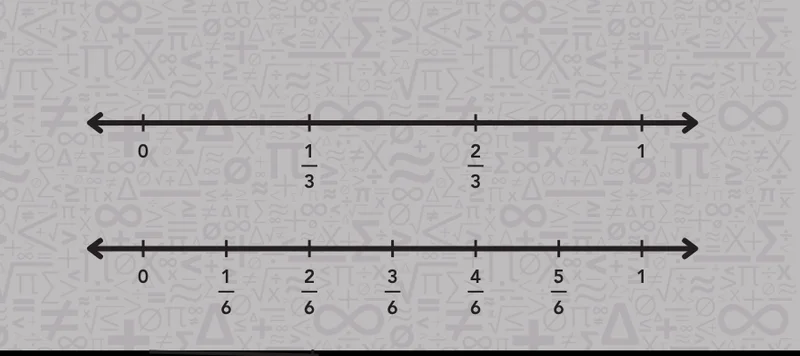
Now we count to \(\Large\frac{2}{3}\) on the top line and \(\Large\frac{4}{6}\) on the bottom line and mark both points.
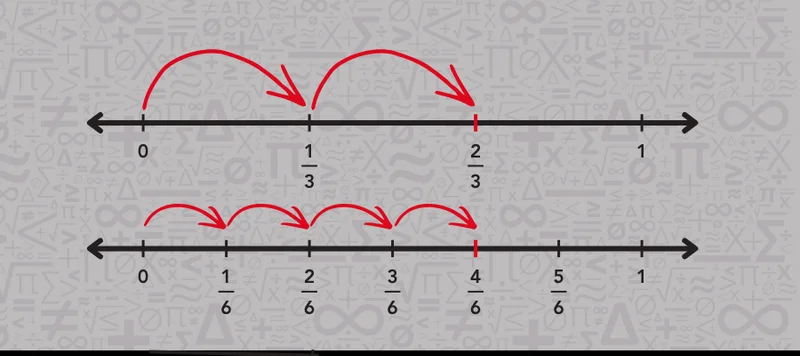
The number line confirms it for us. Same point, same value, just written two different ways.
Improper Fractions on a Number Line
Now this is where it gets even more interesting.
An improper fraction is one where the numerator is larger than the denominator, such as \(\Large\frac{7}{4}\) or \(\Large\frac{5}{3}\). That means it sits beyond 1 on the number line, somewhere between two whole numbers.
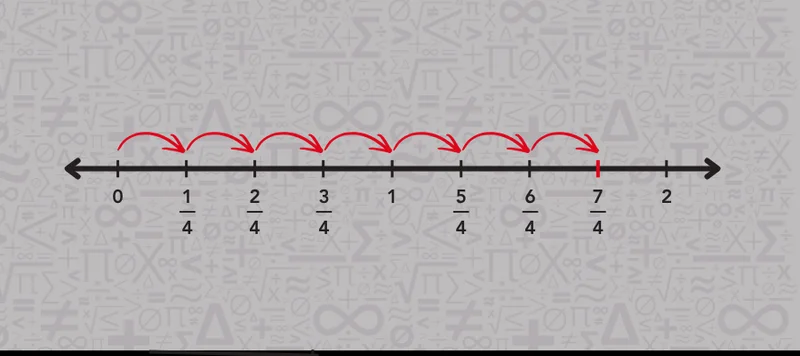
With that in mind, let’s plot \(\Large\frac{7}{4}\).
The denominator is 4. That tells us how many equal parts to create between 0 and 1. But \(\Large\frac{7}{4}\) is bigger than 1, so our number line needs to go further. We'll draw it from 0 to 2 (\(\Large\frac{8}{4}\)).
Now, just like we divide the space between 0 and 1 into 4 equal parts, we do the same for the space between 1 and 2. The parts just keep counting up from where we left off.
-
Between 0 and 1: \(\Large\frac{1}{4}\), \(\Large\frac{2}{4}\), \(\Large\frac{3}{4}\), 1
-
Between 1 and 2: \(\Large\frac{5}{4}\), \(\Large\frac{6}{4}\), \(\Large\frac{7}{4}\), 2
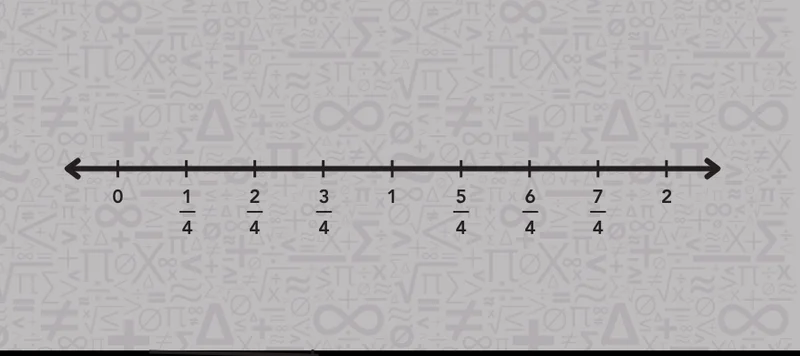
Now we count 7 parts from 0 and place our point there.
Mixed Fractions on a Number Line
A mixed fraction combines a whole number and a proper fraction, such as \(2\Large\frac{1}{3}\) or \(1\Large\frac{3}{4}\). On the number line, it sits between two whole numbers, with the whole number telling us which interval and the fraction telling us how far into it.
Makes sense? Great!
Shall we put \(2\Large\frac{1}{3}\) on a number line now?
The whole number is 2, so we know our point sits somewhere between 2 and 3. The fraction is \(\Large\frac{1}{3}\), which means we divide that interval into 3 equal parts and count 1 part in.
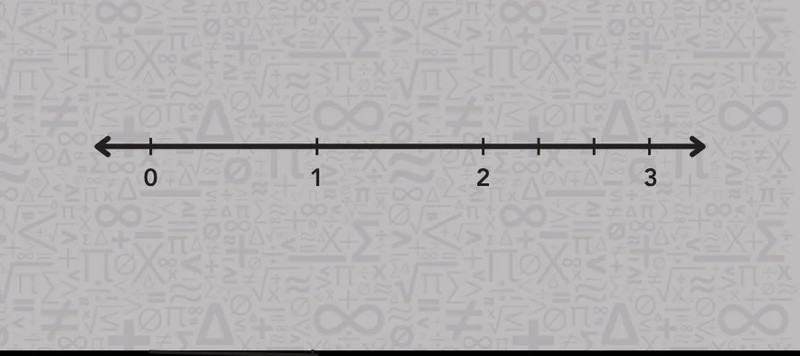
Now we count 1 part past 2 and place our point there. That's where \(2\Large\frac{1}{3}\) lives.
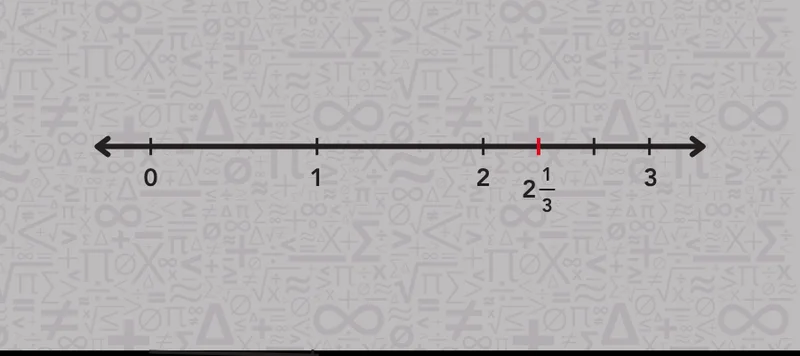
And that’s how we do it. Not so scary, right?
📕 You May Also Like: Types of Fractions—A Comprehensive, Beginner-Friendly Guide
Your Turn: Can You Represent These Fractions on a Number Line?
Proper, equivalent, improper, mixed—you've seen them all. Time to try a few on your own.
Work through these challenges and when you’re done, check your answers at the bottom of our guide.
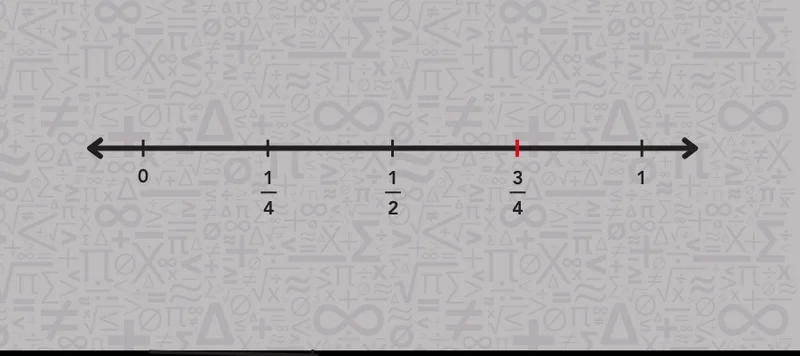
Challenge 1: Plot \(\Large\frac{3}{4}\) on a number line.
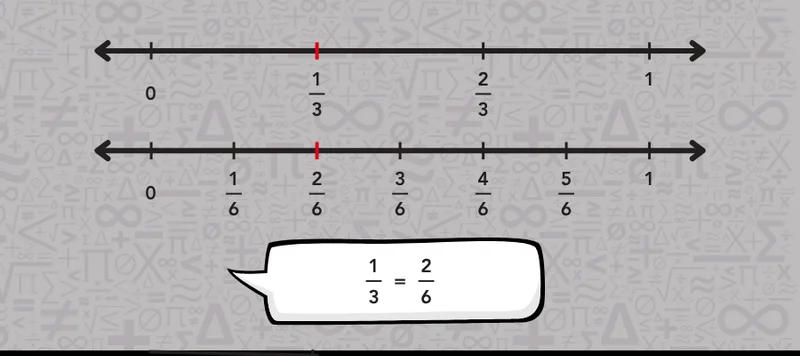
Challenge 2: Check whether that \(\Large\frac{1}{3}\) and \(\Large\frac{2}{6}\) are equivalent on a number line.
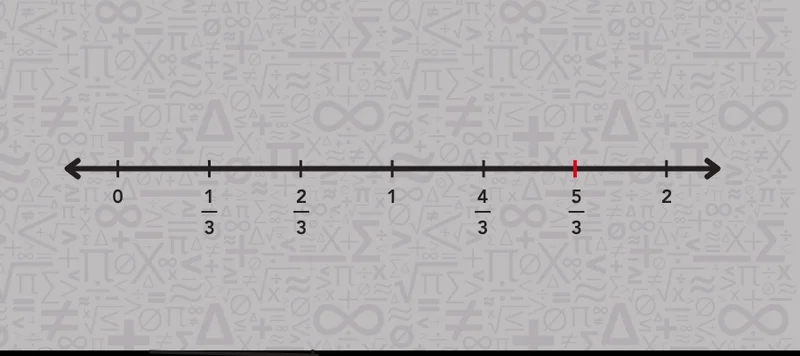
Challenge 3: Plot \(\Large\frac{5}{3}\) on a number line.
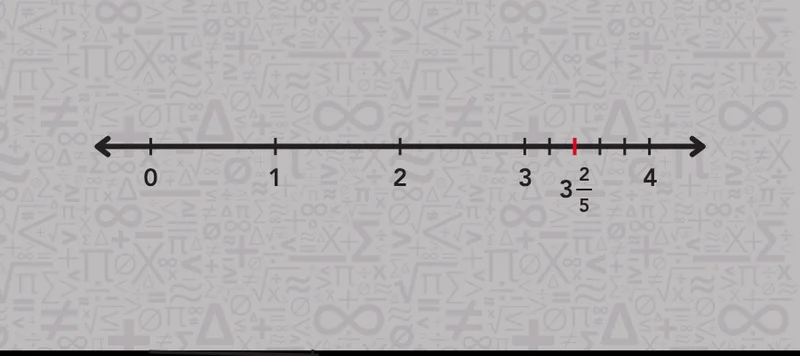
Challenge 4: Plot \(\Large3\frac{2}{5}\) on a number line.
📕 You May Also Like: How Number Lines Improve Math Understanding in Grades 1 Through 5
FAQs About Fractions on a Number Line
Fractions on a number line clear up a lot of confusion, but they tend to spark a few questions of their own. Here are the ones we hear most at our centers, with clear answers to put any lingering doubts to rest.
1. When do students first learn to represent fractions on a number line?
Most students are introduced to fractions on a number line in 3rd grade, when they begin working with unit fractions like \(\Large\frac{1}{2}\), \(\Large\frac{1}{3}\), and \(\Large\frac{1}{4}\). From there, the concept builds through 4th and 5th grade as students work with more complex fractions, equivalence, and eventually improper fractions and mixed numbers.
2. Can we use a number line to compare fractions with different denominators?
Yes. We draw two number lines of the same length, divide one according to the first fraction's denominator and the other according to the second fraction's denominator, then plot both fractions and compare their positions. The one sitting further to the right is the greater fraction.
3. What happens if the denominator is 1?
A fraction with a denominator of 1 is just a whole number in disguise. \(\Large\frac{4}{1}\) is simply 4, and on the number line, it lands exactly on the whole number 4. Dividing by 1 doesn't create any parts; the numerator is the whole thing.

Mathnasium uses personalized learning plans and proven teaching techniques to help students build a deep understanding of any math concept, including fractions.
How Mathnasium Helps Students Master Any Concept
Mathnasium is a math-only learning center empowering K-12 students of all skill levels to learn and master math.
Fractions are one of the most common topics students come to us for support with, and for good reason. They span multiple grade levels, build on each other, and lay the groundwork for more advanced math down the road.
When students need that support, we build a personalized path forward that helps each one work through their challenges at their own pace, strengthen their foundation, and develop the confidence that carries them through every math concept that follows.
Behind each program at Mathnasium is a proprietary teaching approach called the Mathnasium Method™.
The approach begins with a diagnostic assessment, which helps us determine what a student already knows and where they need support. Using these insights, we create a learning plan customized to their needs.
With the plan in place, our specially trained tutors follow it closely, providing face-to-face instruction in a supportive and fun environment.
During sessions, we use a thoughtful balance of Socratic questioning and direct teaching, along with visual, verbal, mental, tactile, and written techniques, so students can see the math from different angles and truly make sense of what they're learning.
Whenever students feel stuck, we break concepts into manageable steps and explain both the how and the why behind each solution, building the problem-solving skills and critical thinking they can use in math and beyond.
And fun plays a big part in our approach. Our activities are often game-based and hands-on, and we celebrate every step of progress students make, growing their confidence with every session.
The results speak volumes:
-
94% of parents report an improvement in their child's math skills and understanding
-
93% of parents report an improved attitude towards math after attending Mathnasium
-
90% of students saw an improvement in their school grades
Whether your student is looking to catch up, keep up, or get ahead in math, your local Mathnasium center can help. Start by booking a diagnostic assessment, and together we'll create a personalized plan for math mastery.

Pssst! Check Your Answers Here
Done with the challenges? Check how you did below.
Challenge 1: Plot \(\Large\frac{3}{4}\) on a number line.
Challenge 2: Check whether that \(\Large\frac{1}{3}\) and \(\Large\frac{2}{6}\) are equivalent on a number line.
Challenge 3: Plot \(\Large\frac{5}{3}\) on a number line.
Challenge 4: Plot \(\Large3\frac{2}{5}\) on a number line.


 (702) 248-8887