Students work closely with circles and pi in Grade 7, when they meet circumference and circle area problems.
π and circle math show up in objects we see every day, such as tires, clocks, pizzas, and Ferris wheels. Each one is secretly a circle problem waiting to be solved. So, these ideas can feel different and much more approachable once real measurements and real objects are involved.
Today, we’ll look at several everyday objects and use circle math to answer a specific question about each one.

Quick Review of the Circumference of the Circle and Circle Area
Before we apply circle math to real objects, let’s refresh the geometry concepts we’ll use today.
What Is the Circumference of a Circle
Circumference is the distance all the way around a circle, in other words, its perimeter. We write it as C. One way to picture circumference is to imagine peeling the edge off a circle and laying it flat as a straight line. That line would show the full distance around the circle.
To find the circumference, we use the relationship between the distance around the circle and the distance across it.
The distance across a circle through its center is called the diameter. We write it as d. For every circle, the circumference is always a little more than 3 times the diameter, whether the circle is as small as a coin or as large as a Ferris wheel.
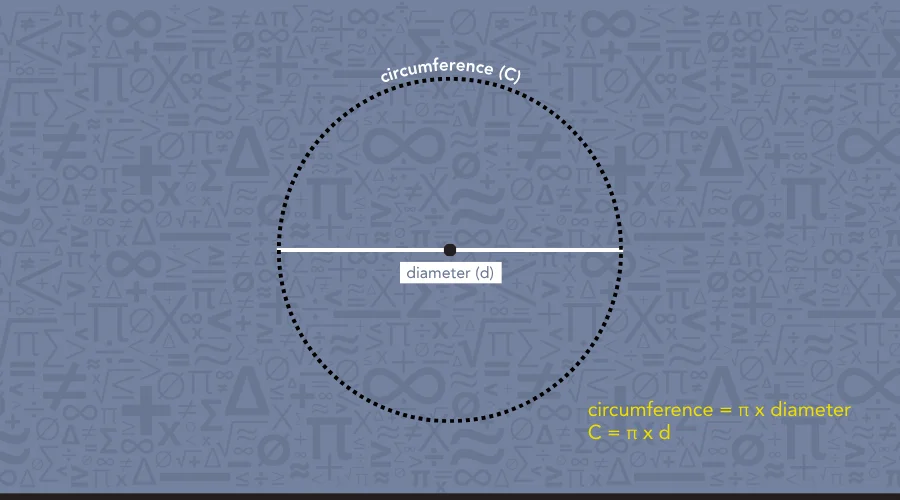
We write that relationship like this:
C ÷ d = π
π is approximately 3.14. That means the distance around a circle is about 3.14 times as long as the distance across it. From that relationship, we get the circumference formula:
C = πd
Sometimes a problem gives us the radius instead of the diameter, the distance from the center to the edge. We write it as r.
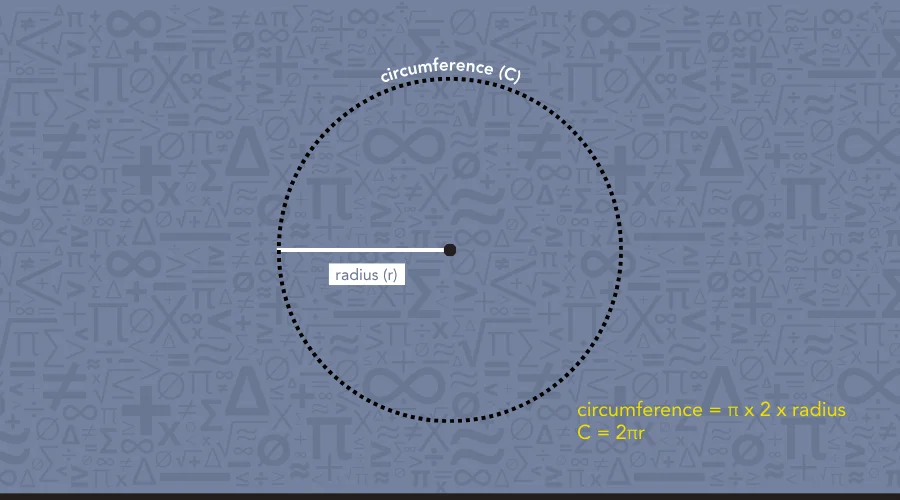
Since the diameter goes all the way across through the center, it is always twice the radius: d = 2r. Substituting:
C = 2πr
We use C = πd when we know the diameter. We use C = 2πr when we know the radius.
📕 You May Also Like: 7 Amazing Facts About Pi Every Math Student Should Know
What Is the Area of a Circle
Area of a circle is the amount of flat space inside a circle, we write it as A.
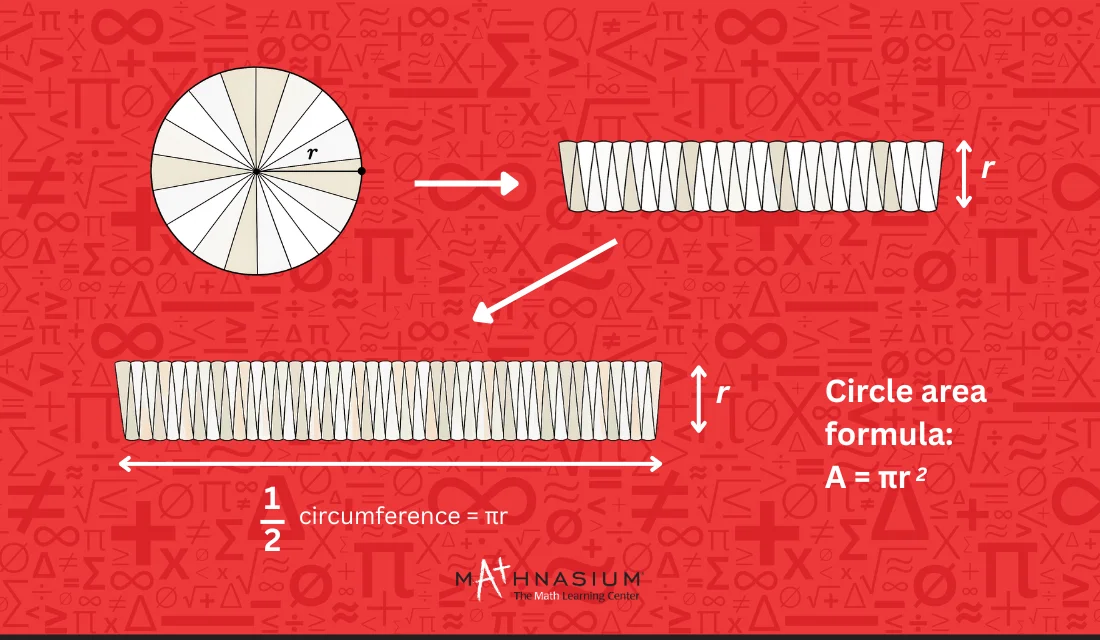
Let’s figure out how to calculate the area of a circle. Picture the circle cut into many thin wedges, like very narrow pizza slices. Rearrange those wedges side by side, alternating point-up and point-down. The shape starts to look like a rectangle.
The thinner the wedges, the closer it gets to a true rectangle. The height of that rectangle is the radius r. The length comes from half the circle’s circumference, because the wedges are split between the top and bottom edges of the new shape. Half of C = 2πr is πr. So:
-
Area = length × height
-
A = πr × r = πr²
-
The area of a circle is:
-
A = πr²
📕 You May Also Like: Perimeter vs. Area: How to Teach the Difference at Home
Tires: How Many Times Does a Wheel Spin on a Road Trip?
Let’s see how circumference and circle area formulas work in the real world. We’ll start with finding out how many times a car wheel spins on a road trip.
Each time a car moves forward, its tires rotate. With one full rotation, a tire rolls forward exactly one circumference. That means the circumference tells us the distance the car travels each time the tire turns once.
To find how many rotations the tire makes over a longer distance, we can compare the total distance traveled to the distance from one tire rotation. Let’s say the tire has a diameter of 25 inches.
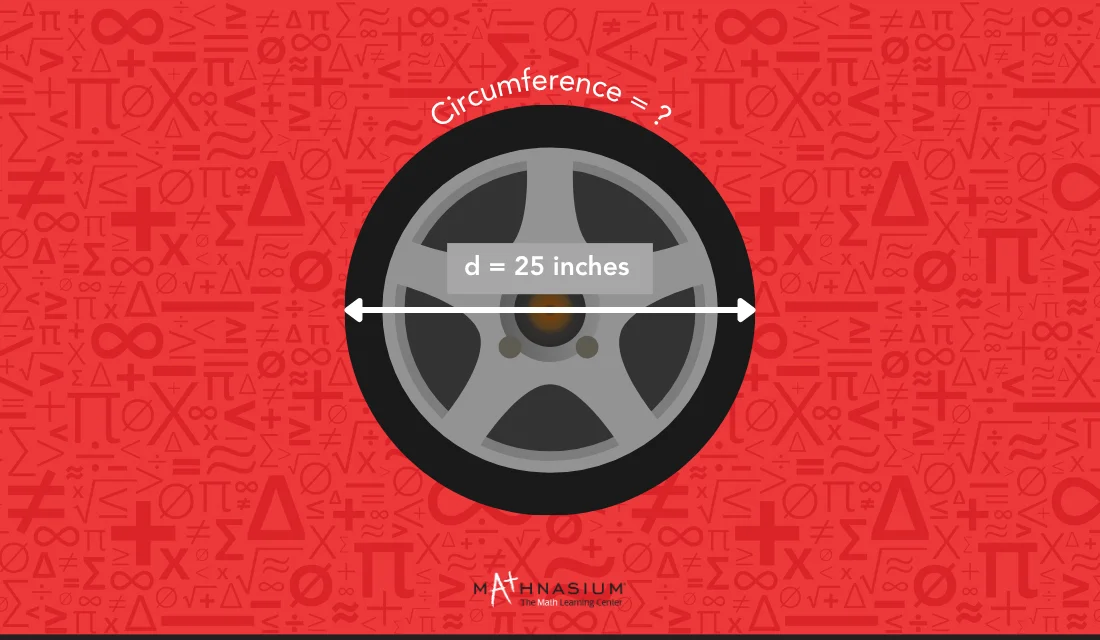
Step 1: Find the Circumference of the Tire
The circumference tells us how far the tire rolls in one full rotation.
-
C = πd
-
C ≈ 3.14 × 25
-
C ≈ 78.5 inches
So, with each full rotation, the tire moves the car forward 78.5 inches.
Step 2: Convert Inches to Feet
We need to convert inches to feet so our units match the miles we’ll use later. There are 12 inches in 1 foot, so we divide by 12:
78.5 ÷ 12 ≈ 6.54 feet
Each full rotation moves the car about 6.54 feet.
Step 3: Find How Many Rotations Happen in 1 Mile
There are 5,280 feet in 1 mile. To find the number of rotations, we divide the total travel distance by the distance from one rotation:
5,280 ÷ 6.54 ≈ 807
So, a tire with a 25-inch diameter makes about 807 full rotations per mile.
A single tire rotates more than 800 times in just one mile. On a 10-mile drive, which is a short trip in many parts of our home state of Georgia and across the country, that is more than 8,000 rotations for each tire.
That is why we usually measure tire wear in miles instead of years. Every mile adds hundreds of rotations, which add up quickly.
Clocks: How Far Does the Minute Hand Travel?
We can use the circle math to find out how far the tip of the minute hand travels. The minute hand on an analog clock moves in a full circle every 60 minutes. The tip of the hand does not move in a straight line. It travels around the edge of an invisible circle.
Let’s use a typical classroom wall clock. Suppose the minute hand is about 5 inches long. The hand starts at the center of the clock and reaches out to the edge of the circle it traces, so the length of the hand is the radius. That means the tip of the minute hand traces a circle with a radius of 5 inches.
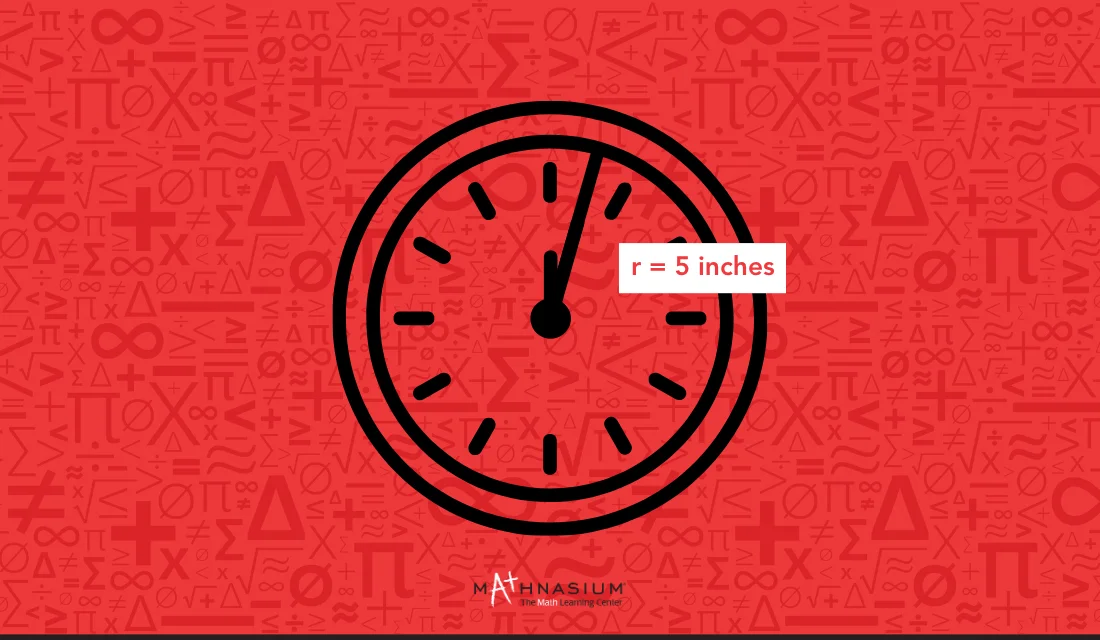
Now, we’ll apply the circle math to answer our question.
Step 1: Find the Distance Traveled in One Full Rotation
The tip of the minute hand traces a circle, so we need the circumference. The radius is 5 inches, so we use:
-
C = 2πr
-
C ≈ 2 × 3.14 × 5
-
C ≈ 31.4 inches
So, in one hour, the tip of the minute hand travels 31.4 inches around the clock.
Step 2: Find the Distance Traveled in a 6-Hour School Day
The minute hand makes one full rotation each hour. In 6 hours, it makes 6 full rotations.
31.4 × 6 ≈ 188.4 inches
Now we convert inches to feet. There are 12 inches in 1 foot, that gives us:
188.4 ÷ 12 ≈ 15.7 feet
So, during a 6-hour school day, the tip of the minute hand travels about 15.7 feet.
Step 3: Find the Distance Traveled in a Full 24-Hour Day
In 24 hours, the minute hand makes 24 full rotations: 31.4 × 24 ≈ 753.6 inches.
Now we convert inches to feet: 753.6 ÷ 12 ≈ 62.8 feet.
So, in one full day, the tip of the minute hand travels about 63 feet, just by tracing the same small circle again and again.
Over a full year, that distance adds up: 63 × 365 ≈ 22,995 feet. That is about 23,000 feet, or roughly 4.3 miles.
But that distance depends on the length of a minute hand. A longer minute hand creates a larger circle, and a larger circle has a greater distance around it. Since the tip of the hand travels one full circumference every hour, even a small change in radius changes the distance traveled each day.
📕 You May Also Like: 9 Ways Analog Clocks Teach Both Time and Fractions
Pizza: Why the Large One May Be the Better Deal
Imagine you and your friends are deciding between two medium pizzas and one large pizza, and you're trying to figure out which one gives you more to eat for the money. Looking at the price helps, but it doesn’t tell you how much pizza you’re actually getting. Let’s use two common pizza sizes in the U.S.:
To compare them, we need to find the area of each pizza. The area shows how much surface each pizza has, which helps us compare how much pizza we get in each size.
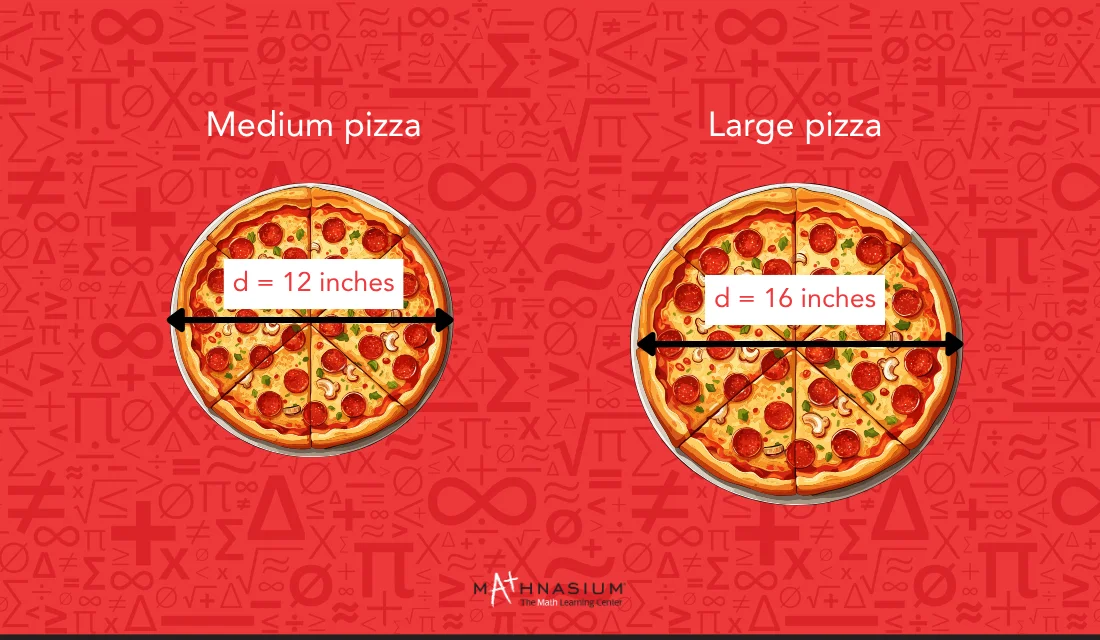
Let’s find the area of medium and large pizzas:
Step 1: Find the Area of a Medium Pizza
A medium pizza has a 12-inch diameter. The radius is half the diameter, so: 12 ÷ 2 = 6. The radius is 6 inches. Now we can find the area:
-
A = πr²
-
A ≈ 3.14 × 6²
-
A ≈ 3.14 × 36
-
A ≈ 113.04
So the medium pizza has an area of about 113 square inches.
Step 2: Calculate the Area of Large Pizza
Now let’s find the area of the large pizza. A large pizza has a 16-inch diameter. The radius is half the diameter, so: 16 ÷ 2 = 8. The radius is 8 inches. Now we use the same area calculation:
-
A = πr²
-
A ≈ 3.14 × 8²
-
A ≈ 3.14 × 64
-
A ≈ 200.96
So the large pizza has an area of about 201 square inches.
Step 3: Compare the Two Areas: Medium vs. Large Pizza
The large pizza has about 201 square inches of pizza, while the medium pizza has about 113 square inches. To find how much more pizza the large gives us, we compare the difference to the medium pizza:
201 − 113 ≈ 88
So the large pizza gives about 88 more square inches of pizza.
Two medium pizzas would give about 226 square inches, which is more than one large pizza. But to decide which option gives better value, we also need to compare the prices. If one large pizza costs much less than two medium pizzas, the large pizza usually gives more pizza for the money.

Mathnasium tutors use hands-on activities and other teaching techniques to help students connect geometry concepts like circumference and circle area to real-life examples.
How Mathnasium Helps Students Understand Circles, Pi, and Other Math Concepts
Mathnasium is a math-only learning center dedicated to helping K–12 students of all skill levels excel in math.
As students work with circles and pi, they begin to see how the same math can describe many real-world situations: wheels, clocks, pizzas, Ferris wheels, and more. Whether they are finding a circumference with C = πd or an area with A = πr², students need to understand what the formula means and when to use it.
To help them build a deep understanding of circle formulas and any other math concept, we use our proprietary teaching approach, the Mathnasium Method™, designed to promote math mastery.
Each student begins with a diagnostic assessment that helps us identify their current skills, knowledge gaps, and how they think about math. From there, we build a personalized learning plan tailored to their specific needs.
Our specially trained tutors deliver face-to-face instruction in a caring and fun group environment, both in-center and online, using a mix of verbal, visual, written, tactile, and mental techniques so each concept lands clearly.
The impact is clear in the results:
-
94% of parents report improvement in their child’s math skills and understanding
-
93% of parents report a more positive attitude toward math after attending Mathnasium
-
90% of students saw improvement in their school grades
With over 1,100 learning centers across North America, there is likely a Mathnasium close to you.
For families in Suwanee and the surrounding communities, Mathnasium of Suwanee brings that same approach close to home, with specially trained tutors who help students make sense of circle math, geometry, and the math topics that come next.
If circle formulas, pi, or any part of your child’s math foundation needs targeted support, our team is ready to help.
📅 Schedule a Free Assessment at Mathnasium of Suwanee
Not near Suwanee?
📍 Find a Mathnasium Learning Center Near You


 (770) 273-9697