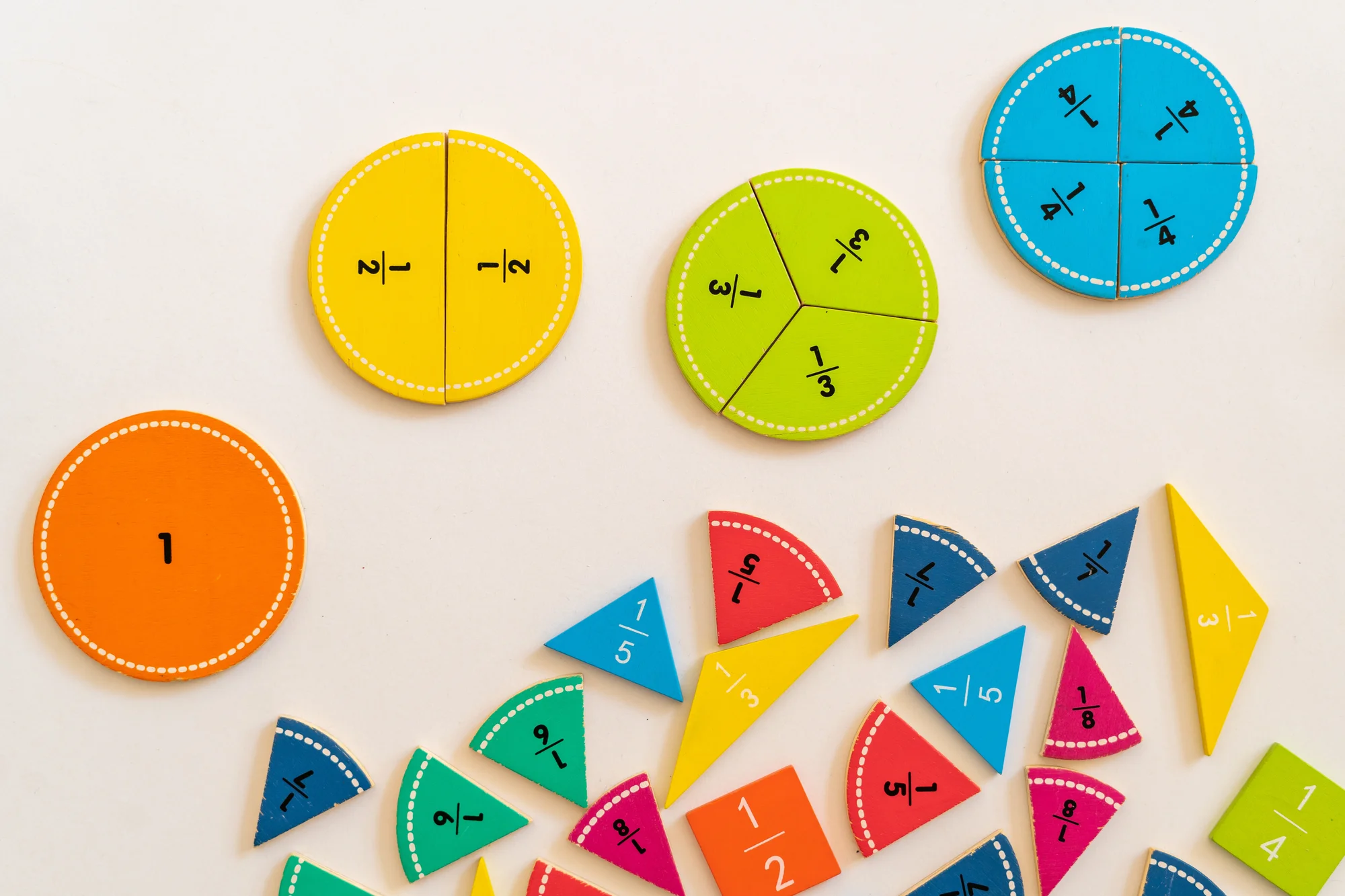
When students learn to compare fractions, the first instinct is almost always to find a common denominator. That is the standard procedural method, and it always works!
However, building a deep understanding of how fraction comparison works takes more than just one tool. It helps to have a few extra aces up our sleeve.
That’s why today, our tutors at Mathnasium of Teaneck have put together three additional ways to compare fractions, no common denominators required.

Quick Review: What Is a Fraction?
A fraction is a part of a whole, showing how a number or an object has been split into equal pieces.
Let's ground this with a simple example. Imagine we break a chocolate bar into 6 equal squares. If we give 5 of those squares to a friend, we have given away 5 parts out of the 6 available.
We write this as \(\Large\frac{5}{6}\).
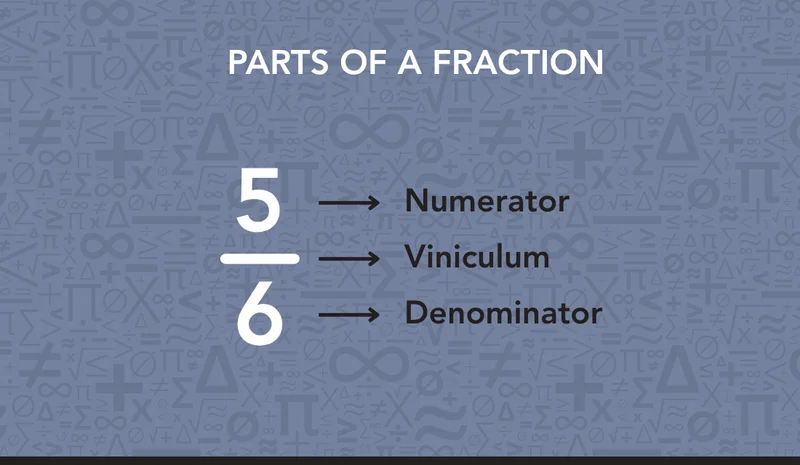
The fraction is made of:
-
Numerator: the top number, telling us how many equal parts we have
-
Denominator: the bottom number, telling us how many equal parts make up the whole
-
Vinculum: the line separating the two numbers that represents division
📕 You May Also Like: 7 Tips to Help Your Child Build Solid Fraction Understanding
3 Different Methods for Comparing Fractions
Our Mathnasium tutors use a few different methods to compare fractions without finding a common denominator first.
Each one fits a different kind of fraction pair, and knowing more than one helps us build number sense instead of just memorizing a single approach.
Let's put those methods to work.
1. Visualizing Fractions with Fraction Bars
A fraction bar is a rectangle split into equal sections, with some of those sections shaded in to represent a fraction.
Since we draw every fraction bar the same size, we can line two of them up side by side and see right away which fraction takes up more space.
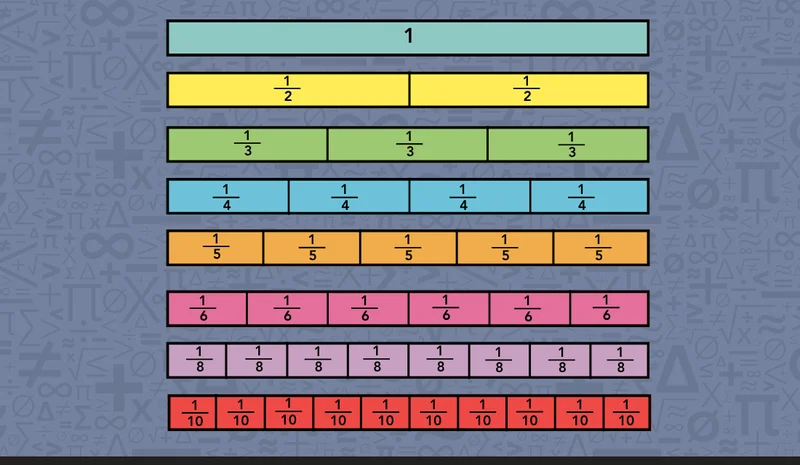
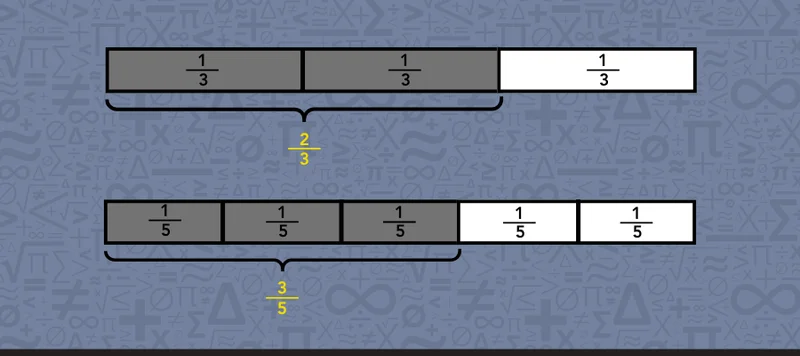
Let's compare \(\Large\frac{3}{5}\) and \(\Large\frac{2}{3}\).
First, we draw two identical bars. Then we split the first bar into 5 equal sections and shade in 3 of them, showing \(\Large\frac{3}{5}\). We split the second bar into 3 equal sections and shade in 2 of them, showing \(\Large\frac{2}{3}\).
Since both bars are the same length, we can compare the shaded portions directly.
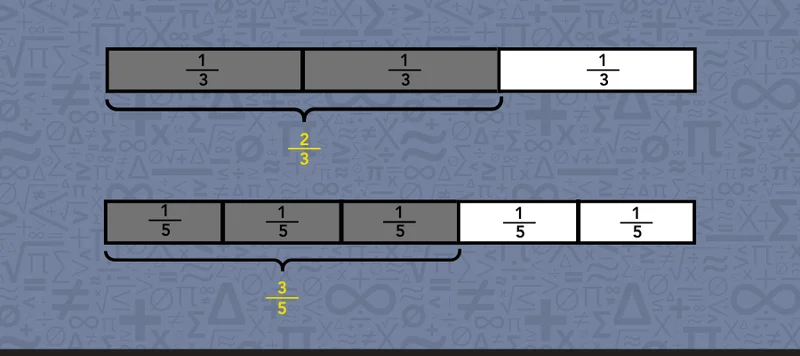
As we can see, the shading on the \(\Large\frac{2}{3}\) bar covers more of the bar than the shading on the \(\Large\frac{3}{5}\) bar.
That means that \(\Large\frac{2}{3}\) is greater than \(\Large\frac{3}{5}\).
\(\Large\frac{2}{3}\) > \(\Large\frac{3}{5}\)
Let's try one more, this time with \(\Large\frac{3}{4}\) and \(\Large\frac{5}{8}\). Which one will end up covering more of its bar?
This time, our first bar gets cut into 4 sections, with 3 shaded in for \(\Large\frac{3}{4}\). Our second bar gets cut into 8 sections instead, with 5 of them shaded for \(\Large\frac{5}{8}\).
Once both bars are shaded, we look at them side by side.
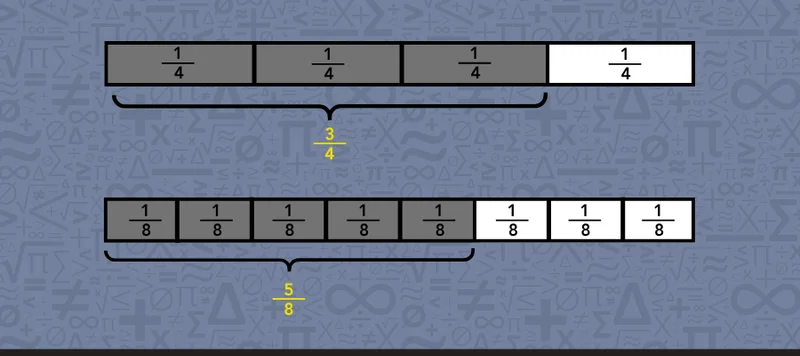
The \(\Large\frac{3}{4}\) bar ends up with more of its length covered.
Which means that \(\Large\frac{3}{4}\) is greater than \(\Large\frac{5}{8}\).
\(\Large\frac{3}{4}\) > \(\Large\frac{5}{8}\)

2. Benchmark Fractions and the Number Line
A benchmark fraction is a familiar reference point used to compare and position other fractions on a number line.
The most useful benchmark fraction is \(\Large\frac{1}{2}\), as it lies right in the middle between 0 and 1. The fractions we are comparing can fall directly on it, or to its left or right. As we determine where a fraction lands, it makes it much easier to compare them.
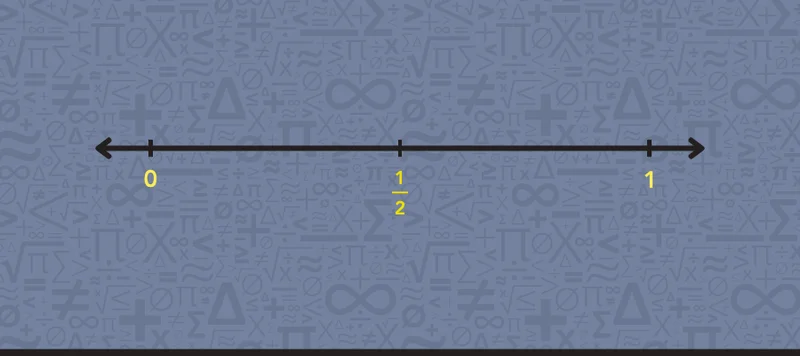
Let's look at \(\Large\frac{1}{8}\) and \(\Large\frac{5}{9}\).
To see where these fractions land, we test them against our \(\Large\frac{1}{2}\) benchmark. First, look at the denominator (the bottom number) to see how many total parts make up our whole, and we find its halfway mark.
Then, we compare that to our numerator (the top number):
-
If our numerator is less than half the denominator, we know our fraction is less than \(\Large\frac{1}{2}\). So we place it to the left of our benchmark.
-
If our numerator is greater than half the denominator, we know our fraction is greater than \(\Large\frac{1}{2}\). So we place it to the right of our benchmark.
-
If our numerator is exactly half the denominator, we place our fraction directly on \(\Large\frac{1}{2}\).
Let's test our fractions together:
For \(\Large\frac{1}{8}\):
-
Half of 8 is 4.
-
Since our numerator 1 is less than 4 we know that our fraction of \(\Large\frac{1}{8}\) is less than \(\Large\frac{1}{2}\).
-
Because \(\Large\frac{1}{8}\) is very close to 0, we plot our point very close to the 0 mark on the left side.
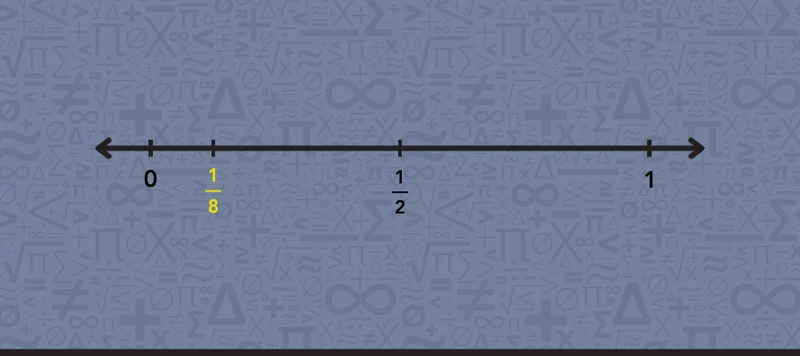
For \(\Large\frac{5}{9}\):
-
We find that half of 9 is 4.5.
-
Since our numerator 5 is greater than 4.5, we know that \(\Large\frac{5}{9}\) is greater than \(\Large\frac{1}{2}\).
-
Because 5 is only a tiny bit larger than 4.5, we plot our point just a tiny bit to the right of the \(\Large\frac{1}{2}\).
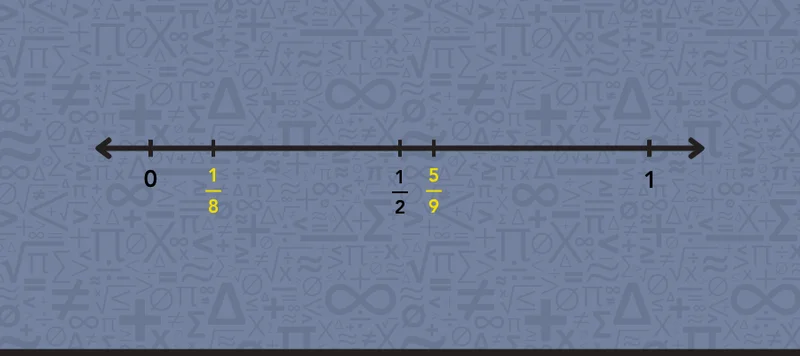
As we can see, \(\Large\frac{1}{8}\) sits further left than \(\Large\frac{5}{9}\) on the number line.
That means \(\Large\frac{1}{8}\) is less than \(\Large\frac{5}{9}\).
\(\Large\frac{1}{8}\) < \(\Large\frac{5}{9}\)
Once we're comfortable with \(\Large\frac{1}{2}\), we can also use other familiar fractions as benchmarks. Fractions like \(\Large\frac{1}{4}\) and \(\Large\frac{3}{4}\) give us tighter reference points, which can be useful when two fractions sit close together on the same side of \(\Large\frac{1}{2}\).
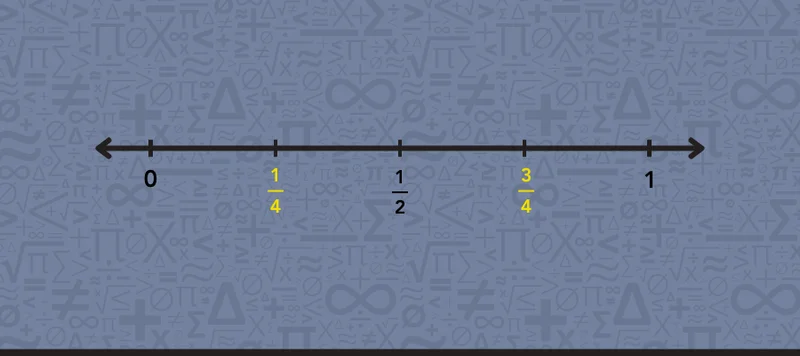
Let's look at \(\Large\frac{1}{6}\) and \(\Large\frac{3}{8}\).
If we check them against \(\Large\frac{1}{2}\):
-
For \(\Large\frac{1}{6}\): Half of 6 is 3. Since 1 is less than 3, \(\Large\frac{1}{6}\) is less than \(\Large\frac{1}{2}\).
-
For \(\Large\frac{3}{8}\): Half of 8 is 4. Since 3 is less than 4, \(\Large\frac{3}{8}\) is also less than \(\Large\frac{1}{2}\).
Because both fractions fall to the left of \(\Large\frac{1}{2}\), that single benchmark isn't enough to tell us which one is smaller. This is where \(\Large\frac{1}{4}\) comes in.
To check if a fraction is smaller or larger than \(\Large\frac{1}{4}\), we find one-quarter of its denominator by dividing the bottom number by 4. Then, we compare our numerator to that value:
-
If our numerator is less than one-quarter of the denominator, we know our fraction is less than \(\Large\frac{1}{4}\). We would place it in between 0 and \(\Large\frac{1}{4}\).
-
If our numerator is greater than one-quarter of the denominator, we know our fraction is greater than \(\Large\frac{1}{4}\). We would place it in between \(\Large\frac{1}{4}\) and \(\Large\frac{1}{2}\).
-
If our numerator is exactly one-quarter of the denominator, we place our fraction directly on \(\Large\frac{1}{4}\).
Let's test our fractions again.
For \(\Large\frac{1}{6}\):
-
We divide 6 by 4, which equals 1.5.
-
Our numerator is 1. Since 1 is smaller than 1.5, we find that \(\Large\frac{1}{6}\) is smaller than \(\Large\frac{1}{4}\).
-
Because 1 is close to 1.5, we place our point just to the left of the \(\Large\frac{1}{4}\) mark.
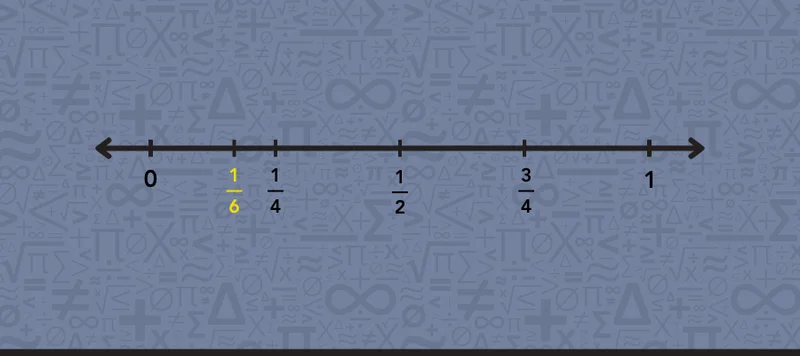
For \(\Large\frac{3}{8}\):
-
We divide 8 by 4, which equals 2.
-
Our numerator is 3. Since 3 is greater than 2, we find that \(\Large\frac{3}{8}\) is greater than \(\Large\frac{1}{4}\).
-
We can notice that 3 is exactly halfway between 2 and 4 (our \(\Large\frac{1}{4}\) and \(\Large\frac{1}{2}\) markers). This means we plot \(\Large\frac{3}{8}\) exactly in the middle of the space between \(\Large\frac{1}{4}\) and \(\Large\frac{1}{2}\).
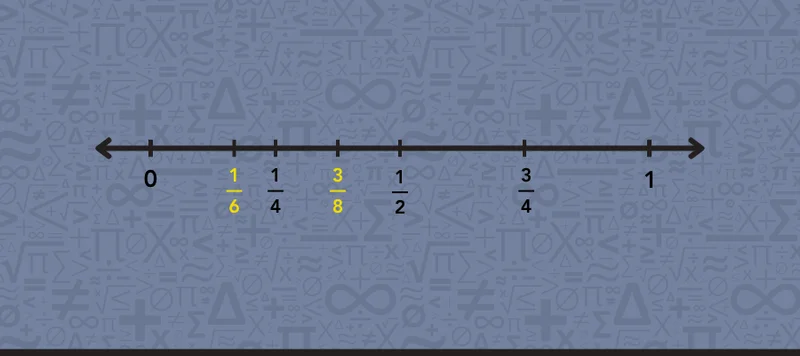
Now we have a clear picture on the number line. \(\Large\frac{1}{6}\) sits to the left of \(\Large\frac{1}{4}\), while \(\Large\frac{3}{8}\) sits to the right of \(\Large\frac{1}{4}\), between \(\Large\frac{1}{4}\) and \(\Large\frac{1}{2}\).
That means \(\Large\frac{1}{6}\) is less than \(\Large\frac{3}{8}\).
\(\Large\frac{1}{6}\) < \(\Large\frac{3}{8}\)
📕 You May Also Like: Benchmark Fractions: The Secret Weapon for Mental Math
3. Cross-Multiplication
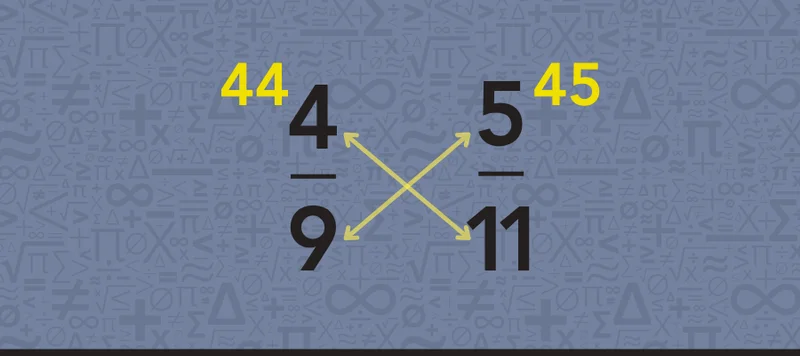
Cross-multiplication compares two fractions with positive denominators by multiplying each fraction's numerator by the opposite fraction's denominator.
We write each result next to its top number, and then we just compare the two numbers to see which one is bigger!
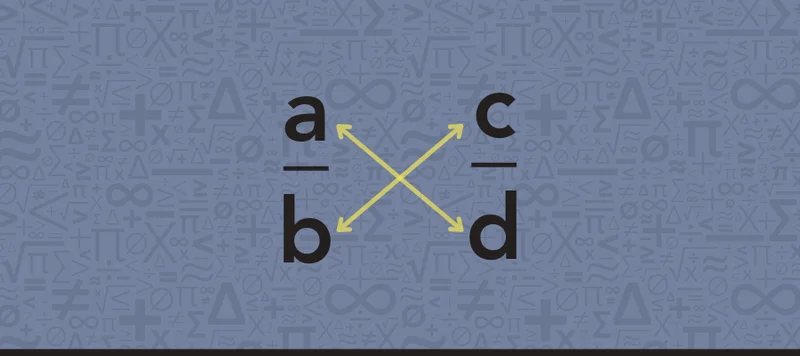
Let's compare \(\Large\frac{1}{6}\) and \(\Large\frac{3}{8}\), the same pair we just compared using benchmarks.
We multiply the numerator of the first fraction by the denominator of the second, and the numerator of the second fraction by the denominator of the first:
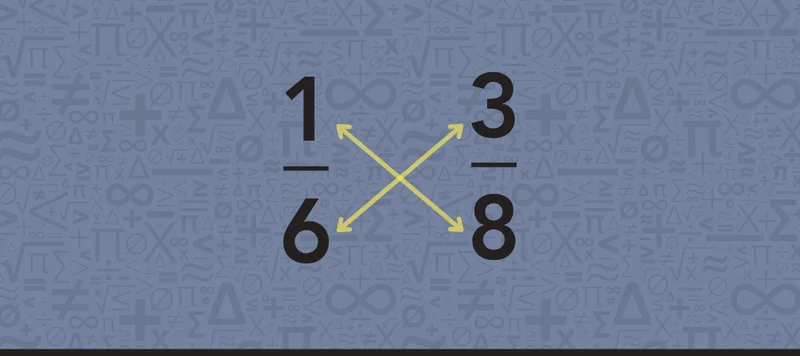
Now, we write each answer next to the fraction whose top number we used:
-
First, we used the 1 from \(\Large\frac{1}{6}\), which puts 8 next to \(\Large\frac{1}{6}\).
-
Following that same logic, we place 18 next to \(\Large\frac{3}{8}\) because we used its top number, 3.
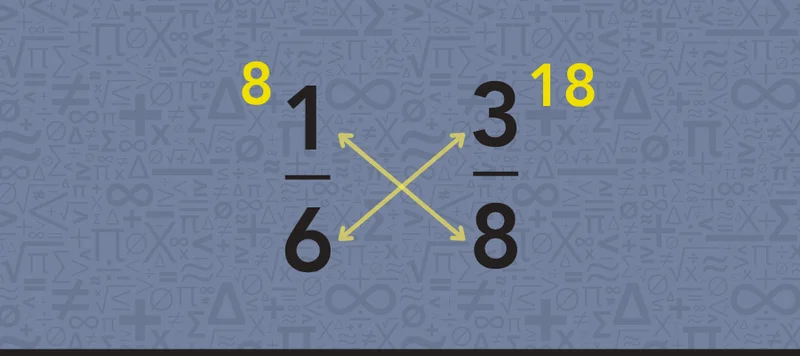
Whichever side gets the bigger number is our bigger fraction!
Since 8 is less than 18, that means that \(\Large\frac{1}{6}\) is less than \(\Large\frac{3}{8}\).
\(\Large\frac{1}{6}\) < \(\Large\frac{3}{8}\)
That matches exactly what we found using benchmarks, just without needing to check against \(\Large\frac{1}{4}\) or \(\Large\frac{1}{2}\) at all.
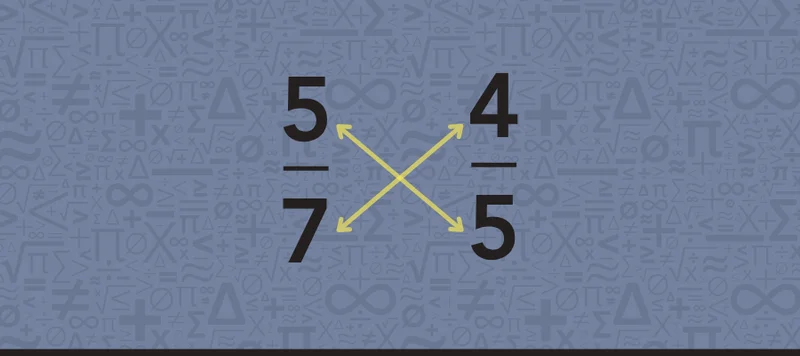
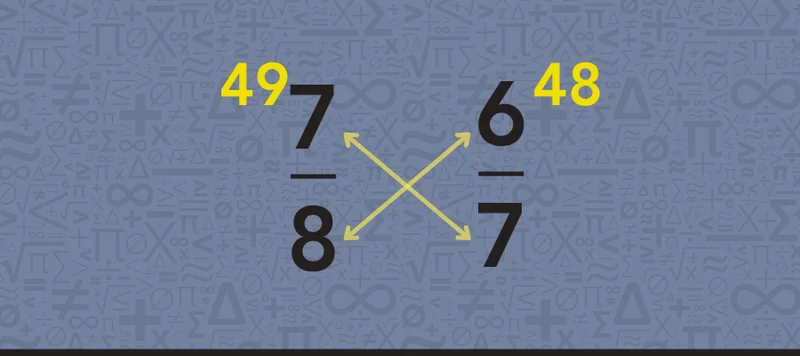
Let's try one more, this time with \(\Large\frac{5}{7}\) and \(\Large\frac{4}{5}\).
We multiply diagonally again:
-
The numerator 5 from \(\Large\frac{5}{7}\) gives us 25, so 25 goes on the left.
-
The numerator 4 from \(\Large\frac{4}{5}\) gives us 28, so 28 goes on the right.
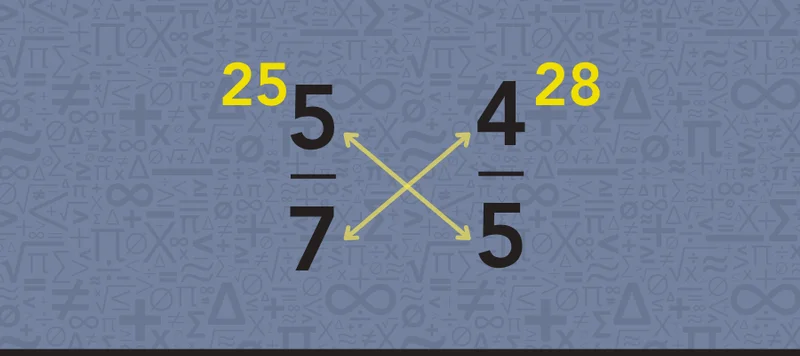
We know that 25 is less than 28, which means that \(\Large\frac{5}{7}\) is less than \(\Large\frac{4}{5}\).
\(\Large\frac{5}{7}\) < \(\Large\frac{4}{5}\)
📕 You May Also Like: How to Cross-Multiply Fractions and Proportions
How to Choose the Right Method for Comparing Fractions
The method we choose depends on the numerators, denominators, and how close the fractions sit to a familiar benchmark. Our Mathnasium tutors have found that some pairs make the comparison obvious right away, while others take a bit more work to sort out.
That's exactly why we teach all three methods, side by side. More than one approach in our toolkit means we're never stuck relying on just one, no matter what pair of fractions we run into.
|
Method
|
Reach for it when:
|
What It Builds |
|
Fraction Bars
|
The denominators are small enough to draw and shade by hand
|
A visual sense of fraction size
|
|
Benchmark Fractions
|
One or both fractions sit close to \(\Large\frac{1}{2}\), \(\Large\frac{1}{4}\), or \(\Large\frac{3}{4}\)
|
Reasoning about proximity to familiar values
|
|
Cross-Multiplication
|
We want a method that works on any pair of fractions
|
A reliable, repeatable process
|
📕 You May Also Like: How to Compare Fractions? A Kid-Friendly Guide
Practice: Compare These Fractions
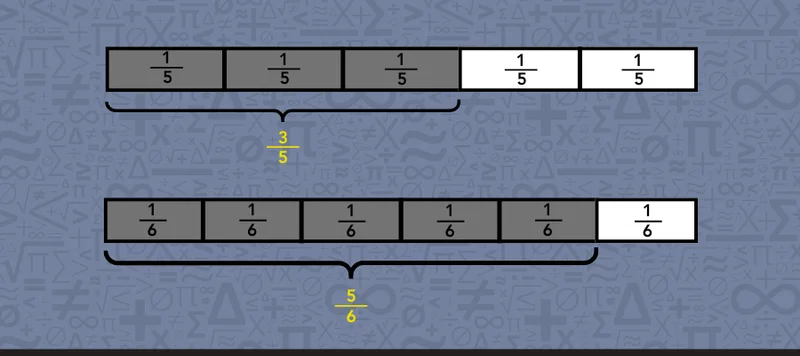
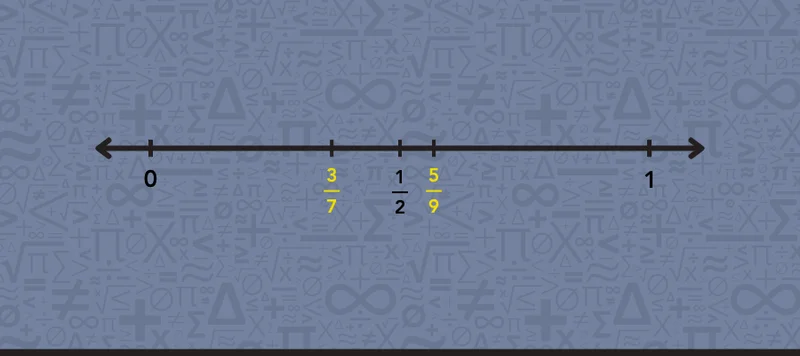
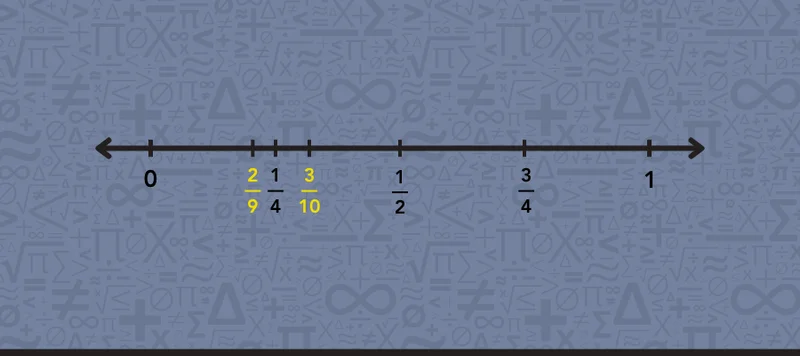
We’ve put together six problems to practice comparing fractions. Use the method named for each pair, and write your answer with <, >, or =.
Fraction Bars
Benchmark Fractions
Cross-Multiplication
Check the answers at the bottom of the guide.

Mathnasium tutors use personalized learning plans and hands-on teaching techniques to help students make sense of comparing fractions, one method at a time.
How Mathnasium Helps Students Master Fractions
Mathnasium is a math-only learning center serving K–12 students, focused on building confident, independent math thinkers through personalized instruction and targeted support.
Students come to us at different points in their understanding of fractions. Some need to build the fundamentals first, while others are ready to go deeper into how and why fractions compare the way they do. Effective support starts with knowing exactly where each student stands.
We do this through the Mathnasium Method™, our proprietary teaching approach built around personalized learning and proven instructional techniques.
Here's what that looks like in practice:
-
Diagnostic Assessment and Personalized Learning Plans: Each student begins with a diagnostic assessment that identifies both visible skill gaps and the reasoning patterns behind them. From that starting point, we build a personalized learning plan tailored to their needs and goals, helping them build lasting math mastery at a pace that works for them.
-
Teaching for Understanding: Our specially trained tutors use plain, everyday language and a mix of verbal, visual, mental, tactile, and written techniques so concepts like comparing fractions land in a way that makes sense to each student.
-
Problem-Solving and Critical Thinking: Our tutors know when to offer support and when to let a student work through a problem on their own. That balance is what builds lasting independence.
-
An Engaging and Fun Learning Environment: Sessions are designed to keep students motivated and enjoying the process. We celebrate every bit of progress, and that consistent recognition builds confidence with each session. Over time, students develop a more positive relationship with math and greater confidence in their own abilities.
The results reflect that approach:
-
94% of parents report improvement in their child's math skills and understanding
-
93% of parents report an improved attitude toward math after attending Mathnasium
-
90% of students saw improvement in their school grades
We operate over 1,100 centers across North America, bringing our proven approach to communities everywhere.
Families across Teaneck, Bergenfield, New Milford, and Hackensack can visit Mathnasium of Teaneck, a trusted local center with a proven record of building confident math thinkers.
Whether your student is looking to catch up, keep up, or get ahead in math, our local team is happy to help!
📅 Schedule a Free Diagnostic Assessment at Mathnasium of Teaneck
Not near Teaneck?
📍 Find a Mathnasium Learning Center Near You
Pssst! Check Your Answers Here
If you've given our practice problems a go, here are the results.
Fraction Bars
Benchmark Fractions
Cross-Multiplication


 (201) 862-1600