Middle school is usually the point where mathematical thinking takes a new direction. It expands to include variables such as x, y, and z, as well as new ways of thinking about mathematical relationships.
As math becomes more abstract, we may naturally ask ourselves what changes after elementary school.
Our Mathnasium education specialists answer that question by explaining what happens after the transition from elementary to middle school math, why those changes occur, and how you can support your child through it.
What Changes Between Elementary and Middle School Math
We see the biggest change in middle school in the kind of thinking math requires.
Let's look at how students are expected to adjust as they move from elementary to middle school.
-
In elementary school, students can often get by relying heavily on procedural skills, using familiar steps, counting strategies, and concrete models to solve problems, even when their conceptual understanding is still developing.
-
By middle school, math becomes more abstract and conceptual, as students begin working with unknowns, variables, and relationships between quantities. They still need solid procedures, but now they’re expected to understand why those procedures work and use the underlying ideas to tackle unfamiliar problems.
The transition to middle school is often accompanied by significant declines in both achievement and attitude toward mathematics, even among students who performed well in elementary school.
Here's what the progression looks like at each stage.
|
|
Elementary Math (Grades K to 5)
|
Middle School Math (Grades 6 to 8)
|
|
Type of thinking
|
Students follow a set of steps to reach the right answer (procedural thinking)
|
Students reason about why a relationship between numbers holds, even when the numbers are unknown (conceptual thinking)
|
|
What problems look like
|
Problems work with real numbers through operations like multiplication, long division, and fraction simplification
|
Problems use variables and expressions, asking students to solve for x, write equations, or interpret a graph
|
|
How success is measured
|
Students get the correct answer by using the right method
|
Students explain their reasoning clearly and use it to solve problems they have not seen before
|
📕 You May Also Like: Why Even Straight-A Students Struggle with 6th Grade Math (and How to Help)
Why Procedural Memory Is Not Enough in Middle School Math
Procedural memory remains an important part of learning math, but middle school asks students to build on those procedures rather than rely on them alone.
Students may remember a rule like "keep, change, flip" for dividing fractions and use it correctly in a familiar problem. Once the same idea appears inside a word problem or an algebraic equation, however, they also need to explain why the procedure works and recognize when to use it.
For example, \(\Large\frac{3}{4}\) ÷ \(\Large\frac{1}{2}\) asks a simple question: “How many halves fit into three quarters?” Because we're counting halves, dividing by \(\Large\frac{1}{2}\) is the same as asking how many \(\Large\frac{1}{2}\) pieces fit into \(\Large\frac{3}{4}\).
Since each whole contains 2 halves, every whole is split into 2 equal pieces. That means counting halves is the same as multiplying by 2, so we can rewrite the problem as \(\Large\frac{1}{2}\) × \(\Large\frac{2}{1}\) = \(\Large\frac{6}{4}\), which simplifies to \(\Large\frac{3}{2}\), or \(1\Large\frac{1}{2}\) written as a mixed number.
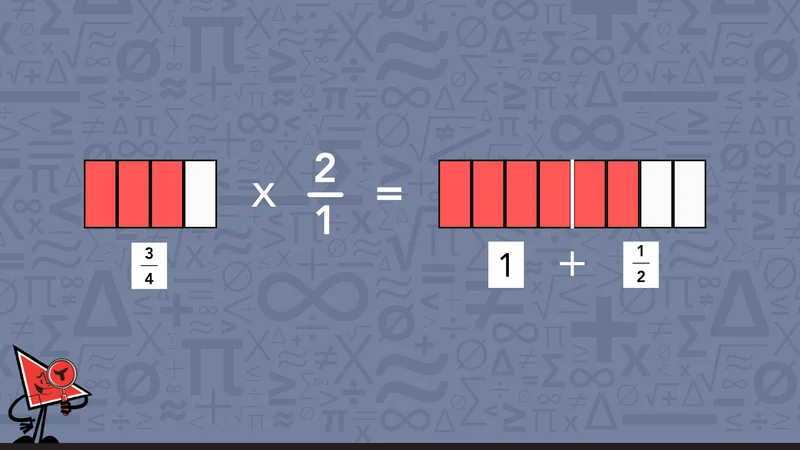
This is where the "keep, change, flip" shortcut comes from. We keep the first fraction, change the division sign to a multiplication sign, and flip the second fraction.
Our example shows that remembering a shortcut is useful, but grasping the reasoning behind the procedure becomes much more important as math grows more complex.
Deep mathematical understanding becomes much harder to build when procedures come before reasoning, which is how many children first experience new math concepts in elementary school.
Let's look at a few elementary habits that can become stumbling blocks in middle school.
|
Elementary Habit
|
What It Looks Like
|
Middle School Consequence
|
|
Step-by-step memorization without understanding
|
Students use the same memorized steps for familiar fraction or equation problems without understanding why the method works
|
The procedure becomes much harder to use when the same idea appears in a multi-step problem or a new context
|
|
Counting instead of automatic recall
|
Students use finger counting or repeated addition for multiplication facts
|
Working memory fills up on basic computation, which leaves no space for the reasoning the problem requires
|
|
Avoiding or guessing at word problems
|
Students avoid problems that require reading and interpreting a situation
|
Translating real-world scenarios into mathematical expressions is one of the main middle school expectations, and students who have never practiced it before will struggle to keep up
|
Correct answers without explanation
|
Students receive full marks on elementary tests without articulating why the method works
|
Middle school assessments ask students to justify their reasoning, which feels unfamiliar when explanation was never part of the process before
|
📕 You May Also Like: Critical Thinking vs. Memorizing: What Really Builds Math Skills?
How Grade 6 Math Builds on Elementary School
The New Jersey Student Learning Standards are designed as a coherent progression, with each new Grade 6 topic building on mathematical ideas introduced in elementary school.
Let's see how those connections appear across the curriculum.
|
Grade 6 Domain (NJSLS-M)
|
Builds on Elementary School Learning
|
|
Ratio and Proportional Relationships
|
Multiplication, division, measurement, and fraction concepts
|
|
The Number System
|
Whole numbers, fractions, decimals, and operations with numbers
|
|
Expressions and Equations
|
Properties of operations, numerical expressions, and algebraic thinking
|
Geometry
|
Geometric figures, measurement, area, perimeter, and coordinate concepts introduced in Grade 5
|
Statistics and Probability
|
Collecting, representing, interpreting, and analyzing data |
📕 You May Also Like: Common 6th Grade Math Problems & How to Help
How Parents Can Support Their Child in Middle School Math
Parents can usually help with short, visible struggles at home, while deeper conceptual gaps often call for more structured support.
Here are a few practical ways to support children through the transition to middle school math.
-
Focus on why a method works. Encourage your child to explain how they solved the problem and why they chose a particular method. Children who can explain their reasoning are more likely to understand the underlying concept, while those who only repeat memorized steps may still rely on procedural thinking.
-
Normalize productive struggle. Confusion usually appears when children begin working with more abstract ideas. Let’s give them time to identify the right step or concept causing the difficulty before offering the solution.
-
Keep home practice short and low-pressure. Ten to fifteen minutes spent working through one problem together give your child time to explain their thinking, ask questions, and make sense of new ideas. That kind of conversation often does more for conceptual understanding than completing another full worksheet.
-
Consider structured support that starts with identifying the specific gap. In our experience, most students need four to six weeks to adjust to the pace and expectations of middle school math. If the same foundational mistakes continue after that period, they may point to a specific gap rather than a temporary adjustment. Support that identifies whether the gap lies in fraction sense, fact fluency, number sense, or procedural reasoning can target the right skill from the start.
At our center, the right starting point is the foundation of effective instruction. Diagnostic assessments help us understand each student's strengths and learning gaps before teaching begins.
📕 You May Also Like: 4 Ways Diagnostic Math Tests Benefit Students & Parents

At Mathnasium, students learn to approach new math concepts with curiosity, confidence, and a deeper understanding of how ideas connect.
How Mathnasium Supports the Middle School Math Transition
Mathnasium is a math-only learning center dedicated to helping K–12 students of all skill levels excel in math.
Whether students are working through the early weeks of middle school math, addressing a foundational gap that surfaced in Grade 6 or 7, or building the conceptual reasoning that middle school math demands, we can support them.
Our proprietary teaching approach, the Mathnasium Method™, is designed around each student's needs and learning style to help them learn and master math. Our approach includes:
-
Assessment and Personalized Learning Plans: Each student begins their Mathnasium journey with a diagnostic assessment that identifies current skills, strengths, and gaps. From those findings, we build a personalized learning plan tailored to their goals.
-
Teaching for Understanding: Our specially trained tutors use natural language and a mix of verbal, visual, mental, tactile, and written techniques so each concept lands before we move forward.
-
Problem-Solving and Critical Thinking: We give students time to work through problems independently. That productive struggle helps them learn to trust their own reasoning. When we do step in, we explain both the how and the why behind each answer, so students build problem-solving and critical thinking skills they can use in math and beyond.
-
An Engaging and Fun Learning Environment: Sessions include games, earned rewards, and consistent celebration of progress. Students build confidence alongside fluency, and many develop a more positive relationship with math over time.
Families who come to us see measurable results:
-
94% of parents report improvement in their child's math skills and understanding
-
93% of parents report an improved attitude toward math after attending Mathnasium
-
90% of students saw improvement in their school grades
With over 1,100 learning centers across North America, there is likely a Mathnasium close to you.
Families across Teaneck and nearby areas, including Bergenfield, New Milford, Bogota, Ridgefield Park, and Hackensack, trust Mathnasium of Teaneck to help their children build lasting math confidence.
If the middle school math transition or any other math concept is giving your child trouble, our team is ready to help.
📅 Schedule a Free Assessment at Mathnasium of Teaneck
Not near Teaneck?
📍 Find a Mathnasium Learning Center Near You


 (201) 862-1600