The Pythagorean theorem is one of the first topics in 8th grade where geometry and algebra meet. It frequently catches students off guard because it requires them to translate a visual shape into a numerical equation before they can perform any calculations.
We’ve helped hundreds of students understand the Pythagorean Theorem and how to apply it, so today, we’ll walk you through some core concepts. Let's start with the definition.

What Is the Hypotenuse?
In any right triangle, the hypotenuse is always the longest side. It sits opposite the right angle, the one marked with a small square in diagrams, and in the formula it is always the side labeled c.
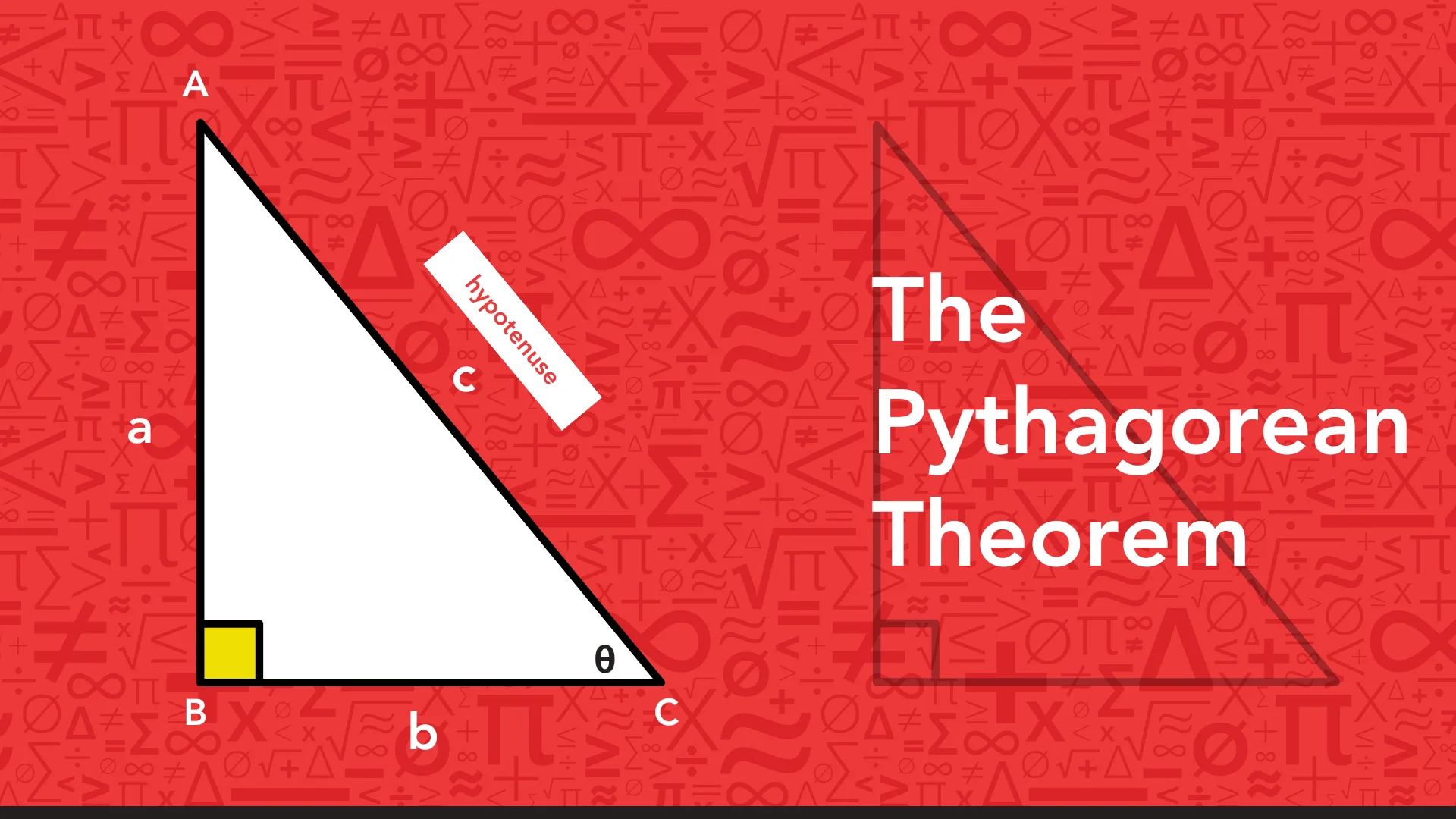
We find the length of this side using the Pythagorean theorem, which describes the geometric relationship between the three sides of a right triangle: a² + b² = c².
The variables a and b stand for the legs. These are the two shorter sides that meet to form the 90-degree corner. Because you add them together, it does not matter which leg you label a or b.
📕 You May Also Like: How Do I Help My 8th Grader With Math?
How to Find the Hypotenuse
We use the Pythagorean theorem to find the hypotenuse. Before we dive into the algebra, it helps to understand what the theorem is really telling us.
The Pythagorean theorem states that if we build physical squares on the two shorter legs of a right triangle, the total area of those two squares will perfectly equal the area of a large square built on the hypotenuse.
When we know the areas of those smaller squares, how do we translate that relationship into a calculated side length?
Math provides a reliable, four-step framework to organize our data and track our thinking.
Step 1: Identify the right angle and label the sides
Before writing anything down, it helps to ask a simple question: where is the right angle pointing?
Locate the small square symbol in the corner that marks a right angle, and the hypotenuse (c) will be directly opposite it. The remaining two sides are the legs, a and b.
Step 2: Write out the formula
We write a² + b² = c² before substituting any numbers.
Why does this matter?
Writing the base formula first gives us a visual map for our data and keeps our algebra organized when working under pressure.
Step 3: Substitute the known values
We replace variables a and b with the lengths of the two legs.
We write the full numerical equation first to avoid skipping a step or mixing up our values during arithmetic.
Step 4: Solve for c
We square each leg and add those two results together, which leaves us looking at the total area of our largest square (c²).
To uncover the single, straight-line distance of the hypotenuse, we need to find the matching side length of that square.
How do we find the value of c?
We take the square root of that total value (c²), which balances our equation and reveals the final length with its proper units.
📕 You May Also Like: 7 Places the Pythagorean Theorem Shows Up in Real Life
Find the Hypotenuse: Worked Examples
Let's look at how these four steps look in action. We will start simple and finish with a real-life scenario.
Example 1: a = 3, b = 4
We start with two known legs, measuring at 3 and 4 units, which means we need to solve for c.
We write out the base formula: a² + b² = c²
Now let’s substitute 3 and 4 in place of our legs a and b: 3² + 4² = c²
9 + 16 = c²
25 = c²
c = √25
Answer: c = 5 units
Example 2: a = 5, b = 7
Once again, look at which dimensions are missing. We have both straight legs, so we are calculating the diagonal distance, c.
We state the theorem before doing any math: a² + b² = c²
Then we plug in the leg lengths: 5² + 7² = c²
25 + 49 = c²
74 = c²
c = √74
Because 74 sits right between perfect squares of 64 and 81, we know our answer must be a decimal between 8 and 9.
Answer: c ≈ 8.60 units
Example 3: A diagonal path across a rectangular park with legs of 6 m and 8 m
The corner of the park forms a right angle. The two sides of the park are the legs, and our unknown side is the hypotenuse.
First, we lay out the formula to keep our steps clean: a² + b² = c²
Finally, we replace the variables with our measurements: 6² + 8² = c²
36 + 64 = c²
100 = c²
c = √100
Answer: c = 10 m
Notice how the sides in Example 1 (3, 4, 5) and Example 3 (6, 8, 10) all came out to whole numbers?
We call these Pythagorean Triples. We can spot the correct answer without doing any calculations at all if we recognize that a 6-8-10 triangle is just a double-sized 3-4-5 triangle.
📕 You May Also Like: What Is a Perfect Square in Math?
Practice Time! Now You Try to Find the Hypotenuse
Now it’s time to try the method independently. Scroll to the end to check your answers.
Problem 1:
A right triangle has legs of a = 8 and b = 15. What is the length of the hypotenuse?
Problem 2:
A right triangle has legs of a = 5 and b = 9. What is the length of the hypotenuse? Round your answer to two decimal places.
Problem 3:
A rectangular soccer field is 90 meters long and 120 meters wide. A player runs diagonally from one corner flag to the exact opposite corner flag. How far did they run?

From breaking down the Pythagorean theorem to mastering multi-step algebra, our tutors help 8th graders approach every triangle with confidence.
How Mathnasium of Tallahassee South Helps Students Master the Pythagorean Theorem
At Mathnasium, we believe that with the right support and approach, all students can learn and master math. That means starting from what a student really knows, not where we assume they should be.
Sessions are guided by the Mathnasium Method™, a proprietary teaching approach that uses verbal, visual, tactile, and written techniques to make concepts stick.
Before any sessions begin, every student completes a diagnostic assessment. Our specially trained tutors use assessment-based insights to build a personalized learning plan that builds on the student’s existing knowledge, bridges the skills gaps, and expands their mathematical thinking step by step.
Our results speak for themselves:
-
94% of parents report an improvement in their child's math skills and understanding
-
93% of parents report their child's improved attitude toward math after attending Mathnasium
-
90% of students saw an improvement in their school grades
Mathnasium operates over 1,100 centers nationwide, bringing specially trained tutors close to you.
For families across Tallahassee, Midtown, and Southwood, our team at Mathnasium of Tallahassee South is here to help your student excel in upper-middle school mathematics. We guide students through major milestones like the Pythagorean theorem, strengthening their algebraic skills and expanding their mathematical thinking.
📅 Schedule a Free Assessment at Mathnasium of Tallahassee South
Not Near Tallahassee South?
📍 Find a Mathnasium Learning Center Near You
How Did You Do? Check the Solutions
If you worked through the three problems, here is how they turn out.


 (850) 988-5549