When we learn to find the volume of rectangular shapes like cubes and prisms, we can rely on grid lines and right angles to visualize the space. It’s easy to picture neat layers of unit cubes filling a box from top to bottom, right?
However, when curved shapes like cylinders, cones, and spheres enter the picture, that grid visual falls apart. This is also the time when we find those intimidating formulas in textbooks, like πr2h or \(\Large\frac{1}{3}\)πr2h, which certainly don’t help when we don’t know where they actually come from.
To help you make sense of it all, Mathnasium tutors prepared this guide. In it, you'll see how to find the volume for cylinders, cones, and spheres, why their formulas work, and how to use them through step-by-step examples and practice questions.

Let’s Remind Ourselves: What Is Volume?
In math, volume measures the total amount of 3D space an object occupies. While flat 2D shapes only have length and width, 3D shapes extend into space by adding a third dimension: height or depth.
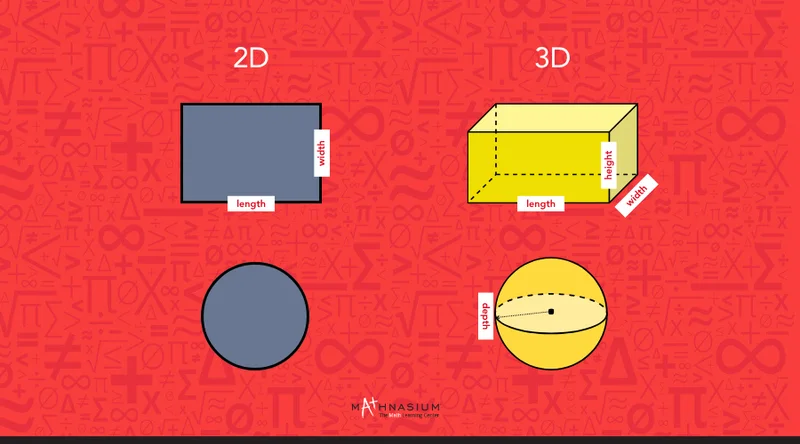
Just like we use inches, feet, and miles to measure length or ounces and pounds to measure weight, volume also has its own set of measuring units.
When measuring the volume of three-dimensional (3D) objects, we use cubic units such as:
-
Cubic centimeters (cm3)
-
Cubic inches (in3)
-
Cubic meters (m3)
To illustrate this, take a board game box on a shelf. Its volume tells us how much 3D space the game box takes up, measured in cubic inches or centimeters.
However, when measuring liquids, we use fluid units like liters (L) and milliliters (mL), or gallons, cups, and fluid ounces. Think of the milk poured into your cereal bowl. Its volume tells us how much liquid is contained inside the bowl.
Now that we've got the basics down, let's see how we actually find the volume for different 3D shapes.
📕 You May Also Like: What Is Volume in Math? A Kid-Friendly Guide
How to Calculate the Volume of 3D Shapes
As 3D shapes vary greatly in shape, there is no universal formula for calculating their volume. However, there is a common pattern we can follow when working with shapes like cubes, prisms, and cylinders.
However, there is a common pattern we can follow when working with shapes like cubes, prisms, and cylinders.
While we work with straight-sided 3D shapes like cubes or rectangular prisms, finding volume is fairly simple because every side is made of flat squares or rectangles.
For example, to calculate the volume of a simple box, we multiply its length by its width to find the area of its base. Then, we multiply that base area by the box’s height to find how much space it fills overall.
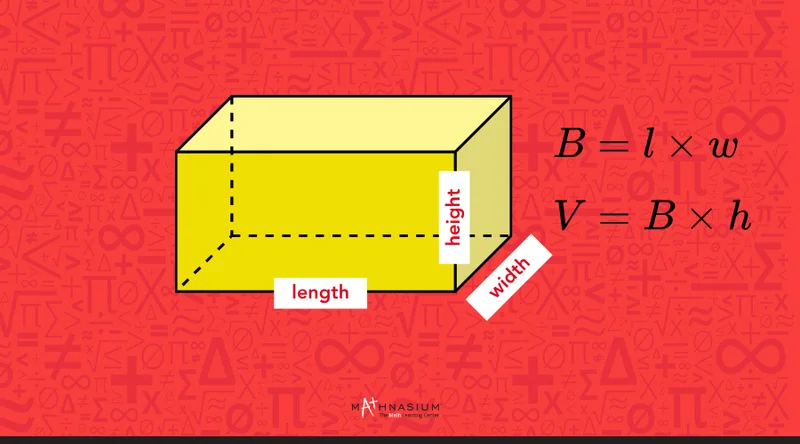
That same concept, taking a 2D base area and extending it straight up through its height, is the secret behind calculating most 3D volume formulas.
How to Calculate the Volume of Curved 3D Shapes
When a shape has round, curving sides, we need a different way to think about how that space is built.
To calculate the volume of curved 3D shapes, we do not need to treat each formula as a separate rule to memorize. Instead, we can look for the shape’s familiar 2D base, such as a circle, and consider how that base extends or changes through the shape’s height.
By looking at how circular layers behave, whether they stack straight up, shrink to a point, or grow wider and then narrower, we can find the volume for cylinders, cones, and spheres.

1. How to Find the Volume of a Cylinder
To find the volume of a cylinder (or how much space it takes up), we can think of its circular base being stacked evenly from the bottom to the top, something like a tall stack of circular coins.
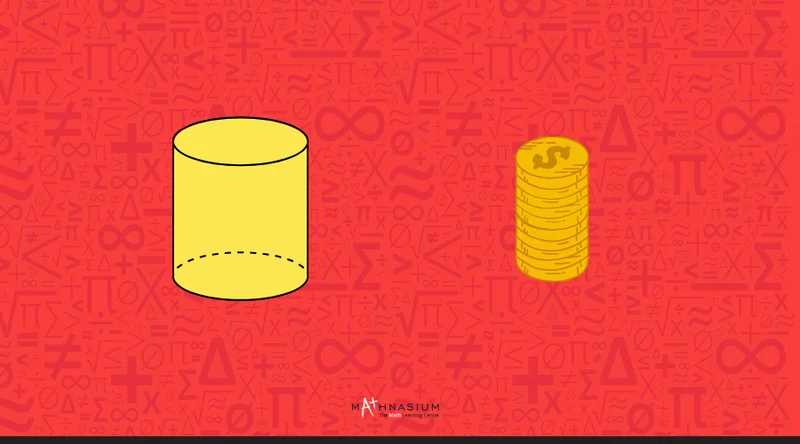
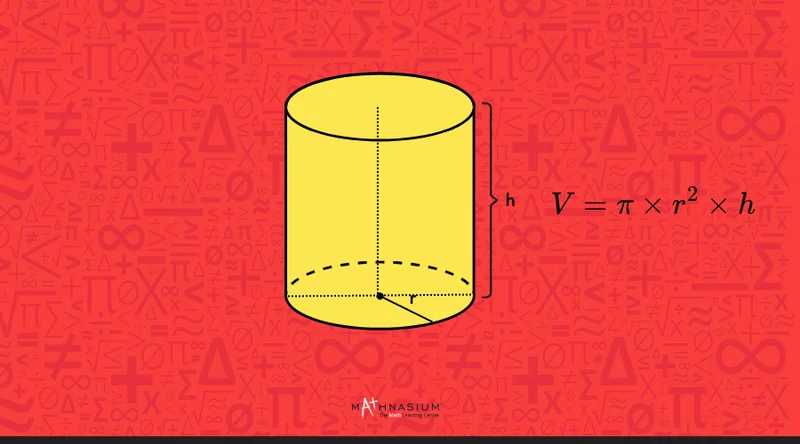
We start at the bottom with a single flat circle. From our area lessons, you might remember that the space inside a flat circle is 3.14 × r2, where r is the radius (the distance from the center of the circle to its outer edge), and 3.14 is the constant Pi (π).
Then, if we stack identical circular layers straight up to a specific height (h), we fill out the entire 3D shape. By taking the area of that circular base and multiplying it by how tall the stack is, we get our final formula:
2. How to Find the Volume of a Cone
To calculate the volume of a cone (or how much space it takes up), we can compare it to a cylinder with the same circular base and height.
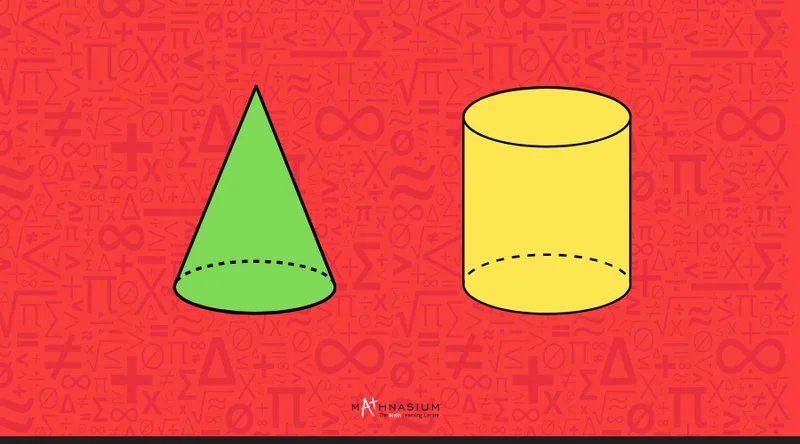
As we see, both a cone and a cylinder start with the same-size circle at the bottom. But while a cylinder stays the same width all the way to the top, a cone gets narrower and narrower until it ends at a sharp point.
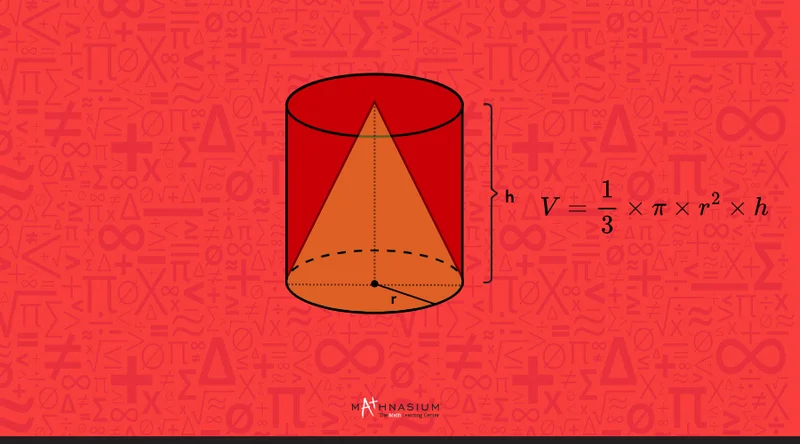
Since the cone becomes narrower, it holds less than the matching cylinder. In fact, it takes three full cones to fill one cylinder when both shapes have the same base radius (r) and height (h).
That means one cone holds one-third of the cylinder’s volume. We’ve already learned the cylinder’s volume V = π × r2 × h. So, we divide it by 3 to find the cone’s volume:
V = \(\Large\frac{1}{3}\) × r2 × h
The \(\Large\frac{1}{3}\) tells us that the cone holds one out of three equal cone-sized amounts needed to fill the matching cylinder.
3. How to Find the Volume of a Sphere
Now, this one calls for a longer breakdown. Unlike cylinders and cones, a sphere has no flat base or straight sides to guide us.
Let’s work through the logic of finding its volume step by step.
A sphere is a perfectly round 3D shape, like a basketball, marble, or globe. Every point on its surface is the same distance from its center. We call that distance the radius, or r.
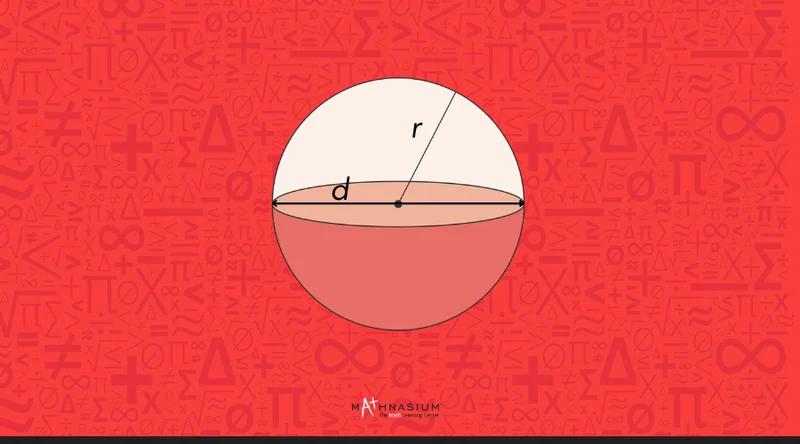
To picture the space inside a sphere, imagine slicing it into many very thin circular layers.
Near the top, the layers are tiny circles. As we move toward the middle of the sphere, the circles become wider and wider. The widest circle is at the sphere’s center. Then, as we move toward the bottom, the circles become smaller again.
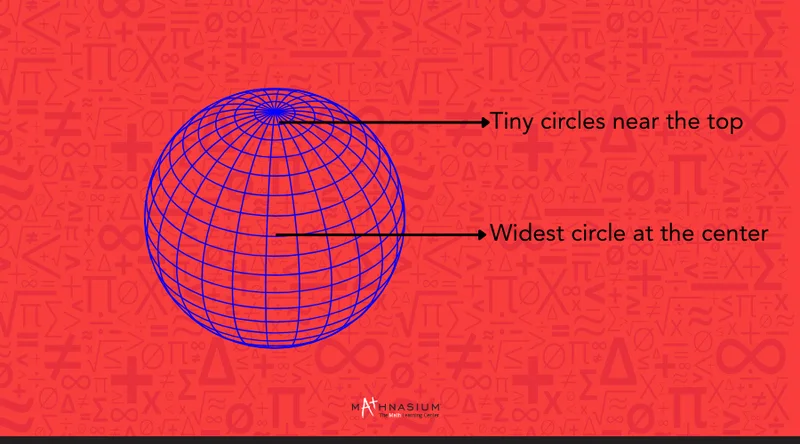
How wide each circular layer is depends on where it sits inside the sphere. The layer through the center has the same radius as the sphere r. The layers above and below it have smaller radii.
To find the space inside one circular layer, we first need to find the area of its circle. Circles have curved edges, so we use the special number π, which is about 3.14, to measure their area.
We find the area of a circle by multiplying π by the circle’s radius squared. The middle layer has area πr2, while the other layers have smaller areas because their radii are smaller.
But a sphere is not one flat circle. It is made of many circular layers stacked from top to bottom. The area of the middle layer involves r2. As we add circular layers through the sphere’s full three-dimensional space, the final volume depends on the radius multiplied by itself three times:
r × r × r = r3
So far, we know that a sphere’s volume must have πr3.
The question we have yet to answer is: How much of πr3 is inside a perfectly round sphere?
The largest layers are near the middle, while the layers near the top and bottom are much smaller. When mathematicians add the volumes of all these changing layers, the exact total is:
\(\Large\frac{4}{3}\)πr3
So, the complete formula for finding the volume of a sphere is:
V = \(\Large\frac{4}{3}\) × π × r3
📕 You May Also Like: 7 Amazing Facts About Pi Every Math Student Should Know
Solved Examples for Finding the Volume of Cylinder, Cone, and Sphere
Now that we’ve covered cylinders, cones, and spheres, let’s put these formulas to work with a few solved practice questions!
Example 1: Finding the Volume of a Cylinder
One soup can in a fridge has a base radius of 4 cm and a height of 10 cm. What is its volume?
Step 1: Identify the Values
First, we identify the values:
Since π is a constant, we’ll use 3.14.
Step 2: Write the Formula
The formula for the volume of a cylinder is:
V = π × r2 × h
Step 3: Substitute the Values and solve
Since we know all the values, we just insert them in the formula and do the calculation.
V = 3.14 × 42 × 10 = 3.14 × 16 × 10 = 502.4
Since we measure the volume in cubic units, and we started with centimeters, the volume of the soup can is 502.4 cm3.
Example 2: Finding the Volume of a Cone
There’s a party hat on a table with a base radius of 6 cm and a height of 15 cm. How much space is inside the hat?
Step 1: Identify the Values
We begin by pulling out our given measurements:
-
r = 6 cm
-
h = 15 cm
-
π = 3.14
Step 2: Write the Formula
The formula for measuring a cone's volume is:
V = \(\Large\frac{1}{3}\) × π × r2 × h
Step 3: Substitute the Values and Solve
After we plug these numbers directly into our formula, we get:
V = \(\Large\frac{1}{3}\) × 3.14 × 62 × 15 = \(\Large\frac{1}{3}\) × 3.14 × 36 × 15 = 565.2
We should never forget to put the appropriate unit next to our result. So, the total volume of the party hat is 565.2 cm3.
📕 You May Also Like: What Are Vertices, Edges, and Faces? A Complete Overview
Example 3: Finding the Volume of a Sphere
A playground ball has a radius of 9 cm. What is the total volume of air inside the ball?
Step 1: Identify the Values
First, we identify our single given dimension r = 9 cm. As for π, it’s 3.14.
Step 2: Write the Formula
The formula we need to calculate how much space is inside a sphere is:
V = \(\Large\frac{4}{3}\) × π × r3
Step 3: Substitute the Values and Solve
Now that we have both the formula and values, we just plug the values in and run the calculation:
V = \(\Large\frac{4}{3}\) × 3.14 × 93 = \(\Large\frac{4}{3}\) × 3.14 × 729 = 3,052.08
Without forgetting to add the proper cubic unit (cm3) next to the result we got, the total volume of the playground ball is 3,052.08 cm3.
Quiz: Check What You've Learned About the Volume of Cylinder, Cone, and Sphere
Ready to practice what we’ve covered? Give our quiz about finding the volume of curved 3D shapes a try and check your answers at the bottom of the guide.
Question 1: Volume measures the total amount of three-dimensional space an object occupies, which is why it is always measured in __________ units.
Question 2: If a cone and a cylinder have the exact same base radius (r) and height (h), how many full cones of water would it take to fill the cylinder completely?
-
2
-
3
-
4
-
6
Question 3: Which formula do we use to calculate the volume of a sphere?
-
V = π × r2 × h
-
V = \(\Large\frac{1}{3}\) × π × r2 × h
-
V = \(\Large\frac{4}{3}\) × π × r3
-
V = 2π × r × h
Question 4: A cylindrical AA battery has a base radius of 7 mm and a height of 50 mm. What is its volume? (Use 3.14 for π)
Question 5: A megaphone shaped like a cone has a base radius of 5 in and a height of 12 in. What is the total volume of space inside the megaphone? (Use 3.14 for π)

Mathnasium tutors break down complex 3D geometry concepts into clear, visual steps so students master volume formulas with confidence.
How Mathnasium Helps Students Master Geometry
Mathnasium is a math-only learning center empowering students of all skill levels to learn and master math.
Each student approaches spatial reasoning and geometry at their own pace. Whether they are building foundational concepts or mastering multi-step volume formulas, effective support starts with knowing exactly where each student stands.
We do this through the Mathnasium Method™, our proprietary teaching approach built around personalized learning and proven instructional techniques.
Here's what that looks like in practice:
-
Diagnostic assessment and personalized learning plans: Each student begins with a diagnostic assessment that identifies both visible skill gaps and the reasoning patterns behind them. From that starting point, we build a personalized learning plan tailored to their needs and goals, helping them build lasting math mastery at a pace that works for them.
-
Teaching for Understanding: Our specially trained tutors use plain, everyday language and a mix of verbal, visual, mental, tactile, and written techniques so concepts like comparing fractions land in a way that makes sense to each student.
-
Problem-Solving and Critical Thinking: Our tutors know when to offer support and when to let a student work through a problem on their own. That balance is what builds lasting independence.
-
An Engaging and Fun Learning Environment: Sessions are designed to keep students motivated and enjoying the process. We celebrate every bit of progress, and that consistent recognition builds confidence with each session. As they make progress, students develop a more positive relationship with math and greater confidence in their own abilities.
The results reflect that approach:
-
94% of parents report improvement in their child's math skills and understanding
-
93% of parents report an improved attitude toward math after attending Mathnasium
-
90% of students saw improvement in their school grades
With over 1,100 learning centers across North America, Mathnasium brings this approach close to your community.
For families across West Boca Raton, Boca Raton, and the surrounding Palm Beach County area, Mathnasium of West Boca Raton is a trusted local center with years of experience of building confident math thinkers.
Whether your student is looking to catch up, keep up, or get ahead in math, our local team is happy to help.
📅 Schedule a Free Diagnostic Assessment at Mathnasium of West Boca Raton
Not near Boca Raton?
📍 Find a Mathnasium Learning Center Near You
Pssst! Check Your Answers Here
If you've given our quiz a go, here are the answers.
Question 1: cubic
Question 2: B) 3
Question 3: C) V = \(\Large\frac{4}{3}\) × π × r3
Question 4: 7,693 mm3(or 7,693 cubic millimeters)
Question 5: 314 in3 (or 314 cubic inches)
How did you do?


 (561) 470-6284