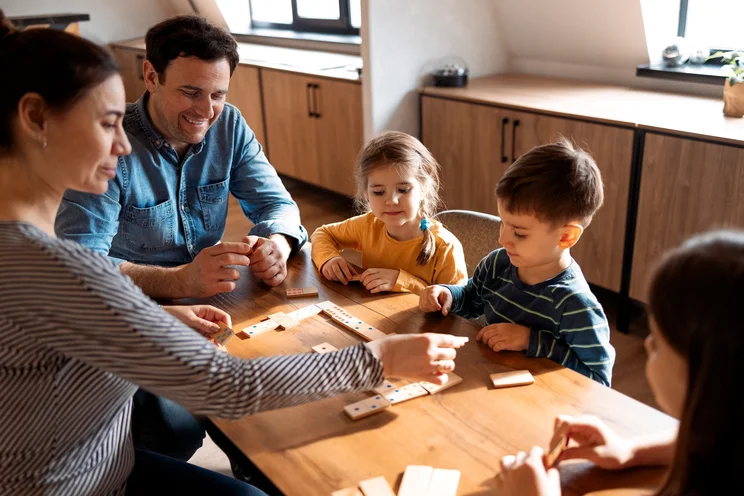
We often find that the most effective practice is the kind your children do not recognize as practice.
A card game, a quick challenge at the kitchen table, or a race to beat their own score keeps your child doing math long after a worksheet would have lost them.
We are Mathnasium of West Houston, and today we'll show you six TEKS-aligned games that build math skills from counting and number sense all the way through coordinate geometry, no setup required.
How Games Keep Kids Practicing Longer
Games give math repetition a purpose, and that changes everything about how long your child stays engaged.
Educational research supports what parents may notice. Game-based learning in mathematics can improve both your child’s engagement and performance.
That means games turn repetition into something your child is willing to keep doing, while still giving them the practice they need to build confidence and skill.
If your child is refusing to do five addition problems, they will happily play five rounds of Math War that require the same calculation. The math is identical, and the experience is completely different.
The six games below are built on that same principle. They are familiar enough to pick up in minutes, engaging enough to keep your child asking for another round.
📕 You May Also Like: 10 Fun Math Games to Play at Home with Your Child
9 Games That Build Math Skills, Grade by Grade
Every game on this list is easy to learn, low on prep, and tied to the math skills Texas students are building in school. They are organized by grade band, following the Texas Essential Knowledge and Skills (TEKS), so you always know you are practicing the right thing at the right time.
1. Games for Grades K–2
In kindergarten through second grade, your child is building the foundations that everything else in math rests on (counting, number recognition, and early addition and subtraction). The three games below practice all of that, and your child definitely knows at least one of them.
A. Go Fish
Go Fish builds number recognition and one-to-one correspondence, two skills that sit at the heart of early number sense.
Remove the jokers from a standard deck of cards, deal 4–5 cards to each player, and place the rest face down in the center.
Take turns with your child and ask for a card they already hold, "Do you have any 3s?" If your kid has it, they hand it over. If not, they say "Go fish!" and you draw from the pile.
As you both set down matching pairs as they collect them, which is also a good moment to count how many pairs each person has. The winner is the one with the most pairs.
📕 You May Also Like: What Is Number Sense & Why It Matters in Early Math Education
B. Dominoes
Dominoes build counting, pattern recognition, and early addition through matching, which your child finds naturally satisfying.
Shuffle the dominoes face down and deal 5–7 to your child and other players. Everybody takes turns matching a domino to one already on the table by pairing up the same number of dots on one end.
Each time your child places a tile, ask them to count the dots on both ends and add them together. A player unable to match draws from the remaining pile. If your child is the first player to use all their dominoes, they win.
C. Uno
Uno builds number recognition, sequencing, and quick comparison, and it moves fast enough to hold your six-year-old's attention for multiple rounds.
Deal 7 cards to each player. Place the remaining deck face down and flip one card to start the discard pile.
Players take turns matching the top card by number or color. Each time your child plays a card, they are making a quick comparison decision:
-
Does this number match?
-
Does this color match?
The first player to get rid of all their cards wins the round.
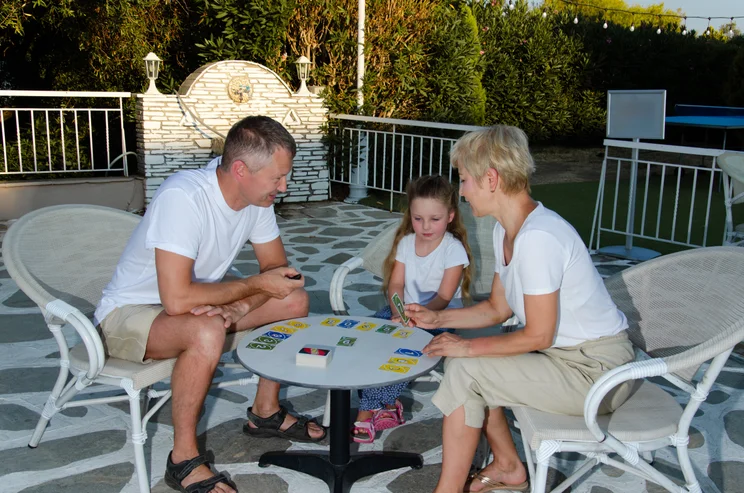
Uno sharpens quick thinking and number recognition, the building blocks of mathematical reasoning.
D. Blokus
Blokus is one of those games that feels like pure fun until you realize your child has been thinking about shapes, angles, and space for the last forty minutes.
Each player picks a color and takes turns placing their pieces on the board. The catch is that every new piece your child places must touch one of their own corners, and never a flat edge. That single rule turns every move into a spatial reasoning problem.
As your child scans the board for their next placement, they are rotating shapes in their head, estimating how much space they have left, and thinking several moves ahead. Those are geometry skills, and they are doing them naturally.
📕 You May Also Like: 3 Ways Early Spatial Skills Impact Long-Term Math Success
2. Games for Grades 3–4
By third and fourth grade, your child is moving beyond counting and into fluency, adding and subtracting larger numbers, learning multiplication, and starting to understand how math works with money. The two games below give them plenty of practice in a format that feels nothing like a worksheet.
A. Math War
Math War builds addition fluency, number comparison, and mental math speed. It also has enough variation to grow with your child as their skills develop.
Remove the jokers and deal all cards evenly between players. Each player flips two cards at the same time and adds the values together:
The player with the higher sum wins all four cards. Play until one of you holds the entire deck, or set a timer and count cards when it goes off.
The moment your child feels comfortable with addition, try these variations with the same deck:
-
Subtraction: Subtract the smaller card from the larger one.
-
Multiplication: Multiply the two cards together.
-
Comparison only: Flip one card each, higher card wins.
Each variation targets a different operation, so the game stays useful well past third grade.
📕 You May Also Like: 5 Ways Mental Math Supports Long-Term Math Success
B. Monopoly
Monopoly builds money sense, addition and subtraction with larger numbers, and some of the earliest real-world financial reasoning children will encounter, such as spending, saving, and budgeting.
Each player starts with $1,500 in play money. Players roll the dice, move around the board, and buy properties they land on.
If you or your child lands on another player's property, that means paying rent. If players pass "Go", they earn $200. Have your child handle their own transactions throughout the game. It means constant practice with:
-
Counting and organizing bills
-
Adding purchase prices and rent payments
-
Subtracting from a running total
-
Making change
Set a time limit if you want a shorter game. The player with the most money and property when time runs out wins.
📕 You May Also Like: How to Teach Kids Money Skills with Math
C. Yahtzee
Yahtzee is one of those games that sneaks a surprising amount of math into what feels like a luck-based dice game.
Each turn, your child rolls five dice up to three times and decides which to keep and which to reroll in pursuit of combinations like three of a kind, a full house, or a straight. That decision-making process, weighing what they have against what they still need, is early probability thinking in action.
The scoring sheet does the rest. Your kid adds up totals, tracks a running score, and figures out which category to fill next, all in a context where they are genuinely invested in the outcome.
All you need is five dice and a score sheet, and a simplified version works just as well with younger players in this band who are not quite ready for the full game.
3. Games for Grades 5–6
In fifth and sixth grade, math starts to feel more abstract. Students are working with coordinate planes, spatial reasoning, and the kind of logical thinking that algebra will soon demand. Battleship and Chess both cover all of that, each in its own way.
A. Chess
Chess has a reputation for being serious, but at this grade level, we can also treat it as a coordinate geometry game.
Why?
Every piece on the board has a position that we can describe in the same way your child describes points on a coordinate plane. A bishop travels diagonally, a knight jumps in an L-shape, and we can map every move to a specific square, just like a coordinate pair.
Beyond position, chess asks you and your child to:
-
Visualize how many squares a piece can reach from any given spot
-
Decide whether trading pieces is worth it based on their relative value
-
Think several moves ahead, building the logical reasoning that algebra will soon demand
You do not need to teach openings or theory. Just play, and let the board do the work.

Chess builds patience, focus, and the habit of thinking ahead, skills that transfer directly to math problem-solving.
B. Battleship
Battleship builds coordinate plane navigation, spatial reasoning, and logical deduction. Every move your child makes on that grid is a geometry and algebra concept in action.
Each player uses two grids, one for their own ships, one to track attacks on their opponent. Players secretly place five ships of varying lengths on their grid:
-
Carrier: 5 spaces
-
Battleship: 4 spaces
-
Destroyer: 3 spaces
-
Submarine: 3 spaces
-
Patrol Boat: 2 spaces
You and your child take turns calling out coordinates, for example, "B-7." The opponent responds with "hit" or "miss." Each response is a data point.
Mark results on your attack grid and watch the pattern emerge. Hits and misses together start to reveal where the remaining ships are hiding. The first player to sink all five of the opponent's ships wins.
A few things you should point out to your child as they play:
-
Calling out "B-7" is exactly how coordinate pairs work on a graph
-
Tracking hits and misses is an early form of data analysis
-
Deciding where to attack next builds logical reasoning and strategy

Mathnasium's specially trained tutors use games, hands-on activities, and personalized learning plans to build math confidence, session by session.
How We Make Math Learning Fun at Mathnasium
Mathnasium is a math-only learning center dedicated to empowering students of all skill levels to learn and master math.
Games are more than just a warm-up at Mathnasium. They are part of how we teach. Our tutors build them into sessions because students are more willing to engage, push through difficulty, and keep going when the practice feels like play.
That principle sits at the heart of our broader approach to math learning, the Mathnasium Method™.
Designed to unlock each student's true math potential, our approach relies on:
-
Personalized learning plans: Each student begins with a diagnostic assessment that identifies their strengths, knowledge gaps, and how they approach math. From there, our specially trained tutors follow a personalized learning plan built around what that student actually needs.
-
Teaching for understanding: Our tutors explain math in clear, everyday language and use visual, verbal, written, mental, tactile, and hands-on techniques so students develop a deep understanding of math concepts.
-
Caring group environment: Students work in a fun, supportive setting where they feel comfortable asking questions, making mistakes, and trying again.
-
Independent problem-solving: Each session gives students time to work through problems on their own, building the critical thinking skills they can apply across topics and grade levels.
-
Math-only focus: We are dedicated to math and math only. This singular focus allows us to go deeper into how students best learn, absorb, and retain math skills.
-
A confidence-building, fun learning environment: We often hear students say our sessions don't feel like lessons at all. That's by design. Our approach includes game-based activities and plenty of encouragement to keep students motivated and moving forward.
And the results speak for themselves:
-
94% of parents report an improvement in their child's math skills and understanding
-
93% of parents report their child's improved attitude toward math after attending Mathnasium
-
90% of students saw an improvement in their school grades
With over 1,100 centers, Mathnasium brings top-rated instruction close to your home.
For families in and around West Houston, Mathnasium of West Houston is a trusted local center with years of experience helping students excel in math.
Whether your child is looking to catch up, keep up, or get ahead, our team is ready to assist!
📅 Schedule a Free Assessment at Mathnasium of West Houston
Not near West Houston?
📍 Find a Mathnasium Learning Center Near You


 (281) 465-4990