When we count change at a checkout or compare prices at the grocery store, we use the same addition, subtraction, multiplication, and percentage skills we learn in class. These everyday moments give us a natural way to practice familiar math skills.
Research supports this idea. A 2025 study by Duong et al. of parent-child interactions during pretend grocery shopping found that regular involvement in everyday activities with math and money was linked to more solid money-related math skills.
Today, we’ll look at how familiar purchases and payments can support math learning.

How Daily Money Situations Connect to Math Skills
Money-related math does not have to start with complicated budgeting or tax forms. We can begin with simple transactions and gradually introduce more advanced calculations as our skills develop.
Younger students might work with totals and change, while older students can explore discounts, interest, annual subscription costs, or loan payments.
Take a look at the table below, which shows how different transactions can match different math skills and age ranges.
Now, we’ll see how to put these situations into practice.
How to Use Everyday Transactions to Practice Math
At Mathnasium, we believe math makes more sense when it connects to real-life situations. That’s why our tutors use hands-on activities, games, different teaching techniques, and familiar examples to make ideas easier to understand.
Here are a few ways to bring the same approach into practice at home.
1. Grocery Checkout (Estimating Total)
Before we even reach the register, we can turn a full cart into an estimation exercise.
-
Round as we go: Say our items cost $3.45, $2.80, $4.20, $1.50, $5.99, and $2.10. As we round each price to the nearest dollar, we get $3 + $3 + $4 + $2 + $6 + $2 = $20. Once the receipt prints, we can see how our $20 estimate is just one cent away from the actual $19.99 total and notice how the rounded numbers balanced out.
-
Keep a running total: As items get scanned, we can keep track mentally: “We’re at about $12… now $17… now $23.” This turns the checkout into a quick mental-addition practice.
For families in our hometown of Houston, this could be a regular grocery run to a store such as H-E-B or Kroger. But the same idea applies anywhere.
📕 You May Also Like: The Grocery Store Budget Challenge for Kids
2. Making Change With Cash
When we pay with cash, we get a chance to practice subtraction. Suppose something costs $6.35 and we hand over a $10 bill.
-
We need to subtract to calculate the change: $10.00 −$6.35=$3.65.
-
From there, we can go one step further and work out which coins and bills would make $3.65. For example: 3 one-dollar bills, 2 quarters = $0.50, 1 dime = $0.10, 1 nickel = $0.05. Together, that gives us $3.65 in 7 pieces.
-
But what if the cashier is running low on smaller coins. We may add 35 cents to the $10 and pay $10.35: $10.35 − $6.35 = $4.00. Now the cashier can give us four $1 bills instead of $3.65 in bills and coins.
📕 You May Also Like: How to Build Decimal Sense Using Money
3. Comparing Two Brands (Unit Price)
Unit price helps us look past the total price and see what we’re getting for our money. One brand might offer 2 items for $7, while another offers 4 for $13:
-
$7 ÷ 2 = $3.50 per item
-
$13 ÷ 4 = $3.25 per item
The second brand costs less per item, even though its total price is higher. We may use the same idea to evaluate different package sizes. A 12-ounce box of cereal for $4.20 costs:
An 18-ounce box for $5.40 costs:
So the larger box gives us a lower unit price.
Next time, in a grocery aisle, compare two similar products and decide which one costs less per ounce or per item.
4. Restaurant Bill (Tip + Tax)
We can practice percentages at a restaurant, including spots around Rice Village or West U here in Houston, by working out the tip and tax ourselves.
Take a $42 bill:
-
For a 10% tip: 42 × 0.10 = 4.20, so the tip is $4.20.
-
For a 15% tip: 42 × 0.15 = 6.30, which gives us $6.30.
-
For a 20% tip: 42 × 0.20 = 8.40, so we would leave $8.40.
Before the card reader suggests tip amounts, we may check our results against the options on the screen.
Tax changes the total too, so we need to include it in the final amount. For a $50 bill, let’s calculate 8% tax and a 15% tip step by step:
-
Find 8% tax: 50 × 0.08 = 4, so the tax is $4.00.
-
Find a 15% tip: 50 × 0.15 = 7.50, so the tip is $7.50.
-
Add: 50 + 4 + 7.50 = 61.50, so the total is $61.50.
5. Streaming Service Subscription
To explore rates and spot patterns in how costs change over time, compare two streaming subscriptions plans.
Imagine one service costs $10 per month, while another charges a $25 sign-up fee plus $7 per month. We can represent the total cost after x months with two equations:
-
Plan A: y = 10x
-
Plan B: y = 7x + 25
Here, x represents the number of months and y represents the total cost. To find when the two plans cost the same amount, we look at their total costs for the same number of months side by side. That means the value of x, the number of months, has to be the same in both plans.
At the point where the plans cost the same, those two totals must be equal, so we write:
10x = 7x + 25
10x - 7x = 7x - 7x + 25
3x = 25
3x ÷ 3 = 25 ÷ 3
x ≈ 8.3
So starting with the 9th month, Plan B becomes less expensive. Before that point, Plan A is the cheaper choice because it has no sign-up fee.
We may also graph both equations and look for the point where the lines cross. That intersection shows when the total costs become equal, while the slopes show how quickly each subscription cost grows from month to month.
How to Practice Math With Tap-to-Pay
Nowadays, we rarely reach for cash, so some of the math that used to happen naturally, such as counting bills or checking change, can be easier to miss.
Digital payments still leave plenty of room for useful math practice:
-
Estimate before we tap: Before paying, we can estimate the total and then push the question a little further. How close can we get without using a calculator? What would the change be from $20 or $50? After the payment goes through, we may see how our estimate differs with the exact amount and figure out what caused the gap.
-
Subscription audit: We can list out recurring charges pulled from email receipts or an app store’s subscription page, then compute a monthly and annual total for each one. Next, we may review plans and work out how much we would save by canceling or switching one.
-
Check whether free shipping actually saves money: Say an online store offers free shipping on orders over $50, and our cart total is $44. We might be tempted to add a $9 item just to avoid a $6 shipping fee. But that would raise the total to $53, while paying for shipping would cost $50 altogether. In this case, we would spend $3 more by adding the extra item.
-
Compare promo codes: For instance, we have two codes to choose for online shopping: 20% off or $15 off. Because 20% of $75 is $15, the two promo codes are equal on a $75 order. If your total is under $75, choose the fixed $15 discount to save more. For orders over $75, the 20% discount becomes the better choice.
📕 You May Also Like: How to Teach Kids Money Skills with Math
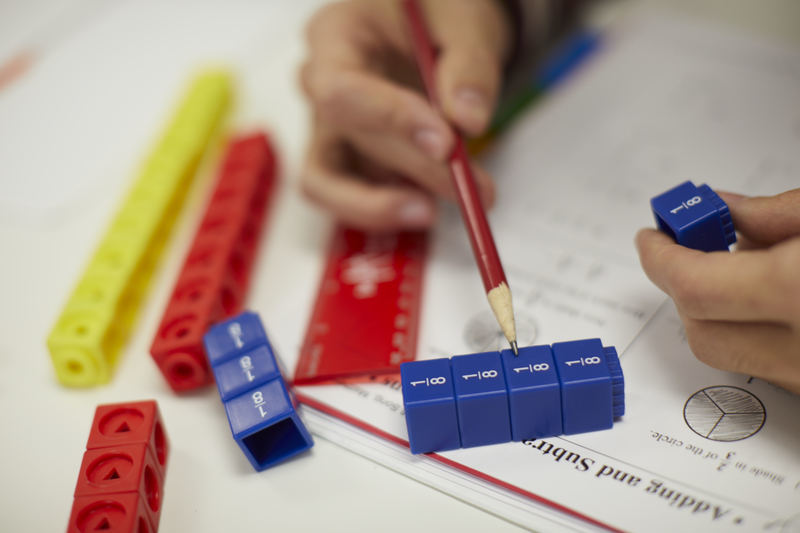
Mathnasium tutors combine hands-on activities, visual models, and real-life examples to help students connect math to everyday situations and understand the concepts more deeply.
How Mathnasium Helps Students Make Sense of Math
Mathnasium is a math-only learning center dedicated to helping K–12 students of all skill levels excel in math.
Everyday transactions give students a practical way to use math outside the classroom. Whether they are estimating a grocery total, checking change, calculating a tip, comparing prices, or working with discounts, we help them connect those real situations to the math ideas behind them.
To meet students where they are and guide them forward step by step, we use the Mathnasium Method™, our proprietary teaching approach.
Each student begins with a diagnostic assessment that helps us understand their current skill level, knowledge gaps, goals, and how they think and feel about math.
Using these insights, we build a personalized learning plan focused on the skills the student needs most, whether that means improving calculation fluency, making sense of percentages, working with decimals and money, or preparing for more advanced math.
Our specially trained tutors follow that plan closely and provide live, face-to-face instruction in a caring and fun group environment. They use mental, verbal, visual, tactile, and written techniques to help students connect math to real situations, compare quantities, estimate reasonable answers, and explain the thinking behind their calculations.
Students also get room to think through problems before tutors step in. Our tutors guide them to test their own ideas, check whether an answer makes sense in context, and try another approach when needed. This helps students build critical thinking, problem-solving skills, and greater independence with math both in and outside the classroom.
Fun is part of the approach, too. We use hands-on and game-based activities, rewards, and consistent encouragement to keep students engaged as they practice math in practical ways.
The impact is clear in our results:
-
94% of parents report an improvement in their child's math skills and understanding
-
93% of parents report their child's improved attitude toward math after attending Mathnasium
-
90% of students saw an improvement in their school grades
With over 1,100 learning centers across North America, there is likely a Mathnasium close to you.
For families in and near Houston, Texas, Mathnasium of West University brings that same approach close to home, with specially trained tutors who help students make sense of the math they use in class and in everyday situations.
If your child could use support with math, a free diagnostic assessment is a great place to start. Using what we learn, we create a personalized learning plan focused on the skills they need next.
📅 Schedule a Free Assessment at Mathnasium of West University
Not near West University?
📍 Find a Mathnasium Learning Center Near You


 (713) 697-6284