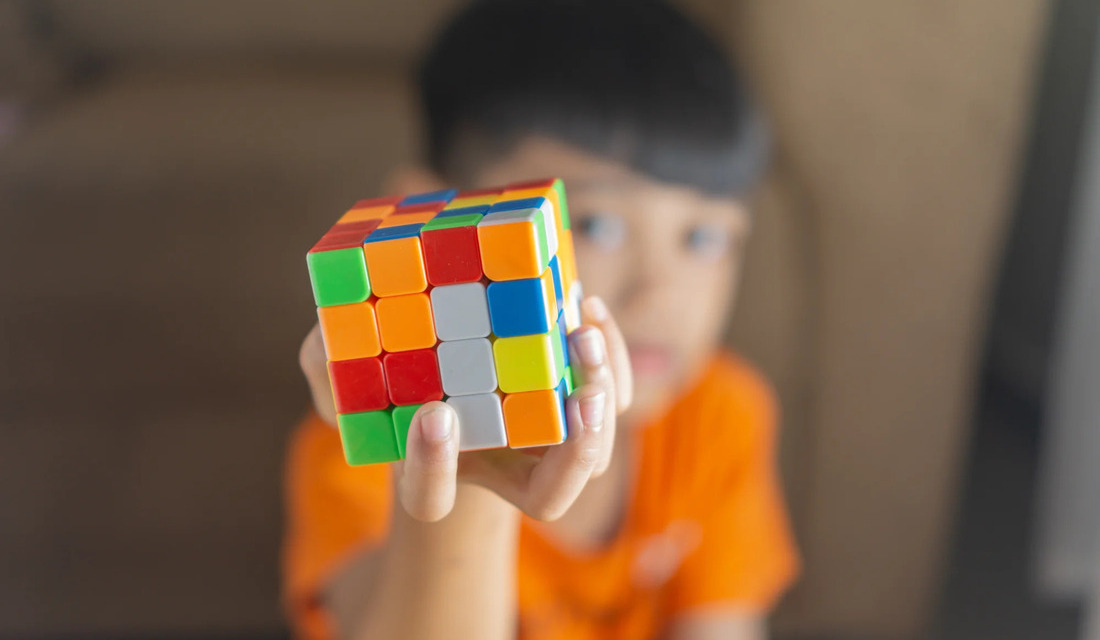
Think about the blocky worlds of Minecraft or Roblox. Now look around the room you’re in and picture the three-dimensional spaces you move through every day. You might not expect these settings to have much in common, but math connects them in a surprising way.
That brings us to a special group of numbers called perfect cubes. What makes a number a perfect cube, and why does the idea show up in both math and the way we describe space? That’s what we’ll explore today.
What Is a Perfect Cube?
A perfect cube is a number we get by multiplying a whole number by itself three times. We can also describe this as raising the number to the third power, or cubing it.
Take 3:
3 × 3 × 3 = 27.
The same calculation can be written more compactly as:
33 =27.
The small 3 tells us to use 3 as a factor three times. So 27 is a perfect cube.
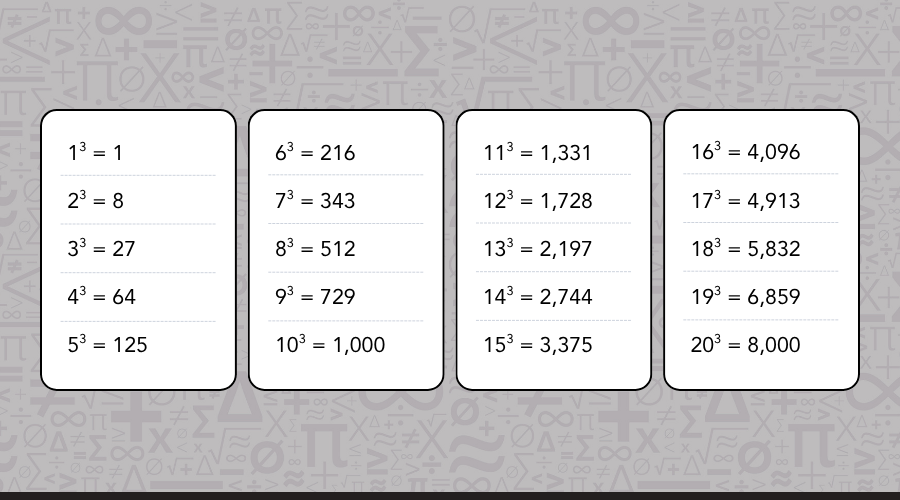
This way, we may find the perfect cube of any whole number. But instead of calculating the same ones again and again, we can memorize a few common perfect cubes. Here are the first 20:
Notice that any integer can be cubed, so perfect cubes can be negative or equal to zero:
-
For example, (−3)3 means (−3) × (−3) × (−3). The first two negatives multiply to a positive, but that positive result gets multiplied by one more negative, leaving us with −27. As we’re multiplying an odd number of negatives together, the result stays negative.
-
0³ = 0 × 0 × 0 = 0, so 0 counts as a perfect cube too.
How to Tell If a Number Is a Perfect Cube
To check whether a number is a perfect cube, we look for an integer that gives us that number when raised to the third power:
-
If we find one, the number is a perfect cube.
-
If no integer cubed gives us the target, the number is not a perfect cube.
Let’s see whether 64 is a perfect cube:
We need to find an integer that gives us 64 when raised to the third power. Since 33 = 27 is too small, we try the next integer, 4:
4 × 4 × 4 = 64.
This means 64 is a perfect cube.
Now, we’ll check 100:
The nearest perfect cubes are 43 = 64 and 53 = 125, and 100 falls right between them. No whole number cubed lands on 100, so 100 isn’t a perfect cube.
Here are a few examples that show how we can tell whether a number is a perfect cube or not:
| Number |
Is it a perfect cube? |
Reason |
| 64 |
Yes. |
43 = 64. |
| 100 |
No. |
No whole number cubed equals 100. |
| 216 |
Yes. |
63 = 216. |
| 500 |
No. |
It lies between 73 = 343 and 83 = 512. |
| −27 |
Yes. |
(−3)3 = −27. |

What Is a Cube Root?
A cube root takes us backward from a perfect cube. It tells us which number was raised to the third power to get that perfect cube.
We write a cube root with the radical symbol and a small 3: 3\(\sqrt{\vphantom{x}\hphantom{x}}\).
For instance, we already know 33 = 27, so if we work backward, the cube root of 27 is 3:
3\(\sqrt{27}\) = 3.
The cube root undoes cubing, much like division undoes multiplication. Cubing takes us from 3 to 27, and the cube root takes us back from 27 to 3.
Cube roots also work with negative numbers. (-2)3 equals (-8), this means:
3\(\sqrt{-8}\) = (-2).
📕 You May Also Like: 5 Math Skills Kids Learn From Solving a Rubik’s Cube
How a Perfect Cube Connects to Geometry
Perfect cubes also show up in geometry. If a cube has whole-number side lengths, its volume is a perfect cube.
Picture a cube-shaped box with sides that are 4 units long. To find its volume, we multiply the three dimensions – length × width × height.
All three measurements are equal, so that’s the same as cubing the side length. That’s also where the name “cube” comes from:
4 × 4 × 4 = 43 = 64.
So a cube with side length 4 units has a volume of 64 cubic units. That gives us a visual way to understand why 64 is a perfect cube.
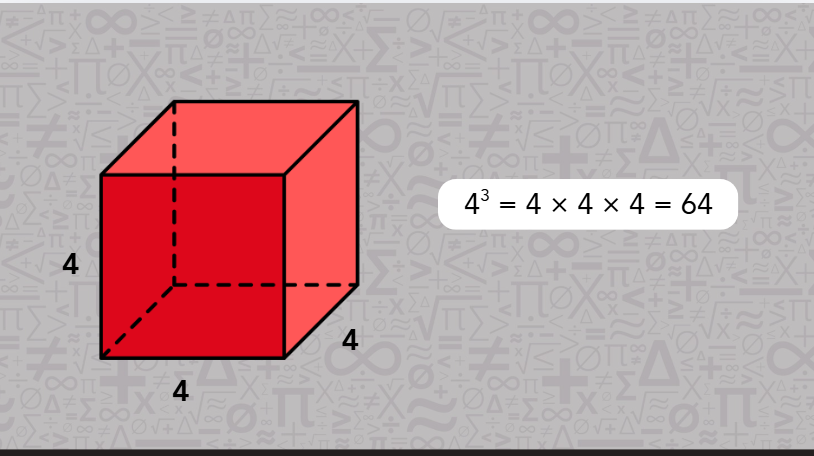
Each perfect cube can represent the volume of a cube with whole-number side lengths, whether it’s unit blocks in a game or a cube-shaped box in real life.
📕 You May Also Like: Is Your Student Ready for Their Geometry Class? [+Quiz]
Perfect Cube vs. Perfect Square: What Is the Difference?
Perfect squares and perfect cubes are often discussed together because both come from multiplying the same number by itself and both connect to geometric shapes.
What sets them apart is how many times we use the same factor. To square a number, we multiply it by itself twice. To cube a number, we multiply it by itself three times.
For example:
-
52 = 5 × 5 = 25
-
53 = 5 × 5 × 5 = 125
Now, take a look at a few other traits that set them apart:
-
How we reverse the operation: We use a square root to work backward from a perfect square and a cube root to work backward from a perfect cube. For example, 42 = 16, so \(\sqrt{16}\) = 4. But 43 = 64, so 3\(\sqrt{64}\) = 4.
-
Whether the result can be negative: Perfect squares are never negative because squaring a negative number gives us a positive result. While perfect cubes can be negative. For instance, (-3)3 = -27.
-
Does 0 belong to the group: Zero belongs to both groups. Since 02 = 0 and 03 = 0, zero is both a perfect square and a perfect cube.
-
How each connects to geometry: A perfect square represents the area of a square with side length of a whole number. A perfect cube represents the volume of a cube with side length of a whole number.
To help you keep the two concepts straight, our tutors put together this quick reference table.
|
Perfect cube |
Perfect square |
| How the number is built |
Multiply the same integer by itself three times. |
Multiply the same integer by itself twice. |
| Example |
43 = 64 |
42 = 16 |
| How we reverse it. |
Use a cube root (3\(\sqrt{\vphantom{x}\hphantom{x}}\)). |
Use a square root (\(\sqrt{\vphantom{x}\hphantom{x}}\)). |
| Can the result be negative? |
Yes. |
No. |
| Is 0 included? |
Yes. |
Yes. |
| How it connects to geometry |
Volume of a cube |
Area of a square |
📕 You May Also Like: What Does “Squared” Mean in Math? Explain It to a 10-Year-Old
Your Turn! Is This a Perfect Cube?
For each number below, decide whether it’s a perfect cube, and explain why. You can check your answers at the bottom of the page.
-
49
-
125
-
−8
-
81
-
3\(\sqrt{27}\)
-
\(\sqrt{36}\)
📕 You May Also Like: 5 Ways Math Practice Impacts Brain Development + Benefits
 Mathnasium is a math-only learning center dedicated to helping K–12 students of all skill levels excel in math, whether they need to catch up, keep up, or get ahead.
How Mathnasium Helps Students Make Sense of Perfect Cubes (and Any Other Math Topic)
Mathnasium is a math-only learning center dedicated to helping K–12 students of all skill levels excel in math.
When students turn to us for math support, we aim to build true understanding of math concepts, such as perfect cubes, so they can carry those skills into more advanced topics with confidence.
To build that level of understanding, we use the Mathnasium Method™, our proprietary teaching approach, to meet students where they are and guide them forward step by step.
Each student begins with a diagnostic assessment that helps us understand their current skill level, knowledge gaps, goals, and how they think and feel about math.
Using these insights, we build a personalized learning plan focused on the skills the student needs most, whether that means recognizing perfect cubes, connecting exponents to repeated multiplication, strengthening multiplication fluency, or preparing for later work with cube roots and algebra.
Our specially trained tutors follow that plan closely and provide live, face-to-face instruction in a caring and fun group environment. They use mental, verbal, visual, tactile, and written techniques to help students build cube models, compare side lengths and volumes, recognize numerical patterns, and explain why a number is or is not a perfect cube.
Students also get room to think through problems before tutors step in. Our tutors guide them to test their ideas, check whether a number fits the pattern, and explain their reasoning. This helps students build critical thinking, problem-solving skills, and greater independence in math.
Fun is part of the approach, too. We use hands-on and game-based activities, rewards, and consistent encouragement to keep students engaged as they explore perfect cubes, exponents, and related number patterns.
The impact is clear in our results:
-
94% of parents report an improvement in their child's math skills and understanding
-
93% of parents report their child's improved attitude toward math after attending Mathnasium
-
90% of students saw an improvement in their school grades
With over 1,100 learning centers across North America, there is likely a Mathnasium close to you.
For families in and near Los Angeles, California, Mathnasium of Westwood brings that same approach close to home, with specially trained tutors who help students make sense of perfect cubes, exponents, and the algebra and geometry concepts that build from them.
If your child is finding perfect cubes or any other math concept hard, a free diagnostic assessment is a great place to start. Using what we learn, we create a personalized learning plan focused on the skills they need next.
📅 Schedule a Free Assessment at Mathnasium of Westwood
Not near Westwood?
📍 Find a Mathnasium Learning Center Near You
Pssst…! Check Your Answers Here
Did you spot the perfect cubes? Let’s check how you did.
-
49: a perfect square (72 = 49), but not a perfect cube. The nearest perfect cubes are 33 = 27 and 43 = 64, and 49 falls between them.
-
125: a perfect cube: 53 = 125.
-
(−8): a perfect cube: (−2)3 = −8.
-
81: a perfect square (92 = 81), but not a perfect cube. It falls between 43 = 64 and 53 = 125.
-
3\(\sqrt{27}\): equals 3, because 33 = 27.
-
\(\sqrt{36}\): equals 6, because 62 = 36. This one’s a square root question, not a cube root, so we’re looking for a number multiplied by itself twice, not three times.


 (310) 475-2222