A number line is a tool most students first meet in kindergarten or first grade as they learn counting order and basic addition.
But as helpful as it is for early math, its job doesn't end there. As the math gets more complex, that same simple line gives kids a visual way to tackle fractions, negative numbers, absolute value, and inequalities.
The best thing about this tool is how simple it is to use at home. You'll be all set with a pencil and a piece of paper to draw things out.
Today, we'll show you how a simple number line works across different stages of math, along with easy ways you can use it at home to help math make sense to your child.
What Is a Number Line?
A number line is a straight horizontal line with numbers placed in order at equal intervals. The values increase as we move to the right and decrease as we move to the left.
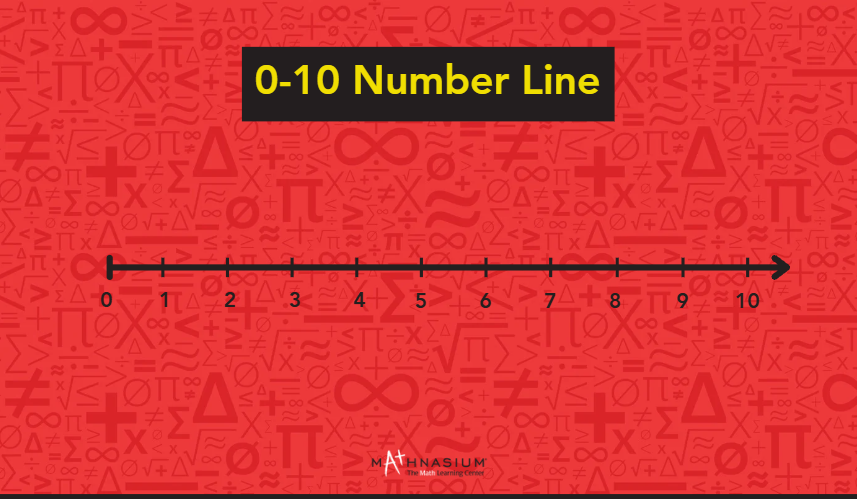
On a number line, we can place each number in a specific position and compare where it sits in relation to the others.

How to Use a Number Line to Build Early Number Sense
In the early grades, you can use a number line to help your learner master foundational math skills such as:
As they become more comfortable with the tool, you can introduce skip counting on the number line as the next step. From our work with students, we’ve found that it gives children an early way to see repeated groups and begin developing the thinking they will later use in multiplication.
Counting and Comparing With a Number Line
Use the number line to help your child see how counting and comparing work visually:
-
Draw a number line from 0 to 10 on a piece of paper.
-
Ask your child to point to each number in order, starting at 0.
-
Choose two numbers, such as 3 and 7, and ask, “Which one is farther to the right?” Explain that the number farther to the right is greater.
-
Try a few more pairs so your child gets comfortable comparing numbers by their position on the line.
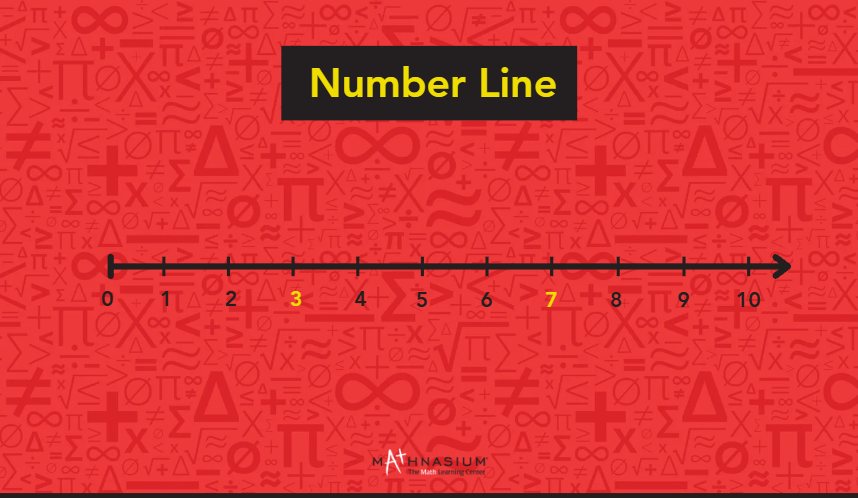
For young learners building these early number skills, our early childhood math tutors at Mathnasium of Westwood in Los Angeles provide age-appropriate instruction that supports understanding and confidence from the start.
📕 You May Also Like: Finger Counting: A Great Tool or a Hindering Habit
Addition and Subtraction on a Number Line
In our sessions, we see addition and subtraction click more clearly when students can track each step and watch the answer build on a number line.
Here’s how our tutors would set it up:
-
Draw a number line from 0 to 10.
-
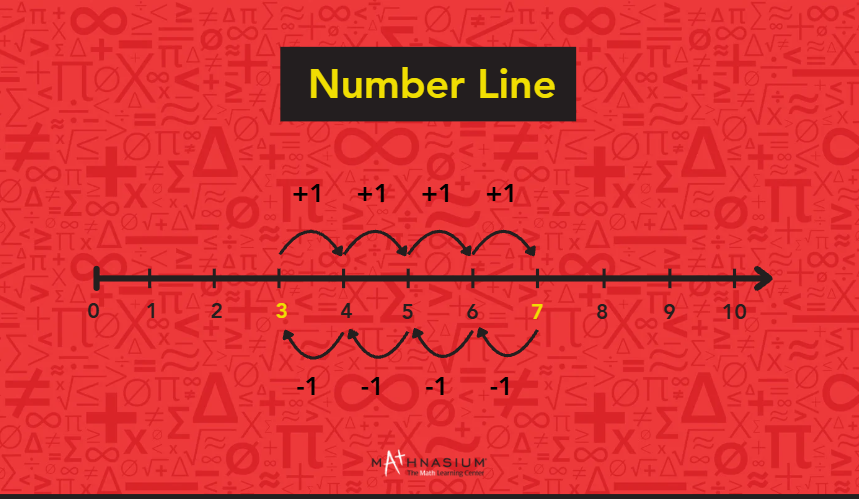
Have your child start at 3 and count forward 4 spaces to solve 3 + 4.
-
Point out that where they land, 7, is the answer.
-
For subtraction, reverse the direction: start at 7 and count backward 4 spaces to land on 3.
Skip Counting
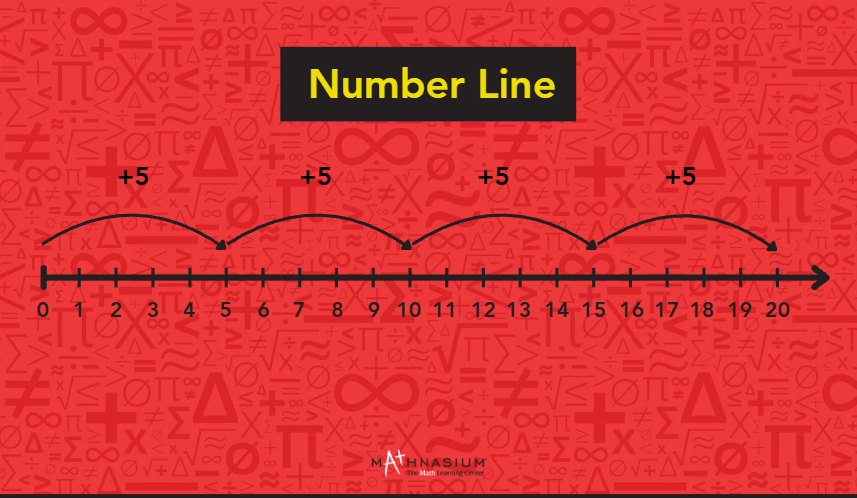
After your child has practiced moving one step at a time on a number line, you can use the tool to introduce larger, equal jumps and connect them to multiplication. Try it like this:
-
Draw a number line from 0 to 20.
-
Ask your child to count by 5s: 5, 10, 15, 20.
-
Show that they made 4 equal jumps of 5, which matches 5 × 4.
-
Repeat with jumps of 2 or 10 so they can practice the same multiplication pattern in a new way.
📕 You May Also Like: Skip Counting: The Bridge Between Counting and Multiplication
How a Number Line Helps With Fractions, Decimals, and Negative Numbers
As your learner moves into fractions and decimals, the number line gives them a simple way to compare values and understand how they relate to whole numbers.
Later, they may also use the tool to understand negative numbers by extending that same line below zero.
Fractions on a Number Line
If your student finds it hard to compare two fractions on paper, show them on a number line so they can see where each one falls between two whole numbers.
For example, follow these steps to compare \(\Large\frac{3}{4}\) and \(\Large\frac{5}{8}\):
1. Draw a number line from 0 to 1 and divide it into eighths.
2. Show your child that \(\Large\frac{3}{4}\) and \(\Large\frac{6}{8}\) land on the same point on the number line. That helps them see that the two fractions are equivalent even though they use different numbers.
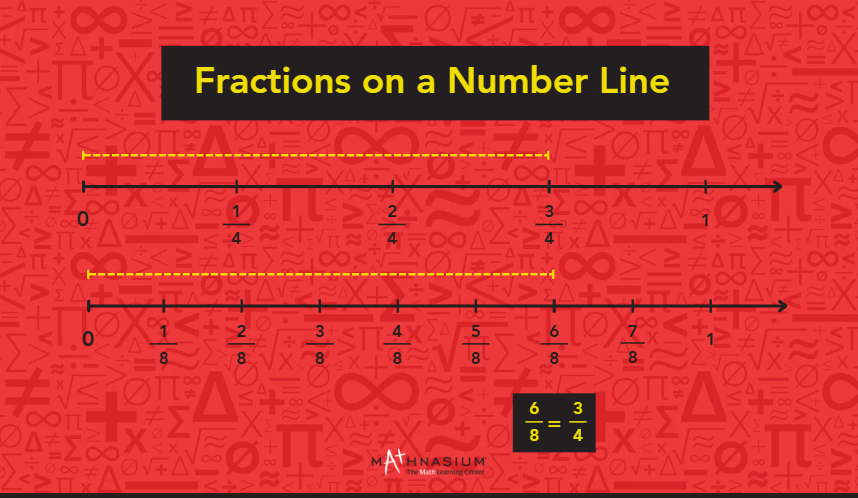
3. Count six eighths from 0 and mark \(\Large\frac{3}{4}\) at that point.
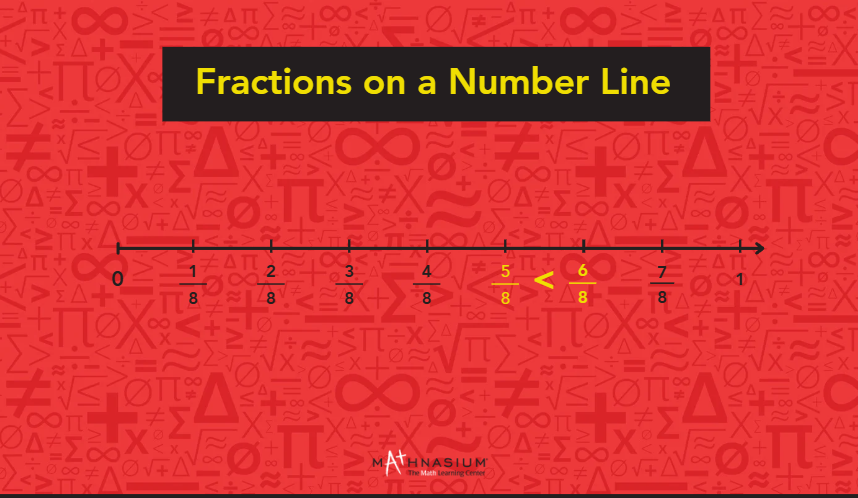
4. Then, have them find and mark \(\Large\frac{5}{8}\) on the same line.
5. Compare the two positions. Since \(\Large\frac{6}{8}\) is farther to the right than \(\Large\frac{5}{8}\), \(\Large\frac{6}{8}\) >\(\Large\frac{5}{8}\). So \(\Large\frac{3}{4}\) > \(\Large\frac{5}{8}\).
📕 You May Also Like: 7 Tips to Help Your Child Build Solid Fraction Understanding
Negative Numbers on a Number Line
Negative numbers can feel confusing at first because your learner is used to thinking of zero as “nothing.” So how can a number be less than nothing?
They may also wonder why −4 is greater than −3 when 4 is clearly the larger digit. This is where a number line comes in handy. It can make both ideas easier to understand by showing where negative values sit in relation to zero and to one another.
You can put it into practice this way:
-
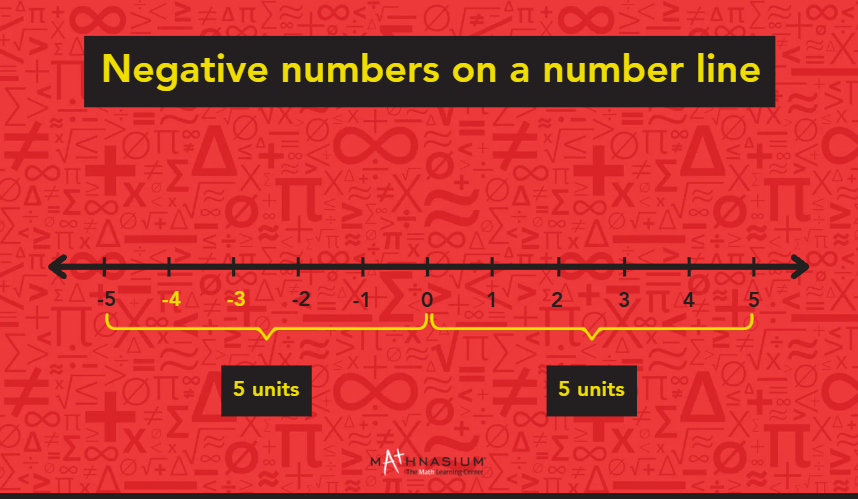
Extend your number line below zero, from −5 to 5.
-
Ask your child to find −3 and −4 on the line.
-
Compare their positions. −3 is greater than −4 because it sits farther to the right on the number line.
-
Then introduce absolute value by comparing −5 and 5. Absolute value tells us how far a number is from zero on the number line. Both −5 and 5 are 5 units from zero, so the absolute value of each is 5.
📕 You May Also Like: How to Use a Number Line With Positive & Negative Numbers
How to Use a Number Line for Inequalities in Algebra
When your student moves into algebra, they can keep using a number line to work with new ideas such as inequalities.
Inequalities describe a range of possible values rather than one exact answer.
Say we solve this inequality:
x − 3 > −1
We add 3 to both sides and get:
x – 3 + 3 > –1 + 3
x > 2
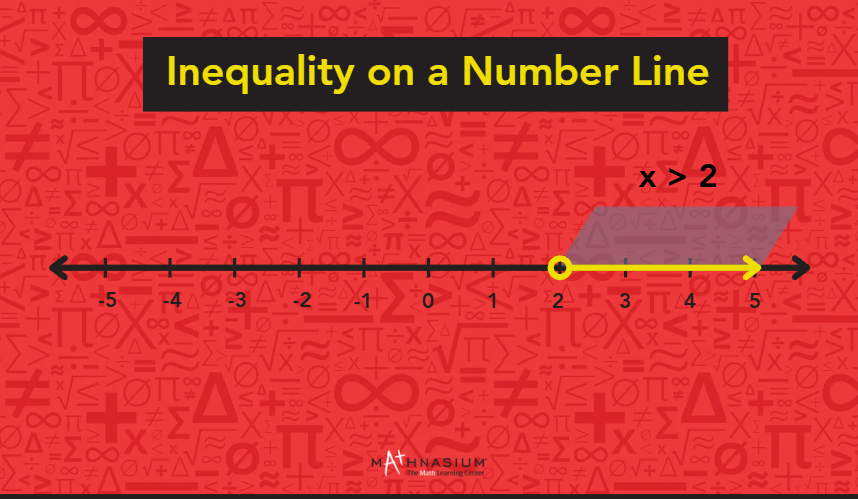
Our answer, x > 2, means that x can be any number greater than 2. That can be hard to picture at first, so we can show it on a number line:
-
Draw an open circle at 2 because 2 is not included.
-
Then shade to the right to represent all possible values of x.
We love using number lines to bring inequalities to life at Mathnasium of Westwood, but it’s just one of many tools in our kit.
If your learner is running into a wall with inequalities or similar topics, our algebra tutors are always here to help them break things down and build that confidence back up.
 Mathnasium tutors draw on visual tools such as number lines, along with a range of other teaching methods, to explain math in ways that match each student’s needs.
How Mathnasium Helps Students Master Any Math Concept
Mathnasium is a math-only learning center dedicated to helping K–12 students of all skill levels excel in math.
We help students build a deeper understanding of math by using different teaching strategies and tools, including number lines. This is all a part of the Mathnasium Method™, our proprietary teaching approach.
Here’s how it works.
Each student begins with a diagnostic assessment that helps us understand their current skill level, knowledge gaps, goals, and how they think and feel about math.
We also look at how your child responds to different ways of learning, so we can adjust instruction accordingly. For some students, that may include visual tools such as a number line or diagram. From there, we create a personalized learning plan focused on the skills the student needs most.
Our specially trained tutors follow the plan closely and provide live, face-to-face instruction in a caring and fun group environment. They help students connect new ideas to what they already know, whether that means using a number line to compare values, reason with fractions, work with negative numbers, or visualize an inequality.
Students also get room to think through problems before tutors step in. Our tutors guide them to explain what they see, choose a useful representation, and check whether their answer makes sense. This helps students build problem-solving skills, critical thinking, and greater independence in math.
Fun is part of the approach, too. Game-based activities, rewards, and consistent encouragement help students stay engaged as they explore number relationships and build confidence with new concepts.
The impact is clear in our results:
-
94% of parents report an improvement in their child's math skills and understanding
-
93% of parents report their child's improved attitude toward math after attending Mathnasium
-
90% of students saw an improvement in their school grades
With over 1,100 learning centers across North America, there is likely a Mathnasium close to you.
For families in and near Westwood, Mathnasium of Westwood brings that same approach close to home, with specially trained tutors who can help students use visual tools like the number line to make sense of math from early number skills through algebra.
Whether your child needs to build number sense, keep up with current coursework, or get ahead, a free diagnostic assessment is a great place to start. Using what we learn, we create a personalized learning plan that helps your child master the skills they need in a way that works best for them.
📅 Schedule a Free Assessment at Mathnasium of Westwood
Not near Westwood?
📍 Find a Mathnasium Learning Center Near You


 (310) 475-2222