3 Ways to Find the Least Common Multiple (and How to Know Which One to Use)
Jul 31, 2026
| Windermere FL
The least common multiple, or LCM, shows up when we need a common denominator to add or subtract fractions. There are several ways to find an LCM. As soon as we understand how each method works, we can choose the one that fits the numbers we’re working with.
Instead of depending on one memorized process, we can look at the problem, think about the numbers, and pick a method that makes sense. That flexibility is an important part of math fluency.
Today, we're going to walk through three methods for finding an LCM and learn how to choose the method that fits the problem in front of us.
Now we compare both lists and look for the first number they share. The first shared number is 12, so 12 is the LCM of 4 and 6.
Method 1: How to Find LCM by Listing Multiples
We find the LCM by listing multiples of each number until one shows up in both lists.
When the numbers are small, we can list their multiples and compare them easily. We may see the pattern clearly and spot the first match. But for larger numbers, those lists can grow fast and take longer to compare.
Let’s use this method to find the LCM of 6 and 8.
Step 1: List the Multiples of the First Number
We multiply 6 by 1, 2, 3, 4, and 5 to find its multiples:
6 × 1 = 6,
6 × 2 = 12,
6 × 3 = 18,
6 × 4 = 24,
6 × 5 = 30.
The list of multiples for 6 is 6, 12, 18, 24, 30, … .
Step 2: List the Multiples of the Second Number
Then, we find the multiples of 8:
8 × 1 = 8,
8 × 2 = 16,
8 × 3 = 24,
8 × 4 = 32,
8 × 5 = 40.
We list out multiples of 8: 8, 16, 24, 32 … .
Step 3: Find the Smallest Number That Appears in Both Lists
Now we look at the two lists of multiples side by side to find the first number that shows up in both of them.
Multiples of 6
Multiples of 8
6
8
12
16
18
24
24
32
30
40
Our first shared multiple is 24, so 24 is the LCM for 6 and 8. We only needed to multiply by 4 to find it, because that's where 24 first appeared in both lists.
We kept multiplying a few more times to make the pattern easier to see, but as soon as a number shows up in both lists, we've found the LCM and don't need to multiply any further.
For larger numbers, that match might take longer to appear, so we may need to keep going with × 6, × 7, and beyond until one does.
To find the LCM through prime factorization, we need to break each number into its prime factors. Then we look at how many times each prime factor appears and use the highest count we see.
This method works best for larger numbers, as it lets us avoid long lists entirely. Before putting the method to work, let’s refresh what a prime factor is.
Prime factors are the prime numbers that multiply together to make a number. As prime numbers can only be divided evenly by 1 and themselves, they cannot be broken down into smaller whole-number factors.
To find prime factors, we divide by the smallest prime number that fits evenly. Then we divide the result the same way and keep going until all the factors are prime.
Now, we’ll find the LCM of 12 and 18 through prime factorization.
Step 1: Find the Prime Factorization of Each Number
We break down 12 into its prime factors by dividing it by the smallest number greater than 1 that fits evenly, then doing the same with each result until nothing more can be split:
12 ÷ 2 = 6
6 ÷ 2 = 3
3 can't be divided evenly any further.
So 12 = 2 × 2 × 3.
We do the same with 18:
18 ÷ 2 = 9
9 ÷ 3 = 3
3 can't be divided evenly any further.
So 18 = 2 × 3 × 3.
Step 2: Compare the Factors and Keep the Higher Count of Each
Now we compare the two prime factorizations:
12 = 2 × 2 × 3
18 = 2 × 3 × 3
For the LCM, we need enough copies of each prime factor to cover both numbers:
The number 2 appears twice in 12, but only once in 18. We use the larger count, so we include two 2s in the LCM.
The number 3 appears once in 12, but twice in 18. We need the larger count, so the LCM must include two 3s.
Prime Factor
Shows Up In 12 As
Shows Up In 12 As
Shows Up In 12 As
2
2 × 2
2
2 × 2
3
3
3 × 3
3 × 3
Step 3: Multiply the Factors, Using the Higher Count for Each
Now we multiply each factor by the higher count we found in Step 2: two 2s and two 3s.
To find an LCM through a division ladder, we write the numbers in a row and divide them by prime numbers whenever they both divide evenly. We keep dividing until there is no shared prime factor left.
This method, also known as the upside-down division or L-method, can feel easier to follow because we don’t need to write long lists of multiples or factor each number separately first. It is especially helpful when we need to find an LCM for three or more numbers at once.
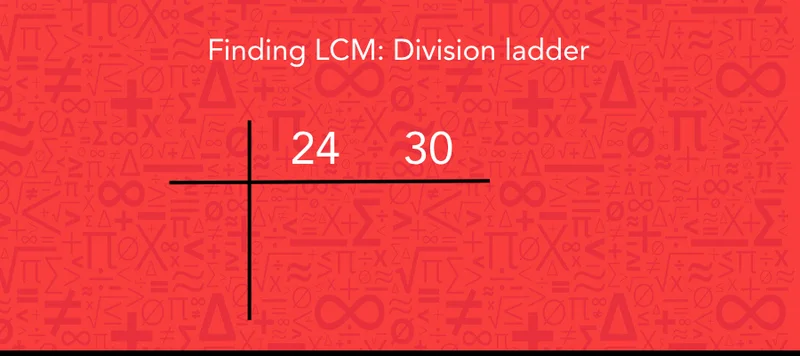
Let's find the LCM of 24 and 30.
Step 1: Set Up the ‘Ladder’ for the Numbers
We write 24 and 30 side by side, then draw a verticalline to their left and a horizontal line underneath them to create the first "step" of the ladder.
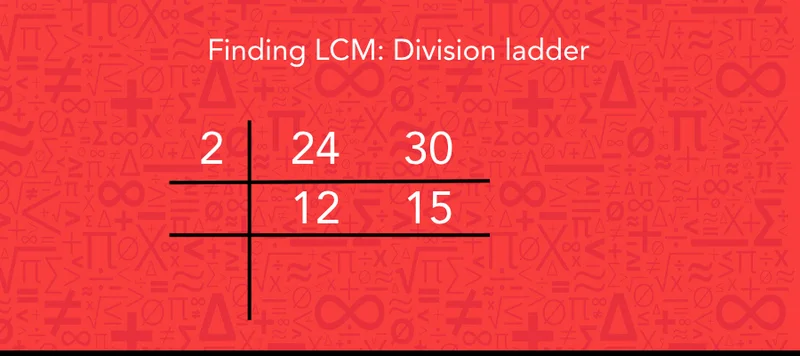
Step 2: Divide the Numbers by the Smallest Shared Prime Factor
Both 24 and 30 are even, so we can divide them by the smallest prime number, 2. We write the 2 on the left side of the ladder, and the results of the division go on the next step down.
24 ÷ 2 = 12
30 ÷ 2 = 15
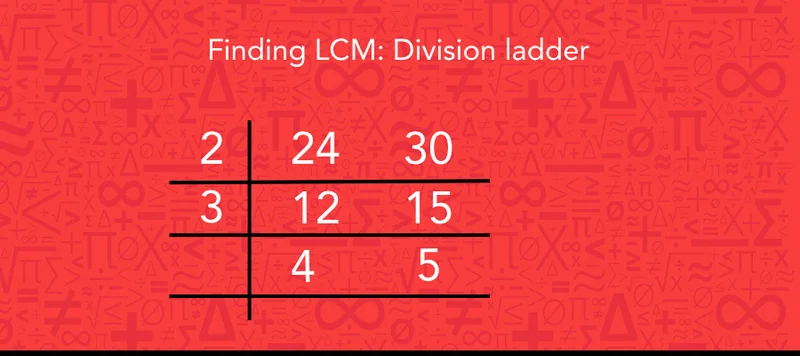
Step 3: Divide the New Numbers by the Smallest Shared Prime Factor
We divided 24 and 30 by 2, which gave us 12 and 15. Next, we look for the smallest prime number that divides evenly into both 12 and 15. Both numbers are divisible by 3, so we write 3 on the left side of the ladder and divide by it:
12 ÷ 3 = 4
15 ÷ 3 = 5
We write down the result of the division on the next step down.
Step 4: Stop When No Shared Factor Remains
We check whether 4 and 5 share any prime factors. Since 4 breaks down to 2 × 2 and 5 is already prime, the two numbers share no factor besides 1, so there's nothing left to divide by. The ladder is complete.
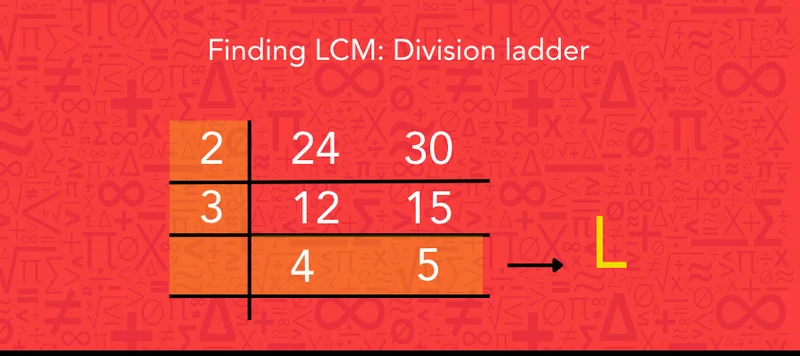
Step 5: Calculate the LCM (The "L" Rule)
To find the LCM of the two numbers, we multiply all the numbers on the left column, 2 and 3, and the bottom row, 4 and 5, together to form an L shape:
2 × 3 × 4 × 5 = 120.
So, the least common multiple for 24 and 30 is 120.
Whether we list multiples, use prime factorization, or set up a division ladder, every method leads us to the exact same LCM.
However, some methods fit certain problems better than others.
When we choose a method that fits the numbers in front of us, we can save time and effort. Use this table as a quick reference to help you decide which method to try.
Method
Best For
Quick Cue
Listing Multiples
Small numbers, especially under 20–30
We can quickly picture or write out both multiplication tables
Prime Factorization
Larger numbers, or numbers we can factor cleanly
The numbers break down into primes we recognize right away
Division Ladder
Larger numbers, or finding the LCM of three or more numbers at once
Listing multiples or factoring separately would take too long
Mathnasium tutors give students room to think through math problems, such as finding the least common multiple, compare methods, and explain why their strategy works.
How Mathnasium Helps Students Understand LCM and Any Other Math Topic
Mathnasium is a math-only learning center dedicated to empowering K–12 students of all skill levels to excel in math.
We work with students to build confidence and fluency with math skills like finding the LCM. Students learn the idea behind each method and how to choose a strategy that fits the numbers, instead of relying on one memorized procedure.
To support that kind of understanding, we use the Mathnasium Method™, our proprietary teaching approach, to meet students where they are and guide them toward math mastery, step by step.
Each student begins their Mathnasium journey with a diagnostic assessment, which helps us identify their current skills, knowledge gaps, and how they think about math. From there, we create a personalized learning plan focused on the skills the student needs most.
Our specially trained tutors follow the plan closely, delivering face-to-face instruction in a caring and supportive group environment, both in-center and online. We teach through a mix of visual, verbal, tactile, written, and mental techniques so each concept lands clearly.
We also make sure that students have room to think through problems before stepping in. They guide students to choose an efficient strategy, check whether their answer makes sense, and explain their reasoning. This balance helps students build problem-solving skills, critical thinking, and greater independence in math.
Fun is a core part of our approach, too. We use hands-on and game-based activities, rewards, and consistent encouragement to keep students engaged as they build confidence with numbers, patterns, and mathematical reasoning.
Families see the difference:
94% of parents report improvement in their child’s math skills and understanding
93% of parents report a more positive attitude toward math after attending Mathnasium
90% of students saw improvement in their school grades
With over 1,100 learning centers across North America, there is likely a Mathnasium close to you.
For families in and near Windermere, Florida, Mathnasium of Windermere FL brings that same approach close to your home, with specially trained tutors helping students develop into confident problem-solvers.
Whether your student is looking to catch up, keep up, or get ahead in math, we’re happy to assist!
Mathnasium of Windermere FL is a math-only learning center for K-12 students in Winter Garden,
FL. Trusted by over a million parents, Mathnasium uses personalized learning plans
and the proprietary Mathnasium Method™ to help students catch up, keep up, and get ahead on their math journey.
Our specially trained tutors deliver face-to-face instruction in a supportive and fun small-group environment,
working with students both in center and online to develop a deep understanding of math, build confidence,
and improve academic performance.


 (407) 243-6284