Just because a student can recite their multiplication tables doesn’t mean they’re fluent in multiplication. At most, it tells us they have a good memory. But memory and understanding are not the same.
Let’s clarify:
Ask your child, “Why does 5 × 0 equal 0?” or “If 4 × 6 is 24, what’s 4 × 60?” and if they give up on finding an answer before they even try, that’s usually a sign that they rely solely on memorization. They haven’t internalized it yet.
True multiplication mastery means knowing both the how and the why behind it.
That’s why seasoned Mathnasium tutors are sharing a piece of our approach today: 7 multiplication strategies to help your child move beyond memorization and toward true multiplication fluency.
1. Start with the Meaning: Teach Equal Groups and Repeated Addition
You can’t build a house without a foundation, right?
If multiplication fluency is the house, addition is the concrete underneath it.
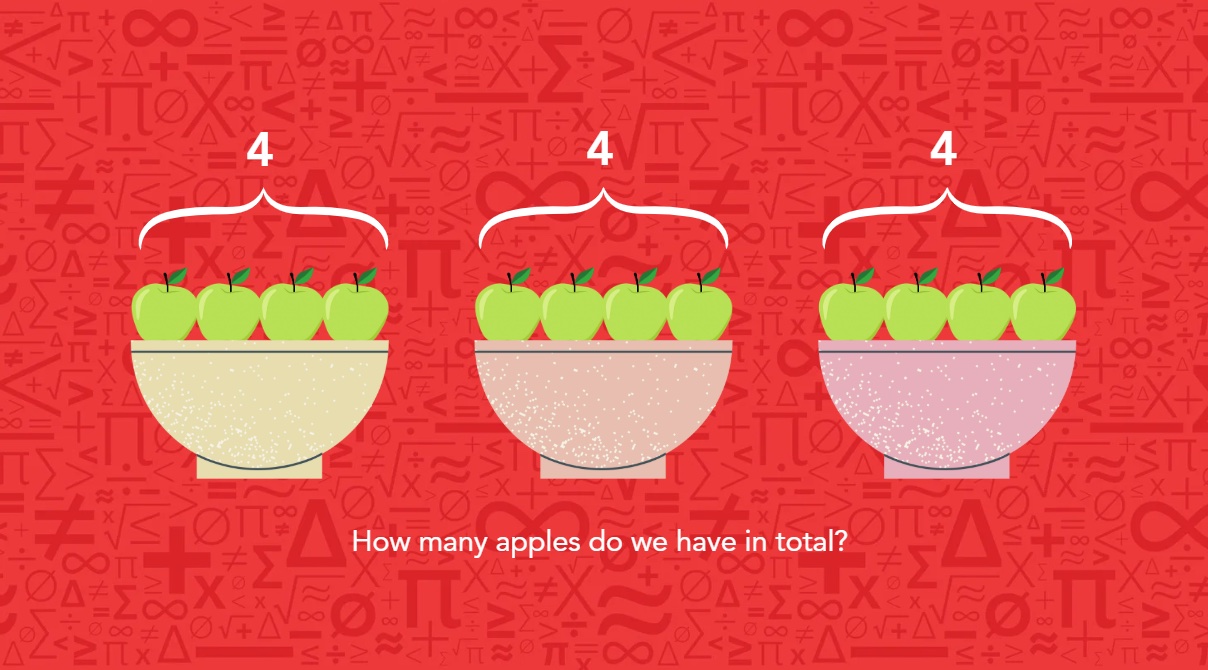
Multiplication means combining equal groups to find a total. And how do you combine equal groups? Through addition. That’s why multiplication can also be understood as repeated addition.
How do you demonstrate this?
For example:
-
3 × 4 means 3 equal groups of 4, or 4 + 4 + 4.
-
5 × 2 is 5 added twice. That’s 2 equal groups of 5: 5 + 5.
-
6 × 0? That’s six equal groups of nothing… which still gives you nothing.
If your student nails down this connection early, they’re ahead of the game when it comes to multiplication fluency.
2. Use Skip Counting and Number Patterns
With repeated addition as the foundation, skip counting becomes the next natural step.
In fact, skip counting is how many children accidentally discover multiplication, maybe while they’re counting by tens during hide-and-seek or chanting by fives while jumping rope.
You may start simple, using the most familiar and friendly patterns:
-
Count by 2s: 2, 4, 6, 8, 10…
-
Count by 5s: 5, 10, 15, 20, 25…
-
Count by 10s: 10, 20, 30, 40, 50...
Think of them as the multiplication tables in action. Counting by 2s is the 2 times table. Counting by 5s is the 5s.
Once those patterns are solid, move to trickier sequences: 3s, 4s, 6s… then work up to 7s, 8s, and 9s.
Help students connect what they’re doing to multiplication directly: “When we count by 3s four times, 3, 6, 9, 12, we’ve just done 4 × 3.”
As students build fluency, draw attention to the patterns hidden in the numbers:
-
Multiples of 2 are always even
-
Multiples of 5 always end in 0 or 5
-
Multiples of 9 have digits that add up to 9 (or another multiple of 9)
-
Multiples of 10 always end in 0
Our tutors use skip counting and pattern-finding to build number sense in action. The result? Students begin to see multiplication not as a memory test but as a flexible, solvable puzzle.
📕 You May Also Like: Skip Counting: The Bridge Between Counting and Multiplication
3. Leverage Arrays and Visual Models
As your child starts putting the pieces of the multiplication puzzle together and things begin to make sense, this is the moment to bring in visuals.
Why now? Because visuals lock it all into place.
You’ve laid the foundation with equal groups, layered in repeated addition, and built fluency through skip counting. Now it’s time to see the math.
And don’t forget: some students are visual learners first. For them, this might be the step that makes multiplication finally click.
So how do we show multiplication visually?
Start with arrays.
These are simple rows and columns that turn multiplication into a picture. Think of an egg carton, a chocolate bar, or rows of chairs in a theater; each one shows equal groups laid out in space.
For example, 4 × 3 becomes 4 rows of 3 dots:
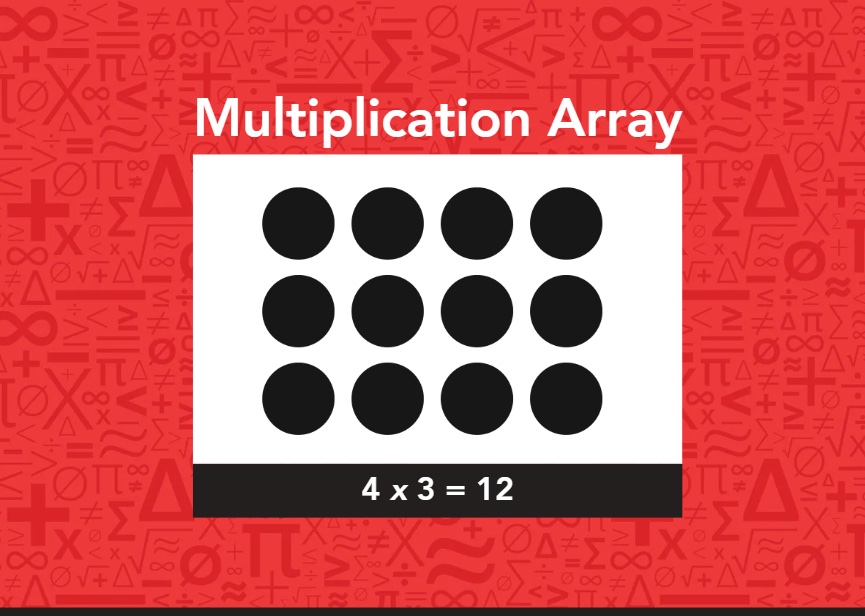
Students can count the total, see the structure, and connect it directly to a fact: 4 × 3 = 12.
Visual models also make it easier to spot patterns, compare facts, and even explore commutativity early on (like how 3 × 4 and 4 × 3 show the same total but look different).
4. Teach the Commutative Property Early
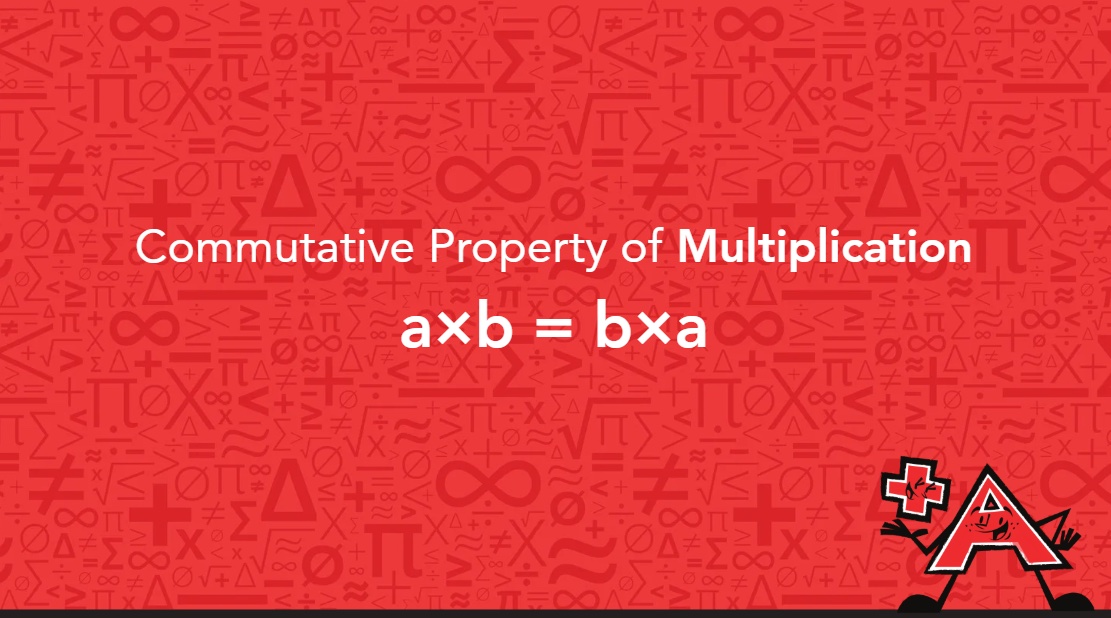
In multiplication, order doesn’t matter. That’s the commutative property: 3 × 8 equals 8 × 3. Same product, different order.
When students understand this, they don’t need to memorize every single fact. If they know 3 × 8 = 24, then 8 × 3 = 24 is already in the bag.
Here’s the part most parents don’t realize: The full 12 × 12 multiplication chart has 144 facts, but your child doesn’t need to memorize all 144.
Thanks to the commutative property (3 × 8 is the same as 8 × 3), every fact has a twin. After you account for that and set aside the 12 square numbers (like 4 × 4), the actual number of unique facts drops to just 78.
So instead of learning 144 combinations, your child can focus on fewer than half, and still know them all.
Don’t assume kids will notice that on their own. To show this clearly:
-
Use arrays (yes, the ones from earlier): Rotate them to show both versions of the fact.
-
Try physical models: Set up 3 bags with 8 marbles each, then switch to 8 bags with 3.
-
Draw it out: Sketch 3 rows of 8 stars, then 8 rows of 3. Same total, different layout.
The more students see this idea across different formats, the faster they internalize it and the more flexible their thinking becomes.
5. Make Real-World Connections
An educational study found that using local materials and student-life contexts leads to stronger concept retention and understanding.
We couldn’t agree more.
At Mathnasium, we consistently use real-world examples to ground abstract math, and multiplication is no exception.
To help students see why multiplication matters, start with everyday scenarios:
-
Cooking: “If one batch needs 2 eggs and we’re making 3, how many eggs total?”
-
Shopping: “These socks come in packs of 5. If we buy 4 packs, how many socks is that?”
-
Time: “There are 7 days in a week. How many days in 3 weeks?”
-
Video Games: “You earn 15 coins per level. How many coins after 4 levels?”
As small as they seem, these moments can reinforce understanding and help your child recognize how multiplication shows up in the world around them.
📕 You May Also Like: 9 Math Skills Kids Use Every Day Without Realizing It
6. Break Down Facts with the Distributive Property
Some multiplication facts take longer to stick than others, but students don’t need to memorize them all at face value. They can break facts apart and rebuild them using the distributive property.
In case you need a reminder, the distributive property allows you to split one factor into smaller parts, multiply each part separately, and then add the results together.
For example:
7 × 8 → (5 × 8) + (2 × 8) = 40 + 16 = 56
So why teach it?
Because it gives students a way to work through facts they don’t yet recall by using ones they already know, like 5s, 2s, and 10s. It turns frustration into problem-solving, which builds both fluency and confidence.
This approach also supports deeper math thinking. Say a student successfully breaks down these multiplication problems like so:
That means they’ve begun to recognize structure in numbers and patterns in operations. That’s a foundation they’ll return to again in algebra and beyond.
📕 You May Also Like: 7 Multiplication Games to Build Times Tables Fluency
7. Strengthen Mental Math and Number Sense
By this stage, students have seen multiplication from multiple angles, through groups, patterns, visuals, and number relationships. Now it's time to bring those pieces together.
That’s where mental math strategies come in.
This final stage is where fluency becomes flexibility. Instead of relying on paper, students solve facts by thinking in relationships, making adjustments, or simply using what they know to figure out what they don’t.
These strategies develop number sense, a skill that goes far beyond memorization.
Near-Tens Strategy
Multiplying by 10 is easier than multiplying by 9 or 11. So students can use 10 as a jumping-off point, then adjust.
Here are a few examples:
-
9 × 6 = (10 × 6) – (1 × 6) = 60 – 6 = 54
-
11 × 7 = (10 × 7) + (1 × 7) = 70 + 7 = 77
-
9 × 4 = (10 × 4) – (1 × 4) = 40 – 4 = 36
-
11 × 9 = (10 × 9) + (1 × 9) = 90 + 9 = 99
This strategy reduces effort and builds an instinct for breaking apart numbers efficiently.
Doubling and Halving
By doubling one factor and halving the other, students can reshape a problem into a more comfortable fact, particularly when one number is even.
Use these examples for inspiration:
-
4 × 16 → 8 × 8 = 64
-
6 × 14 → 3 × 28 = 84
-
12 × 5 → 6 × 10 = 60
As you may have noticed, this approach relies on the commutative property and reinforces multiplicative structure.
Use Known Facts to Build New Ones
Once students know a core set of facts, like 5s and 10s, they can apply them to nearby problems by adding or subtracting a group.
For example:
-
If 10 × 7 = 70, then 9 × 7 = 70 – 7 = 63
-
If 5 × 6 = 30, then 6 × 6 = 30 + 6 = 36
This helps students move confidently through facts they haven’t memorized yet by using logic instead of guesswork.
📕 You May Also Like: 10 Easy Steps to Teach Times Tables That Actually Work
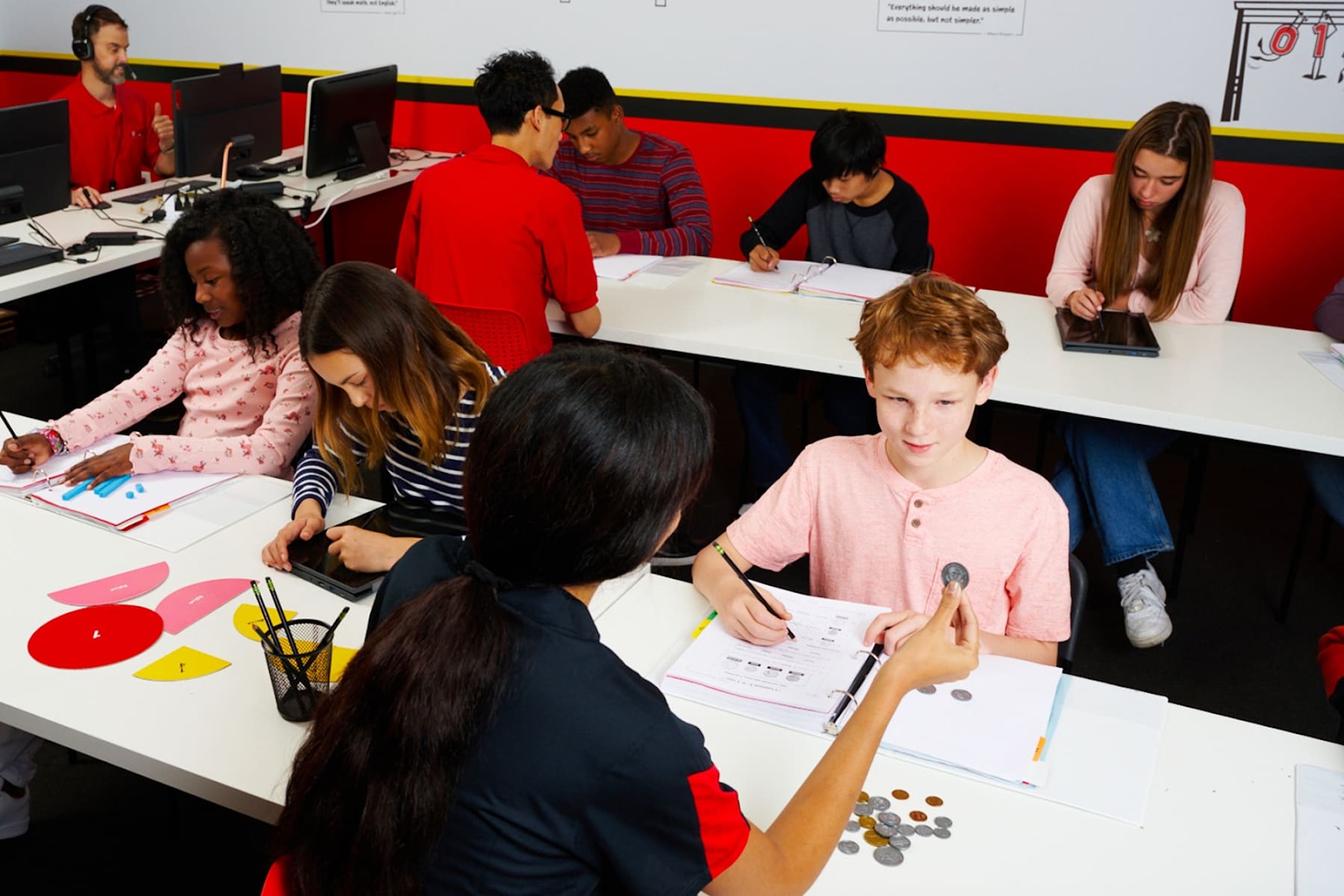
Mathnasium uses a mix of verbal, visual, mental, tactile, and written techniques to help students build lasting mastery of any math skill.
How Mathnasium Helps Students Master Any Math Skill
Mathnasium is a math-only learning center that has helped thousands of students across the U.S. learn and master math.
When students turn to us for support, whether that means developing foundational skills like multiplication or advancing into more complex problem-solving, we focus on building true mastery.
True mastery, as we define it, means a student understands how and why a solution works. They can talk through their thinking, spot errors in their process, and apply the same reasoning to different types of problems. This kind of learning builds confidence and carries over to new material with less struggle.
To build that level of understanding, we don’t rely on a one-size-fits-all system. Instead, we use our proprietary teaching approach: the Mathnasium Method™.
Our approach includes:
-
Personalized learning: Each student begins their Mathnasium enrollment with a diagnostic assessment. This helps us identify their strengths, potential knowledge gaps, and how they approach math overall. Using these insights, we design a learning plan customized to each student’s needs.
-
Teaching for understanding: We use natural, everyday language to phrase math concepts. We also use a combination of verbal, visual, mental, tactile, and written teaching techniques to help students truly make sense of what they’re learning.
-
Caring, supportive tutors: Our tutors are specially trained in math as well as the technical and emotional aspects of teaching. This means they know how to encourage a student who’s stuck and how to challenge one who’s ready to stretch their thinking.
-
Problem-solving and critical thinking skills: During sessions, we always allow time for productive struggle, then rejoin students to check and correct their processes. This helps them learn to rely on their own thinking. We guide them through both the how and the why behind each math problem, not only the final answer. This approach develops the problem-solving and critical thinking tools they’ll use in math and life.
-
Singular focus on math: We are dedicated to math and math only. This singular focus on math allows us to dive deeper into how students best learn, absorb, and retain math skills.
-
A confidence-building, fun learning environment: We often hear students say our sessions don’t feel like lessons at all. That’s because we incorporate game-based activities and plenty of rewards to keep students motivated and engaged.
Families see measurable results:
-
94% of parents report an improvement in their child's math skills and understanding
-
93% of parents report an improved attitude towards math after attending Mathnasium
-
90% of students saw an improvement in their school grades
With over 1,100 centers across the country, Mathnasium brings top-rated math tutors and our proven method close to your home.
For families located in or near Crystal Lake, IL, Mathnasium of Crystal Lake is a trusted local center with years of experience building confident math thinkers.
If your child is looking to catch up, keep up, or get ahead in math, our team is happy to help!
Ready to get started?
📅 Schedule a Diagnostic Assessment at Mathnasium of Crystal Lake
Not near Crystal Lake?
📍 Find a Mathnasium Learning Center Near You


 (815) 526-3453
 (815) 526-3453