For families exploring Algebra 1 in Denver Public Schools (DPS), questions often go beyond what the course covers. Those questions include what a student should know before starting, how accelerated pathways work, and where families can find support along the way.
At Mathnasium of Denver Highland, we work with K–12 students from Highland and surrounding communities, including Sloan Lake, Wheat Ridge, Berkeley, and Edgewater. We provide personalized, face-to-face math instruction to help them build skills and confidence in courses such as Algebra 1.
This guide brings together an overview of Algebra 1 in DPS, the foundations students build on, and local learning resources and funding options families can explore.
Algebra 1 Curriculum Overview in Denver Public Schools (DPS)
Denver Public Schools (DPS)’s math curriculum follows the Colorado Academic Standards. The Colorado Department of Education publishes a family guide to high school mathematics with learning expectations for Algebra 1.
Families can also consult the district’s course catalog for course information and syllabi, where available.
The state’s Algebra 1 learning expectations emphasize:
Students connect these ideas through real-world problems. They use tables, graphs, and equations to describe changing quantities, compare patterns of growth, and interpret data. They also explain their reasoning and consider what their solutions mean in the context of a problem.
1. Expressions, Equations, and Inequalities
An expression represents a mathematical quantity, while an equation states that two expressions are equal. Inequalities describe quantities that are greater than or less than one another.
Students work with these statements by identifying variables, rewriting expressions, and finding values that meet given conditions. They consider units as they write equations and interpret solutions. Colorado’s Algebra 1 expectations emphasize choosing appropriate units and using them consistently throughout a problem.
2. Linear Functions and Systems of Equations
A linear function describes a relationship with a constant rate of change. Students write equations for lines and connect them to tables and graphs. They interpret how changes in one quantity relate to changes in another.
Systems of equations bring two or more equations together. Students find values that satisfy the equations at the same time and identify those solutions across different representations.
Colorado’s Algebra 1 expectations include using tables, graphs, and equations to solve systems involving linear and quadratic functions.
3. Exponents and Exponential Functions
Exponents express repeated multiplication. In exponential functions, the input appears in an exponent, and the output is multiplied by the same amount each time the input increases by one.
Students represent exponential relationships through equations, tables, and graphs. They compare exponential growth and decline with linear change. In the process, they learn the difference between multiplying by the same number each time and adding the same amount each time.
Colorado’s Algebra 1 expectations include representing relationships with exponential functions and comparing them with linear and quadratic functions.
📕 You May Also Like: 3 Beginner-Friendly Visual Strategies to Learn Exponents
4. Polynomials and Quadratic Functions
Polynomials are expressions made up of terms with variables raised to whole-number exponents of zero or greater. Students add, subtract, and multiply polynomials, while keeping track of like terms.
Quadratic functions are defined by polynomials whose highest exponent is two. Students connect their equations to their curved graphs and rewrite quadratic equations through factoring and completing the square.
Students rewrite quadratic equations in different forms to solve them and identify features of the corresponding graphs.
5. Data Analysis and Relationships Between Variables
Data analysis involves examining information and interpreting patterns. In Algebra 1, students study how two variables change together and how consistent that pattern is.
Students also learn the difference between correlation and causation. Two variables can change together without one causing the other to change. Students use data to explain the connection without assuming that one causes the other.
📕 You May Also Like: What Is an Outlier in Math? Explained For Middle School
Algebra 1 Acceleration Tracks
Students in DPS can take Algebra 1 in ninth grade or complete it in eighth grade through an accelerated math pathway. In schools that follow an Algebra 1–Geometry sequence, students who complete Algebra 1 early can prepare to take Geometry when they enter high school.
Math course names, sequences, and placement requirements vary by school. Some DPS schools, including Northfield High School, use an integrated math pathway rather than separate Algebra 1 and Geometry courses.
An accelerated pathway covers the required math material at a faster pace, which includes the middle school skills students need for Algebra 1.
Families can ask their student’s school which accelerated courses are available and how placement works.

Algebra 1 Foundations: What Should Denver Students Know to Prepare?
Algebra 1 builds on the number skills and early algebra students learn in middle school. Families can use the areas below to identify what their student understands and what needs more practice before the course begins.
1. Fractions, Decimals, and Negative Numbers
If students are comfortable with fractions, decimals, and negative numbers, they can focus on the algebra rather than get stuck on calculations. Preparation includes adding, subtracting, multiplying, and dividing these numbers accurately.
Students also need to understand how positive and negative signs affect an answer and check whether a result makes sense.
2. Ratios, Proportions, and Rates
While a ratio compares quantities, a rate compares quantities measured in different units. In a proportional relationship, the ratio between the quantities stays the same.
As students work with tables, graphs, and equations, they learn to recognize these relationships. Their understanding of a unit rate, or the amount for one unit, also prepares them for slope and linear functions.
3. Variables and Expressions
A variable is a letter that represents a number. Early algebra work includes replacing variables with given values and calculating the resulting expressions.
Students practice combining like terms and using the distributive property to expand expressions. They need to change how an expression looks without changing its value.
4. Equations and Inequalities
An equation states that two expressions are equal. To find an unknown value, students perform operations that keep both sides equal. Middle school preparation includes equations that require several steps and have variables on both sides.
An inequality compares quantities using symbols such as greater than or less than. Unlike an equation with one solution, an inequality can describe a range of possible values.
5. Exponents and Square Roots
Exponents express repeated multiplication. Familiarity with exponent rules helps students simplify expressions and prepares them for more advanced algebra.
A square root reverses the process of squaring a number. Before Algebra 1, students practice finding square roots of perfect squares and working with whole-number and negative exponents.
6. Tables, Graphs, and Functions
Tables and graphs show how quantities relate to one another. Preparation includes plotting points, reading coordinates, and describing how one quantity changes as another changes.
A function assigns exactly one output to each input. Students connect functions across tables, graphs, and equations so they can recognize the same relationship in different forms.
Algebra 1 Support Resources Available to DPS Students
Families can explore school-based support and library homework help, along with personalized algebra instruction at Mathnasium.
-
DPS school support: Schools may offer extra math classes or other support during the school day. Families can ask their student’s math teacher or counselor what is available. For example, Dr. Martin Luther King Jr. Early College’s tutoring page includes online math resources and details about school-based help.
-
Denver Public Library: Students can access online tutoring and homework help with a library card. Live tutors are available from 3–10 p.m. daily, except on four major holidays.
-
Mathnasium of Denver Highland: Our personalized algebra tutoring programs are created to support students at every stage of their math journey.
FAQs About Algebra 1 in Denver Public Schools
From course materials to graduation credit, parents may have practical questions about their child’s Algebra 1 class. Below, we answer common questions and point you toward school and district resources for more information.
1. Do all Denver Public Schools use the same Algebra 1 textbook or learning materials?
Not necessarily. Textbooks and learning materials can vary by school. Check your child’s course syllabus or ask their math teacher which materials the class uses. Request the textbook title, any online learning platforms, and instructions for accessing assignments at home.
2. Does Algebra 1 taken in middle school count toward high school graduation requirements?
If your child completes Algebra 1 in middle school, they do not necessarily earn high school graduation credit. For example, Hamilton Middle School’s math pathway guidance states that high school courses taken in middle school do not count for high school credit.
Ask your child’s counselor to confirm how the course affects both graduation requirements and high school math placement.
3. What happens if my child does not pass Algebra 1?
Contact your child’s counselor to discuss options for completing the course requirements and staying on track. DPS offers credit-recovery opportunities, including Regional Summer School for eligible students.
For more information, visit the DPS summer programs page, and ask the counselor about course availability, eligibility, and enrollment.
4. Does my child need a calculator for Algebra 1?
Your child may need a calculator for Algebra 1, but the requirement and permitted models depend on their school and teacher. Check the teacher’s supply list before purchasing one, and ask which models students may use for homework and tests.
For example, Northfield High School requires a graphing calculator for all math courses and prefers the TI-84, which is taught in class.
5. How can I find out whether my child has an Algebra 1 final exam?
The course syllabus or your student’s teacher can provide info on whether students take a final exam or another end-of-course assessment, and how it contributes to their grade. Colorado’s high school state testing program includes PSAT and SAT assessments, which are separate from an Algebra 1 course final.
 Mathnasium is a math-only learning center dedicated to helping K–12 students of all skill levels excel in algebra and beyond one step at a time.
Algebra 1 Tutoring at Mathnasium of Denver Highland
Mathnasium of Denver Highland is a math-only learning center dedicated to helping K–12 students in local communities, including Sloan Lake, Wheat Ridge, Berkeley, and Edgewater.
We work with students of all skill levels and help them excel in algebra and beyond, whether they need to catch up, keep up, or get ahead.
To meet students where they are and guide them forward in algebra step by step, we use the Mathnasium Method™, our proprietary teaching approach.
Here’s how it works.
Every student begins their Mathnasium journey with a diagnostic assessment that helps us understand their current skill level, knowledge gaps, goals, and how they think and feel about algebra and math in general.
For example:
-
For a student preparing to take Algebra 1 in DPS, that may include looking closely at fractions, negative numbers, proportional reasoning, expressions, equations, and graphing—the foundations they will build on in the course.
-
For a student already taking Algebra 1 in DPS, the assessment may identify gaps affecting current work with linear equations, systems of equations, exponential functions, polynomials, or quadratic functions.
From these insights, we build a personalized learning plan focused on the skills the student needs most, whether that means reinforcing earlier foundations, making sense of algebraic relationships, or preparing for the level of math they will take on next.
Our specially trained tutors follow that plan closely and provide live, face-to-face instruction in a caring and fun group environment. They use mental, verbal, visual, tactile, and written techniques to help students understand why a method works rather than relying on memorized procedures alone.
Students also get room to think through problems before tutors step in. They guide them to explain their reasoning instead of simply giving the answers. This way, students build critical thinking, problem-solving skills, and independence they will need as math becomes more challenging.
Fun is part of the approach, too. We use game-based activities, rewards, and consistent encouragement to keep students engaged as they revisit earlier skills and prepare for Algebra 1 and the math courses that follow it.
The results speak for themselves:
-
94% of parents report an improvement in their child's math skills and understanding
-
93% of parents report their child's improved attitude toward math after attending Mathnasium
-
90% of students saw an improvement in their school grades
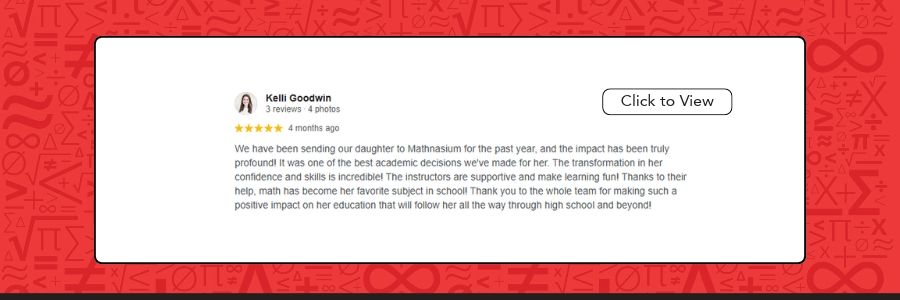
Here’s what one Denver parent shared about their experience with Mathnasium:
If your child needs help with algebra foundations or current Algebra 1 coursework, a free diagnostic assessment is a great place to start. Using what we learn, we create a personalized learning plan focused on the skills your child needs next to prepare for the math ahead.
📅 Schedule a Free Assessment at Mathnasium of Denver Highland
Not near Denver?
📍 Find a Mathnasium Learning Center Near You


 (720) 524-4763
 (720) 524-4763