5 Math Skills Your Child Needs to Master Before 6th Grade
Jul 7, 2026
| Foothill Ranch
The Grade 6 transition can be a significant pressure point in math. West and Schwerdt’s 2012 research found that students moving from elementary to middle school in Grade 6 show a 0.12 standard deviation drop in math achievement compared with students who remained in K–8 schools.
We see a similar pattern in our work with students at Mathnasium. Many families come to our math-only learning center after a sudden Grade 6 math drop.
Elementary math tends to feel more concrete and procedural. Students learn operations, practice methods, and get answers. In Grade 6, the work moves toward relationships between quantities: ratios, rates, proportional reasoning, and early algebra.
To help you prepare your student for this transition, we’ll walk through five skill areas that matter most for Grade 6 readiness. We’ll show what each one looks like in practice, why it affects later math, and how to tell the difference between real mastery and surface familiarity.
5 Foundational Math Skills for a Smooth Grade 6 Start
Not all elementary math skills are equally important at the Grade 5–6 transition. Some gaps are easy to close with a few weeks of focused practice. Others affect how your child handles whole groups of new concepts, so they deserve attention before the school year begins.
Our tutors regularly see these five skills at the root of middle school math challenges. All five align with Common Core Grade 5 expectations, which most U.S. states, including our home state of California, follow, with some state-specific additions.
For example, in California, along with other skills, students are expected to express whole numbers from 2 to 50 as products of their prime factors by the end of Grade 5. For example, 24 = 2 × 2 × 2 × 3, or 2³ × 3.
This is a California-specific addition, so families outside California may not see it emphasized in the same way. For California families, though, make sure that your child can work through prime factorization comfortably before Grade 6.
That said, we recommend checking your own state's math standards to see whether any local additions apply alongside these five Common Core-aligned skills.
1. Fraction Fluency
Siegler et al.’s 2012 research aligns with what we observe in our work with students: fractions are not a small, isolated unit that students can leave behind after elementary school.
According to the study, elementary students’ knowledge of fractions and division is one of the predictors of later algebra knowledge and overall high school math achievement.
Fraction fluency means more than getting fraction problems right. Your learner needs to understand what a fraction represents:
Students with a full understanding of fractions as a meaningful quantity are better prepared for ratios, proportions, and algebra because they can see how the ideas connect. They can recognize that a ratio such as 3 to 4, or 3:4, can be represented as a fraction, and a proportion shows that two ratios are equal.
To check your learner’s fraction fluency, you can ask them to explain why \(\Large\frac{1}{2}\) and \(\Large\frac{3}{6}\) are the same. If they have true fraction fluency, they can walk you through their reasoning instead of simply repeating the rule.
If they are relying on procedure, they may get the right answer but hit a wall with explaining why it makes sense.
2. Place Value and Decimal Sense
Grade 6 brings work with percentages, discounts, taxes, and data. All of these assume your student can move between fractions and decimals with confidence.
Your student should be able to understand how decimal place value works, perform operations with decimals confidently, and recognize how decimals and fractions describe the same quantities in different forms.
Fluent movement between decimals and fractions helps students enter Grade 6 ready for ratios andrates, which depend on exactly this kind of flexible thinking. Percentages, which students meet formally in Grade 6 under Common Core Standards, also build directly on this foundation.
You may wonder why your child has not worked much with percentages yet, especially if you remember learning them in elementary school.
So, your 5th-grader may not be familiar with percents, and that is completely normal. The focus right now should be on solid decimal and fraction fluency, because those skills will make the transition to percents much smoother.
To find out whether your student has true place value and decimal sense, ask them to convert a fraction to a decimal and explain what each form means.
Fluency with the procedure is not enough here; what you’re listening for is whether they understand that the forms describe the same value.
Multiplication and division fluency go beyond quick recall of the times tables. Your 5th-grader needs to think flexibly with these operations across whole numbers, fractions, and decimals, and understand what the operation means in each situation.
In Grade 6, those skills should feel automatic enough that they do not take attention away from ratios, rates, and early algebra. Students pausing to reconstruct a multiplication fact, or working through decimal division slowly and uncertainly, spend the energy on computation instead of the new reasoning.
To build multiplication and division fluency, along with other foundational math skills, our tutors use a mix of verbal, visual, tactile, and written techniques. This helps students understand what the operation means, how it works, and how to apply it in different types of problems.
Your child is fluent enough in multiplication and division if they can solve a multi-digit multiplication or division problem, including with decimals, without much hesitation. More importantly, they can tell you what they’re doing and why.
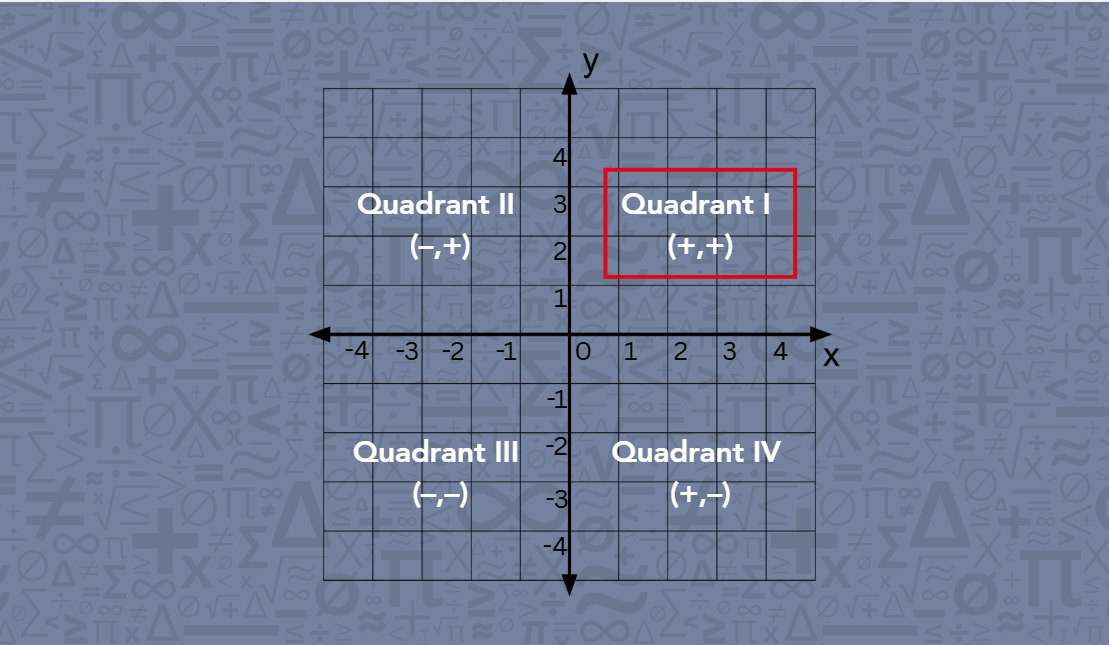
Before middle school, your 5th-grader should be able to plot and identify points in the first quadrant of the coordinate plane and understand what each coordinate represents.
In Grade 6, the coordinate plane expands to all four quadrants, and students use it to represent real-world situations, graph relationships, and reason about distance and position.
Before the work becomes more complex, check whether your student understands the basics of the coordinate grid, including:
With those skills in place, they can focus on the new reasoning instead of the mechanics of the grid.
To see whether your learner has a solid understanding of the coordinate plane, we suggest asking them to plot a point like (3, 5) and explain what each number tells them. Then ask what happens if you swap the numbers to (5, 3). They should be able to tell you why those two points land in different places.
Your 5th-grader also should be able to work through problems that involve more than one step and explain how one step leads to the next.
In Grade 6, students work with more demanding multi-step problems. They are asked to plan a solution, choose the right operations, and keep track of several pieces of information at once.
This means your child needs to finish 5th grade feeling comfortable enough with the structure of the problem. Make sure they can:
Identify what the problem is asking,
Decide what information they need first,
Choose the right operation for each step,
Keep track of what each number represents,
Check whether the final answer makes sense.
These skills help students stay organized as problems become longer and less direct.
For a quick check of multi-step problem-solving skills, try giving your student a two-step word problem, such as finding the total cost of several items after a discount.
Before the calculations, ask them to explain how they would start. They should be able to tell you a clear plan, steps in the right order, and an explanation of why each step is needed.
Work through this list with your learner to see how they are prepared for the 6th grade. As you go through each item, notice whether they can do it comfortably, without prompting or much hesitation.
Explain why \(\Large\frac{1}{2}\) and \(\Large\frac{4}{8}\) are equivalent
Place fractions \(\Large\frac{5}{3}\) or \(\Large\frac{7}{4}\) correctly on a number line
Convert \(\Large\frac{3}{4}\) into a decimal and explain what 0.75 means
Perform decimal operations: for example, solve 4.56 ÷ 3
Recall multiplication facts fluently and apply them flexibly across whole numbers, fractions, and decimals. Solve: 6 × 9 = ?; 6 × 0.9 = ?; find out what \(\Large\frac{1}{6}\) of 54 is.
Plot a point (3, 5) on a coordinate plane and explain what each number means
Explain why (3, 5) and (5, 3) land in different places on the grid
Solve a two-step word problem and explain the plan before calculating. For example, a store sells notebooks for $1.25 each. You buy 4 and pay with a $10 bill. How much change do you get?
Keep track of what each number represents across multiple steps
Check whether a final answer makes sense given the original problem
For California families, there is one more skill to check: prime factorization:
Break 36 into its prime factors
The checklist gives you a helpful first look at your child’s Grade 6 readiness. Still, some math gaps are hard to identify from a few questions at home. That is where a more complete assessment can help.
At Mathnasium, we use a diagnostic assessment to identify each student’s current skill level, learning gaps, and readiness for the next stage of math.
With those insights, our tutors create a personalized learning plan and provide targeted instruction to help students strengthen the skills they need for a smoother transition into middle school math.
What You Can Do to Build Your Child’s Grade 6 Readiness
If you noticed that your student has not fully mastered certain skills before 6th grade, you can use a few specific strategies to build the foundation they need.
A. Focus on Understanding Instead of the Right Answer
When your child completes a math problem at home, ask them to explain their reasoning rather than just check whether the answer is correct.
Questions like "How did you get that?" and "Does that answer make sense?" are more useful than "Is that right?" A student capable of explaining their thinking has a more solid foundation than one who can produce correct answers without understanding them.
B. Identify the Specific Skill That Needs Practice
A broad review of everything from 5th grade is rarely the most effective approach. Use the Grade 6 readiness checklist to identify which skills feel uncertain, then focus practice on those specific areas.
Ten minutes of targeted work on fraction-to-decimal conversion or multi-step problem planning may be more useful than a general worksheet covering multiple topics.
If you are not sure where to start, or if at‑home checks are giving you mixed signals, Mathnasium begins each student’s journey with a diagnostic assessment. That first step pinpoints specific strengths and gaps so practice time goes toward the skills that matter most.
One of the most natural ways to build fraction, decimal, and coordinate thinking at home is to invite your child into the math that already exists around them. You can try any of these at home:
When you are cooking, ask them to scale a recipe up or down.
At a restaurant, have them figure out how to split the bill or estimate a tip.
On a road trip, ask how much you would spend on gas if you need to fill up twice at a given price.
Pull up a simple map and ask them to describe a location using two reference points. A chessboard works too. Ask your student to describe a piece's location by row and column, then ask what changes if those two coordinates are switched.
You do not need to turn these moments into worksheets. Just include your child in the thinking instead of doing the math for them.
D. Make Multi-Step Thinking a Regular Habit
Multi-step problem solving is less about the math and more about the reasoning habit. At home, you can build this by asking your child to plan before they calculate.
Give them a word problem and ask: "What do you need to figure out first? What comes next?" That planning habit transfers directly into Grade 6 work.
E. Know When It’s Time for Structured Support
If you notice that gaps are spreading across several skills, or that home practice is not improving things over a few weeks, it is a sign your child may need more structured support than occasional review at home.
At that point, the goal changes from “extra practice” to “guided instruction in a consistent environment,” where a tutor can diagnose specific misunderstandings, introduce concepts step by step, and help your child stay on track over time.
Mathnasium provides exactly this kind of structured support: students start with a diagnostic assessment, work from a personalized learning plan, and get regular, face‑to‑face guidance designed to close gaps and build lasting confidence before 6th grade begins.
Mathnasium tutors help students build the foundational skills, confidence, and problem-solving habits they need for 6th-grade math.
How Mathnasium Can Help Students With the 5th–6th Grade Transition
Mathnasium is a math-only learning center that helps K–12 students excel in math. We have worked with thousands of students preparing for the transition into middle school, and we know how to help make that transition smoother.
To support students in this transition, we use the Mathnasium Method™, our proprietary teaching approach, which addresses the specific gaps in a logical sequence.
Each student begins with a diagnostic assessment that maps their mathematical understanding: which concepts are truly solid, which are procedurally familiar but not fully understood, and which gaps are affecting the math that comes next.
For a student approaching 6th grade, that assessment gives you a clear picture of where their readiness actually stands. From there, we create a personalized learning plan that addresses gaps gradually at the student’s pace and builds on what is already known.
Our specially trained tutors work with students in a caring and fun group environment, and use visual, verbal, tactile, and written techniques to make abstract concepts concrete, moving at the pace real understanding requires.
Here is what families across the U.S. report after working with us:
94% of parents report an improvement in their child’s math skills and understanding
93% of parents report their child’s improved attitude toward math after attending Mathnasium
90% of students saw an improvement in their school grades
With over 1,100 centers across the U.S., Mathnasium brings our proven method close to your community.
For families in Foothill Ranch, CA, and the surrounding communities, Mathnasium of Foothill Ranch brings that same approach close to home.
If you’d like a clear picture of where your child stands before the school year starts, a free diagnostic assessment is the right first step.
Mathnasium of Foothill Ranch is a math-only learning center for K-12 students in Foothill Ranch,
CA. Trusted by over a million parents, Mathnasium uses personalized learning plans
and the proprietary Mathnasium Method™ to help students catch up, keep up, and get ahead on their math journey.
Our specially trained tutors deliver face-to-face instruction in a supportive and fun small-group environment,
working with students both in center and online to develop a deep understanding of math, build confidence,
and improve academic performance.
Learn how to read your child's math report card, spot key skill gaps, and take meaningful steps to guide their learning with advice from Mathnasium tutors.
Learn how the 5 C’s of Math Engagement, developed by Stanford’s Jo Boaler, help students build deeper understanding, with guidance from Mathnasium tutors.


 (949) 868-6480