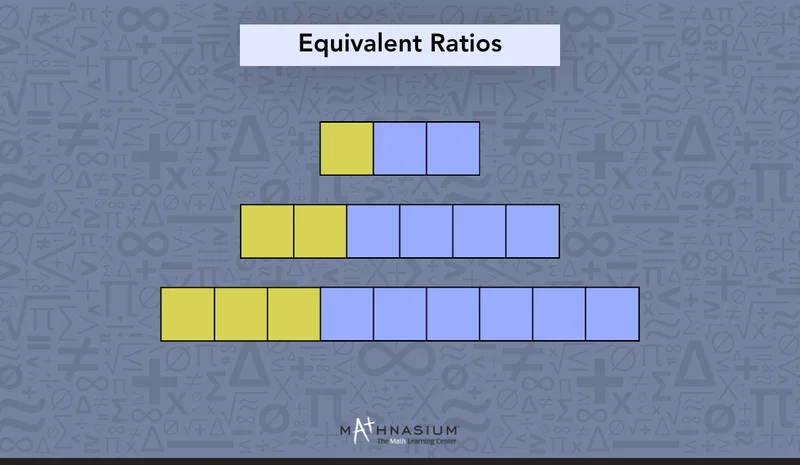
Sixth grade is an exciting step forward as students start building a formal understanding of ratios. During this year, they learn how to describe the relationships between different quantities, setting a solid foundation for bigger topics like percentages, unit rates, and early algebra.
Equivalent ratios are a key part of that journey. As students learn how ratios scale, they develop the proportional thinking needed for algebra and real-world problem-solving. This concept builds the confidence they need as they move forward.
To help, our Mathnasium tutors put together this guide to explain what makes two ratios equivalent, how to find equivalent ratios, and how equivalent ratios connect to proportions.

Let’s Review First: What Is a Ratio?
A ratio compares two or more quantities and shows the relationship between them, either as a part-to-part or a part-to-whole comparison.
We use ratios anywhere two things sit side by side, and we want to describe how they relate, like:
Let's use a simple example to show this.
Say we have a basket containing 5 red and 3 green apples.
We can express that relationship with the ratio of 5 to 3, meaning there are 5 red apples for every 3 green apples.

This is a part-to-part comparison, since we're comparing one part of the basket to another part of the basket.
In math, we can write that same ratio in three different ways:
All three notations describe the same comparison.
Our Mathnasium tutors always remind students that order matters when writing a ratio, since we're always comparing the first quantity to the second.
If we compared 3 green apples to 5 red ones, our ratio would show a different relationship of 3 to 5.
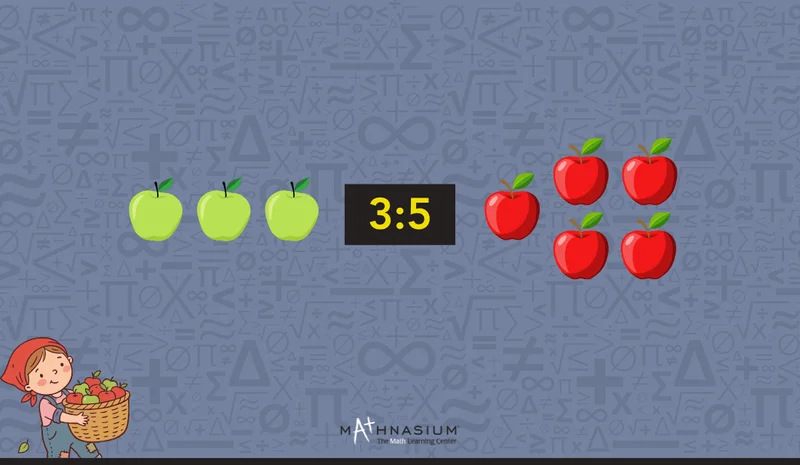
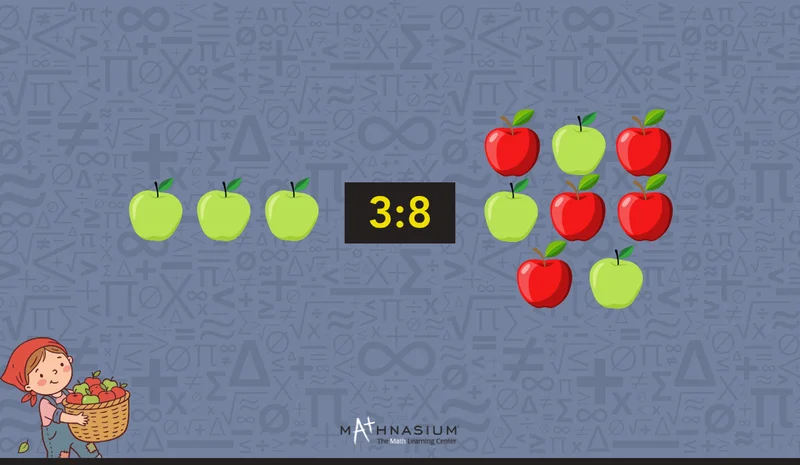
Order also matters when we move from a part-to-part comparison to a part-to-whole comparison.
Our basket holds 8 apples in total, 5 red and 3 green. If we compare the green apples to the whole basket instead, our ratio becomes 3 to 8.
📕 You May Also Like: Ratios: What They Are and How They're Used in Real Life
So, What Are Equivalent Ratios?
Equivalent ratios are ratios that describe the same relationship between quantities, just at a different scale.
Let's see how they work with a simple example.
Say one batch of lemonade takes 1 cup of sugar for every 3 lemons. We can write that relationship as a ratio:
1 : 3
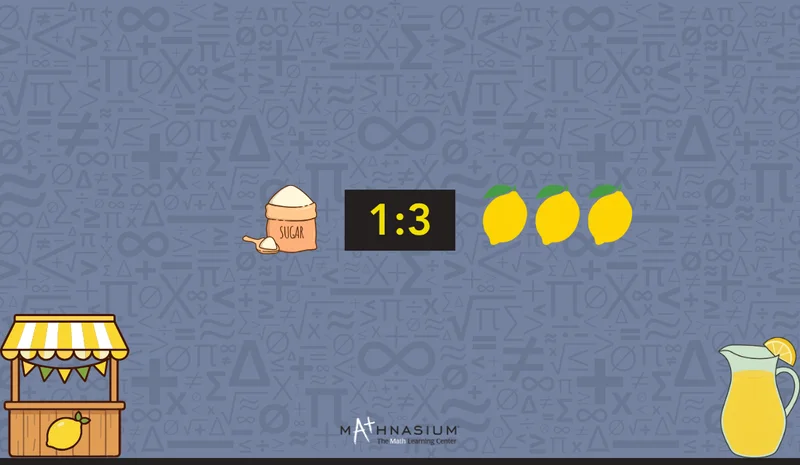
Now, say we need a second batch of lemonade. We use another cup of sugar and another 3 lemons, so our ratio becomes:
2 : 6
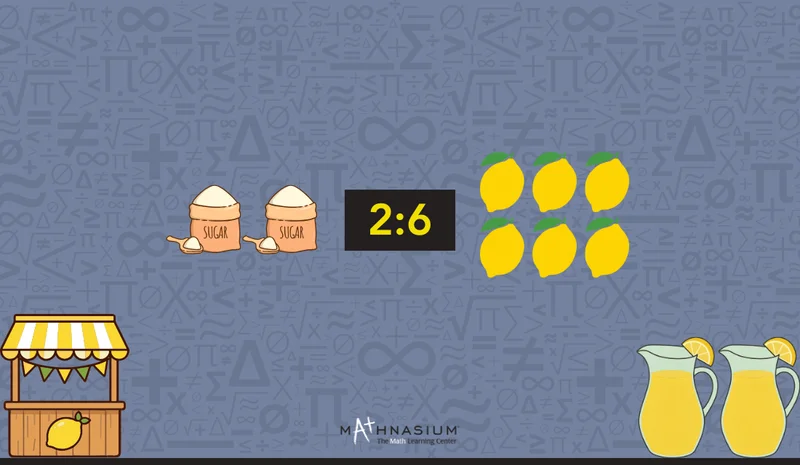
So in total, we used 2 cups of sugar and 6 lemons.
For every next batch of lemonade, we use that same 1 : 3 ratio, and our ratio keeps growing:
-
3 batches → 3 : 9
-
4 batches → 4 : 12
-
5 batches → 5 : 15
And so on.
At first glance, these all look like different ratios. But we built every single one of them by scaling the same 1 to 3 relationship, batch after batch, so they should all bring us back to where we started.
Let's check that.
If we divide each ratio back down by its batch number, we should land on our original 1 to 3 ratio every time.
-
2 : 6 → Divide both terms by 2 → 1 : 3
-
3 : 9 → Divide both terms by 3 → 1 : 3
-
4 : 12 → Divide both terms by 4 → 1 : 3
-
5 : 15 → Divide both terms by 5 → 1 : 3
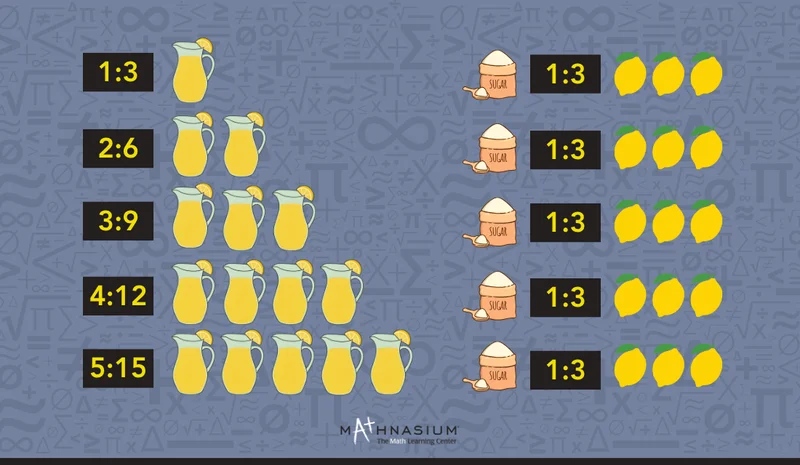
No matter how many batches we make, dividing back down always brings us to the same 1 to 3 relationship.
And that's what makes these ratios equivalent!

How To Find Equivalent Ratios?
To find equivalent ratios, we scale both terms of a ratio up or down by the same number, the same way we scale equivalent fractions.
-
When scaling up, we multiply both numbers by the same nonzero number to make the ratio terms larger while keeping the relationship the same.
-
When scaling down, we divide both numbers by the same common factor to make the ratio smaller or simplify it.
The simplest approach to this is to write the ratio in its fraction form. Once a ratio looks like a fraction, we're doing the same thing as finding an equivalent fraction.
Scale Up by Multiplying Both Terms
Say we have a jar with 2 green marbles for every 3 blue marbles. That gives us a ratio of 2 to 3, which we can write as a fraction: \(\Large\frac{2}{3}\).
To scale up, we multiply both the numerator and the denominator by the same number.
Let's multiply by 3.
\(\Large\frac{2×3}{3×3} = \Large\frac{6}{9}\)
That gives us 6 to 9, a ratio equivalent to 2 to 3. In other words, a jar with 6 green marbles would need 9 blue marbles to keep the same relationship.

Scale Down by Dividing Both Terms
Say we have a jar with 8 green marbles and 12 blue marbles, and we want to find the simplest ratio hiding inside it.
First, we write that ratio as a fraction \(\Large\frac{8}{12}\). As we can see, the greatest common factor for 8 and 12 is 4, which means that both numbers divide evenly.
\(\Large\frac{8÷4}{12÷4} = \Large\frac{2}{3}\)
That brings us right back to 2 to 3.
Which makes 8 to 12 equivalent to 2 to 3.
Either way, the rule stays the same. Whatever we do to one term, we do to the other.

Organize Equivalent Ratios in a Ratio Table
We can scale our 2 to 3 ratio to find out how many blue marbles we'd need for different numbers of green marbles, and lay each result out as a new row in our table.
-
2 green: 2 × 1 = 2 and 3 × 1 = 3, giving us 2 : 3
-
4 green: 2 × 2 = 4 and 3 × 2 = 6, giving us 4 : 6
-
6 green: 2 × 3 = 6 and 3 × 3 = 9, giving us 6 : 9
-
8 green: 2 × 4 = 8 and 3 × 4 = 12, giving us 8 : 12
Laid out as a table, that looks like this:
|
Green Marbles
|
Blue Marbles
|
|
2
|
3
|
|
4
|
6 |
|
6
|
9
|
|
8
|
12
|
Every row holds its own equivalent ratio, all built by scaling 2 to 3 the same way we scaled our fraction earlier. Instead of working out one ratio at a time, the table lets us see the whole pattern at once.
📕 You May Also Like: Equivalent Fractions Explained: A Kid-Friendly Guide
How Do Equivalent Ratios Connect to Proportions?
A proportion is simply two equivalent ratios written as equal to each other.
We already know from our previous example that our ratio of 2 green marbles to 3 blue marbles is equivalent to 4 green marbles to 6 blue marbles.
That means that we can write them as equal to each other:
2 : 3 = 4 : 6
And that's exactly what a proportion is. Two equivalent ratios, set side by side, joined with an equal sign.
That’s why we can say that equivalent ratios are the building blocks of proportional thinking.
|
|
Equivalent Ratio
|
Proportion
|
|
What it is
|
A ratio scaled to a different size that keeps the same relationship
|
Two equivalent ratios written as equal to each other
|
|
Marble example
|
2 to 3 scaled up to 4 to 6
|
2 to 3 = 4 to 6
|
|
Written as
|
2 : 3 or 4 : 6
|
2 : 3 = 4 : 6
|
📕 You May Also Like: Four Methods for Solving Proportions (and When to Use Each)
Quiz: How Well Do You Know Equivalent Ratios?
Our tutors at Mathnasium put together five questions, each testing a different part of what we covered in this guide. Work through each one carefully.
Question 1: A fruit bowl holds 6 apples and 9 oranges. Which ratio describes this relationship?
a) 9 : 6
b) 6 : 9
c) 6 : 15
d) 3 : 9
Question 2: Which ratio is equivalent to 3 to 4?
a) 4 : 3
b) 6 : 8
c) 7 : 8
d) 3 : 8
Question 3: What is the simplest ratio hiding inside 12/16?
a) 6 : 8
b) 4 : 3
c) 3 : 4
d) 12 : 4
Question 4: Are 5 : 8 and 15 : 24 equivalent ratios?
a) Yes, both terms were multiplied by 3
b) No, the terms don't share a common factor
c) Yes, both terms were multiplied by 5
d) No, only one term was scaled
Question 5: What do we call the statement 2 : 3 = 6 : 9?
a) A ratio
b) An equivalent ratio
c) A proportion
d) A ratio table
Take as much time as needed on each question. The answers are at the bottom of the guide.

Mathnasium tutors use personalized learning plans and hands-on techniques to help students make sense of concepts like equivalent ratios and proportional thinking.
How Mathnasium Helps Students Master Any Math Concept
Mathnasium is a math-only learning center empowering students of all skill levels to learn and master math.
Whether a student is meeting ratios for the first time, building a more solid foundation, or ready to move into proportional thinking, we can provide the support they need.
We do this through our proprietary teaching approach called the Mathnasium Method™.
Here's how it works.
It starts with a diagnostic assessment, a relaxed interaction that helps us pinpoint each student's strengths and knowledge gaps. With those insights, we build a personalized learning plan tailored to their needs and goals.
With the plan in place, our specially trained tutors follow it closely, delivering face-to-face instruction in a supportive and fun environment.
We use plain, everyday language and a mix of verbal, visual, mental, tactile, and written techniques so concepts land in a way that makes sense to each student.
When a student gets stuck, we break the concept down into manageable parts, guiding them through both the how and the why. In time, this builds the problem-solving skills and critical thinking they can use across all areas of math and beyond.
Fun is a core part of how we work. Our activities are often game-based and hands-on, keeping students engaged and genuinely enjoying the process.
We celebrate every bit of progress, so confidence grows with every session.
The results speak for themselves:
-
94% of parents report an improvement in their child's math skills and understanding
-
93% of parents report an improved attitude toward math after attending Mathnasium
-
90% of students saw an improvement in their school grades
With over 1,100 learning centers across North America, there is likely a Mathnasium close to you.
Families across Greenwood, Bargersville, Whiteland, and Franklin can visit Mathnasium of Greenwood, a trusted local center with a proven record of building confident math thinkers.
Whether your student is looking to catch up, keep up, or get ahead in math, our local team is happy to help!
📅 Schedule a Free Diagnostic Assessment at Mathnasium of Greenwood
Not near Greenwood?
📍 Find a Mathnasium Learning Center Near You
Pssst! Check Your Answers Here
How did you do?
Question 1: b) 6 : 9.
Question 2: b) 6 : 8.
Question 3: c) 3 : 4.
Question 4: a) Yes, both terms were multiplied by 3.
Question 5: c) A proportion.


 (317) 733-9100