Lake Nona keeps growing, and each school year our community welcomes new families from across the country and beyond.
Many students arrive from other states, where math followed different standards, course names, and state tests than they’ll find in Florida. That can be a lot to adjust to at once, for children and parents alike.
At Mathnasium of Lake Nona, we work with students of all skill levels and backgrounds, including students new to Florida math, and we’re here to help make that transition easier for your family.
Today, our education specialists walk you through what your child will learn in Florida math, how courses and placement work, what the FAST and EOC tests measure, and where to find math support as your family settles in.
1. What Will Your Child Learn in Florida Math?
Your child will work toward Florida’s B.E.S.T. math standards, short for Benchmarks for Excellent Student Thinking.
Each benchmark within these standards names a specific skill your child should master by the end of the school year. Their teacher and class materials show which topics the class covers right now, so there’s no need to worry if some topics look new in the first few weeks.
What Math Topics Come Up at Each Level
Much of the math may look familiar, even if the topics come in a different order than at your child’s previous school. Here’s what to expect at each level:
-
Elementary school: Number sense and operations, followed by fractions, decimals, measurement, geometry, and data as grades progress.
-
Middle school: Rational numbers, ratios and proportional relationships, expressions and equations, geometry, statistics, and probability.
-
High school: Course-specific expectations for algebra, functions, geometry, and other subjects.
Which of these topics has your child already covered?
How Florida Expects Students to Think About Math
Florida’s Mathematical Thinking and Reasoning (MTR) standards apply from kindergarten through 12th grade. They accompany the math content and don’t form a separate course. Under the MTRs, your child may be asked to:
-
Show a problem in more than one way
-
Explain and discuss their reasoning
-
Check whether an answer makes sense
-
Apply math to everyday situations
For example, after finding \(\Large\frac{3}{4}\) of 20, your child might draw a model or explain why 15 is a reasonable answer. Your child’s previous school may have taught these habits too. Florida names them explicitly in its standards.
Where to Find Your Child’s Learning Goals
Start with the parent guide for your child’s grade or course from the Florida Department of Education. Each guide summarizes the year’s expectations, defines key terms, and suggests questions to discuss with the teacher. Compare its topics with your child’s previous work, since a familiar course name alone tells you little.
📕 You May Also Like: What Florida’s B.E.S.T. Standards Mean for Your Child
2. How Do Math Courses and Advanced Options Fit Together?
Florida math moves from grade-level classes in elementary school to course-specific classes in high school, with advanced options along the way.
Lake Nona-area schools follow state standards and the Orange County Public Schools (OCPS) framework, and your child’s own school sets which courses it offers.
Elementary and Middle School Options
In elementary school, your child starts with grade-level math. Some classes add extra challenge within that work, but your child still stays in the same grade-level course.
Middle school brings more choices. Your child may take:
-
Grade-level math, following the standard middle school sequence.
-
Accelerated math, which covers content at a faster pace without automatically earning high school credit.
-
High school courses, such as Algebra 1, before ninth grade.
So two seventh graders at the same school may sit in different math classes, and your child’s schedule may look different from a neighbor’s. Lake Nona Middle, for example, lists its options in its curriculum guide and incoming sixth-grade registration presentation.
High School Courses
In high school, math is organized by course name. Florida’s standard diploma requires four math credits, including Algebra 1 and Geometry. A typical route runs from Algebra 1 to Geometry to Algebra 2, though your child may enter ninth grade further along if they took high school math in middle school.
3 Course Labels to Know
The same course label can mean different things from state to state. Here’s how these three work in Florida:
|
Term
|
What It Means
|
|
Honors
|
A course level with added depth. Each school describes its own expectations and prerequisites.
|
|
AP
|
Advanced Placement courses, which can lead to college credit depending on the AP exam score.
|
|
Gifted
|
A student services designation, separate from any specific math course or acceleration.
|
The math your child learned before may match a Florida course even when the titles differ. The school’s placement process helps connect the two.
📕 You May Also Like: How to Help Your Child Adjust to Florida Math After a Move
3. How Will the School Decide Where Your Child Starts?
Your child’s school decides their grade, their math course, and, for high schoolers, which previous credits count toward graduation. These are three separate decisions, and OCPS sets the rules for each one in its Student Progression Plan.
Records That Help the School
A move brings plenty of paperwork, and a few school records go a long way. They show the school what your child has already learned. Before enrollment, gather:
-
Recent report cards and transcripts.
-
Any available test or assessment results.
-
Course descriptions or topic lists, especially when a course name doesn’t explain its content.
Topic lists are especially useful when your child’s previous school combined algebra, geometry, and other topics into one math course. Ask the school which documents it requires, since some of these are optional extras.
Questions to Ask About Placement
Placement can feel uncertain at first, and your child’s school counselor is the main contact for math placement. These three questions can help you understand where your child starts:
-
How does this course connect with my child’s previous work?
-
What information did you use to decide the placement?
-
Whom should we contact if the work feels too familiar or too far ahead?
You can also ask whether the school can review the placement later in the year.
Support for International Families
Families arriving from another country can also contact the OCPS Global Family Welcome Center. It helps newcomer families with enrollment, language screening, and academic support. Its language screening is separate from math placement.
After your child settles into class, you’ll start hearing about Florida’s state math tests.

Settling into a new math class takes time, and a clear picture of your child’s math background helps them find their place sooner.
4. What Are FAST and End-of-Course Math Tests?
Florida uses two kinds of state math tests. Neither one is an entrance exam, so your child doesn’t need to pass anything to start school.
FAST Progress Monitoring
FAST stands for Florida Assessment of Student Thinking. In grades 3–8, students take FAST Mathematics three times a year, at the beginning, middle, and end of the school year. A fall score may reflect topics your child hasn’t covered yet, so treat it as a starting point and use it to see which topics need attention.
End-of-Course (EOC) Exams
Algebra 1 and Geometry have their own EOC exams, separate from FAST. Each EOC counts for 30% of the final course grade. Florida’s standard diploma also requires a passing Algebra 1 EOC score or an approved comparative score.
Transferring With High School Math Credit
Florida honors the final grade and credit your child earned in Algebra 1 or Geometry at a previous school. Meeting the Algebra 1 test requirement for graduation is a separate step. A passing score on another state’s Algebra 1 test or an approved comparative score may count, so ask the school counselor to review your child’s transcript.
📕 You May Also Like: The Florida Back-to-School Math Guide for K-12 Families
5. Where Can Lake Nona Families Find Math Support?
Your child’s school is the first place to look for math help, and Lake Nona families have a few other options close to home. Here’s what each one offers:
-
OCPS math resources: The district’s mathematics page shares curriculum information and resources for the math taught in OCPS schools. It helps parents follow the work but doesn’t offer tutoring.
-
Orange County Library System: A full-access OCLS library card includes free live online tutoring through Brainfuse. You can sign up for a card online or at any branch.
-
Mathnasium of Lake Nona: Our math-only learning center provides personalized, face-to-face instruction for K–12 students. Every student begins with a diagnostic assessment to identify their unique needs, allowing our expert tutors to build a customized learning plan.
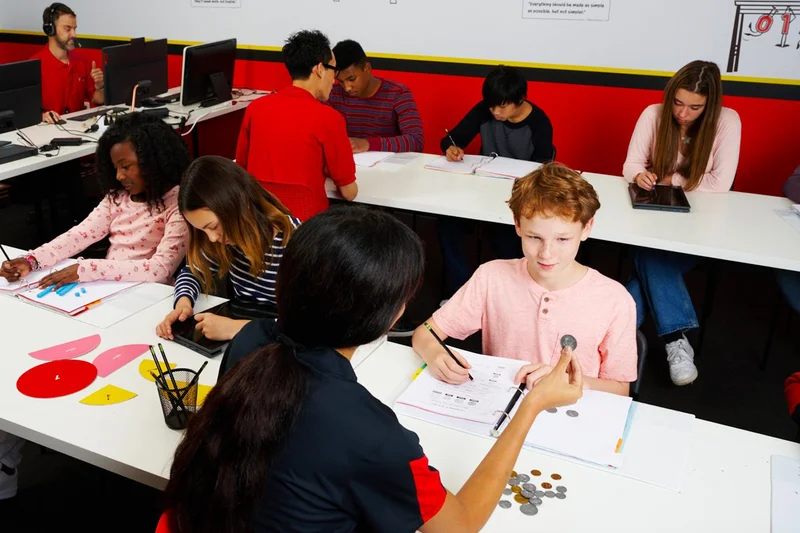
At Mathnasium of Lake Nona, our tutors help students new to Florida schools feel at home in their new math class.
How Mathnasium of Lake Nona Helps Students Excel in Florida Math
Mathnasium of Lake Nona is a math-only learning center in Orlando and part of the Mathnasium network of more than 1,200 learning centers.
Our local team works with K–12 students of all skill levels. For families new to Florida schools, that can mean catching up on unfamiliar topics, keeping pace with a new math class, or moving ahead to more advanced concepts.
To meet each of those needs, we teach with the Mathnasium Method™, our proprietary approach built around each student.
Every student starts with a diagnostic assessment that shows their current skills, strengths, and knowledge gaps. From there, we build a personalized learning plan around their needs and goals.
Our specially trained tutors follow that plan with face-to-face instruction in a caring and fun group environment. They teach for understanding, using verbal, visual, mental, tactile, and written techniques so each concept makes sense to your child.
When your child gets stuck, our tutors break the concept into smaller steps and explain both the how and the why behind the answer. Your child builds the problem-solving and critical thinking skills needed to work through new problems on their own.
We keep sessions fun with game-based activities and rewards that celebrate every bit of progress, so your child can see how far they’ve come.
The results speak for themselves:
-
94% of parents report an improvement in their child’s math skills and understanding.
-
93% of parents report their child’s improved attitude toward math after attending Mathnasium.
-
90% of students saw an improvement in their school grades.
A new school takes some getting used to, and our team is happy to help your child find their footing in math.
📅 Schedule a Free Assessment at Mathnasium of Lake Nona
Not near Lake Nona?
📍 Find a Mathnasium Learning Center Near You


 (407) 243-6284