Students generally begin learning about percentages and solving basic percent word problems in sixth grade. While they may understand how to calculate a percent, a part, or a whole, they may find it harder to identify what to calculate in a word problem.
Basic percent word problems use the same part–whole–percent relationship as numerical exercises. The added challenge comes down to figuring out what the information means and which value they need to find.
These problems can be solved in several ways, such as with diagrams, tables, and equations. Today, Mathnasium tutors explain one of them, which is the percent equation, and guide you on how to use it to solve percent word problems in a few simple steps.

What Is a Percent Equation?
In math, a percent equation shows us how a part relates to a whole through a percentage. We write it like this:

Let’s break down the equation:
-
The whole is the total amount,
-
The part is the amount we’re comparing with the total, and
-
The percent describes how much of the whole we have, measured out of 100.
We know that the % symbol is just shorthand for "out of 100" and not a regular number. For that reason, we can’t do math operations with it directly. So, we need to express the percent either as a decimal or as a fraction.
If we know two values, we can use the percent equation to find the missing one:
-
Find the part using the whole and the percent.
-
Work out the whole from a known part and percent.
-
Calculate the percent by comparing the part with the whole.
Let’s move on to the actual word problems to see how everything works.

How Do We Solve Percent Word Problems With Percent Equations?
We use a percent equation to turn the information in a word problem into a calculation. The equation connects the values we know with the value we need to find.
Let’s go through one percent word problem together and solve it.
A school has 200 students. 30% of students take the bus to school. How many students take the bus?
Step 1: Identify What We Know and What We Need to Find
From the problem, we know the total number of students (whole) and the percentage of those who take the bus. The question asks us to find the part, or the number of students, who take the bus. Let’s write:
-
Whole = 200 students
-
Percent = 30%
-
Part = unknown
Step 2: Set Up the Percent Equation
Then, we need to write the percent equation (Part = Percent × Whole) with everything we’ve identified. It should look like this:
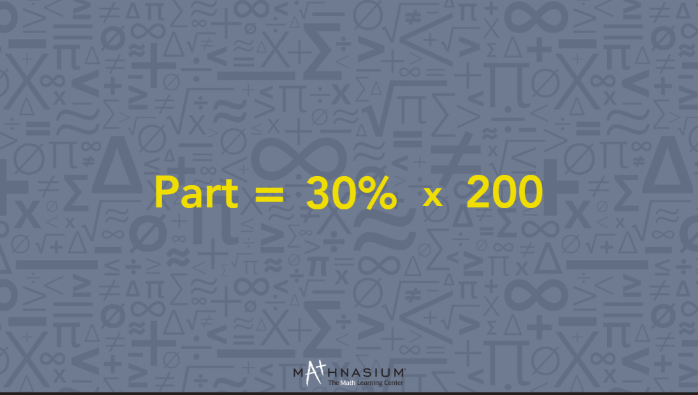
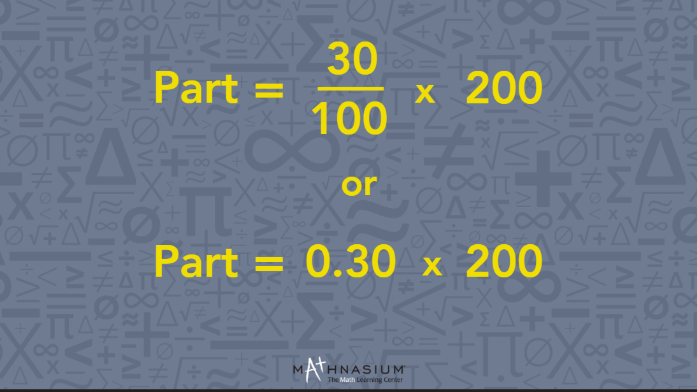
Before we start calculating, we need to express the 30% either as a fraction (\(\Large\frac{30}{100}\)) or a decimal (0.30).
Step 3: Solve the Equation
We are one step closer to finding the missing value and solving the word problem. With all the values in place, let’s do the calculation.
In this example, we’ll go with the fraction form of the percent over the decimal. Before we multiply, we can simplify the \(\Large\frac{30}{100}\) to \(\Large\frac{3}{10}\) by dividing both the numerator and denominator by 10 to get a simpler number.
\(\Large\frac{30 ÷ 10}{100 ÷ 10}\) = \(\Large\frac{3}{10}\)
Then, we multiply:
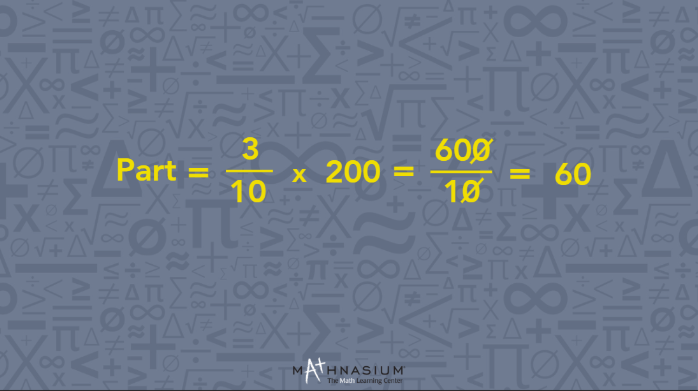
The missing part is 60, which means 60 students take a bus to school.
If we choose to go with the decimal form instead, the answer will still be the same.
Part = 0.30 × 200 = 60
📕 You May Also Like: Multiplying Decimals: A Step-by-Step Guide
Solved Examples for Percent Word Problems
Let’s go through three word problems together and see what the steps look like when we need to find the other two values. We’ll start by finding the part, then use the percent equation to find the other two missing values.
Example 1: Finding the Part
A library has 364 books. Out of all books, 25% are for children. How many books for children does the library have?
Step 1: Identify What We Know and What We Need to Find
What is this problem telling us, and what do we need to find? The whole is 364 books, and the percent is 25%. We need to find the part (the number of books for children). Let’s represent it with ‘‘x’’.
Step 2: Set Up the Percent Equation
In the equation we already know, let’s add what we know and ‘’x’’. We will rewrite 25% as a fraction \(\Large\frac{25}{100}\). However, we can simplify it further. We can divide both the numerator and denominator by 25.
\(\Large\frac{25}{100}\) -> \(\Large\frac{25 ÷ 25}{100 ÷ 25}\) = \(\Large\frac{1}{4}\)
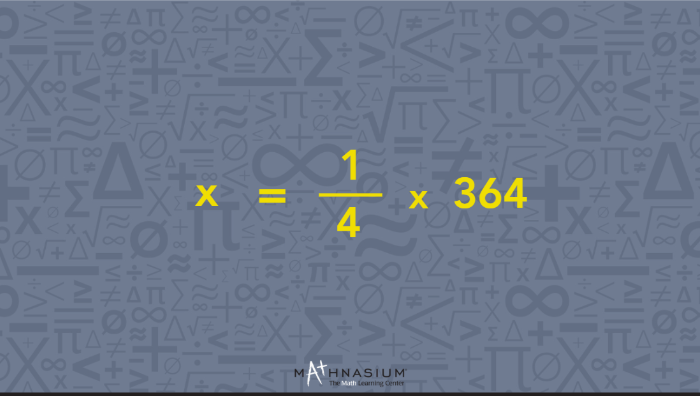
The equation now looks like this:
Step 3: Solve the Equation
Now, we just need to multiply the simplified fraction (\(\Large\frac{1}{4}\)) by 364.
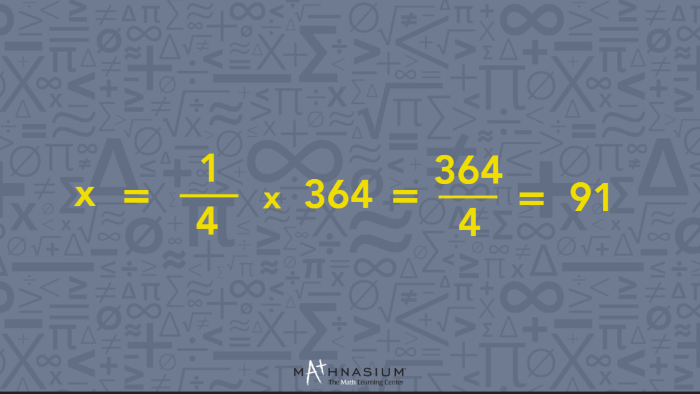
The answer to this word problem is 91, which tells us that there are 91 books for children in the library.
The answer does not change if we decide to go with the decimal form instead.
Part = 0.25 × 364 = 91
Example 2: Finding the Whole
In a school choir, there are 18 sixth graders. They make up 40% of its members. How many members does the school choir have in total?
Step 1: Identify What We Know and What We Need to Find
The problem has changed a bit. Let’s read it together and see what we need to do. Now, we have a part, which is 18 sixth graders. They are 40 percent of the total number of choir members. We need to find the whole (total). Let’s write that down.
-
Part: 18
-
Percent: 40%
-
Whole: X
Step 2: Set Up the Percent Equation
Although we are looking for another value, this step does not change. We enter what we wrote down in the equation before calculating. We will again go down the fraction path instead of the decimal one and write it in place of the percent we know. We divide both the numerator and denominator by 20.
\(\Large\frac{40}{100}\) -> \(\Large\frac{40 ÷ 20}{100 ÷ 20}\) = \(\Large\frac{2}{5}\)
With the fraction in its simplest form, the equation is:
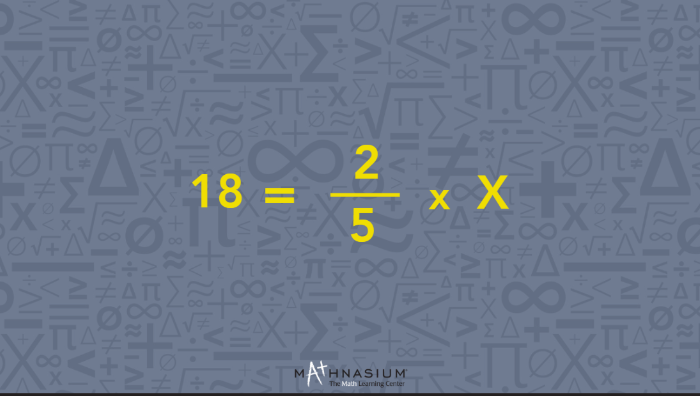
Step 3: Solve the Equation
To find what the value of X is, we now need to divide instead of multiplying. To isolate X, we need to divide both sides by \(\Large\frac{2}{5}\).
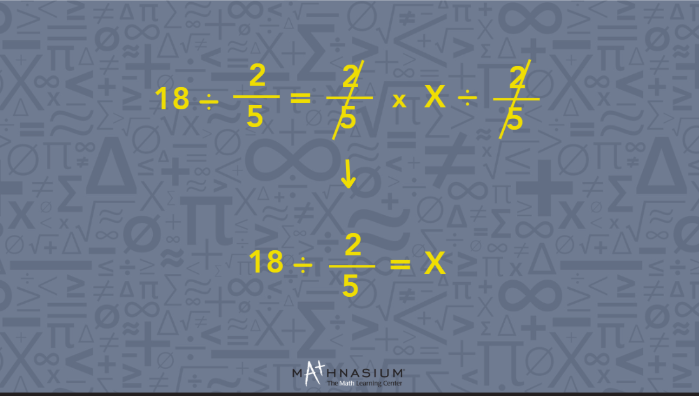
When we need to divide by a fraction, that is the same as multiplying by its reciprocal, which is \(\Large\frac{5}{2}\).
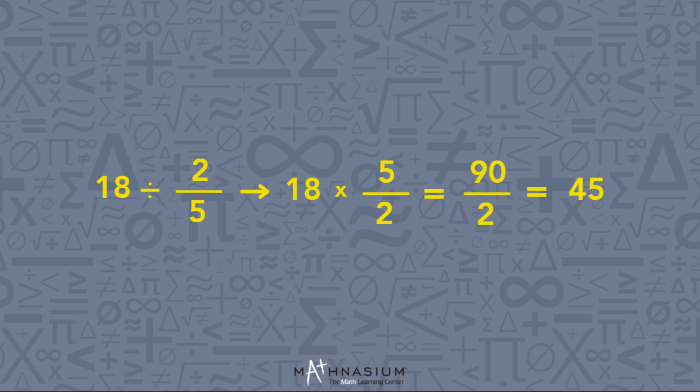
The school choir has 45 members in total.
📕 You May Also Like: How to Divide Fraction by Fraction (+ Tips & Visual Aid)
Example 3: Finding the Percent
In a collection of 260 stickers, 117 are animal stickers. What percent of the collection’s stickers are animal stickers?
Step 1: Identify What We Know and What We Need to Find
In this problem, we know the part (117 animal stickers) and the whole (260 stickers). We need to find the percent, and let’s use ‘’p’’ to represent it.
Step 2: Write the Percent Equation
Next, we write the percent equation and replace what we already know.
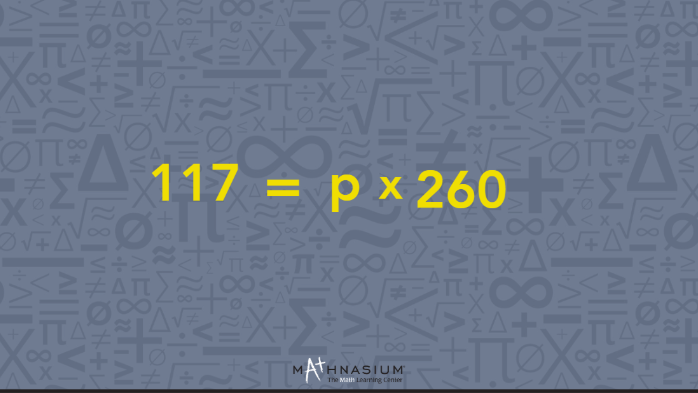
Step 3: Solve the Equation
To isolate ‘’p’’, we need to divide both sides by 260.
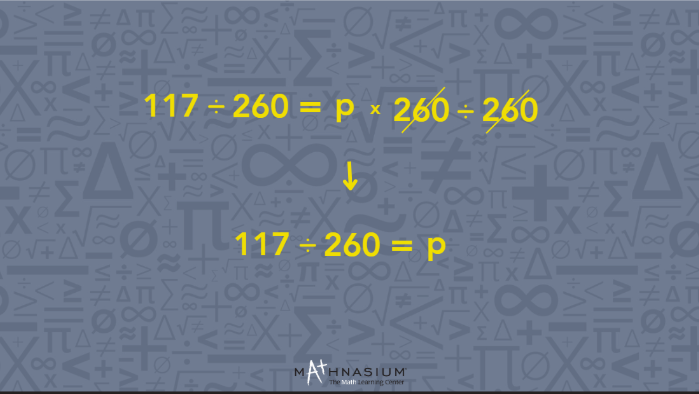
We can write this division as a fraction, with 117 on top and 260 on the bottom. That gives us
\(\Large\frac{117}{260}\) = p
We can further simplify the fraction. If we divide both the numerator and denominator by 13, we get:
\(\Large\frac{117 ÷ 13}{260 ÷ 13}\) = \(\Large\frac{9}{20}\)
That means p = \(\Large\frac{9}{20}\). However, we need to express the fraction as a percent. How do we do that? We need to write it with a denominator of 100. To do that, we need to multiply both the numerator and denominator by 5:
\(\Large\frac{9 × 5}{20 × 5}\) = \(\Large\frac{45}{100}\)
We know that percent means “out of 100.” So \(\Large\frac{45}{100}\) is 45%, which means 45% of the total amount if stickers are animal stickers.
📕 You May Also Like: How to Turn a Fraction into a Percent: A Kid-Friendly Guide
Practice Time! Check Your Knowledge of Percent Word Problems
We created a few different percentage word problem challenges for you to try on your own. Give them a try by using the percent equation method to find the missing value, and check the answers at the bottom of the guide.
Challenge 1: A school garden has 80 plants. Of these plants, 25% are tomato plants. How many tomato plants are in the garden?
Challenge 2: A soccer club has 18 sixth graders. They make up 30% of the club’s members. How many members does the club have in total?
Challenge 3: A student has completed 24 pages of a 40-page activity book. What percent of the activity book have they completed?
 At Mathnasium, we use personalized learning plans and proven teaching techniques to help students master solving word problems with confidence.
How Mathnasium Helps Students Master Any Math Concept
Mathnasium is a math-only learning center empowering K–12 students of all skill levels to excel in math.
When students need help with specific word problems, such as percent word problems, we help them understand the why behind the how instead of simply memorizing procedures.
To build that understanding, we use the Mathnasium Method™, our proprietary teaching approach, which allows us to meet students where they are and guide them forward step by step.
Each student begins with a diagnostic assessment that helps us understand their current skill level, knowledge gaps, goals, and how they think and feel about math. For percent word problems, that may include understanding the relationship between percents, parts, and wholes.
Using these insights, we build a personalized learning plan focused on the skills the student needs most or preparing them for more advanced math topics.
Our specially trained tutors follow that plan closely and provide live, face-to-face instruction in a caring and fun group environment. They use mental, verbal, visual, tactile, and written techniques to help math behind percent word problems make sense.
Students also get room to think through problems before tutors step in. Our tutors guide them through the reasoning, which helps them build critical thinking, problem-solving skills, and greater independence they need both in math and beyond.
Fun is an important part of how we work. Sessions often include game-based and hands-on activities that keep students engaged and make learning more enjoyable. Students earn rewards along the way, and we celebrate every bit of progress, so confidence grows alongside mastery.
The results speak for themselves:
-
94% of parents report an improvement in their child's math skills and understanding
-
93% of parents report their child's improved attitude toward math after attending Mathnasium
-
90% of students saw an improvement in their school grades
With over 1,100 learning centers, there is likely a Mathnasium close to you.
For families in and near Logan, Utah, Mathnasium of Logan brings that same approach close to home, with specially trained tutors who help students make sense of any math behind the word problems they are currently working on.
If your child is finding any math concept hard, a free diagnostic assessment is a great place to start. From what we learn, we create a personalized learning plan focused on the skills they need next.
📅 Schedule a Free Assessment at Mathnasium of Logan
Not near Logan?
📍 Find a Mathnasium Learning Center Near You
Psst! Check Your Answers Here
How did the percent word problems go? Here are the answers to the practice challenges above.
Challenge 1: 20 tomato plants
Challenge 2: 60 members
Challenge 3: 60%


 (385) 423-2185
 (385) 423-2185