Roman numerals can feel a little like Number Tetris. We use symbols such as I, V, X, and L as blocks to build larger numbers and arrange those symbols in different ways to create different values.
Some combinations fit together in a straightforward way, while others change how we read the numeral depending on the order of the symbols.
Let’s find out how Roman numerals work and how to convert between Roman numerals and standard numbers.

How Do Roman Numerals Work?
Roman numerals use a small set of symbols that we combine to write different numbers. Each symbol has its own fixed value:
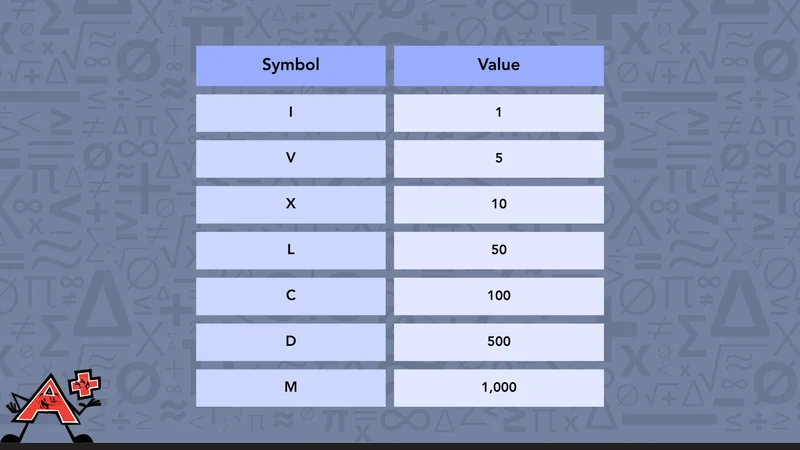
Most of the time, Roman numerals are written from larger values to smaller values, and we add the symbols together.
For example:
-
II is 1 + 1 = 2.
-
VI is 5 + 1 = 6.
-
XII is 10 + 1 + 1 = 12.
In other words, if a symbol is followed by one of the same value or a smaller value, we use the additive rule.
But what if we need to write a number like 9?
If we only used addition, we might try to write 9 as VIIII, with four I’s in a row. Roman numerals use a shorter form instead: IX.
How does IX make 9?
Here, I comes before X, so we subtract 1 from 10:
IX = 10 − 1 = 9
This is called the subtractive rule, and it helps us write some numbers more compactly.
Roman numerals use these six common subtractive pairs:
|
Everyday Situation
|
Value
|
|
IV
|
4
|
|
IX
|
9
|
|
XL
|
40
|
|
XC
|
90
|
|
CD
|
400
|
|
CM
|
900
|
So when we read a Roman numeral, we look for these specific pairs before combining the values.
Now that we know the seven basic symbols and the common subtractive pairs, we’re ready to convert a Roman numeral into a standard number and vice versa.

How to Convert a Roman Numeral Into a Standard Number
To convert a Roman numeral into a standard number, we break it into symbols and identify subtractive pairs, find the value of each pair or a symbol, and add those values together.
At Mathnasium, we like to use examples to make steps clear. So let’s work through this numeral CXLVII together.
Step 1: Break the numeral into symbols and subtractive pairs
We read the numeral from left to right and look for any of the six common subtractive pairs.
CXLVII breaks into C, XL, V, I, I. We keep XL together because it is a subtractive pair, as X comes before the larger symbol L.
Step 2: Find the value of each pair or a symbol
Next, we match each part to its value:
Step 3: Add the values together
Finally, we add the values, keeping a running total as we go:
100 (C) + 40 (XL) +5 (V) +1 (I) +1 (I) = 147.
So, CXLVII = 147.
📕 You May Also Like: The History of Roman Numerals & Why They Still Matter
How to Convert a Standard Number Into a Roman Numeral
To write a standard number as a Roman numeral, we split the number into place-value groups, convert each group separately, and then combine the Roman numeral parts from largest to smallest.
We’ll convert this number, 384, into a Roman numeral.
Step 1: Break the number into place-value groups
We start by splitting a standard number into hundreds, tens, and ones. 384 breaks into:
-
Hundreds: 300
-
Tens: 80
-
Ones: 4
Step 2: Convert each group into roman numerals
Now we convert each part separately:
-
To make 300, we use C three times because each C is worth 100: 100 + 100 + 100 = 300, so 300 = CCC.
-
To get 80, we start with L, which is 50, and add three Xs, worth 10 each: 50 + 10 + 10 + 10 = 80, so 80 = LXXX.
-
To make 4, we use the subtractive pair IV. As I comes before V, we subtract: 5 − 1 = 4.
Step 3: Combine the parts from largest to smallest
Finally, we put the converted parts together in place-value order:
CCC + LXXX + IV = CCCLXXXIV
Our number, 384, is written as CCCLXXXIV in Roman numerals.
📕 You May Also Like: How to Read and Write Years in Roman Numerals
Common Mistakes to Avoid With Roman Numerals
We’ve noticed that students often make the same mistakes when they first start working with Roman numerals. To help you avoid them, our tutors put together a quick table with what to watch for.
|
Everyday Situation
|
How to avoid it
|
|
Repeating V, L, or D:
10 = VV ❌
100 = LL ❌
1,000 = DD. ❌
|
We do not repeat V, L, or D.
Roman numerals already have X for 10, Cfor 100, and M for 1,000. ✅
|
|
Repeating a symbol four times
4 = IIII ❌
40 = XXXX ❌
90 = LXXXX ❌
|
In standard notation, we use subtractive pairs instead:
IV = 4 ✅
XL = 40 ✅
XC = 90 ✅
You may still see IIII on some clock faces, as that is a long-standing tradition.
|
|
Mixing up the subtractive pairs
49 = IL ❌
99 = IC ❌
VC = 95 ❌
XM = 990 ❌
|
Roman numerals only use six subtractive pairs: IV, IX, XL, XC, CD, and CM. If the number does not match one of these pairs, break it into place-value groups first:
49 = 40 + 9 = XL + IX = XLIX ✅
99 = 90 + 9 = XC + IX = XCIX ✅
95 = 90 + 5 = XC + V = XCV ✅
990 = 900 + 90 = CM + XC = CMXC ✅
|
|
Missing a subtractive pair while reading
MCM = 2,100. ❌
|
Look for subtractive pairs before you add.
CM = 900, so MCM = M (1,000) + CM (900) = 1,900. ✅
|
📕 You May Also Like: Roman Numerals: Fun Facts and Real-Life Uses
Try Converting Between Roman Numerals and Standard Numbers Yourself
Now it’s your turn to practice converting Roman numerals to standard numbers and standard numbers to Roman numerals.
-
Convert XIX to a standard number.
-
Convert LXXIV to a standard number.
-
Write 38 as a Roman numeral.
-
Write 209 as a Roman numeral.
-
Try writing your own age with Roman numerals.

Mathnasium tutors use hands-on activities and different teaching techniques to help students make sense of any math topic.
How Mathnasium Helps Students Master Any Math Concept
Mathnasium is a math-only learning center empowering K–12 students of all skill levels to excel in math.
When students need help with foundational skills like place value or specific topics like Roman numerals, we help them understand the why behind the how instead of simply memorizing procedures.
To build that understanding, we use the Mathnasium Method™, our proprietary teaching approach, to meet students where they are and guide them forward step by step.
Each student begins with a diagnostic assessment that helps us understand their current skill level, knowledge gaps, goals, and how they think and feel about math. For topics like Roman numerals, that may include looking at how comfortably they recognize number patterns, compare values, and apply rules consistently.
Using these insights, we build a personalized learning plan focused on the skills the student needs most, whether that means reinforcing number sense, working with place value in standard numbers, recognizing patterns, or preparing for more advanced math topics.
Our specially trained tutors follow that plan closely and provide live, face-to-face instruction in a caring and fun group environment. They use mental, verbal, visual, tactile, and written techniques to help students decode numeral patterns and make sense of math topics.
Students also get room to think through problems before tutors step in. Our tutors guide them through the reasoning, helping them build critical thinking, problem-solving skills, and greater independence in math.
Fun is part of the approach, too. We use hands-on and game-based activities, rewards, and consistent encouragement to keep students engaged as they work with Roman numerals, number patterns, and other math concepts.
The results? True, measurable progress:
-
94% of parents report an improvement in their child's math skills and understanding
-
93% of parents report their child's improved attitude toward math after attending Mathnasium
-
90% of students saw an improvement in their school grades
With over 1,100 learning centers across North America, there is likely a Mathnasium close to you.
For families in and near Logan, Utah, Mathnasium of Logan brings that same approach close to home, with specially trained tutors who help students make sense of number systems, patterns, and the math concepts that build from them.
If your child is finding any math concept hard, a free diagnostic assessment is a great place to start. Using what we learn, we create a personalized learning plan focused on the skills they need next.
📅 Schedule a Free Assessment at Mathnasium of Logan
Not near Logan?
📍 Find a Mathnasium Learning Center Near You
Pssst…! Check Your Answers Here
Ready to see how you did? Here are the answers to the practice problems above.
-
XIX = 19. We break it into X, I, X. Since I comes before the second X, we subtract: X + (X − I) = 10 + 9 = 19.
-
LXXIV = 74. We break it into L, X, X, IV. First, we add the individual symbols: 50 + 10 + 10 = 70. Then we add the value of the subtractive pair IV, which is 4: 70 + 4 = 74.
-
38 = XXXVIII. We break 38 into 30 and 8. Thirty becomes XXX, and eight becomes VIII= 5 + 1 + 1 + 1. Combined: XXXVIII.
-
209 = CCIX. We break 209 into 200 and 9. Two hundred becomes CC, and nine becomes the subtractive pair IX. Combined: CCIX.
-
There’s no single right answer here, since it depends on your age, but here’s an example of how the steps may play out. Let’s say you’re 15 years old. We break 15 into 10 and 5. Ten becomes X, and five becomes V. Combined, 15 becomes XV.


 (385) 423-2185
 (385) 423-2185