Your student mentions over breakfast that they want to become a robotics engineer. Tomorrow, they may decide they want to be a marine biologist or game designer instead. Career plans change all the time, but a connection to math follows nearly every STEM path.
At Mathnasium, we love hearing students talk about their interests, ambitions, and big ideas for the future. Conversations like these naturally lead to bigger questions. How does math support STEM careers? Which math skills should we nurture the most? And how do today's classroom lessons connect to tomorrow's opportunities?
Today, our education specialists will explore the math skills behind STEM careers and the many paths students can pursue as their interest in math grows and evolves.
What Are STEM Careers?
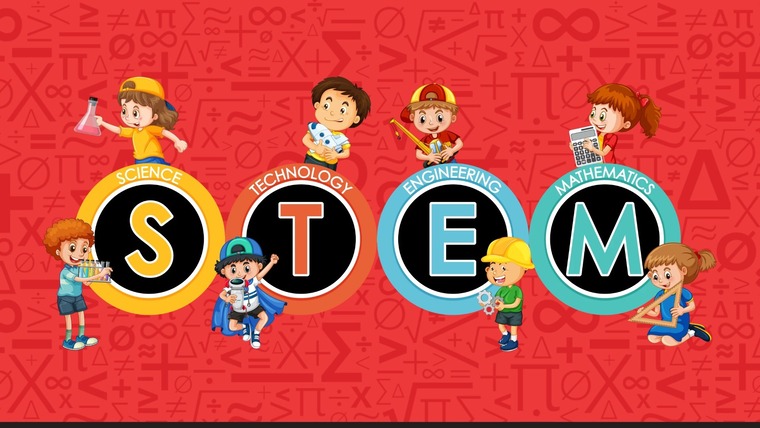
STEM careers are professional paths focused on solving real-world problems using science, technology, engineering, and mathematics, the four fields represented by the STEM acronym.
Each field contributes a different perspective:
-
Science explores how the natural world works.
-
Technology builds the tools we use to navigate it.
-
Engineering designs the physical systems we rely on.
-
Mathematics translates ideas across all three with precision.
STEM careers span nearly every sector of the modern economy, from agriculture and conservation to entertainment and medicine.
The wide range of STEM opportunities means students can follow many different interests while continuing to build on the same mathematical foundation.
📕 You May Also Like: STEM Careers That Start With Math
 The most exciting STEM opportunities often start with a simple question: "What if?"
4 Math Skills That Support STEM Careers
Math skills support STEM careers by helping professionals solve problems, test ideas, analyze information, and make accurate decisions.
Here are four skills students can build in school that may pave the way to their desired STEM paths later in life.
1. Proportional Reasoning
Proportional reasoning helps professionals work accurately across different sizes, quantities, and measurements.
Students begin building this skill through fractions, ratios, and percentages.
Architects may use scale to translate full-size buildings onto blueprints, while biochemists may adjust formulas from laboratory samples to large-scale production.
2. Spatial Reasoning
Spatial reasoning helps with visualizing how objects fit, move, and interact within physical space.
Geometry helps students strengthen spatial reasoning through work with shapes, distance, angles, and three-dimensional structures.
For example, engineers rely on such skills when testing how parts interact or how forces move through a structure.
3. Statistical Literacy
Statistical literacy means organizing information, spotting trends, and making decisions based on what the numbers show. Students begin developing it through graphs, data sets, averages, probability, and data analysis.
In healthcare, clinical researchers use statistical literacy to review thousands of patient records and determine whether a treatment is effective.
4. Algorithmic Thinking
Algorithmic thinking helps professionals break complex problems into clear, manageable steps.
Algebra helps students develop algorithmic thinking by teaching them how to work through unknowns using established rules and logical sequences. Computer programmers use the same type of thinking when building software and troubleshooting code.
Although students may encounter each skill in a different math unit at school, STEM professionals often combine them to solve a single problem.
📕 You May Also Like: 6 Ways to Help Your Middle Schooler Understand Proportionality
 The fractions, graphs, and patterns students practice today become the tools STEM professionals use to design, analyze, and innovate tomorrow.
STEM Careers Where Math Makes the Difference
STEM careers reach much further than engineering labs and computer screens. Students interested in technology, healthcare, design, research, and even video game development can all find paths that build on sound math skills.
Let's examine a few STEM fields where mathematical thinking plays an important role.
Technology and Software
Technology careers rely on logic, patterns, and structured problem-solving to build reliable systems and solve complex challenges.
Several careers can bring this type of thinking to life:
-
Software developers use algorithmic and conditional logic (if/then thinking), loops, and variables to turn a problem into working code
-
Data scientists use statistics and modeling to find meaningful patterns in large datasets
-
Cybersecurity analysts use discrete mathematics and logic to identify system vulnerabilities before they can be exploited
| Core math concepts: algorithms, computational thinking, logic, statistics |
Engineering and Design
Engineering careers apply mathematics to test designs, measure performance, and ensure structures and systems work safely.
Many engineering roles can bring classroom math into practical applications:
-
Aerospace engineers calculate fluid dynamics and weight distribution to ensure aircraft safety and performance
-
Civil engineers use geometric proofs and load calculations to design structures that hold under sustained pressure
-
Mechanical engineers apply geometric modeling to align moving parts inside complex systems
| Core math concepts: geometry, algebra, calculus-based modeling |
Healthcare and Science
Healthcare and science careers use mathematics to analyze data, evaluate evidence, and make informed decisions.
Let's explore a few careers where numbers can help guide important decisions:
-
Pharmacologists use ratios and precise calculations to determine safe medication dosages based on body mass and metabolism
-
Epidemiologists apply statistical modeling to track illness spread and predict public health needs
-
Lab researchers use statistical probability to validate experimental findings and identify genetic markers
| Core math concepts: measurement, data analysis, proportional reasoning |
Emerging and Creative Fields
Emerging STEM careers connect math to fields that many students may not expect, from video game development to robotics and environmental research.
Let's look at a few surprising examples that illustrate the range of opportunities available today:
-
Game designers use coordinate geometry and vector mathematics to make characters move fluidly and realistically across a screen
-
Environmental scientists analyze statistical data to track wildlife populations and manage water resources
-
Robotics specialists program precise coordinate points for autonomous movement in manufacturing and surgical settings
| Core math concepts: spatial reasoning, coordinate geometry, data interpretation |
📕 You May Also Like: How Important Is Math for a STEM Career? Here’s What Parents Should Know
From the Classroom to the STEM Career
STEM careers come in many forms, and some may surprise students who are just beginning to explore future possibilities.
Here are a few more STEM careers that can spark curiosity and show how familiar math concepts connect to real-world work.
| What Kids Learn in School |
The Math Skill |
How It Shows Up in a STEM Career |
| Fractions, ratios, and scale |
Proportional reasoning |
Audio engineer: balancing frequency bands and decibel levels to mix sound |
| Coordinate planes and graphing |
Spatial reasoning |
GIS analyst: creating digital maps used in transportation, planning, and environmental projects |
| Variables and algebraic functions |
Algorithmic logic |
Machine learning engineer: building systems that recognize patterns and improve over time |
| Data sets, averages, and probability |
Statistical analysis |
Wildlife biologist: analyzing population trends and habitat data to support conservation efforts |
| Geometric proofs and angles |
Structural reasoning |
Structural engineer: calculating load paths and stress points for buildings and bridges |
| Percentages and linear growth |
Predictive modeling |
Renewable energy analyst: projecting long-term power output for solar arrays |
Interest in STEM may begin with a sense of discovery, but growth happens through practice, encouragement, and opportunities to build new skills. Supportive learning environments give students space to explore ideas, ask questions, and strengthen mathematical thinking with confidence.
📕 You May Also Like: How Katherine Johnson Used Math to Help Win the Space Race
 At Mathnasium, students build mathematical thinking that supports learning, exploration, and countless future opportunities.
How Mathnasium Builds the Mindset for Future Careers
Mathnasium is a math-only learning center dedicated to helping K-12 students of all skill levels excel in math.
Students come to us at different starting points. Some are building foundational skills, while others may be ready to push into enrichment and challenge. The path forward is built around exactly where each student is.
Along the way, our students develop a mindset that encourages persistence, curiosity, and confidence when approaching new challenges.
We build that foundation through the Mathnasium Method™, our proprietary teaching approach. This proven approach includes:
-
Assessment and Personalized Learning Plans: Each student starts with a diagnostic assessment that identifies current skills, strengths, and gaps. From those findings, we build a personalized learning plan tailored to their goals, whether that means strengthening foundational skills, building fluency, or developing the reasoning flexibility that STEM careers require.
-
Teaching for Understanding: Our specially trained tutors use natural language and a mix of verbal, visual, mental, tactile, and written techniques so each concept lands before we move forward.
-
Problem-Solving and Critical Thinking: Our tutors know when to offer support and when to let students work through a problem on their own. That balance builds the independence and persistence that STEM careers reward.
-
An Engaging and Fun Learning Environment: Sessions include games, earned rewards, and consistent celebration of progress. Students learn to treat a difficult problem as a puzzle rather than a verdict on their ability.
The results speak for themselves:
-
94% of parents report improvement in their child's math skills and understanding
-
93% of parents report an improved attitude toward math after attending Mathnasium
-
90% of students saw improvement in their school grades
With over 1,100 learning centers across North America, there is likely a Mathnasium close to you.
Families across Logan, North Logan, Providence, Hyde Park, Nibley, Wellsville, River Heights, Smithfield, and Hyrum trust Mathnasium of Logan to help their children build math confidence.
Whether your child is excited about a future in STEM or simply wants to build solid math skills, our team is ready to help.
📅 Schedule a Free Assessment at Mathnasium of Logan
Not near Logan?
📍 Find a Mathnasium Learning Center Near You


 (385) 423-2185
 (385) 423-2185