Additive inverse may sound like a complicated math term at first, but the idea behind it is something students already see whenever opposite amounts cancel each other out.
At Mathnasium of Logan, we follow Utah Core Standards for Mathematics, which introduce additive inverses formally in Grade 6 and build on them in Grade 7 algebra.
Today, our tutors walk through additive inverses using real examples and everyday situations, so the concept lands before students ever have to memorize the term.

What Is an Additive Inverse in 6th and 7th-Grade Math?
An inverse is a value that reverses another number's effect and brings us back to where we started. In addition, that inverse is the opposite number, because opposites cancel each other out to reach the starting point, which is always zero.
Additive inverse is the formal name for this cancellation, and it is exactly the term students will see in their Grade 6 and 7 math classes.
Later in algebra, students also learn multiplicative inverses, which undo multiplication instead of addition.
📕 You May Also Like: What Are Inverse Operations? A Complete Overview
Opposite Numbers on the Number Line
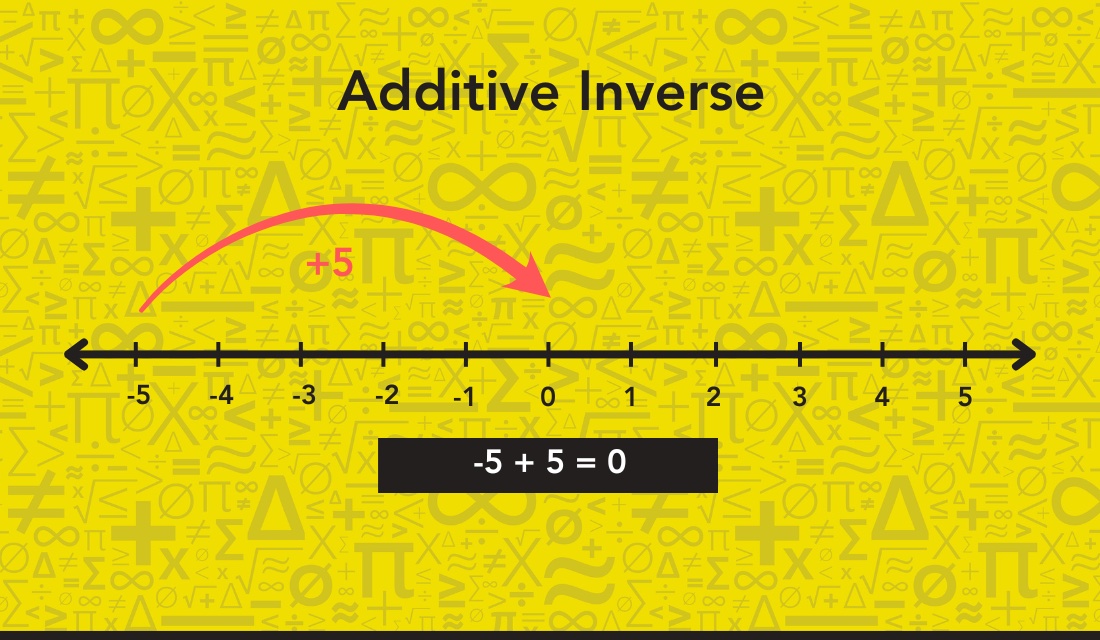
Two numbers are opposites when they sit at the same distance from zero on either side of the number line:
Zero sits at the center of the number line. It does not have a different number as its opposite, because it is already at the middle point.
📕 You May Also Like: How Number Lines Improve Math Understanding in Grades 1 Through 5
Additive Inverses in Everyday Life
Additive inverses show up in everyday situations that we already navigate without thinking of them as math. Some real-world situations include:
-
Money: earn $10, spend $10, end at $0
-
Temperature: rise 6 degrees, drop 6 degrees, return to the starting temperature
-
Games: gain 7 points, lose 7 points, return to the same score
-
Floors: go up 4 floors, come down 4 floors, return to the starting floor
As you can see, we already understand additive inverses intuitively. The formal term simply gives a name to something we have been experiencing all along.
📕 You May Also Like: Math for Life: Why Math Skills Matter Beyond School
Additive Inverses in the Classroom
Additive inverses appear at a specific point in the math curriculum and build directly on each other across grades. At Mathnasium of Logan, we follow the Utah Core Standards for Mathematics, which map out exactly when and how this concept arrives in your child's classroom:
-
Grades 5 to 6: extends the number line to include integers and negative numbers for the first time
-
Grades 6 to 7: opposite numbers and additive inverses are formally introduced
-
Grade 7 and beyond: additive inverses become a tool for solving equations
In algebra, additive inverses help simplify equations because opposite terms cancel each other out:
-
x + 5 − 5 = x
-
x + 7 + (−7) = x
This pattern gives algebra much more structure and predictability from the very beginning. The additive inverse works the same way every time, which helps equations feel less confusing and far easier to simplify.
📕 You May Also Like: How to Make Sure Your Child Is Ready for Algebra
4 Mistakes Students Make With Additive Inverses
Additive inverses tend to cause confusion in four specific areas. A clear explanation of each one makes the pattern much easier to recognize.
1. Negative Numbers and Subtraction Look the Same
Negative numbers may confuse students when they appear alone in an expression. −5 means the opposite of 5, not an instruction to subtract. A student reading −5 as a subtraction sign will make consistent errors once negative numbers appear in expressions on their own.
2. Zero Is Its Own Opposite
Zero is its own additive inverse, and that breaks the pattern every other number follows. Other numbers have a distinct opposite on the far side of the number line. Zero is already at the center, so it has nowhere to mirror. The result is always the same: 0 + 0 = 0.
3. Similar Expressions Produce Different Results
Students may assume that switching the signs around makes no difference to the answer. These two expressions show exactly why it does:
-
7 + (−3) = 4, because 7 is larger and positive, so the answer stays positive
-
−7 + 3 = −4, because 7 is larger and negative, so the answer stays negative
The sign of the number with the greater absolute value determines the sign of the answer.
4. Inverse Pairs in Multi-Step Problems Are Easy to Miss
Multi-step problems involve three or more numbers we add or subtract in sequence. Students working strictly left to right, through −4 + 9 + 4 may take the longer route:
-
Step 1: −4 + 9 = 5
-
Step 2: 5 + 4 = 9
If a student spots the inverse pair first, they solve it in one step:
We build speed and accuracy across every grade that follows by learning to look for inverse pairs before starting the calculation.
Additive inverses are one of those concepts that click quickly once you see exactly where your thinking is going wrong. Our tutors at Mathnasium of Logan identify precisely which of these confusion points you may be hitting and build from that exact spot, so the path to grasping the concept is as direct as possible.
📕 You May Also Like: How to Subtract Positive and Negative Integers? A Simple Guide

At Mathnasium of Logan, our tutors help children understand how opposite numbers work together, so integers and early algebra feel clearer and less overwhelming.
How Mathnasium Builds Confidence With Any Math Skill or Concept
Mathnasium is a math-only learning center dedicated to helping K-12 students learn and master math at every level.
Whether a student needs help with integers and opposite numbers or is ready to apply additive inverses in early algebra, we focus on building true understanding.
To help them reach that level, we use the Mathnasium Method™, our proprietary teaching approach designed to uncover each student's math potential.
Our approach starts with a diagnostic assessment that identifies their current skills, strengths, and gaps. From those insights, we build a personalized learning plan built around their goals.
With the plan in place, our tutors follow it closely, delivering face-to-face instruction in a supportive environment. We teach for understanding, using clear everyday language and a mix of verbal, visual, mental, tactile, and written techniques so each concept lands before we move forward.
When students get stuck, we break the concept down into manageable steps and work through both the how and the why, so students leave each session with problem-solving skills they can apply independently.
We make sessions engaging, too. Games, earned rewards, and consistent celebration of progress keep learning purposeful and help students build confidence alongside fluency.
The results speak for themselves:
-
94% of parents report improvement in their child's math skills and understanding
-
93% of parents report an improved attitude toward math after attending Mathnasium
-
90% of students saw improvement in their school grades
With over 1,100 learning centers across North America, there is likely a Mathnasium close to you.
Families across Logan, North Logan, Providence, Hyde Park, Nibley, Wellsville, River Heights, and Smithfield trust Mathnasium of Logan to help their children build real math confidence at every level.
If your child is working through integers or algebra and needs more targeted support, our team is ready to help.
📅 Schedule a Free Assessment at Mathnasium of Logan
Not near Logan?
📍 Find a Mathnasium Learning Center Near You


 (385) 423-2185
 (385) 423-2185