You may have already used a few different ways to multiply, such as skip counting, doubling, partial products, or an area model. Each method helps us understand what multiplication means by breaking a larger problem into smaller parts.
But let’s say your school is running a fundraiser and sells 236 raffle tickets at $18 each. We could solve 236 × 18 with an area model or partial products, but the work can start to take up a lot of space.
For larger numbers like these, we can use the standard algorithm, a faster and more compact way to keep the multiplication organized.
Today, we’ll look at what the standard algorithm is and how to use it to multiply multi-digit numbers.

What Is the Standard Algorithm for Multiplication?
The standard algorithm of multiplication is a method for multiplication where we stack the numbers vertically and multiply one digit at a time. You may also hear it called the traditional or long multiplication method.
Each digit represents a place value, such as ones, tens, or hundreds. The standard algorithm helps us keep those place values lined up correctly as we multiply.
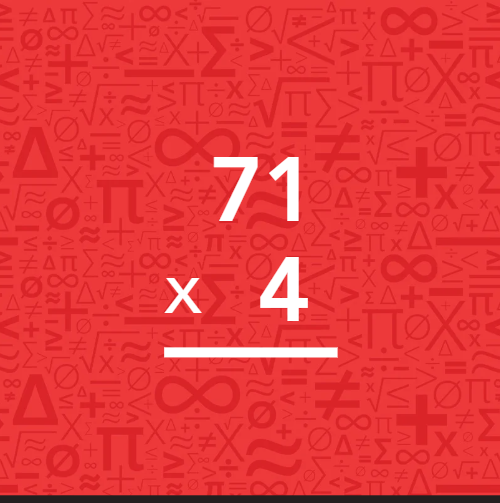
At Mathnasium, we love teaching through examples. So, let's break down 71 × 4 using the standard algorithm.
Step 1: Line up the digits by place value
We stack the numbers vertically so the digits line up by place value. For 71 × 4, we write 71 on top and 4 underneath, with the 4 directly below the 1 in the ones place.
📕 You May Also Like: How to Make Place Value Click for Your Child—At-Home Guide
Step 2: Multiply the ones digit
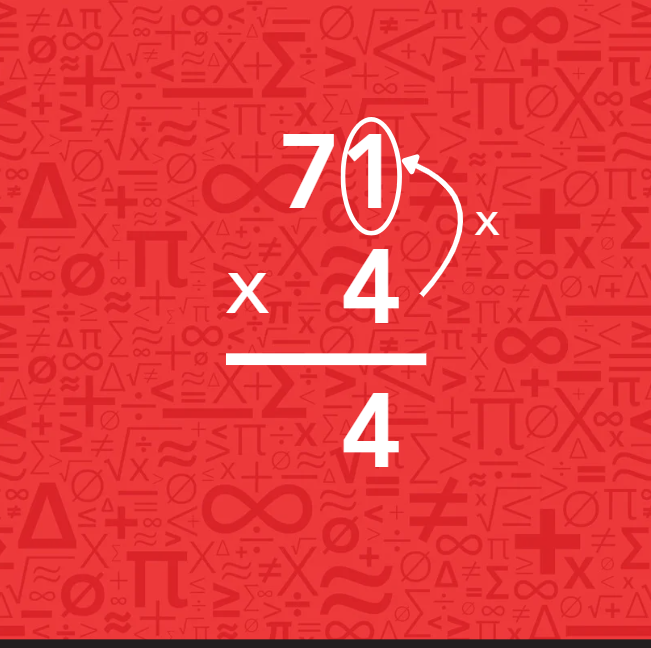
We start by multiplying 4 by the ones digit of 71, which is 1:
4 × 1 = 4
We write 4 in the ones place of the answer.
Step 3: Add a placeholder zero & multiply by the tens digit
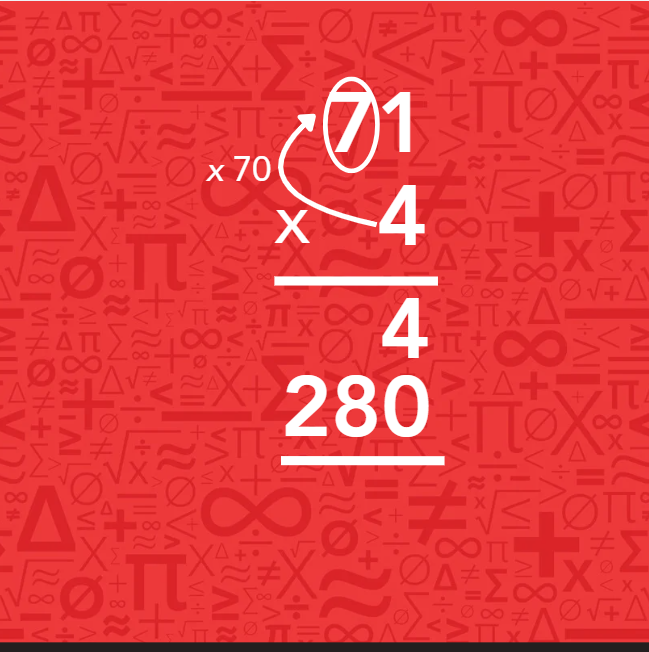
Before we multiply by the tens digit, we place a 0 in the ones place of the new row. We do this because the 7 in the tens place represents 70, so we are multiplying by 70 rather than 7. This placeholder shows that our next partial product comes from the tens place, so it needs to start one place to the left.
Now, we can multiply 4 by the tens digit of 71, which is 7:
4 × 7 = 28
We write 28 to the left of the placeholder zero, placing the 8 in the tens place and the 2 in the hundreds place. This gives us 280.
Step 4: Add the products
Now we add the two partial products, 4 and 280, to get the final answer:
4 + 280 = 284
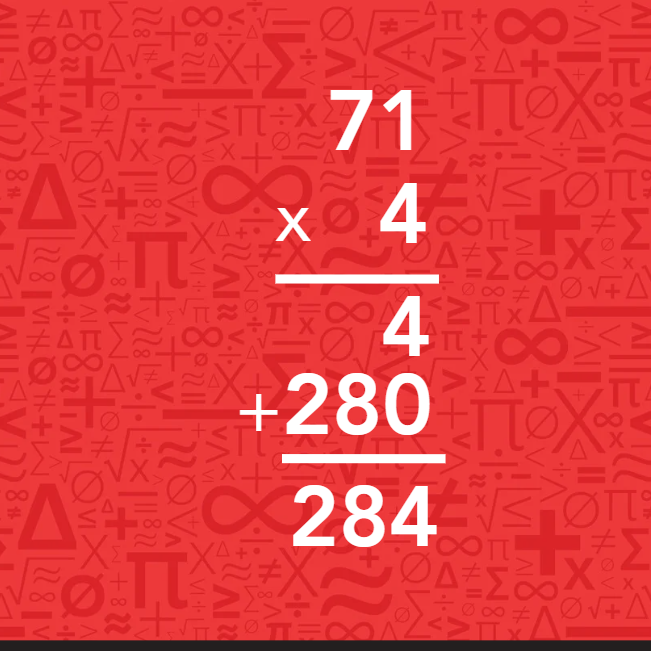
This means that 71 × 4 = 284.

How to Use the Standard Algorithm for Multi-Digit Multiplication
To multiply larger numbers with the standard algorithm method, we need to work through the bottom number one digit at a time. For each digit, we multiply it by the top number and write down a partial product. Once we have all the partial products, we add them together.
As the numbers get bigger, you’ll notice two things:
-
We may need several rows of partial products. Each digit in the bottom number gets its own row.
-
Each new row starts one place farther to the left. We can use placeholder zeros to show that change and keep the digits lined up by place value.
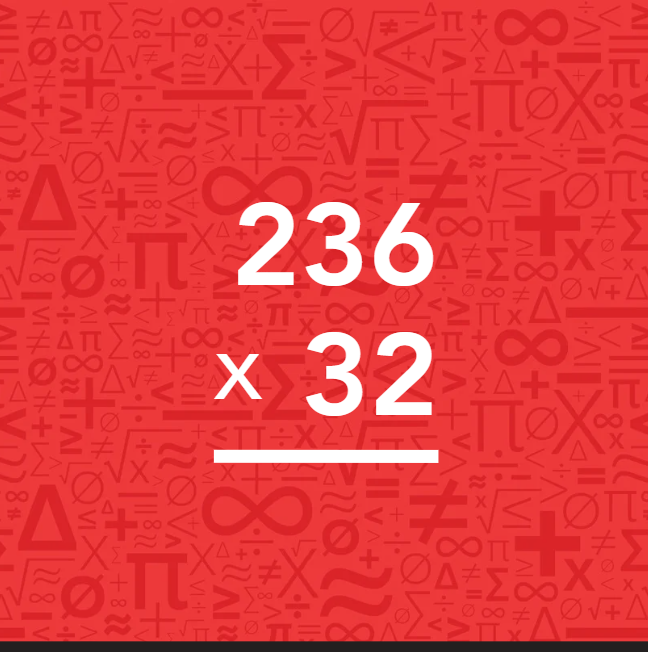
Let’s put this into practice with a three-digit by two-digit example: 236 × 32.
Step 1: Line up the digits by place value
We stack 236 on top and 32 underneath, lining up the ones digits with the ones and the tens digits with the tens.
Step 2: Multiply by the ones digit
We start with the ones digit of 32, which is 2, and multiply it by each digit in 236, starting from the right.
-
2 × 6 = 12. Write 2 in the ones place and carry 1 ten.
-
2 × 3 = 6, then add the carried 1: 6 + 1 = 7. Write 7 in the tens place.
-
2 × 2 = 4. Write 4 in the hundreds place.
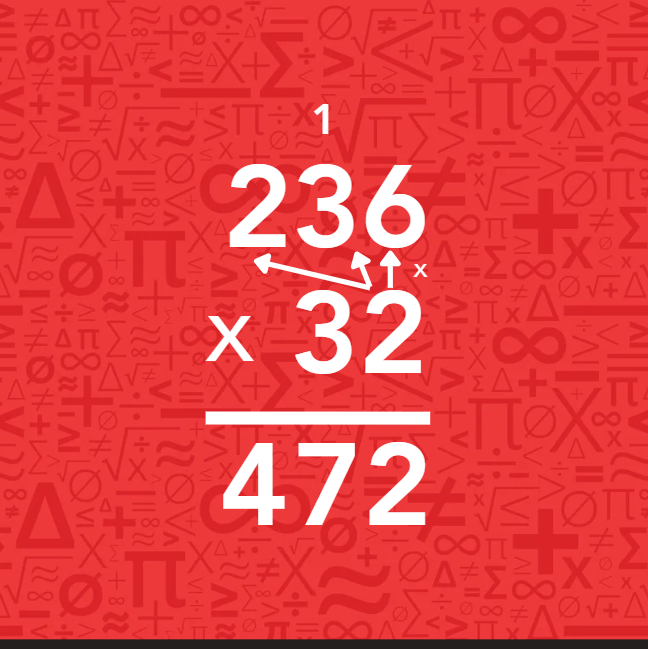
So our first partial product is 472.
Step 3: Add a placeholder zero & multiply by the tens digit
Since we’re now multiplying by the tens digit, we’re really multiplying by 30, not 3. We first write a 0 in the ones place of the new row as a placeholder. Then we multiply 236 by 3, going from right to left:
-
6 × 3 = 18. Write 8 to the left of the placeholder 0 and carry 1 to the next place.
-
3 × 3 = 9. Add the carried 1: 9 + 1 = 10. Write 0 to the left of 8 and carry 1 again.
-
2 × 3 = 6. Add the carried 1: 6 + 1 = 7. Write 7 to the left of the 0.
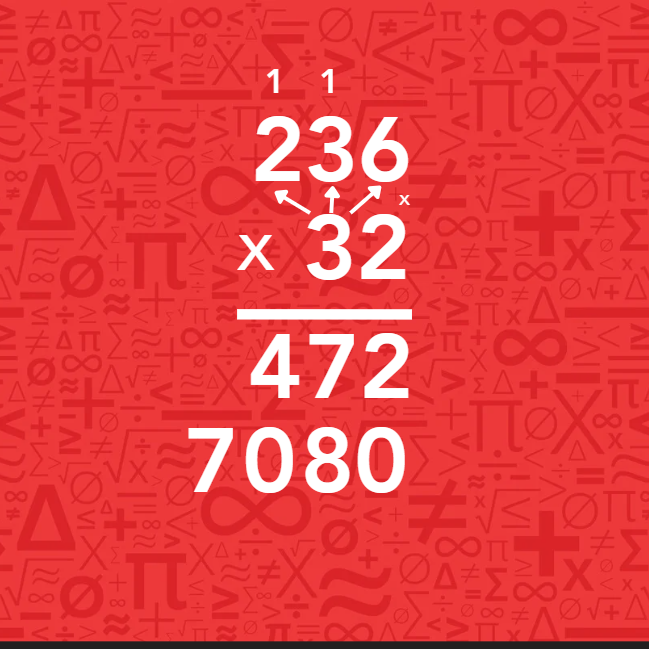
So 236 × 3 = 708. With the placeholder zero in the ones place, our second partial product is 7080.
Step 4: Add the partial products
Finally, we add our two partial products together:
472 + 7080 = 7552
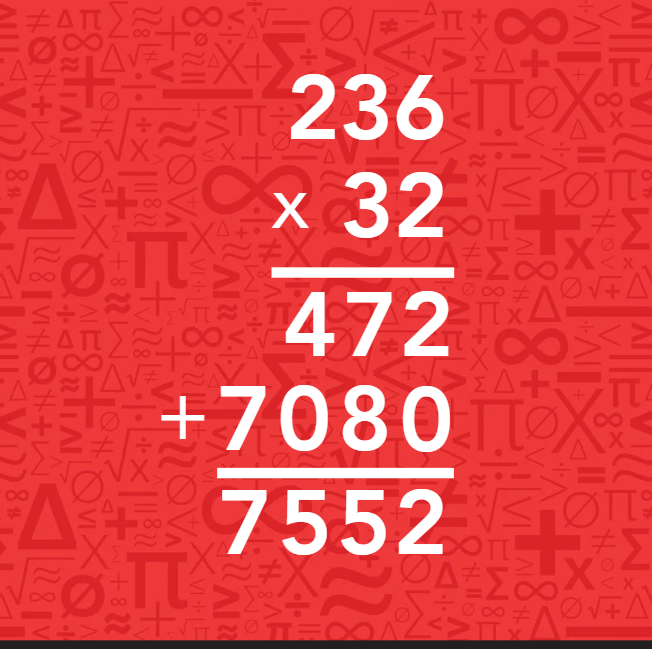
So 236 × 32 = 7552.
📕 You May Also Like: 8 Multiplication Tips to Support Understanding and Fluency
Common Mistakes to Avoid With Multi-Digit Multiplication
From our tutoring experience, we see a few mistakes that come up often with the standard algorithm. As soon as you know where they tend to happen, they become much easier to catch and correct.
Use this table to see what to watch for, why each mistake causes a problem, and how to avoid it.
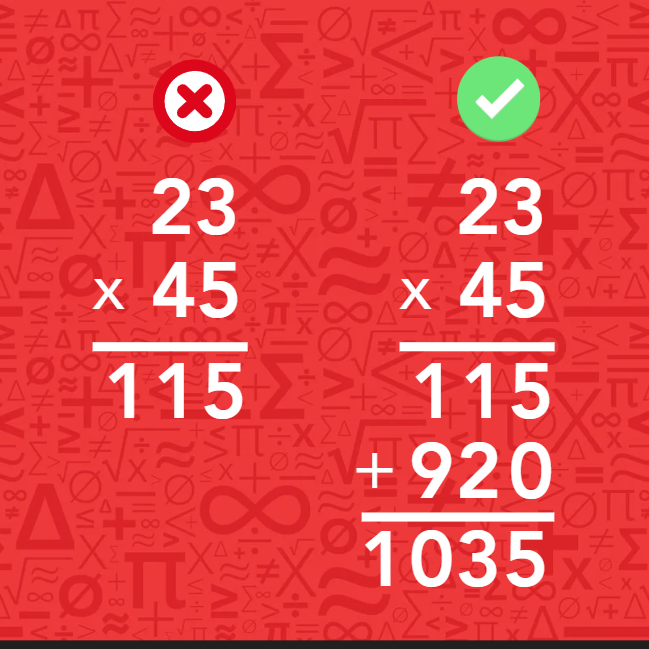
A. Multiplying only by the ones digit on the bottom
The first row can look like a finished answer, especially if the ones digit was the only one multiplied. To avoid this mistake, we need to give each digit in the bottom number its own row of partial products.
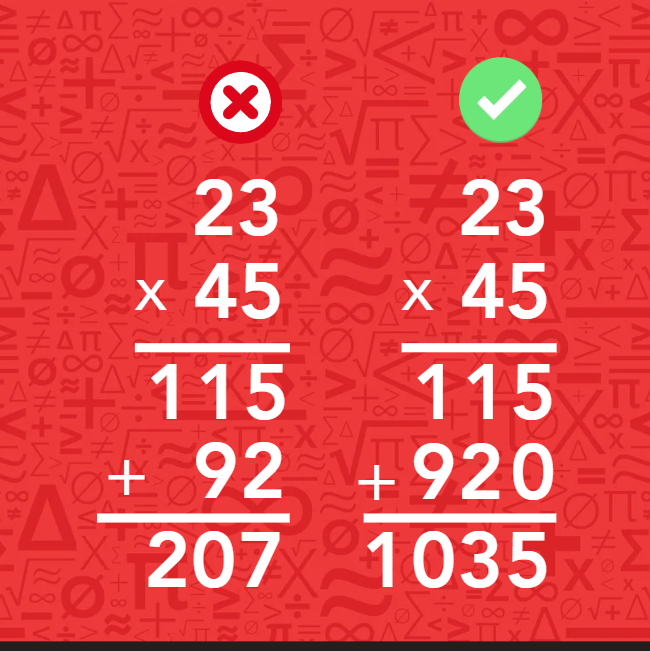
B. Forgetting the placeholder zero when multiplying by tens
Learners may not realize that multiplying by the tens digit means multiplying by a multiple of ten. Before multiplying by the tens digit, we place a 0 in the ones column to show that the second partial product starts in the tens place and to keep the digits aligned correctly.
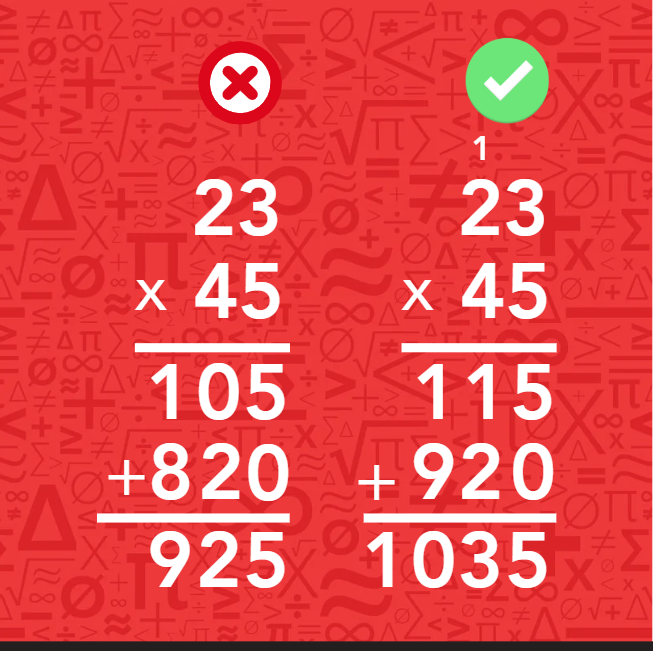
C. Forgetting to add the carried digit
When a multiplication gives us a two-digit result, we write one digit and carry the other to the next place. It’s easy to move on and forget to add that carried digit in the next multiplication step. To prevent this, write the carried digit clearly above the next column before continuing.
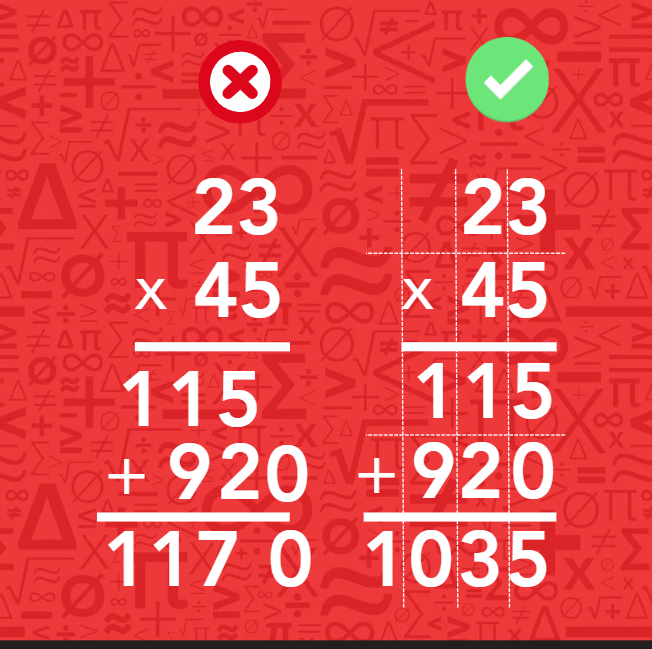
D. Misaligning the partial products
Extra rows are easy to lose track of, especially once there's more than one to line up. Use place-value columns or graph paper to keep ones, tens, and hundreds aligned
📕 You May Also Like: Lattice Multiplication: A Step-by-Step Guide for Students
Try the Standard Method for Multi-Digit Multiplication Yourself!
Now, you can practice multi-digit multiplication with the standard method on your own. Check your answers at the bottom of the page.
-
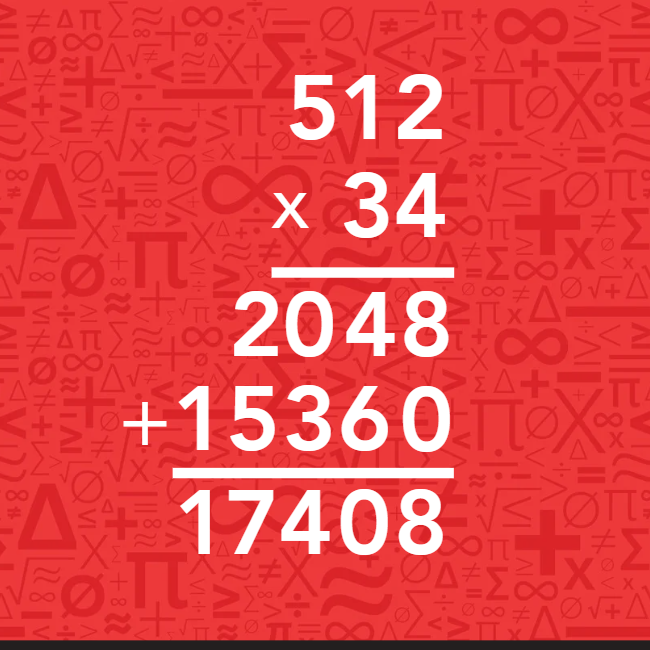
512 × 34 = ?
-
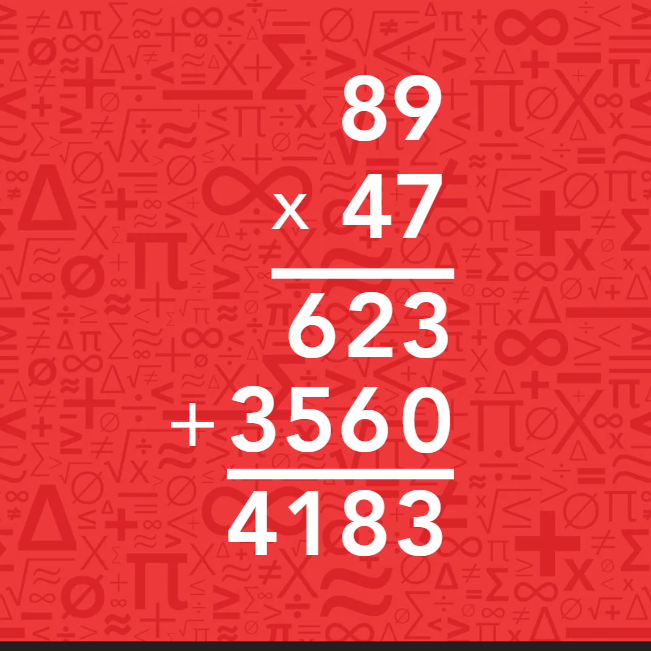
89 × 47 = ?
-
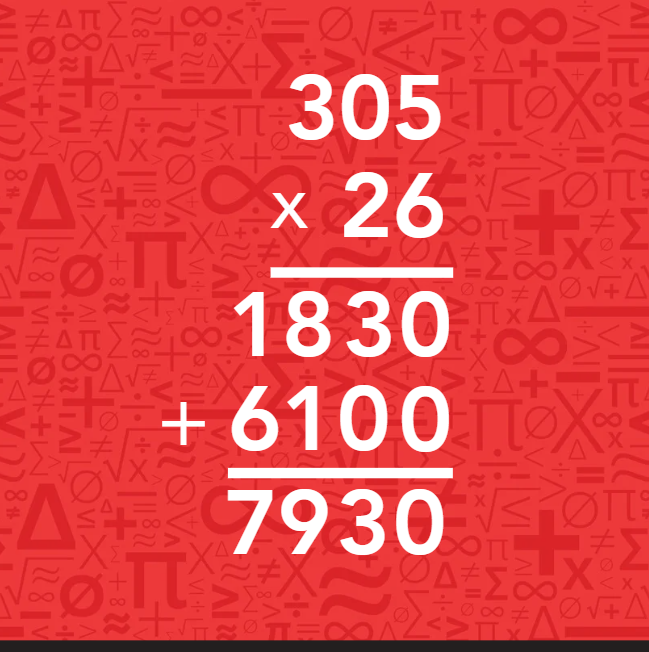
305 × 26 = ?
📕 You May Also Like: How to Do Long Multiplication — A Complete Overview
 During sessions, Mathnasium tutors follow a personalized learning plan tailored to each student’s needs and goals in math.
How Mathnasium Helps Students With Multi-Digit Multiplication (and Any Other Math Topic)
Mathnasium is a math-only learning center dedicated to helping K–12 students of all skill levels excel in math.
We help students build a deep understanding of any math concept, including multi-digit multiplication.
To do that, we use the Mathnasium Method™, our proprietary teaching approach, designed around each student’s needs. We help students understand why the method works instead of just memorizing procedures. This way, they can use it accurately, catch mistakes, and apply the same reasoning to new problems.
Here’s how it works in practice.
Each student begins with a diagnostic assessment that helps us understand which skills are secure, which need more support, and how the learner thinks and feels about math.
Using these insights, we create a personalized learning plan focused on the skills the student needs most, whether that means working on place value, improving multiplication facts, or building fluency with multi-digit multiplication.
Our specially trained tutors follow the plan closely and provide live, face-to-face instruction in a caring and fun group environment. They use mental, verbal, visual, tactile, and written techniques to help students see the why behind the how of any math problem.
Students also get room to think through problems before tutors step in. Our tutors guide them to explain each step, check whether the answers make sense, and spot errors in their own work. This helps students build problem-solving skills, critical thinking, and greater independence in math.
Fun is an important part of the approach, too. We use game-based activities, rewards, and consistent encouragement to help students stay engaged as they build multiplication fluency and confidence with larger numbers.
The results speak for themselves:
-
94% of parents report an improvement in their child's math skills and understanding
-
93% of parents report their child's improved attitude toward math after attending Mathnasium
-
90% of students saw an improvement in their school grades
With over 1,100 learning centers across North America, there is likely a Mathnasium close to you.
For families in and near Logan, Mathnasium of Logan brings that same approach close to home, with specially trained tutors, helping students make sense of multi-digit multiplication and the number sense skills behind it.
Whether your child needs to reinforce multiplication foundations, keep up with current coursework, or get ahead, a free diagnostic assessment is a great place to start. Using what we learn, we create a personalized learning plan that helps your child master the skills they need next.
📅 Schedule a Free Assessment at Mathnasium of Logan
Not near Logan?
📍 Find a Mathnasium Learning Center Near You
Pssst! Check Your Answers Here
Ready to see how you did? Here are the answers for the practice problems above:
1. 512 × 34 = 17408
2. 89 × 47 = 4183
3. 305 × 26 = 7930


 (385) 423-2185
 (385) 423-2185