It’s not unusual to hear from fourth graders that math starts to feel different at this stage. That reaction lines up with how the curriculum evolves, moving beyond basic computations into more layered thinking, like multi-digit multiplication or understanding fractions with greater nuance.
While every Common Core standard plays a role, there are a few critical areas that stand out. These are the skills students need to master in fourth grade to stay on track for long-term success.
Today, Mathnasium tutors will walk you through those key concepts, explain what true mastery looks like, and share strategies, drawn directly from our centers, that you can use at home to help your child build confidence and skill.

Math Concepts 4th Graders Must Master
In third grade, students learn their multiplication facts, explore basic fractions, and begin working with larger numbers, mostly in predictable, one-step problems.
Fourth grade raises the bar. Students tackle larger numbers, more complex operations, and fraction work that pushes beyond intuition. Math becomes less about quick answers and more about organized thinking.
But beyond the added demands of the curriculum, fourth grade is also when future skills start to take shape.
Math is a cumulative subject, where each new skill builds directly on the last. It’s like laying bricks where each one supports what comes next. Fourth grade is where many of the most important layers are set.
With both the current curriculum and future learning in mind, our tutors have put together a list of key concepts that deserve focused attention in fourth grade.
1. Multi-Digit Multiplication
Basic fact recall evolves into something more layered. In fourth grade, students are expected to:
-
Use place value to break numbers into tens and ones: Recognizing that 36 is 30 + 6 and using that to simplify more complex multiplication
-
Solve problems with partial products: Multiplying in parts (like 20 × 30, 20 × 6, 4 × 30, and 4 × 6) and then combining the results
-
Multiply two-digit numbers by one- and two-digit numbers: For example, solving problems like 42 × 3 or 24 × 36 with structured methods rather than mental math alone
-
Estimate before solving to check for reasonableness: Thinking, “40 × 30 is about 1,200,” to make sure their final answer is in the right range
Mastering these is the ideal scenario. In reality, things don’t always go smoothly. When fourth-grade students come to us for help with multiplication, we see a few consistent error patterns, including:
-
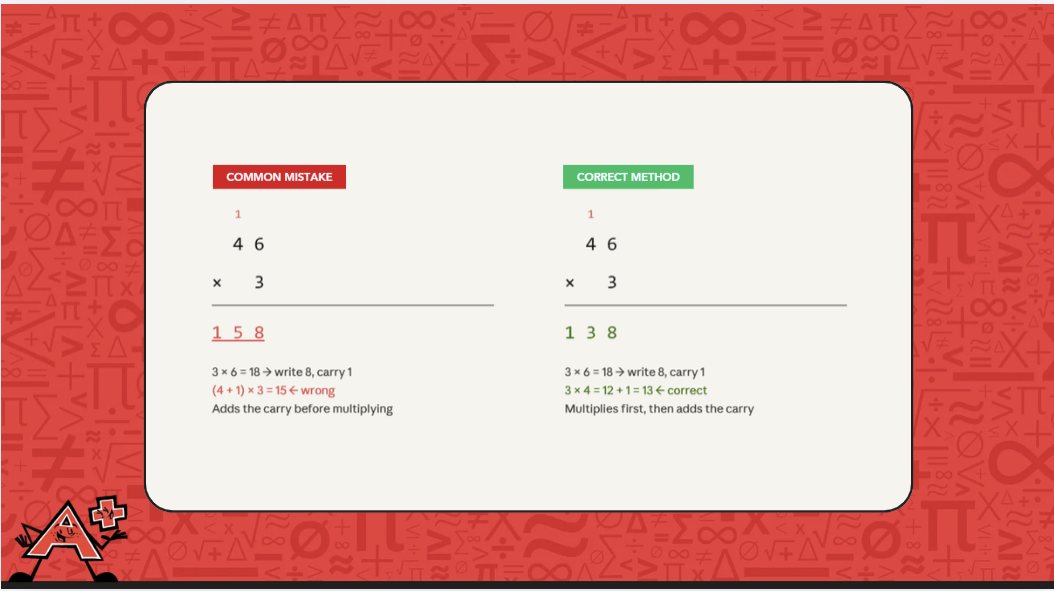
Addition carryover confusion: In a problem like 46 × 3, a student might multiply 3 × 6 = 18, carry the 1, but then mistakenly add before multiplying: (4 + 1) × 3 = 15, leading to 158 instead of the correct 138.
-
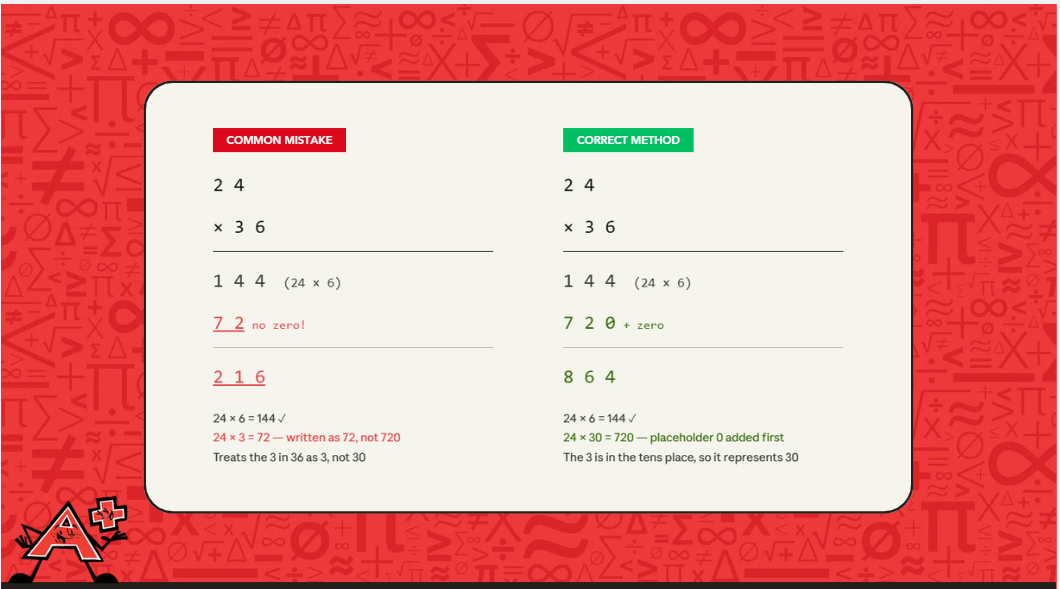
Forgotten placeholder zero: When multiplying two-digit numbers (like 24 × 36), students often forget to place a zero when shifting to the tens row, treating the 3 in 36 as just 3, not 30.
It’s also worth noting that multi-digit multiplication doesn’t stay in its lane for long. Right after this chapter, students begin using it to solve division problems, work through word problems with multiple steps, compare fractions, and estimate larger quantities with more precision.
And if we zoom out past fourth grade, the same skill keeps showing up with decimals, variables, fraction operations, and area formulas that depend on careful multiplication.
The better this foundation is now, the more flexible and prepared students are for what’s ahead.
📕 You May Also Like: 7 Strategies to Help Your Child Move Beyond Memorization in Multiplication
2. Multi-Digit Division (Often with Remainders)
In fourth grade, division (just like multiplication) becomes a more structured process. Students work with larger numbers, rely on place value to move through each step, and begin handling remainders where division doesn’t result in a clean split.
By the end of fourth grade, students should be able to:
-
Divide 2- and 3-digit numbers by 1-digit divisors: For example, solving 96 ÷ 4 or 237 ÷ 6
-
Use place value to divide in parts: Breaking 96 into 80 and 16, or reasoning through how many groups of 4 fit into each place
-
Understand and interpret remainders: Recognizing that a remainder is what's left over after equal groups have been made, then deciding, based on context, whether to round, leave it as a remainder, or express it differently
-
Apply division to word problems: This might mean figuring out how many boxes are needed if 94 items fit 5 per box
Understandably, this skill brings its share of confusion. Some of the most common mistakes include:
-
Treating the remainder as an extra number: Students write answers like “18 R4” without thinking about what the 4 means or how it affects the situation
-
Guessing at quotients: Instead of using place value or estimation, students jump to a number and adjust from there
-
Trying to divide the whole number at once: Skipping the step-by-step process and missing how place value breaks the number into manageable parts
Similar to multi-digit multiplication, this skill carries forward. Division lays the groundwork for understanding fractions, ratios, and algebraic reasoning.
📕 You May Also Like: How to Do Long Division? Explained for 4th Graders
3. Fractions (Equivalence, Addition/Subtraction with Like Denominators)
Fractions take center stage in fourth grade. Students work on developing skills such as:
-
Comparing and ordering fractions using number lines, benchmarks like \(\Large\frac{1}{2}\), and visual representations
-
Building and recognizing equivalent fractions; for example, seeing that \(\Large\frac{3}{6}\) and \(\Large\frac{1}{2}\) represent the same amount
-
Adding and subtracting fractions with like denominators, such as \(\Large\frac{5}{8}\) + \(\Large\frac{2}{8}\) or \(\Large\frac{7}{10}\) − \(\Large\frac{3}{10}\)
-
Using models and part-whole reasoning to explain why a fraction makes sense in context
Reasoning through fractions doesn’t come easily for many fourth graders. What our tutors often notice are small but telling breakdowns in understanding, such as:
-
Treating the numerator and denominator as separate whole numbers: For example, thinking \(\Large\frac{1}{8}\) is greater than \(\Large\frac{1}{4}\) because 8 is bigger than 4
-
Guessing based on how a fraction looks rather than using models or benchmarks to compare
-
Adding only the numerators when working with like denominators: For instance, solving \(\Large\frac{2}{6}\) + \(\Large\frac{1}{6}\) as \(\Large\frac{3}{12}\) instead of \(\Large\frac{3}{6}\)
The fraction work students do in fourth grade becomes part of how they approach decimals, percentages, ratios, and proportional reasoning in later years. Each of these topics builds on the same core idea: understanding parts in relation to a whole.
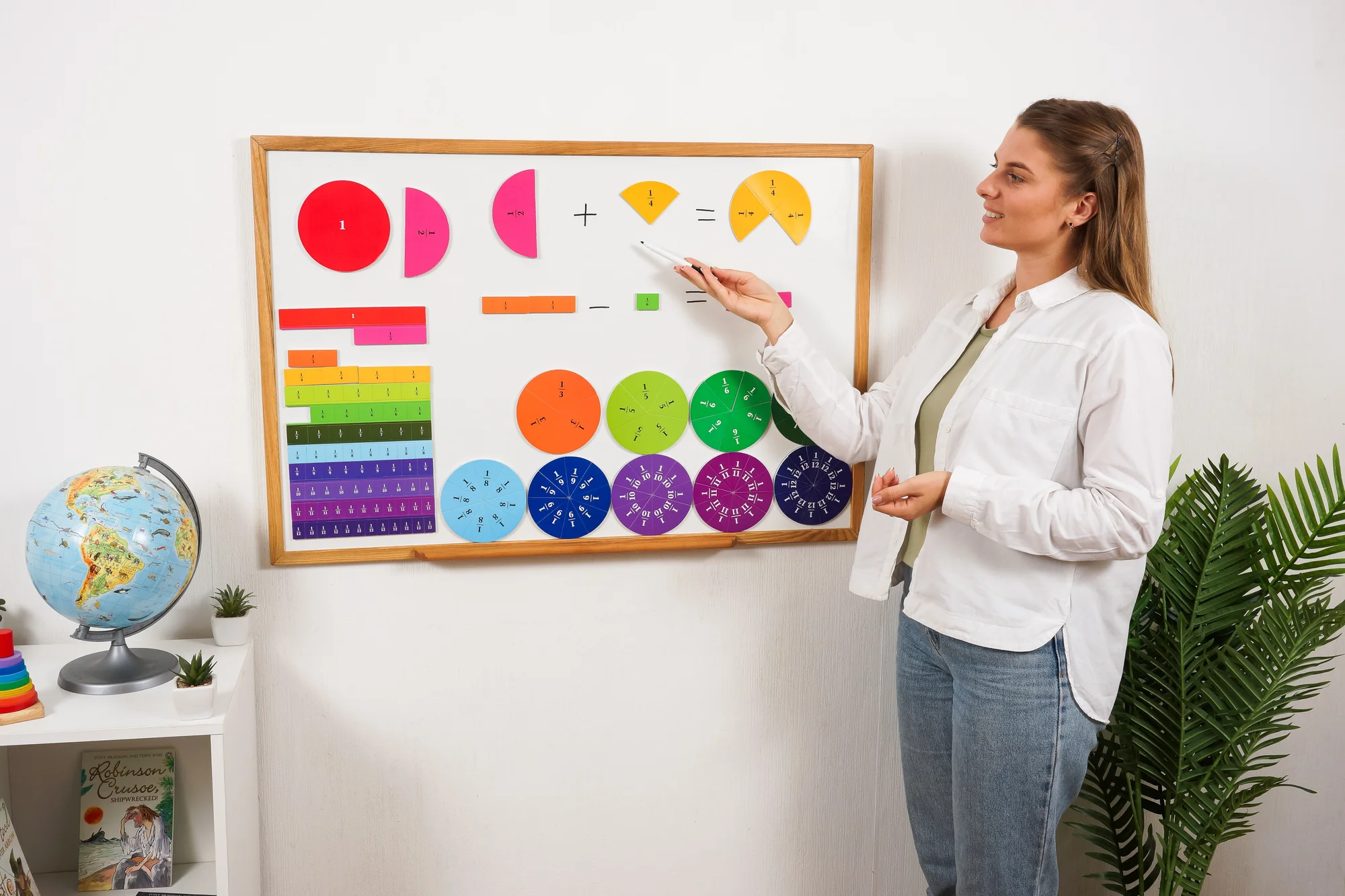
In fourth grade, students build core fraction skills, comparing, finding equivalence, and working with like denominators
4. Place Value to the Millions
Fourth grade stretches students’ understanding of our number system. Instead of stopping at thousands, they now read, write, and compare numbers in the hundreds of thousands and even millions.
By the end of fourth grade, students should be able to:
-
Read and write multi-digit numbers up to the millions in standard, word, and expanded form
-
Compare and order large numbers by looking carefully at the value of each digit
-
Use place value to round numbers to any given place, not just the nearest ten or hundred
-
Make reasonable estimates by recognizing the size and scale of the numbers involved
Even with dedicated practice, certain misunderstandings show up. Our tutors frequently see:
-
Dropping zeros in large numbers: For example, writing “three million, forty thousand, seven” as 3,40,7 or skipping necessary placeholders in standard form
-
Missing the scale between digits: Not recognizing that the 4 in 400,000 is ten times greater than the 4 in 40,000
-
Rounding confusion around midpoints: Struggling to identify which place value to round to and which digit determines whether to round up or down. For example, does 3,500 round to 3,000 or 4,000? Does 24,500 round to 20,000 or 30,000?
Place value touches almost everything students do in math. A solid grasp of large numbers gives them confidence to estimate, spot mistakes, and stay grounded as problems become more layered.
5. Geometry and Measurement
At this point, students start working more closely with shapes and measurements. It’s one of the first times math feels hands-on, where numbers connect to what they can actually see and measure.
In class, they’re expected to make progress with:
We’re sure many parents would agree: this is where math can get messy. Once shapes turn into measurements and formulas, errors like these appear:
-
Mixing up area and perimeter, especially when shapes aren’t labeled or drawn to scale
-
Guessing angle types instead of measuring or checking with known benchmarks
-
Plugging numbers into formulas without knowing what they represent, which leads to answers that don’t match the question
These are often signs that a student is focused on steps rather than structure. A little clarity here goes a long way in future math.
📕 You May Also Like: Perimeter vs. Area: How to Teach the Difference at Home
6. Multi-Step Word Problems and Reasoning
Instead of solving one operation at a time, students in fourth grade are asked to plan their steps, think through what the question is really asking, and carry out multiple operations in order.
At this stage, students are learning to:
-
Read carefully to understand what’s being asked, not just scan for numbers
-
Decide which operations to use and in what order, such as subtracting, then multiplying
-
Model each step, whether with diagrams, equations, or written explanations
-
Use estimation and logic to check if their answers make sense
That’s a lot to juggle, and the process doesn’t always stick right away.
When students see a problem like “Lena buys 3 packs of markers. Each pack has 6 markers. Then she gives 5 to a friend. How many does she have left?” they might:
-
Rush into the first calculation before fully understanding the question
-
Solve only part of the problem, and stop too soon
-
Misread or skip important information, although this usually refers to longer word problems
These kinds of challenges go beyond basic calculation. They ask students to slow down and think through what the problem really wants, one step at a time.
Strategies to Support 4th Grade Math Mastery at Home
With all the challenges fourth-grade math may bring, how can parents offer the right kind of support at home?
You don’t need to be a math expert, but it does take a more intentional approach to how practice happens.
Our instructors rely on these methods in the centers, and they translate easily to learning at home.
1. Break Down Multiplication Using Area Models
When multi-digit multiplication starts to get overwhelming or confusing, we turn to structure, and one of our go-to tools is the area model, sometimes called the box method.
It’s a way of organizing multiplication by breaking numbers into parts and showing each piece of the calculation in its own space.
So, why do we use it?
Because it gives students a visual way to see what’s really happening in the problem. Instead of just stacking numbers and hoping for the best, they break the problem into parts they can manage and make sense of.
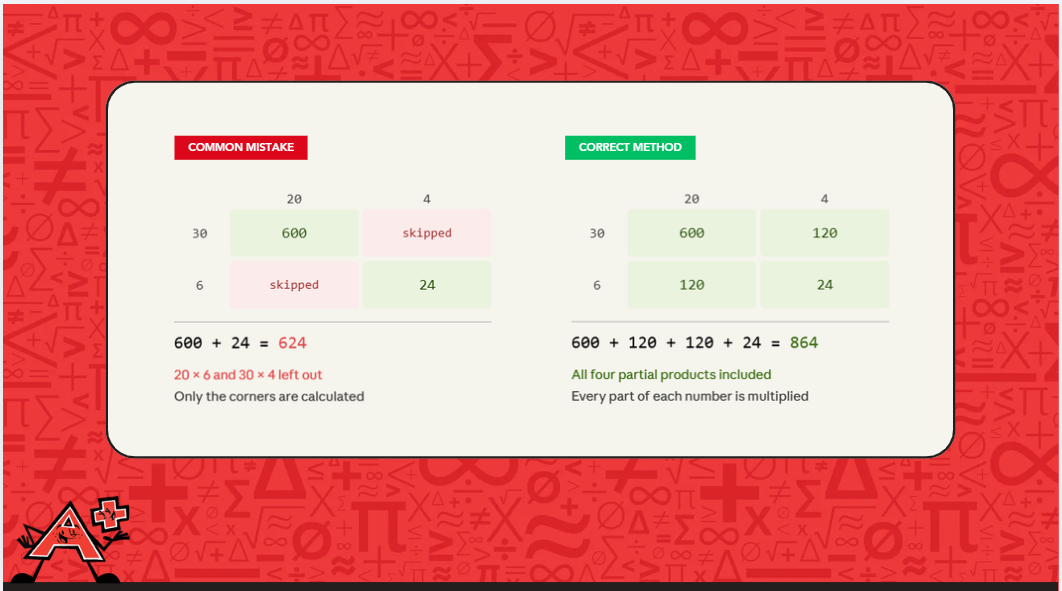
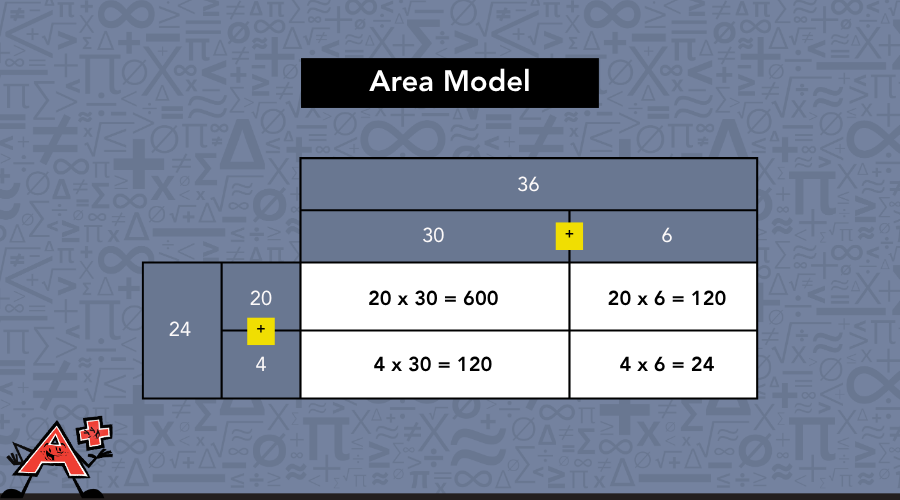
Let’s say a student is working on 24 × 36. Using an area model, they split the numbers by place value:
-
24 becomes 20 and 4
-
36 becomes 30 and 6
They draw a box, label the sides, and multiply part by part:
-
20 × 30 = 600
-
20 × 6 = 120
-
4 × 30 = 120
-
4 × 6 = 24
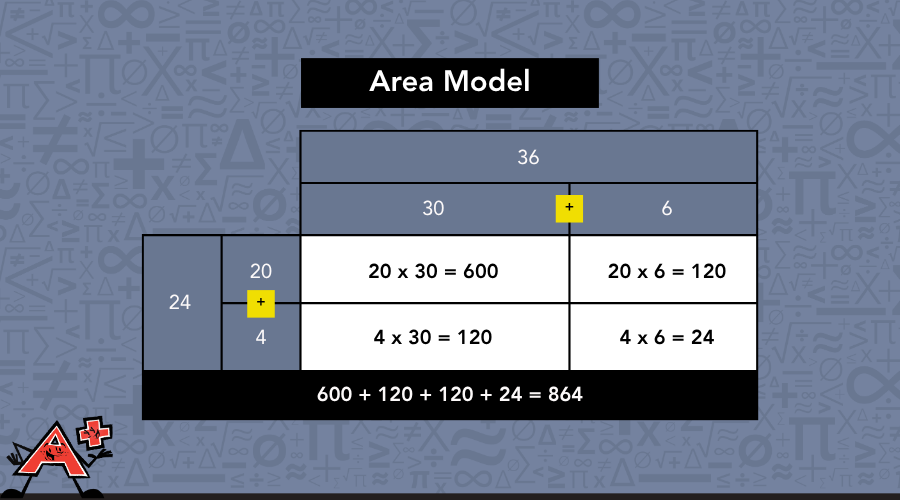
Then, they combine the partial products:
600 + 120 + 120 + 24 = 864
Now that you’ve seen how it works, give it a try with your child at home.
2. Use Manipulatives to Model Division, Then Transition to Abstract
Your student may have had a solid grasp of division last year. But now that problems involve larger numbers and remainders, confusion can start to set in.
That’s normal.
To help them move past it, we often return to manipulatives or physical objects that make math visible. These could be fruits, coins, buttons, cereal, or anything you have around the house that’s easy to count and group.
The goal is to show division as equal groups so students can see what fits evenly and what’s left over.
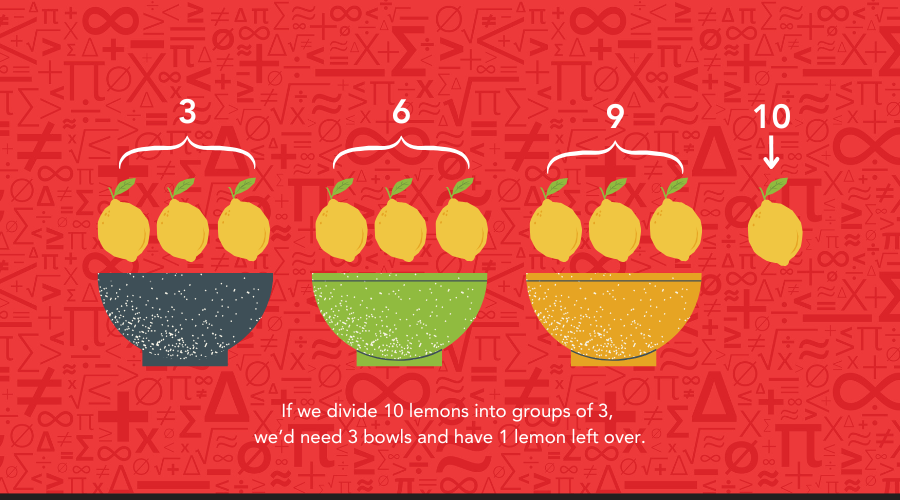
For example, hand your student 10 lemons and ask them to divide them into groups of 3. They’ll place 3 lemons in each bowl until there are no full groups left, then spot that 1 lemon is left over.
Then you can ask:
From there, you can write out the equation together:
10 ÷ 3 = 3 R1
Once they’ve nailed down equal groups and can make sense of remainders, they can slowly work their way up to more structured methods, like long division.
Take 85 ÷ 3 as an example.
-
We start by dividing the 8 tens by 3. The question is, “How many groups of 3 tens fit into 8 tens?” The answer is 2 groups, which accounts for 6 of the 8 tens.
-
That’s why we write 2 on top and subtract 6 from 8, leaving 2 tens still to divide.
-
Next, we bring down the 5 ones, which makes 25.
-
Now we ask: “How many groups of 3 fit into 25?” That’s 8 groups, because 8 × 3 = 24.
-
Subtracting leaves us with a remainder of 1.
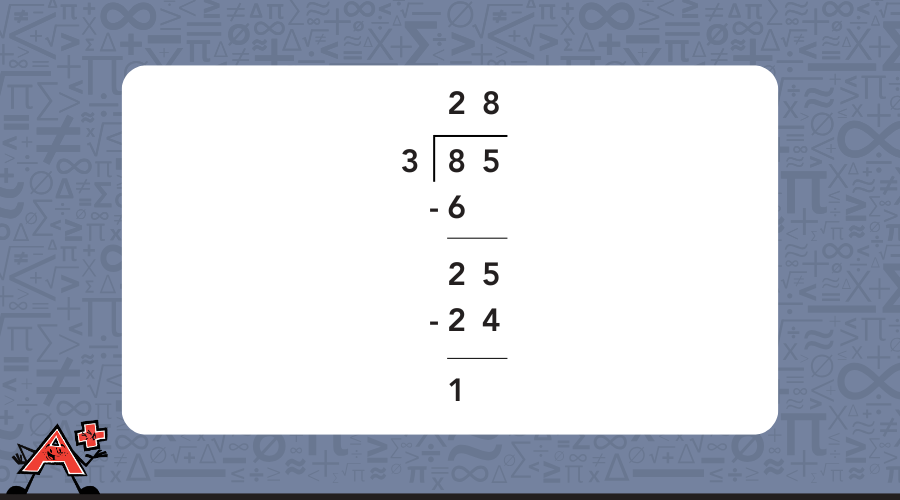
So, 85 ÷ 3 = 28 R1.
Each step connects to what students practiced earlier: building full groups, seeing what’s left, and moving place by place.
3. Compare and Add Fractions with Paper Models or Fraction Strips
Of all math concepts that can feel abstract, fractions tend to top the list. That’s why it’s not always helpful to push through with numbers alone. Instead, you can bring in visuals like paper models, fraction strips, or even folded index cards to make them see the math behind them.
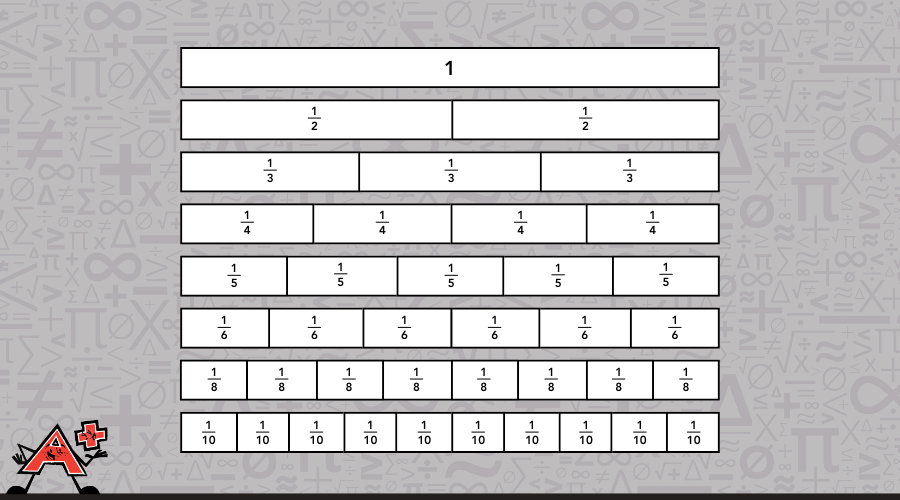
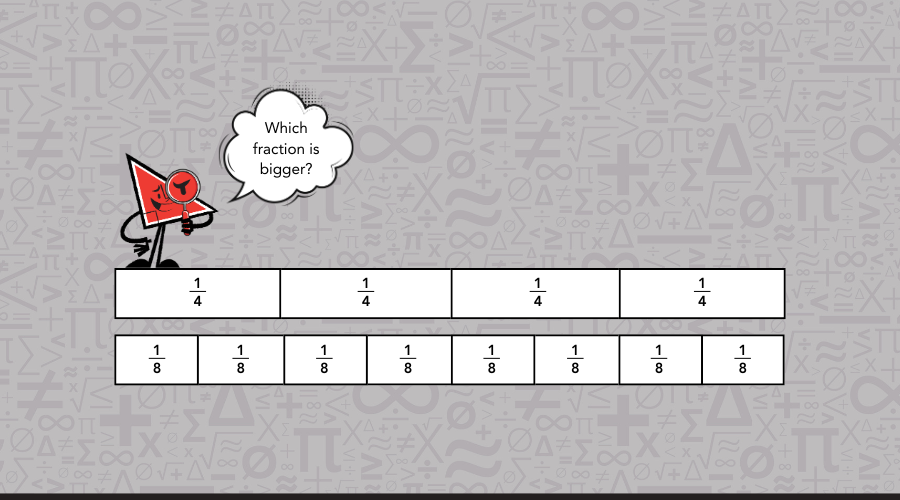
Imagine a student who just can’t grasp why \(\Large\frac{1}{8}\) is smaller than \(\Large\frac{1}{4}\). Show them both strips. Point out that \(\Large\frac{1}{8}\) means one part of eight total pieces, while \(\Large\frac{1}{4}\) means one part of four. Seeing it makes the comparison click.
From there, use the same strips to build addition:
\(\Large\frac{1}{4}\) + \(\Large\frac{1}{4}\) = \(\Large\frac{1}{2}\)
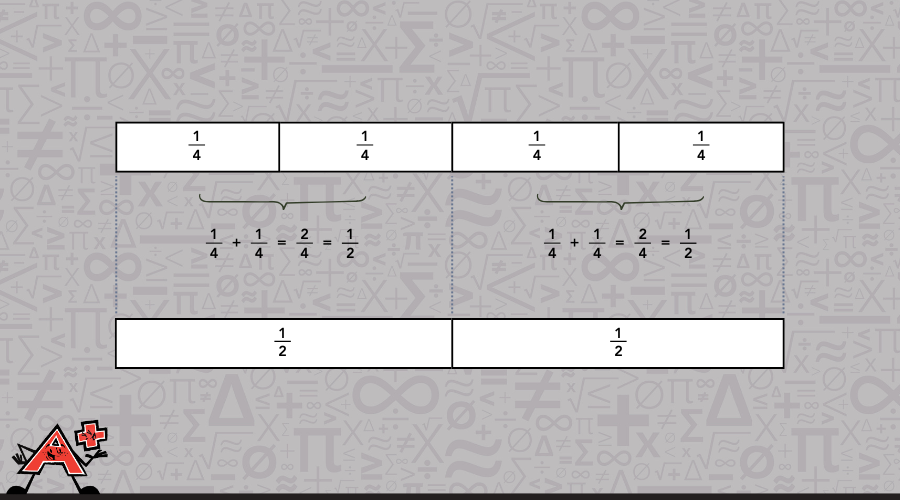
And that’s how fractions go from something that doesn’t stick to something that finally makes sense.
📕 You May Also Like: How to Teach Math to Visual Learners with Pictures & Manipulatives
4. Reinforce Place Value Using Real-Life Numbers and Expanded Form
Place value sticks best when students connect it to numbers they already see around them; no worksheet needed. Look for chances at home to turn ordinary moments into quick math check-ins.
Try things like:
-
Looking at a grocery receipt. Ask, “What does the 2 in $124.58 mean?” (Answer: 2 tens, or 20)
-
Reading the energy bill together. Point to a number like 3,480 and ask them to say it in expanded form
-
Setting a timer for 90 seconds. Ask, “If that’s 9 tens, what would 900 seconds be?”
-
Talking through rounding. If a package says it weighs 2,746 grams, ask, “Would you round that to 2,700 or 2,800? Why?”
The more of these quick, real-world moments they get, the more naturally place value becomes part of how they think.
📕 You May Also Like: How to Teach Place Value Using Base-10 Blocks
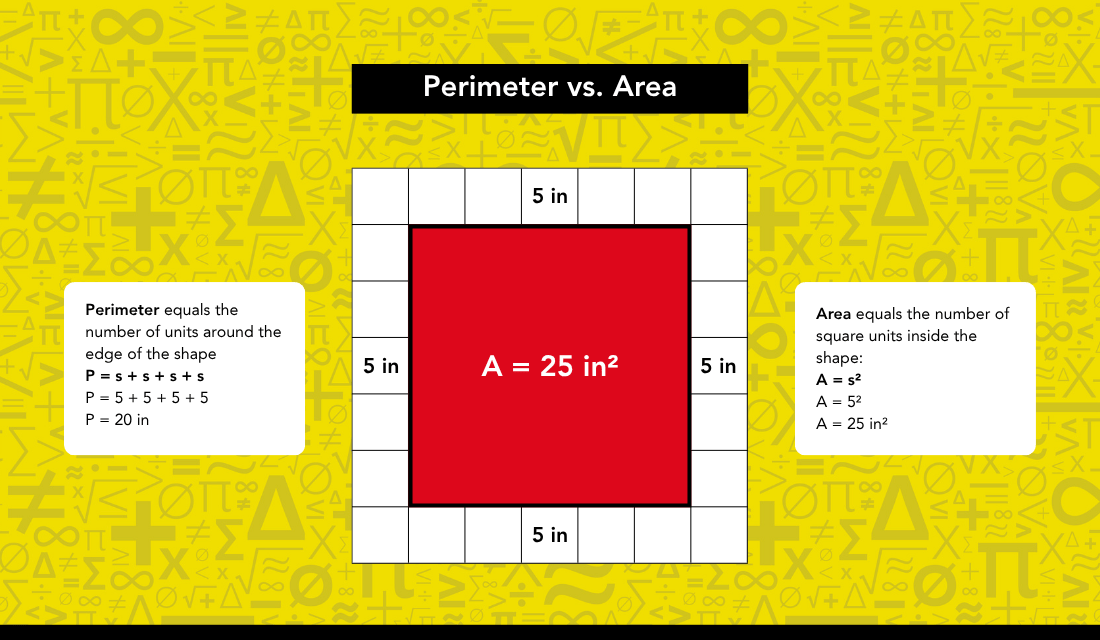
5. Clear Up Area vs. Perimeter Confusion with Hands-On Practice
Area and perimeter are taught side by side, which is exactly why students often mix them up. Instead of going over definitions and formulas, give them something to measure and label.
-
Use grid paper to sketch rectangles or L-shaped figures. Have your student count square units inside the shape for area, then walk the border to count the perimeter.
-
Trace a placemat or book on paper. Ask them to label the side lengths, then find the perimeter (by adding all the sides) and the area (by multiplying length × width).
-
Add real units like inches or cm, and talk about why area is measured in square units while perimeter is not.
6. Walk Through One Word Problem Together Out Loud
At Mathnasium, we don’t rush students through word problems. Instead, we walk through them step by step, out loud. That’s because most errors don’t come from the math itself but from misreading, jumping ahead, or simply not knowing what the question is really asking.
Here’s how we’d approach a typical fourth-grade problem:
“A class collects 28 cans of food each week. How many cans will they collect in 6 weeks?”
We pause and ask:
-
“What do we know?” (One group of 28 each week)
-
“What are we finding?” (Total after 6 weeks)
-
“What operation fits?” (Multiplication)
Only after the reasoning is clear do we solve:
28 × 6 = 168
That kind of verbal reasoning gives students space to think clearly before the numbers ever hit the page.
How Mathnasium Helps 4th Graders Learn and Master Math
Mathnasium is a math-only learning center helping K–12 students across the U.S. and beyond learn and master math.
We’ve worked with thousands of 4th graders who find curriculum shifts challenging, whether that means tackling multi-digit multiplication or solidifying fraction comparison.
At the heart of how we work with them and all our students is not a one-size-fits-all program but a proprietary teaching approach: the Mathnasium Method™.
Unlike rote drills or passive repetition, our method is designed to build a deep understanding of math while developing critical thinking and problem-solving skills.
To support math mastery, our approach relies on:
-
Personalized learning: Each student begins their Mathnasium enrollment with a diagnostic assessment. This helps us identify their strengths as well as potential knowledge gaps. Using these insights, we design a learning plan customized to each student’s needs. From one student to the next, learning plans are never the same.
-
Teaching for understanding: We use natural, everyday language to phrase math concepts. We also employ a mix of verbal, visual, mental, tactile, and written teaching techniques to help students truly make sense of what they’re learning.
-
Caring, supportive tutors: Our tutors are specially trained in math as well as the technical and emotional aspects of teaching. This means they know how to encourage a student who’s stuck and how to challenge one who’s ready to stretch their thinking.
-
Problem-solving and critical thinking skills: During sessions, we always allow time for productive struggle, then rejoin students to check and correct their processes. This helps them learn to rely on their own thinking. We guide them through both the how and the why behind each math problem, not only the final answer. This approach develops the problem-solving and critical thinking tools they’ll use in math and life.
-
A confidence-building, fun learning environment: We often hear students say our sessions don’t feel like lessons at all. That’s because we incorporate game-based activities and plenty of rewards to keep students motivated and engaged.
The Mathnasium Method™ brings measurable results:
-
94% of parents report an improvement in their child's math skills and understanding
-
93% of parents report an improved attitude towards math after attending Mathnasium
-
90% of students saw an improvement in their school grades
With over 1,100 centers across the country, Mathnasium brings top-rated math instruction close to your community.
Whether your 4th grader is looking to catch up, keep up, or get ahead in math, your local Mathnasium Learning Center is ready to help.
Contact your nearest center today to schedule a diagnostic assessment and get a personalized learning plan that puts them on the best path to math mastery.



 (732) 490-5725
 (551) 998-5202