Take any number apart, and you'll find smaller numbers hiding inside it.
Look at 12. If we break it down far enough, it's really 2 × 2 × 3 in disguise.
Finding those hidden numbers is called prime factorization, and it's one of the most useful skills a student can build in math.
A factor tree is the tool that makes this process easy to see. Why? It's completely visual. Students draw it out, branch by branch, until every number left is prime.
Today, seasoned Mathnasium tutors show you how to build a factor tree step by step, explain how to know when the tree is complete, and demonstrate how this simple visual strategy makes prime factorization much easier.

Let's Review First: What Is Prime Factorization?
Prime factorization is the process of breaking a number down until only prime numbers are left.
To understand how it works, we need to know these two terms.
-
A composite number is a number that can be broken down into smaller factors. Numbers like 12, 18, and 30 are composite, since other numbers besides 1 and themselves divide into them evenly.
-
A prime number is a number that can only be divided evenly by 1 and itself. Numbers like 2, 3, 5, and 7 are prime because nothing else divides into them evenly.
Put those together, and prime factorization is simply breaking a composite number apart until every piece left is prime.
Here’s how this looks in action.
Take the composite number 12.
-
If we break 12 down into 4 × 3, we aren't done yet because 4 is composite.
-
We break 4 down further into 2 × 2.
-
Now every piece is prime: 2 × 2 × 3 (or 22 × 3).
But what if we chose a different path at the start?
What if, instead of starting with 4 and 3, we broke 12 apart into 6 and 2?
Let's trace that branch down:
-
We start with 12 and split it into 6 × 2.
-
2 is already a prime number, so that branch stops right away.
-
6 is composite, so we break it down further into 3 × 2. Both 3 and 2 are prime!
Gather all the prime endpoints together, and what do we get? 2 × 3 × 2 , which rearranges to 2 × 2 × 3 .
Whether we start with 4 × 3 or 6 × 2, we land on the exact same prime building blocks: two 2s and one 3.
While we can work out the prime factorization of small numbers in our head, larger numbers can quickly get messy.
Keeping track of which factors are prime and which ones still need breaking down gets much easier when you can see the process laid out. That is where the factor tree method comes in.
📕 You May Also Like: How to Tell If a Big Number Is Prime: Quick Tips
What Is a Factor Tree?
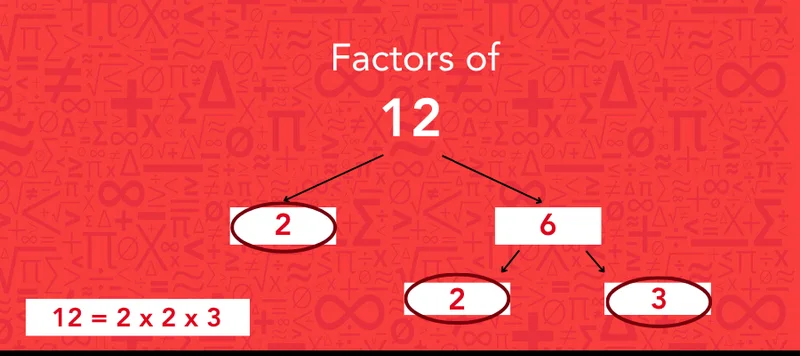
A factor tree is a diagram that shows how a number breaks apart into smaller factors, branch by branch. It’s also our favorite tool for prime factorization because it makes the whole process visual.
It's called a "tree" because it starts with one number at the top and spreads downward into branches, even though this tree technically grows upside down.
Picture the number sitting at the very top, with two lines branching down to the pair of factors that multiply together to make it. If either of those factors isn't prime yet, it grows two more branches of its own, splitting again into a new pair.
Each branch keeps splitting until it hits a prime number. After a branch reaches a prime, it stops, since primes can't be broken down any further.
We can circle each prime as it appears, so by the end, every branch ends in a small circled number.
That's a factor tree in its simplest form. Next, we can see exactly how to build one step by step.
📕 You May Also Like: Exploring Factors and Multiples: Building Blocks of Math
How to Make a Factor Tree Step by Step
Building a factor tree follows the same steps every time, no matter which number we start with.
-
Write the starting number at the top.
-
Split it into any two factors that multiply together to make it.
-
Circle any prime numbers as soon as they appear.
-
Keep branching any numbers that aren't prime yet.
-
Write the final answer as a multiplication string.
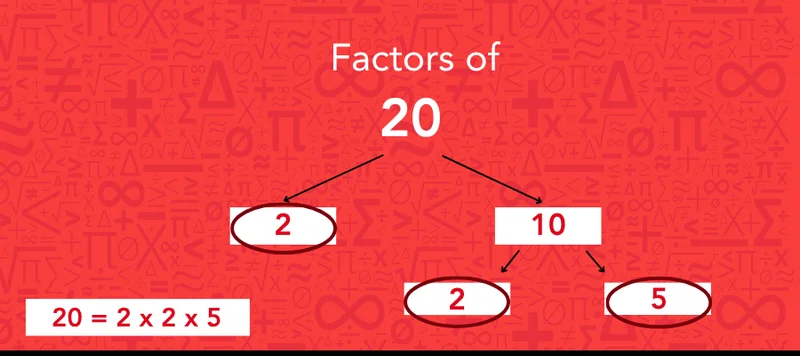
Let's walk through it with 20.
-
Write the starting number at the top: We place 20 at the top of our page.
-
Split it into any two factors: We split 20 into 2 and 10.
-
Circle prime numbers as soon as they appear: Since 2 is already prime, that branch is done, we circle it! Ten isn't prime yet, so it keeps growing.
-
Keep branching numbers that aren't prime yet: We split 10 into 2 and 5. Both of those are prime, so we circle them too.
-
Write the final answer as a multiplication string: Every branch now ends in a circled prime number, giving us 20 = 2 × 2 × 5.
And remember, our starting split doesn't have to match anyone else's. We could have split 20 into 4 and 5 instead of 2 and 10, and we would still end up with the exact same three primes at the bottom (2 × 2 × 5). The starting point can change, but the final answer never does.
Try It Yourself: Build Factor Trees
Ready to build factor trees on your own? Try these two challenges. When you finish, check your answers at the bottom of the guide.

At Mathnasium, specially trained tutors help students build a deep understanding of visual math models, such as a factor tree.
How Mathnasium Helps Students Master Any Math Concept
Mathnasium is a math-only learning center helping K-12 students of all skill levels learn and master math.
When students turn to us for math support, whether it’s (re)building foundational skills like multiplication or fractions, or mastering specific ones like prime factorization and factor trees, our tutors focus on building a deep understanding of each concept.
We do this through the Mathnasium Method™, a proprietary teaching approach designed around individual students’ needs and learning styles.
Here is how it works in practice:
-
Assessment and Personalized Learning Plans: Each student begins with a diagnostic assessment that identifies current skills, strengths, and knowledge gaps. From those findings, we build a personalized learning plan tailored to their goals.
-
Teaching for Understanding: Our specially trained tutors use natural language and a mix of verbal, visual, mental, tactile, and written techniques so each concept lands before we move forward.
-
Problem-Solving and Critical Thinking: We allow time for productive struggle so students can rely on their own reasoning. When we step in, we make sure to show both the how and the why behind the answer. Over time, this helps students build their own problem-solving skills and critical thinking tools.
-
An Engaging and Fun Learning Environment: Sessions include games, earned rewards, and consistent celebration of progress. Students build confidence alongside fluency, and many develop a more positive relationship with math over time.
The impact shows up in the classroom and beyond:
-
94% of parents report improvement in their child's math skills and understanding
-
93% of parents report an improved attitude toward math after attending Mathnasium
-
90% of students saw improvement in their school grades
With over 1,100 learning centers across North America, there is likely a Mathnasium close to you.
Families across Meridian, Eagle, and Star trust Mathnasium of Meridian to help their children build true math confidence at every level.
If number sense or any other math concept is giving your child trouble, our team is ready to help.
📅 Schedule a Free Assessment at Mathnasium of Meridian
Not near Meridian?
📍 Find a Mathnasium Learning Center Near You
Pssst! Check Your Answers Here
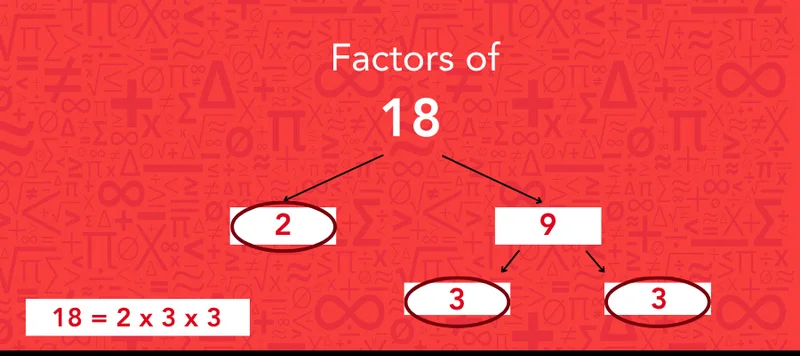
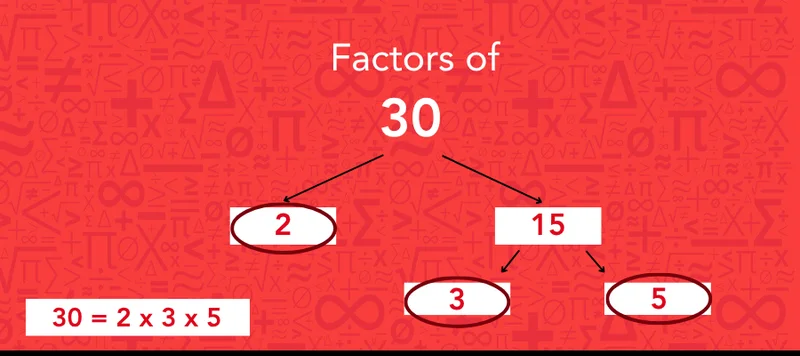
If you’ve given our challenges a try, check your answers here. We've laid the solutions out visually just like the examples above!
Challenge 1
Challenge 2
How did you do?


 (208) 888-0020
 (208) 888-0020