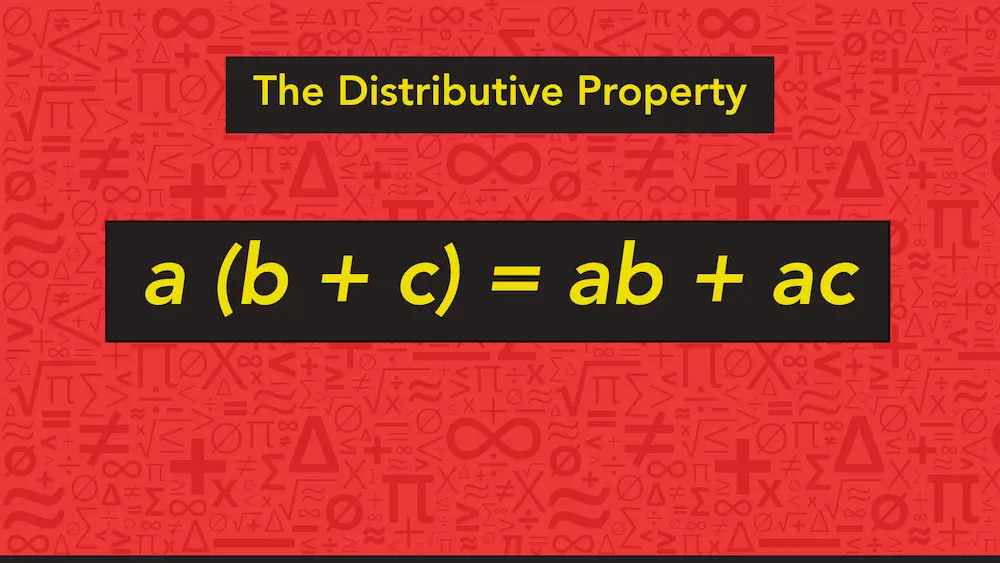
The distributive property is one of those math ideas we learn fairly early, then keep meeting again as the problems become more advanced. What starts as a way to multiply numbers can later help us work with algebraic expressions and equations.
We can use it to expand parentheses, simplify expressions, and understand how the same process can work in reverse through factoring.
Today, our seasoned tutors will break down how to expand and factor expressions using the distributive property.

Quick Review: What Is the Distributive Property?
The distributive property shows us how multiplication interacts with addition and subtraction. When a number multiplies a sum, we can multiply that number by each term inside the parentheses and then add the products. We get the same value as we would by multiplying by the whole sum at once.
Here is how it works.
Take the expression:
3 × 14.
We can calculate it directly:
3 × 14 = 42.
But we can also break 14 into 10 and 4 and multiply each part by 3:
3 × 10 + 3 × 4.
-
Multiply: 3 × 10 = 30.
-
Multiply: 3 × 4 = 12.
-
Add the products: 30 + 12 = 42.
We get the same result: 42.
In the second form, we multiplied 3 by each term. In other words, we distributed the 3 across both terms. That is where the name distributive property comes from.
We can also group 10 and 4 inside parentheses:
3 × (10 + 4).
As 10 + 4 = 14, this expression still has a value of 42.
So we can write:
3 × (10 + 4) = 3 × 10 + 3 × 4.
The two sides look different, but they are equivalent because they have the same value.
This pattern works with any numbers. In algebra, we write it in general form as:
a(b + c) = ab + ac.
Here, a multiplies both terms inside the parentheses, b and c.

How to Use the Distributive Property When Expanding
To expand an expression using the distributive property, we multiply the factor outside the parentheses by every term inside, then simplify. The result is an equivalent expression without parentheses.
We can follow four steps:
-
Multiply the outside factor by the first term inside the parentheses.
-
Multiply it by each remaining term, keeping the correct sign.
-
Put the products together in one expression.
-
Combine any like terms.
Let’s work through the steps with this example:
5(x + 2) + 3x.
-
Multiply the factor by the first term in the parentheses: 5 × x = 5x.
-
Multiply the factor by the second term: 5 × 2 = 10.
-
Put the products together in one expression: The +3x was already outside the parentheses, so it stays: 5x + 10 + 3x.
-
Combine the like term: Because 5x and 3x are both x-terms, we can add them:5x + 3x = 8x.
So the expanded and simplified expression is:
8x + 10.
Now, we’ll look at some more complicated examples of using the distributive property to expand expressions.
A. Expanding an Expression With More Than Two Terms
When the parentheses contain two or more terms, we still distribute the outside factor to every term inside.
Take this expression:
2(x + 3y + 4).
The 2 outside the parentheses needs to multiply every term inside:
-
2 × x = 2x
-
2 × 3y = 6y
-
2 × 4 = 8
Now we put the products together:
2x + 6y + 8.
The terms 2x, 6y, and 8 are not like terms, so we cannot combine them any further. That means the expression is fully expanded and simplified.
We recommend drawing a small arrow from the outside factor to each term as you multiply. This will help you make sure that every term has been included.
B. Expanding an Expression With Subtraction
Subtraction inside the parentheses doesn’t change how we use the distributive property. We just need to keep the minus sign attached to the term it belongs to.
For example, we can think of 2x − 4 as 2x +(–4). Written this way, we can clearly see that the minus sign belongs with the 4, so we carry −4 through the multiplication.
Let’s expand this expression:
3(2x −4) + 5.
First, distribute the 3 to both terms inside the parentheses:
Our expression becomes:
6x − 12 + 5.
We can combine the terms without a variable:
–12 + 5 = –7.
So the simplified expression is:
6x − 7.
📕 You May Also Like: How to Simplify Algebraic Expressions: A Step-by-Step Guide
C. Expanding an Expression With a Negative Outside Factor
When the factor outside the parentheses is negative, we distribute that negative factor to every term inside. As we multiply, we need to pay close attention to the sign of each product.
We’ll work through this example:
–4(x − 3) + x.
We start by distributing –4 to both terms inside the parentheses:
This gives us:
–4x + 12 + x.
Then, we combine the like terms, -4x and x:
–4x + x = –3x.
Our expanded and simplified expressions now look like this:
–3x +1 2.
If a minus sign appears alone in front of parentheses, we can think of it as −1. That −1 is then distributed to every term inside:
–(x + 2) = –1(x + 2) = –x − 2.
How Signs Work When We Distribute
Signs can be easy to mix up when we distribute, especially when negative numbers appear. To help you check the sign of each product as you work, our tutors put together this quick table:
|
Outside factor
|
Inside term
|
Product
|
|
Positive (+)
|
Positive (+)
|
Positive (+)
|
|
Positive (+)
|
Negative (−)
|
Negative (−)
|
|
Negative (−)
|
Positive (+)
|
Negative (−)
|
|
Negative (−)
|
Negative (−)
|
Positive (+)
|
Now that we know how to use the distributive property to expand an expression, we can reverse those same steps to factor one.
📕 You May Also Like: 5 Tips for Students Struggling with Algebraic Expressions
How to Use the Distributive Property When Factoring
To factor an expression using the distributive property, we work through these steps:
-
Find the greatest common factor (GCF) of all the terms.
-
Divide each term by the GCF.
-
Write the GCF outside the parentheses and the results inside.
-
Check by expanding. We should get back the expression we started with.
The GCF may be a number, or it may include both a number and a variable. Let’s look at an example of each.
A. Factoring Out a Common Number Factor
We’ll begin with factoring this expression:
12x +18.
-
Find the GCF. Both 12x and 18 are divisible by 6, and no larger number divides both terms. So the GCF is 6.
-
Divide each term by the GCF. This gives us: 12x ÷ 6 = 2x and 18 ÷ 6 = 3.
-
Write the factored form. We place the GCF outside the parentheses and the remaining factors inside: 6(2x + 3).
-
Check by expanding. Distribute the 6 back across both terms: 6 × 2x = 12x, 6 × 3 = 18. We put the products together in one expression and get: 12x + 18. This matches the expression we started with. ✓
Notice that we can also factor 12x + 18 as 2(6x + 9). But the terms inside the parentheses still share a factor of 3. In 6(2x + 3), there is no common factor left to pull out.
When a term equals the GCF itself, dividing it by the GCF leaves us with 1. For example:
7x + 7 = 7(x + 1), not 7(x).
The 1 stays inside the parentheses because 7 ÷ 7 = 1. If we expand 7(x + 1), we get 7x + 7 so both original terms are still there.
B. Factoring Out a Variable Common Factor
The greatest common factor of an expression we pull out may include both a number and a variable. Let’s see how that works with:
4x² + 10x.
-
Find the GCF of the terms. 4 and 10 are both divisible by 2, so their greatest common factor is 2. But the terms also have a common variable factor. Because x² means x × x and 10x also contains one x, both terms are divisible by x. We put the common factors, 2 and x, together. The full GCF is 2x.
-
Divide each term by the GCF. We get: 4x² ÷ 2x = 2x and 10x ÷ 2x = 5.
-
Write the factored form. Our expression becomes: 2x(2x + 5).
-
Check by expanding. We distribute 2x across both terms: 2x × 2x = 4x² and 2x × 5 = 10x. We put the products together, this gives us our original expression: 4x² + 10x.✓
When a variable appears in every term, we factor out the smallest power they all share. Here, one term has x² and the other has x, so both contain at least one x. That means we can factor out x, but not x².
📕 You May Also Like: How to Spot and Overcome Early Algebra Gaps
Put the Distributive Property to Work Yourself!
Ready to try it on your own? Use the steps we’ve covered to expand the first expression and factor the second. Take your time with the signs, and check your answers at the bottom of the page.
Challenge 1
Expand and simplify:
–2(3x − 4y + 1) + 5x.
Challenge 2
Factor this expression:
12x + 18.
Expanding or factoring still feels confusing? Our algebra tutors at Mathnasium of Nora can help you work through the distributive property step by step and understand why each step works.

Mathnasium tutors guide students through problems rather than simply giving correct answers, helping them build true understanding of math concepts.
How Mathnasium Helps Students With the Distributive Property (and Any Other Math Topic)
Mathnasium is a math-only learning center dedicated to helping K–12 students of all skill levels excel in math.
In our work, we aim to help students understand how math ideas, such as the distributive property, connect to one another instead of treating each new rule as something separate to memorize.
To help students build that kind of understanding, we use the Mathnasium Method™, our proprietary teaching approach, to meet students where they are and guide them forward step by step.
Each student begins with a diagnostic assessment that helps us understand their current skill level, knowledge gaps, goals, and how they think and feel about math.
Using these insights, we create a personalized learning plan focused on the skills the student needs most, whether that means reinforcing multiplication fluency, reviewing integer sign rules, practicing combining like terms, or preparing for factoring and more advanced algebra.
Our specially trained tutors follow the plan closely and provide live, face-to-face instruction in a caring and fun group environment. They use mental, verbal, visual, tactile, and written techniques to help students see how the distributive property works.
Students also get room to think through problems before tutors step in. Our tutors guide them to notice structure, check whether every term has been included, and explain why each step works. This helps students build critical thinking, problem-solving skills, and greater independence in math.
Fun is part of the approach, too. We use game-based activities, rewards, and consistent encouragement to keep students engaged as they work with expressions, patterns, and increasingly complex algebra.
Families see the difference:
-
94% of parents report an improvement in their child's math skills and understanding
-
93% of parents report their child's improved attitude toward math after attending Mathnasium
-
90% of students saw an improvement in their school grades
With over 1,200 learning centers across North America, there is likely a Mathnasium close to you.
For families in and near Indianapolis, IN, Mathnasium of Nora brings that same approach close to home, with specially trained tutors who help students make sense of the distributive property, factoring, and the algebra skills that build from them.
If your child needs support with the distributive property, factoring, or any other math topic, a free diagnostic assessment is a great place to start. Using what we learn, we create a personalized learning plan that helps your child strengthen the skills they need next.
📅 Schedule a Free Assessment at Mathnasium of Nora
Not near Indianapolis?
📍 Find a Mathnasium Learning Center Near You
Check Your Answers Here
How did you do? Here’s how each challenge works out:
Challenge 1
–2(3x − 4y + 1) + 5x = –x + 8y − 2.
-
We distribute –2 to every term inside the parentheses: −2 × 3x = –6x, –2 × (−4y) = 8y, and –2 × 1 = –2. We get: −6x + 8y − 2 + 5x.
-
Next, we combine the like terms: −6x + 5x = −x.
-
The 8y and −2 do not have like terms to combine with, so the simplified expression is: −x + 8y − 2.
Challenge 2
12x + 18 = 6(2x + 3).
-
Find the GCF. The greatest number that divides both 12 and 18 is 6.
-
Divide each term. We get: 12x ÷ 6 = 2x, and 18 ÷ 6 = 3.
-
Write the factored form. The factored form of our expression is: 6(2x +3).
-
Check by expanding. 6 × 2x = 12x and 6 × 3 = 18. When we put the terms back together, we get our original expression: 12x + 18. ✓
If you wrote 2(6x + 9) or 3(4x + 6), you’re on the right track. Both are equivalent, but they aren’t fully factored because the terms inside still share a common factor.


 (317) 733-9100