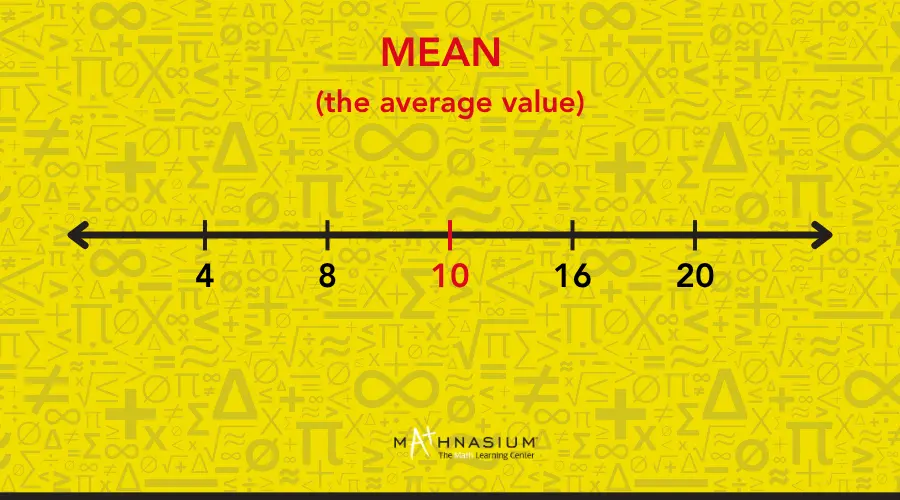
Have you ever had to divide a box of snacks equally among a group of friends so that everyone gets the exact same amount? If so, you already understand the core idea behind the mean in math!
We use it with test scores, sports stats, and weekly savings whenever one number needs to describe a whole group.
That’s why today our Mathnasium tutors will explain what the mean is, show how to calculate it with worked examples that include a decimal and a zero, and point out when the mean is useful and when it is not.

What Is the Mean in Math?
In math, the mean is the value each number in a data set would have if all the numbers were shared equally. It is commonly referred to as the average, and the two words are synonymous in this context.
To see how mean works, let’s picture three stacks of identical cubes:
-
First stack: 2 cubes
-
Second stack: 3 cubes
-
Third stack: 7 cubes
Our goal is to find what the height of each stack would be if we shared all the cubes equally.

We can move 2 cubes from the tallest stack to the shortest one. Now the stacks hold 4, 3, and 5 cubes.

Then we can move 1 cube from the stack of 5 to the stack of 3. Now all three stacks hold 4 cubes.
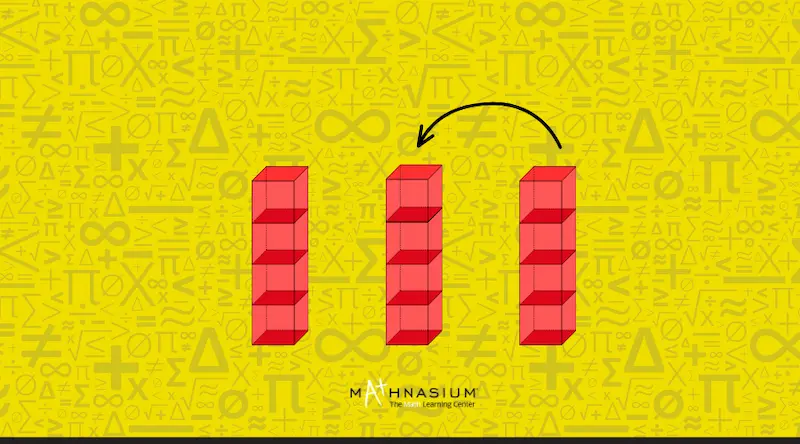
Since every stack ends up with 4 cubes after being leveled out, that equal amount is the mean (or average) of 2, 3, and 7.
Notice that we only moved cubes from one stack to another. We never added or removed any, so the total number of cubes stayed the same the whole time.
What we did here is basically split the total amount of cubes into 3 equal groups, and that is how we find the mean.
We can write what we just did as a rule:
\(Mean = \Large\frac{Sum\:of\:all\:values}{Number\:of\:values}\)
📕 You May Also Like: Mean vs. Average: Are They the Same Thing?
How to Find the Mean: Worked Examples
To find the mean of any data set, we can follow these steps:
-
We add the values to find the total, which tells us how much there is to share.
-
We count the values to find how many equal shares we need.
-
We divide the total by the count to find the size of one equal share.
Our tutors put together three examples so we can see how the mean works in different situations.
Let’s dig right in!
1. Worked Example: How to Find the Mean of a Data Set
Maya saved $5, $8, $6, $9, and $7 from her allowance over 5 weeks. What is the mean amount she saved each week?
We can sort the data in a table, so we can see every value and count them easily.
|
Week
|
Dollars Saved
|
|
1
|
$5
|
|
2
|
$8
|
|
3
|
$6
|
|
4
|
$9
|
|
5
|
$7
|
Step 1: Add the values to find the total
We get the total by adding all of the money Maya saved from each week.
5 + 8 + 6 + 9 + 7 = 35
Maya saved $35 in total.
Step 2: Count the values
To find out how many values we are working with, we need to count the weeks Maya saved money.
Weeks 1, 2, 3, 4, 5 → 5 values
Step 3: Divide the total by the number of values
Since the $35 is shared equally across the 5 weeks, the next step is to divide. We can write this out using our formula.
\(Mean = \Large\frac{Sum\:of\:all\:values}{Number\:of\:values}\)
Now we plug in the sum, 35, and the number of values, 5.
\(Mean = \Large\frac{35}{5} = 7\)
The mean is $7. In other words, Maya saved $7 per week on average.
📕 You May Also Like: What Is a Frequency Table in Math? A Kid-Friendly Guide
2. Worked Example: How to Find the Mean When the Answer Is a Decimal
Four plants measure 4, 7, 6, and 9 inches tall. What is the mean height of the plants?
Let’s organize our data in a table again.
|
Plant
|
Height (iinches)
|
|
1
|
4
|
|
2
|
7
|
|
3
|
6
|
|
4
|
9
|
Step 1: Add the values to find the total
To find the mean, we first need to know how many inches there are to share. We can find the total by combining all four heights.
4 + 7 + 6 + 9 = 26
The plants measure a total of 26 inches.
Step 2: Count the values
The mean is a share for each value, so we also need to know how many shares to make. Each plant is one value, and the table has one row for each plant:
Plants 1, 2, 3, 4 → 4 values
There are 4 different plants, so we need 4 equal shares.
Step 3: Divide the total by the number of values
Now we can divide the sum by the number of values.
\(Mean = \Large\frac{26}{4} = 6.5\)
The mean or average height of our plants is 6.5 inches.
So, when the total doesn’t divide evenly, the mean is a decimal, because an equal share can include part of a whole.
📕 You May Also Like: How to Do Long Division? Explained for 4th Graders
3. Worked Example: How to Find the Mean When a Value Is 0
Jordan walked 4, 0, 6, 5, and 10 miles over 5 days. What is the mean number of miles Jordan walked each day?
We can organize our data in a table here also.
|
Day
|
Miles walked
|
|
1
|
4
|
|
2
|
0
|
|
3
|
6
|
|
4
|
5
|
|
5
|
10
|
Step 1: Add the values to find the total
We need to add all five distances to get that total. Even though Jordan didn't walk during day 2, we need to include the zero because every recorded day counts toward our total number of values.
4 + 0 + 6 + 5 + 10 = 25
Jordan walked a total of 25 miles.
Step 2: Add the values to find the total
Each day is one value, including the day with 0 miles.
Days 1, 2, 3, 4, 5 → 5 values
There are 5 values, so we need 5 equal shares.
25 ÷ 5 = 5
Step 3: Divide the total by the number of values
We divide our total of 25 miles by 5 days to get the mean.
\(Mean = \Large\frac{25}{5} = 5\)
The mean is 5 miles. Which means that Jordan walked 5 miles a day on average.
When a data set includes a zero, it is important to look at what that zero actually means before we decide to use it. We should always count a zero as a value when it represents a real, recorded entry of exactly "none," like a day when Jordan chose to walk 0 miles.
However, we should never use a zero if the data is simply missing, skipped, or forgotten.

When Is Calculating the Mean Useful?
We calculate the mean when we want one number that describes a whole group of values or when we want to compare groups fairly. A single equal share is easier to talk about than a long list of numbers.
Here are a few places we see it every day:
-
Grades: Our test scores are different each time. The mean gives us one number that shows how the class is doing overall.
-
Sports: A basketball player scores a different number of points each game. The average points per game lets us compare players and their performances.
-
Budgets: The money we spend changes each week. The mean weekly spending shows how much we typically spend, so we can plan ahead.
In each case, the mean works because it answers one question: “What would each value be if everything were shared equally?”
It has one weakness, though. One very large or very small value can pull the mean away from where most of the values sit, since the mean uses every value in the total.
In that case, we can use the median instead. To explore how the two measures differ, you can read how our Mathnasium tutors compare the mean and the median.
📕 You May Also Like: What Are Mean, Mode, Median & Range in Math?
Your Turn: Can You Find the Mean?
Our Mathnasium tutors put together 4 problems that cover everything we did today.
For each problem, find the mean. Add all the values first, count how many values there are, and then divide.
-
Find the mean of 11, 14, 8, 15, and 12.
-
Find the mean of 48, 65, 73, and 52.
-
Lena practiced piano for 5 days this week. She played for 20, 0, 35, 25, and 30 minutes. What is the mean number of minutes she practiced each day?
-
A basketball player scored 14, 18, 11, 20, 16, 9, and 10 points in his first 7 games. What is the mean number of points he scored per game?
Check your answers at the bottom of the guide.

At Mathnasium, we build understanding from the ground up, so concepts like the mean make sense to every student.
How Mathnasium Helps Students Master Statistics (and Any Math Concept)
Mathnasium is a math-only learning center serving K-12 students of all skill levels, focusing on building confident, independent math thinkers through personalized instruction and targeted support.
Whether a student needs support with foundational statistics concepts like the mean, median, and mode or is ready to move into more advanced topics like box plots and mean absolute deviation, we teach for deep understanding.
We do that through the Mathnasium Method™, our proprietary teaching approach built around personalized learning and proven instructional techniques. Here is what that looks like in practice:
-
Diagnostic Assessment and Personalized Learning Plans. Each student begins with a diagnostic assessment, a relaxed interaction that identifies both strengths and knowledge gaps. From there, we build a personalized learning plan tailored to their needs and goals, so they can build lasting math mastery at a pace that works for them.
-
Teaching for Understanding: Our specially trained tutors teach face-to-face, using everyday language and a mix of verbal, visual, mental, tactile, and written techniques so concepts like the mean make sense to each student.
-
Problem-Solving and Critical Thinking: When a concept feels unclear, we break it down into smaller steps and explain both the how and the why. Our tutors know when to offer support and when to let a student push through on their own, and that balance builds problem-solving skills and independence for math and beyond.
-
An Engaging and Fun Learning Environment: Our activities are often game-based and hands-on, and students earn rewards along the way. We track progress and celebrate every win, big or small, so confidence grows with every session.
The results reflect that approach:
-
94% of parents report an improvement in their child’s math skills and understanding
-
93% of parents report an improved attitude toward math after attending Mathnasium
-
90% of students saw an improvement in their school grades
We operate over 1,200 centers across North America, bringing our proven approach to communities everywhere.
Families across Plantation, Sunrise, Davie, and Lauderhill can visit Mathnasium of Plantation, a trusted local center with a proven record of building confident math thinkers.
Whether your student is looking to catch up, keep up, or get ahead in math, our local team is happy to help!
📅 Schedule a Free Assessment at Mathnasium of Plantation
Not near Plantation?
📍 Find a Mathnasium Learning Center Near You
Pssst! Check Your Answers Here
Here are the answers. How did you do?
Problem 1: 12
Problem 2: 59.5
Problem 3: 22 minutes
Problem 4: 14 points


 (954) 441-6284