You already know shapes like triangles, squares, and hexagons. But did you know mathematicians sort them into special groups based on their sides, angles, and shape?
Just like scientists classify animals into groups like mammals, birds, and reptiles, mathematicians classify polygons into groups too. When we know which group a polygon belongs to, it tells us a lot about how it looks and behaves.
Today, our Mathnasium tutors will remind you what a polygon is and walk you through how to tell regular polygons from irregular ones and how to spot the difference between convex and concave polygons.

A Quick Reminder: What is a Polygon?
A polygon is a flat, closed 2D shape made entirely of straight sides.
Every polygon follows three rules:
-
It must be closed, with no gaps or openings.
-
Its sides must be straight line segments, not curves. A line segment is a straight line with a definite start point and end point. That is what each side of a polygon is.
-
Its sides must meet at corners. Those corners are called vertices. One corner on its own is called a vertex. A triangle has three vertices, one at each corner where two sides meet.
If a shape breaks any of these rules, it is not a polygon. Circles, ovals, hearts, and open shapes are not polygons because they either have curved edges or do not close.
Now let’s look at how we sort polygons into different classes based on their sides, angles, and shape.
📕 You May Also Like: 2D Shape Names: The Complete List from 3 to 12 Sides

Regular vs. Irregular Polygons
Polygons are classified as regular or irregular based on whether their sides and angles are all equal.
What Is a Regular Polygon?
A regular polygon has all sides the same length, and all angles the same size.
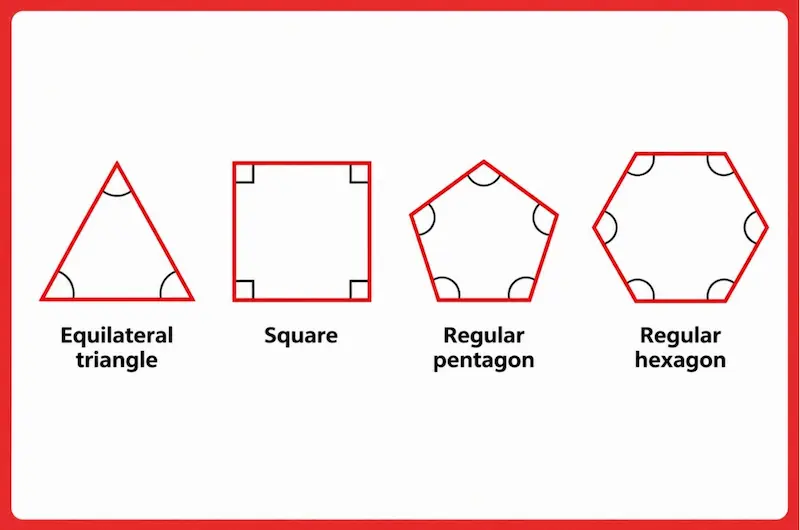
Regular polygons
Let’s look at an equilateral triangle. All three sides of the triangle are the same. All three angles of an equilateral triangle are 60 degrees each.
Now, look at a square. All four sides of the square are the same length. All four corners are the same size, 90 degrees each. No matter which side or corner you measure, you get the same result every time.
So, what do these shapes have in common?
Every side is equal, and every angle is equal. That is what makes them regular polygons. Regular means equal all around.
Some other examples of regular polygons are a regular pentagon and a regular hexagon.
What Is an Irregular Polygon?
An irregular polygon has sides or angles that are not all equal.
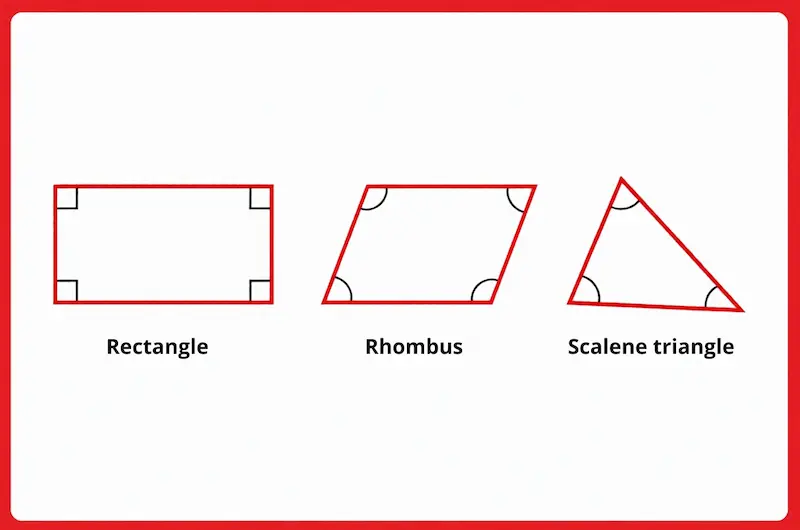
Irregular polygons
Let’s look at a rectangle. The four corners are all right angles, so the angles are equal. But two sides are longer, and two are shorter. Does that make it regular? No.
For a polygon to be regular, both the sides and the angles must be equal. The rectangle has equal angles but unequal sides, so it is irregular.
Now, what about a scalene triangle?
All three sides are different lengths, and all three angles are different sizes. Neither the sides nor the angles are equal, so it is irregular too.
Irregular polygons are still polygons, since they follow the three polygon rules. They are just not equal all around.
Examples of irregular polygons also include a rhombus and an uneven pentagon.
How to Tell the Difference
To tell whether a polygon is regular or irregular, check two things:
-
Compare the side lengths. Are they all equal?
-
Compare the angle sizes. Are they all equal?
If both answers are yes, the polygon is regular. If either answer is no, the polygon is irregular.
📕 You May Also Like: Regular vs. Irregular Polygons: What's the Difference?
Convex vs. Concave Polygons
Convex and concave are two ways of classifying polygons based on whether any of their corners point inward.
What Is a Convex Polygon?
Convex polygons have no inward dents. Every corner points outward, and all interior angles measure less than 180 degrees.
Think of a triangle, a square, or a regular hexagon. No matter which corner you look at, it points away from the center of the shape. The outline of the shape always curves outward, never inward.
Every polygon you have probably drawn in class is convex, because convex polygons are by far the most common type students encounter in Grades 4 through 6.
Interior angles are key here. In a convex polygon, every interior angle is less than 180 degrees. That means every corner opens up to less than a straight line. The moment any angle reaches or exceeds 180 degrees, the shape is no longer convex.
Examples of convex polygons include triangles, squares, rectangles, regular pentagons, and regular hexagons.
What Is a Concave Polygon?
Concave polygons feature at least one corner that points inward, creating a dent in the geometric shape. That inward corner creates an interior angle greater than 180 degrees, which mathematicians call a reflex angle.
Picture an arrow shape. Most of its corners point outward, but one corner at the back of the arrow points inward, into the shape itself. The outline of the arrow dips inward at that point instead of continuing outward. That single inward corner, and the reflex angle it creates, is enough to classify the whole shape as concave.
Star-like shapes work the same way. The pointed tips stick outward, but the corners between them cave inward. Each of those inward corners is a reflex angle, making the star concave.
Only one inward corner is needed to classify a polygon as concave. The rest of the corners can point outward, but that one dent changes the classification.
Examples of concave polygons include arrow-shaped polygons, star-like shapes, and any polygon with at least one reflex angle.
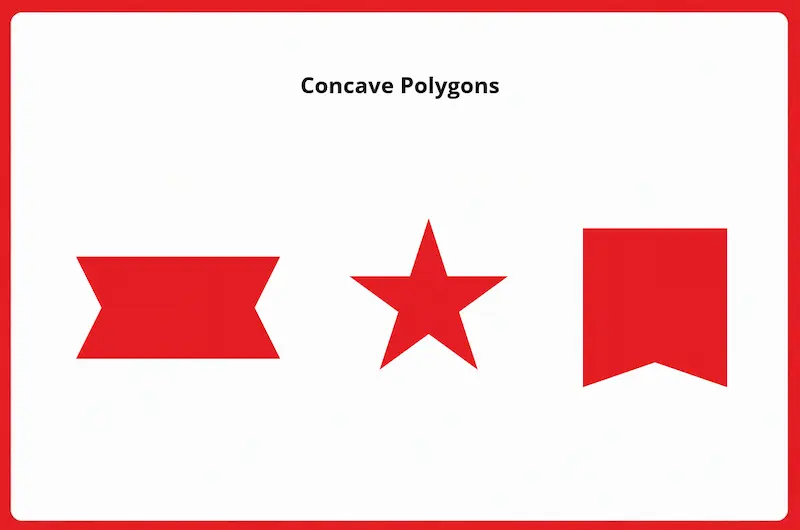
Concave Polygons
How to Spot the Difference
You can tell convex and concave polygons apart by doing one of three quick tests below:
-
The dent test: Look at the corners. Do any of them point inward? If yes, the polygon is concave. If every corner points outward, the polygon is convex.
-
The angle test: Check the interior angles. Convex polygons have all interior angles less than 180 degrees. Concave polygons have at least one angle greater than 180 degrees.
-
The line test: Draw a straight line between any two points inside the polygon. If the line stays inside the shape the whole way, the polygon is convex. If the line goes outside the shape at any point, the polygon is concave.
Once you know what to look for, you can notice the difference between convex and concave polygons at a glance.
📕 You May Also Like: What Are Supplementary Angles? A Kid-Friendly Guide

Mathnasium is a math-only learning center dedicated to helping K–12 students of all skill levels excel in math.
How Mathnasium Helps Students Make Sense of Polygons and Geometry
Mathnasium is a math-only learning center dedicated to helping K–12 students of all skill levels excel in math.
We help students see the idea behind math concepts, like classifying polygons, so the rules make sense.
To support that understanding, we use the Mathnasium Method™, our proprietary teaching approach, to meet students where they are and guide them forward step by step.
Each student begins with a diagnostic assessment that helps us understand their current skill level, knowledge gaps, goals, and how they think and feel about math.
Using these insights, we build a personalized learning plan focused on the skills the student needs most, whether that means understanding what makes a shape a polygon, recognizing regular and irregular polygons, identifying convex and concave polygons, or preparing for more advanced geometry work with angles, area, and perimeter.
Our specially trained tutors follow that plan closely and provide live, face-to-face instruction in a caring and fun group environment. They use mental, verbal, visual, tactile, and written techniques to help students identify polygon properties, work with real examples, and explain why each classification makes sense.
Students also get room to think through problems before tutors step in. Our tutors guide them through the reasoning rather than simply giving the correct answers. This helps students build critical thinking, problem-solving skills, and greater independence with geometry and later math.
Fun is part of the approach too. We use hands-on and game-based activities, rewards, and consistent encouragement to keep students engaged as they work with shapes, angles, and spatial reasoning.
The results? True, measurable progress:
-
94% of parents report an improvement in their child's math skills and understanding
-
93% of parents report their child's improved attitude toward math after attending Mathnasium
-
90% of students saw an improvement in their school grades
With over 1,200 learning centers across North America, there is likely a Mathnasium close to you.
For families in and near Ramsey, New Jersey, Mathnasium of Ramsey brings that same approach close to home, with specially trained tutors who help students make sense of polygons, geometry concepts, and the spatial reasoning that builds from them.
If your child needs to catch up, keep up, or is ready to get ahead, a free diagnostic assessment is a great place to start. Using what we learn, we create a personalized learning plan focused on the skills they need next.
📅 Schedule a Free Assessment at Mathnasium of Ramsey
Not near Ramsey?
📍 Find a Mathnasium Learning Center Near You


 (201) 891-6284