You probably won't use Roman numerals to add up your allowance or check the score of a game. But that doesn't mean they're not important to know.
Look around, and you'll spot them everywhere. They show up on clock faces, at the end of movie titles like Rocky II and Toy Story III, in the name of a Super Bowl, and even at the start of chapters in your favorite books.
Today, Mathnasium tutors are going to show you how to read and write Roman numerals like a pro. No memorizing required, just a few simple rules.

What Are Roman Numerals?
Roman numerals are the number system that ancient Rome used. Instead of the ten digits we use today (0–9), the whole system is built from just seven letters.
Historians don't know exactly why the Romans chose those seven letters, but the system grew over time from tally marks and earlier number symbols. Seven building block numerals were enough to write any number they needed, without making the system large and hard to learn.
Each letter stands for a different value. Put them together in the right order, and we can write almost any number we want.
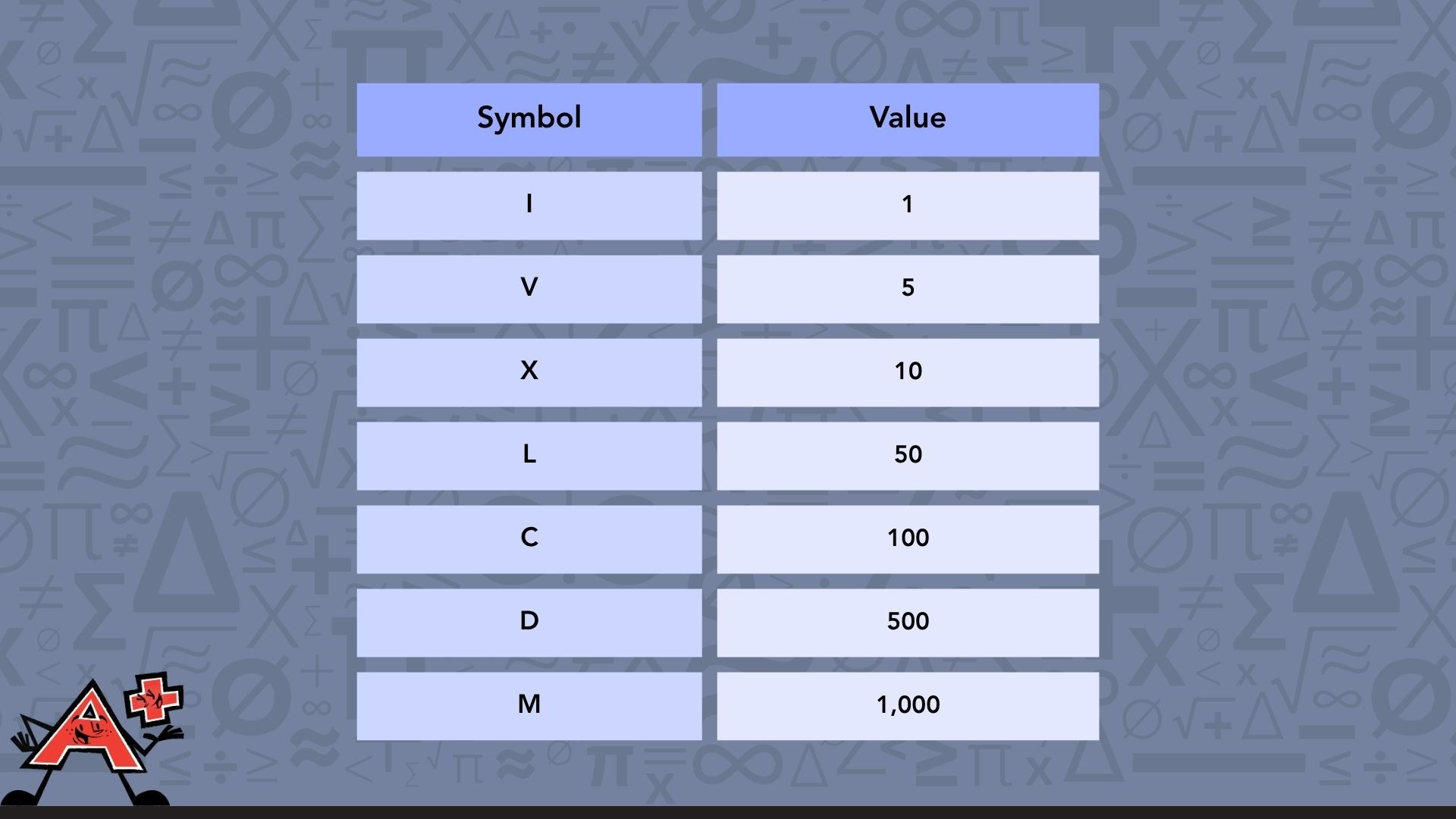
So instead of writing 1, the Romans wrote I. Instead of 5, they wrote V. Instead of 10, they wrote X.
Notice anything? There's no symbol for 0, and no symbol for numbers like 2, 3, or 4 either. That's intentional. Roman numerals work by combining a small set of symbols to build any number you need.
📕 You May Also Like: Roman Numerals 1 to 100: Chart, Rules, and Real-World Examples
How to Read Roman Numerals
Reading Roman numerals means adding or subtracting the value of each symbol, depending on where it sits next to the others. Once you know the order to look for, it works the same way every time.
When we read Roman numerals, we add or subtract the value of each symbol depending on where it sits next to the others.
Let's break it down:
-
Each Roman numeral letter has a value (I = 1, V = 5, X = 10, L = 50, C = 100, D = 500, M = 1000).
-
When a symbol repeats in a row, you add its value that many times. III is 1 + 1 + 1 = 3. In standard Roman numerals, symbols are not usually repeated more than three times in a row.
-
When a smaller-value symbol comes after a larger-value symbol, you add. VI is 5 + 1 = 6, XVI is 10 + 5 + 1 = 16.
-
For certain pairs, when a smaller-value symbol comes before a larger-value symbol, you subtract. IV is 5 − 1 = 4 and IX is 10 − 1 = 9, so you treat each pair as one chunk.
-
Read the numeral from left to right, adding or subtracting each symbol (or pair) as you go.
Now, we can put these rules to work.
VII: Start with V, which is 5. Then you've got two I's after it, so you add 1 and 1.
That's 5 + 1 + 1 = 7.
XIV: Look at the X first — that's 10. Next comes IV. Since the I sits before the V, you subtract: 5 − 1 = 4.
Put it together: 10 + 4 = 14.
XLII: Start with XL. The X sits before the L, so you subtract: 50 − 10 = 40. Next is II, which adds 1 + 1 = 2.
Altogether: 40 + 2 = 42.
Here's a tip our tutors always share: if you ever see the same symbol repeated four or more times in a row, like IIII or XXXX, something's off. Romans always found a shorter way to write it, so watch for that pattern.
📕 You May Also Like: The History of Roman Numerals & Why They Still Matter
How to Write Roman Numerals
Writing Roman numerals means breaking a number apart by place value, then converting each piece separately before putting it all back together.
Here's the process, step by step:
-
Break the number into parts. Split it into thousands, hundreds, tens, and ones (for example, 1984 → 1000, 900, 80, 4).
-
Convert each part into Roman numerals. For each place value, use the symbols and subtractive forms you already know (like M, CM, D, C, XC, L, X, IX, V, I).
-
Write the parts from biggest to smallest. Put the Roman numerals for thousands first, then hundreds, then tens, then ones, all in one row.
Let's try it.
18: Break it apart: 10 + 8. The 10 is X. The 8 breaks down further into 5 + 1 + 1 + 1, which is V, I, I, I.
Put it together: X + VIII = XVIII.
49: Break it apart: 40 + 9. For 40, a smaller symbol (X) comes before a bigger one (L), so you subtract: L − X, written as XL. For 9, the same thing happens with I and X: X − I, written as IX.
Put it together: XL + IX = XLIX.
247: Break it apart: 200 + 40 + 7. The 200 is two C's, or CC. You already know 40 is XL. The 7 breaks down into 5 + 1 + 1, or VII.
Put it together: CC + XL + VII = CCXLVII.
Notice that writing Roman numerals uses the exact same rules as reading them. You're just working in the opposite direction, starting with a number and turning it into symbols instead of the other way around.
📕 You May Also Like: How to Read and Write Years in Roman Numerals
Practice Time: Test Your Roman Numeral Skills
Ready to try reading and writing Roman numerals yourself? Work through these problems in order, easiest to hardest, and see how many you can get right.
Read these Roman numerals:
-
VIII
-
XIX
-
XCIV
Write these numbers as Roman numerals:
-
6
-
33
-
149
Take your time, and work through each one using the rules you just learned. Sound it out the same way you practiced above:
-
Look for repeated symbols.
-
Check what comes before and after each letter.
-
Break bigger numbers apart by place value.
Want to check your work? You'll find the answers at the end of this article.

At Mathnasium of Rancho Palos Verdes, students strengthen their understanding of Roman numerals through engaging activities and step-by-step instruction.
How Mathnasium Helps Students Master Any Math Concept
Mathnasium is a math-only learning center empowering K–12 students of all levels to excel in math.
We've worked with many elementary school students to help them build solid number sense foundations, including topics like Roman numerals.
The Mathnasium Method™ helps students learn any new math topic or skill, from Roman numerals to fractions to algebra, by starting with what they already know and building from there.
Every student begins with a diagnostic assessment.
This helps our specially trained tutors understand exactly where a student is starting from, including their strengths and any knowledge gaps. From there, we build a personalized learning plan that introduces new concepts step by step, so nothing feels rushed or overwhelming.
Students work through material with face-to-face instruction in a caring and fun small-group environment, where questions are always welcome and mistakes are part of learning.
When there’s a challenge, we break it down into manageable parts, guiding each student to see both the how and the why behind each answer. In time, students acquire their own problem-solving skill and critical thinking that they can use in math and beyond.
Our method brings measurable results:
-
94% of parents report an improvement in their child's math skills and understanding
-
93% of parents report an improved attitude towards math after attending Mathnasium
-
90% of students saw an improvement in their school grades
With a network of over 1,100 learning centers across North America, there is likely a Mathnasium near you.
If your family is based in Rancho Palos Verdes, CA, we invite you to visit Mathnasium of Rancho Palos Verdes. Our center is located at 28901 S Western Ave, Suite 217, Rancho Palos Verdes, CA, and proudly serves families in the city and surrounding communities.
Whether your child is looking to catch up, keep up, or get ahead in math, our team is ready to help.
📅 Schedule a Free Assessment at Mathnasium of Rancho Palos Verdes
Not near Rancho Palos Verdes, CA?
📍 Find a Mathnasium Learning Center Near You
Pssst! Check Your Answers Here
Reading Roman numerals:
-
VIII = 8
-
XIX = 19
-
XCIV = 94
Writing Roman numerals:
-
6 = VI
-
33 = XXXIII
-
149 = CXLIX
How'd you do? If you got them all right, you've officially cracked the code. If a few tripped you up, take another look at the rules above and try again; every mistake is one step closer to mastering it.


 (424) 277-9584
 (424) 277-9584