Algebra is easily one of the biggest turning points in a student's math education. It introduces variables, letters that stand in for numbers we're solving for, and gives us a way to find them instead of guessing.
Students use algebra across a wide range of problems, from simple expressions to full word problems and inequalities.
Early middle school is where all of this begins, and that's exactly what we're here for today.
Our tutors will walk you through expressions, equations, word problems, and inequalities, with a worked example for each one.
Let's get into it!

1. Algebraic Expressions
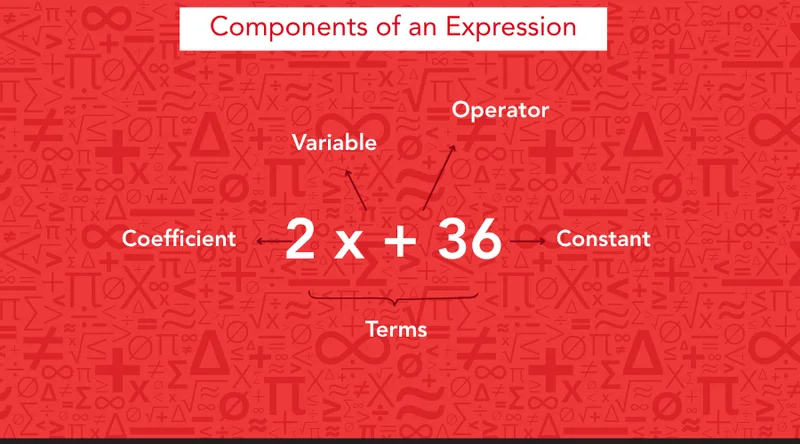
An algebraic expression is a math phrase built from numbers, variables, and operations, without an equals sign.
Every expression can go through three moves:
Let's walk through each move with an example.
A. Writing Algebraic Expressions
Writing an algebraic expression means translating words into that same phrase.
Every word problem gives us clues about which operation to use:
Once we spot those clue words, we can replace the unknown amount with a variable, and turn the rest of the sentence into numbers and operations around it.
This same process works for every word problem:
Let's put that to work with an example.
“A chocolate bar costs c cents, and a drink costs d cents. Write an algebraic expression for the total cost of 2 chocolate bars and 2 drinks.”
Step 1: Match each phrase to an operation
In our problem, "2 chocolate bars" and "2 drinks" are counts of items, so those phrases point to multiplication. What operation does "and" point to?
The word "and" points to addition, since we're combining two separate costs.
-
"2 chocolate bars" means 2 times c
-
"2 drinks" means 2 times d
-
"and" means we add the two
Step 2: Combine the pieces into one expression
We write each piece using the operation it matched, then join them the way the words joined them.
2c + 2d
That's our expression for the total cost.
📕 You May Also Like: What Is an Algebraic Expression? A Simple Guide
B. Evaluating Expressions
Evaluating an expression means finding its value once we know what number the variable stands for.
Every expression with a variable is like a placeholder waiting for a number. Once we're told what that number is, we can swap it in wherever the variable appears, then simplify the rest using the normal order of operations.
That's the whole process, no matter what the expression looks like:
Let’s see this in action.
We'll evaluate 3x + 5 when x = 4.
Step 1: Replace the variable with its given value
We substitute the given number everywhere the variable appears. Replace x with 4:
3(4) + 5
Step 2: Simplify using order of operations
We handle multiplication before addition. 3 × 4 gives us 12.
3 × 4 + 5
12 + 5 = 17
So 3x + 5 equals 17 when x = 4.
📕 You May Also Like: Numerical Expression & Algebraic Expression: Key Difference
C. Simplifying Expressions
Simplifying an expression means rewriting it in its shortest form without changing its value. This usually means combining like terms, distributing, or both.
|
Concept
|
What It Means
|
Example
|
|
Like Terms
|
Terms that share the same variable, or are both plain numbers
|
4x and 2x
5 and −1
|
|
Distribution
|
Multiplying a number outside parentheses by every term inside
|
3(x + 7)
3x + 21
|
To simplify an expression, we usually work through two moves:
-
Distribute, if any parentheses are involved.
-
Combine like terms, grouping the variable terms and the plain numbers separately.
Let's simplify 4(x + 7) + 2(−x + 4).
So how do we approach this one?
We distribute first, since we can't combine x and 7 or −x and 4 directly, they aren't like terms.
Step 1: Distribute each number into its parentheses
4 × x = 4x and 4 × 7 = 28
2 × −x = −2x and 2 × 4 = 8
That gives us 4x + 28 − 2x + 8.
Step 2: Combine the like terms
Now that the parentheses are gone, we can group the x terms and the plain numbers together.
2x + 36
📕 You May Also Like: How to Simplify Algebraic Expressions: A Step-by-Step Guide
2. Algebraic Equations
An equation is a math statement that says two expressions are equal, joined by an equals sign.
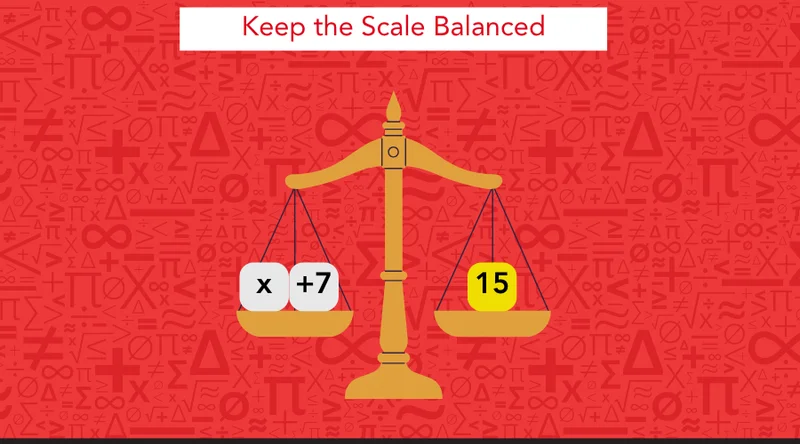
At Mathnasium, we like to say that an equation is like a balanced scale. Both sides have to stay equal, and we find our unknown by keeping that balance every step of the way.
Whatever we do to one side, we have to do to the other, or the scale tips.
Every equation can go through one of three levels:
-
One-step
-
Two-step
-
Multi-step
Let's walk through each one with an example.
A. One-Step Equations
A one-step equation only needs one move to solve. We identify which operation is attached to the variable, then perform the inverse operation to undo it.
|
Operation
|
Operation We Use
|
|
Addition
|
Subtraction
|
|
Subtraction
|
Addition
|
|
Multiplication
|
Division
|
|
Division
|
Multiplication
|
Let's solve x + 7 = 15.
Step 1: Apply the inverse operation to both sides
Since 7 is added to x, what operation undoes that?
The answer is subtraction!
Remember, since an equation is a balanced scale, we have to subtract 7 from both sides.
x + 7 − 7 = 15 − 7
On the left side, 7 − 7 cancels out, leaving just x.
And on the right, we subtract 15 − 7 to get 8.
x = 8
📕 You May Also Like: How to Solve Basic Equations — A Parent and Student Guide
B. Two-Step Equations
A two-step equation needs two moves exactly to solve in a specific order.
We can think of it as doing PEMDAS in reverse. PEMDAS tells us the order in which operations happen.
To undo an equation, we work backward through that same order, addition and subtraction first, then multiplication and division.
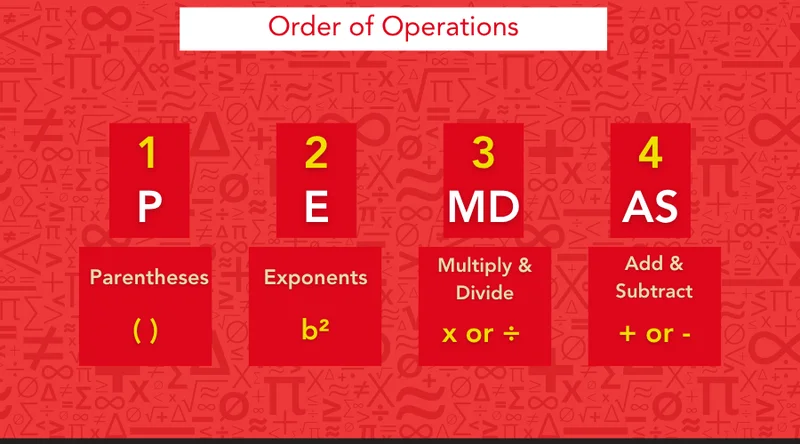
That gives us a simple rule to follow:
Let's tackle this equation: 3x + 4 = 19.
In 3x + 4, x was multiplied by 3 first, then 4 was added second, following our PEMDAS. Since we undo things in reverse order, which operation do we tackle first?
The addition happened last, so we undo it first.
Step 1: Undo the addition
We subtract 4 from both sides.
3x + 4 − 4 = 19 − 4
4 - 4 cancels out, leaving 3x on the left side.
And on the right, we subtract 19 − 4 to get 5.
3x = 15
Can we spot something here? This is now a one-step equation, and we already know how to solve it.
Step 2: Undo the multiplication
Only the multiplication is left. So, we divide both sides by 3.
3x ÷ 3 = 15 ÷ 3
3x ÷ 3 gives us x only. And 15 ÷ 3 is 5.
x = 5
📕 You May Also Like: How to Solve Two-Step Equations Using the Undo Method
C. Multi-Step Equations
A multi-step equation is an equation that needs more than two moves to solve, usually because it involves distribution or combining like terms before we can isolate the variable.
Let's solve 4(x + 3) + 2x = 30.
Since x and 3 are unlike terms, we can't combine them inside the parentheses. Distributing is our only way to clear them. So how do we start?
Step 1: Distribute the number outside into every term inside
That leaves us with 4x + 12 + 2x = 30.
Step 2: Combine the like terms
We combine the x terms: 4x + 2x = 6x
That leaves us with 6x + 12 = 30.
Hey, this is now a two-step equation! We know what happens here next.
Step 3: Undo the operations in reverse order, on both sides
The addition happened last, so we undo it first. We subtract 12 from both sides.
6x + 12 − 12 = 30 − 12
On the left side, 12 − 12 cancels out, leaving just 6x. On the right side, 30 − 12 = 18.
6x = 18
Only the multiplication is left. We divide both sides by 6.
6x ÷ 6 = 18 ÷ 6
On the left side, 6x ÷ 6 leaves just x. On the right side, 18 ÷ 6 = 3.
x = 3
📕 You May Also Like: Solving Multi-Step Equations with Variables on Both Sides
3. Algebra Word Problems
An algebra word problem describes a real situation using words, and solving it means translating those words into an equation first.
Every word problem hides the same math underneath a story. Some numbers stay fixed no matter what, some numbers depend on another quantity, and the words connecting them tell us how the pieces combine.
Once we spot those three things, writing the equation becomes a matter of matching each part to its number.
Here's what to look for in any word problem:
|
What to Look For
|
What It Means
|
|
Fixed amount
|
A number that stays the same no matter what, like a flat fee
|
|
Changing amount
|
A number that depends on another quantity, and usually needs a variable
|
|
Connecting words
|
Words like "plus," "total," or "per" that tell us how the pieces combine
|
We can apply these steps to any word problem:
-
Break down the words into their parts.
-
Write an equation from those parts.
-
Substitute any given numbers.
-
Solve for the unknown.
Let's solve this problem.
Brian charges $20 for cleaning, plus $4 per window. How much does he charge for a house with 7 windows?
Step 1: Break down the words into their parts
-
"$20" is a flat fee, a fixed amount that stays the same no matter what.
-
"$4 per window" is a changing amount, since it depends on how many windows there are.
-
"Plus" tells us these two parts get added together.
Step 2: Write an equation from those parts
Step 3: Substitute the given number and simplify.
We're told the house has 7 windows. Which number in our equation do we replace n with?
We replace n with 7.
20 + 4(7)
First, we handle the multiplication: 4(7) = 28.
20 + 28
Then we add: 20 + 28 = 48.
Brian charges $48 for a house with 7 windows.
📕 You May Also Like: A 4-Step Method for Solving Word Problems (With Examples)
4. Algebraic Inequalities
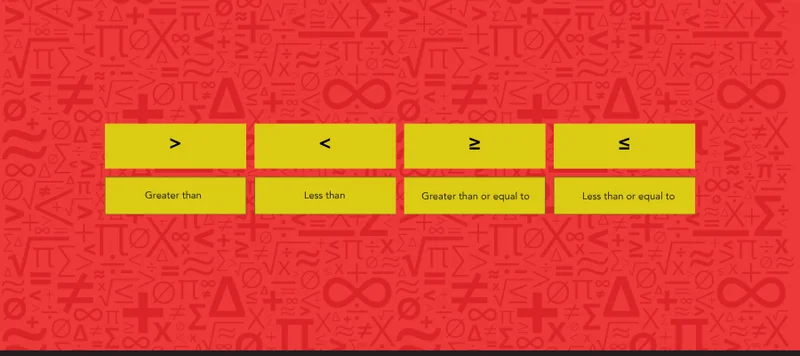
An inequality compares two expressions using a symbol like <, >, ≤, or ≥, instead of setting them equal with an equals sign.
We solve an inequality the same way we solve an equation, undoing operations in reverse order until the variable stands alone.
There's just one extra rule to watch for, one that only applies to inequalities.
|
Operation
|
Effect on the Symbol
|
|
Add or subtract any number, positive or negative
|
Symbol stays the same
|
|
Multiply or divide by a positive number
|
Symbol stays the same
|
|
Multiply or divide by a negative number
|
Symbol flips
|
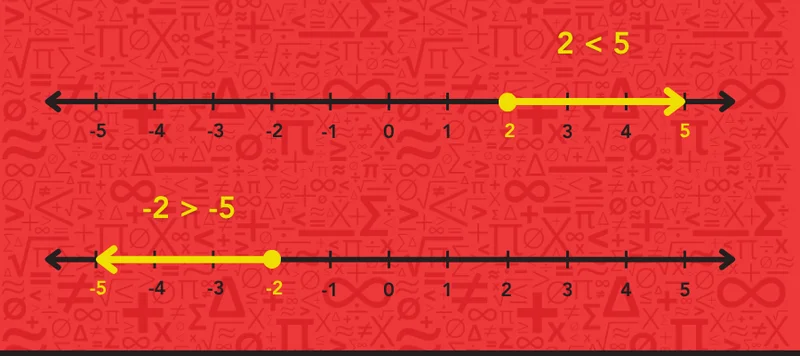
Why does the symbol flip at all?
Take 2 < 5, which is true. Multiply both sides by −1, and we get −2 and −5.
But −2 is greater than −5, so the statement only stays true if we flip the symbol to −2 > −5.
Multiplying or dividing by a negative reverses the order of every number on the number line, so the symbol has to reverse right along with it.
We can solve inequalities like this:
-
Undo the operations in reverse order, on both sides.
-
Flip the symbol if we multiply or divide by a negative number.
-
Graph the solution on a number line.
Let's see an example here: −6n − 3 ≤ −9.
Step 1: Undo the operations in reverse order, on both sides
We add 3 to both sides, the same way we've been keeping both sides of an equation balanced.
−6n − 3 + 3 ≤ −9 + 3
On the left side, −3 + 3 cancels out, leaving just −6n. On the right side, −9 + 3 = −6.
−6n ≤ −6
Step 2: Divide both sides
Here's where that rule comes in.
To isolate n, we divide by −6, the number multiplying it. Since −6 is negative, what happens to the symbol? It flips.
−6n ÷ −6 ≥ −6 ÷ −6
On the left side, −6n ÷ −6 leaves just n.
Since we divided by a negative number, the symbol flips from ≤ to ≥.
On the right side, −6 ÷ −6 = 1.
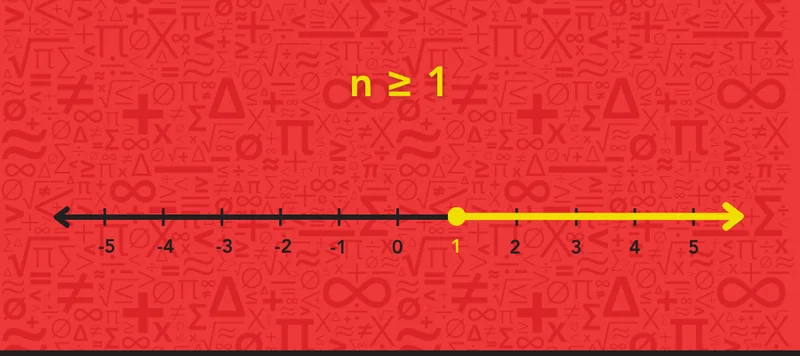
n ≥ 1
Once we have our answer, we can graph it on a number line.
Graphing an inequality uses three parts:
-
Closed circle: Marks a value that's included, used for ≤ or ≥.
-
Open circle: Marks a value that's not included, used for < or >.
-
Arrow: Points in the direction the solution covers, right for "greater than," left for "less than.
Since n ≥ 1, we draw a closed circle at 1, because 1 is included in the solution. Then we shade the arrow to the right, covering every number greater than 1.
📕 You May Also Like: How to Use a Number Line With Positive & Negative Numbers
Try It Yourself: Early Algebra Practice
Our Mathnasium tutors put together questions to test what we've covered. For each one, follow the steps we just walked through to find the answer.
Question 1 (Writing Algebraic Expressions): A movie ticket costs t dollars, and a bag of popcorn costs p dollars. Write an expression for the cost of 3 tickets and 2 bags of popcorn.
Question 2 (Evaluating Expressions): Evaluate 4x + 3 when x = 5.
Question 3 (Simplifying Expressions): Simplify 3(x + 4) + 2x.
Question 4 (One-Step Equations): Solve x − 6 = 10.
Question 5 (Two-Step Equations): Solve 5x + 3 = 28.
Question 6 (Multi-Step Equations): Solve 3(x + 2) + x = 22.
Question 7 (Algebra Word Problems): A taxi charges a $5 flat fee plus $3 per mile. Write an equation for the total cost, then find the cost for a 6-mile ride.
Question 8 (Inequalities): Solve −4n + 2 ≥ 14, then graph the solution on a number line.
Check the answers at the bottom of the guide.

Mathnasium uses personalized learning plans and interactive teaching techniques to help students master any math concept.
How Mathnasium Helps Students Master Algebra
Mathnasium is a math-only learning center dedicated to helping K–12 students of all skill levels learn and master math.
Algebra is often the first math class that truly challenges students, with new vocabulary and a completely different way of thinking about numbers.
We help students work through that challenge using the Mathnasium Method™, our proprietary teaching approach.
Here's how it works in practice:
-
Diagnostic Assessment and Personalized Learning Plans. Every student begins with a diagnostic assessment that identifies both visible skill gaps and the reasoning patterns behind them. From that starting point, we build a personalized learning plan tailored to their needs and goals.
-
Teaching for Understanding. Our specially trained tutors use plain, everyday language and a mix of verbal, visual, mental, tactile, and written techniques so concepts like algebra make sense to every student.
-
Problem-Solving and Critical Thinking. When a concept feels challenging, we break it down into manageable parts and guide students through both the how and the why. Over time, this builds the problem-solving skills and critical thinking they can use in math and everyday life.
-
An Engaging and Fun Learning Environment. Our sessions are often game-based and hands-on, and we celebrate every bit of progress. Over time, students build a more positive relationship with math and greater confidence in their own abilities.
The results reflect that approach:
-
94% of parents report an improvement in their child's math skills and understanding
-
93% of parents report an improved attitude toward math after attending Mathnasium
-
90% of students saw an improvement in their school grades
We operate over 1,100 centers across North America, bringing our proven approach to communities everywhere.
Families across Steiner Ranch, TX, can visit Mathnasium of Steiner Ranch, a trusted local center with a proven record of building confident math thinkers.
Whether your student is looking to catch up, keep up, or get ahead in math, our local team is happy to help!
📅 Schedule a Free Assessment at Mathnasium of Steiner Ranch
Not near Steiner Ranch?
📍 Find a Mathnasium Learning Center Near You
Pssst! Check Your Answers Here
If you've given our practice questions a go, here's what each one comes out to.
Question 1: 3t + 2p
Question 2: 4(5) + 3 = 23
Question 3: 5x + 12
Question 4: x = 16
Question 5: x = 5
Question 6: x = 4
Question 7: 5 + 3(6) = $23
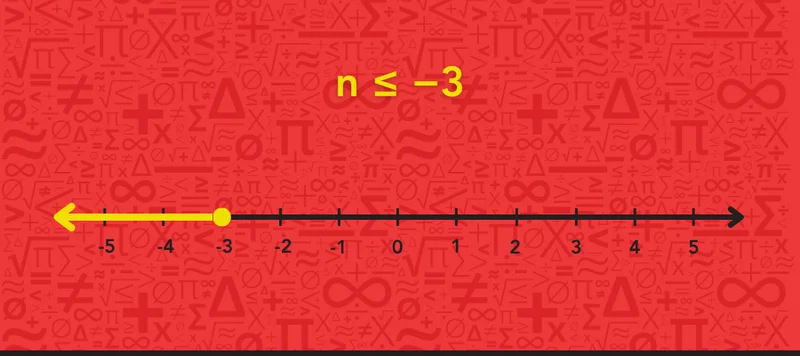
Question 8: n ≤ −3


 (512) 246-6284