Have you ever noticed how house numbers along a street follow a predictable pattern—like skipping by twos as you walk down the block? After we spot the pattern, we can easily predict the next house number. Number patterns in math work the same way!
Mathnasium tutors break down how to spot the rule behind any number sequence and use it to figure out the numbers that come next.

What Are Number Patterns?
Number patterns are sequences of numbers that follow a certain rule and are arranged in a particular order.
We encounter two types of number patterns: arithmetic and geometric.
Arithmetic patterns/sequences, also called linear patterns, are sequences where we add or subtract the same amount every time.
To check if we are working with an arithmetic pattern, we take a look at the difference between consecutive terms and confirm it stays the same throughout.
Take the sequence 3, 7, 11, 15, 19. We add 4 each time, and the sequence climbs at a steady, even rate.
Geometric patterns/sequences, also called exponential patterns, are sequences where we multiply or divide by the same number each time.
Here, we check the ratio between consecutive terms. If it stays the same, we’re talking about a geometric pattern.
For example, in the sequence 2, 6, 18, 54, 162, we multiply by 3 each time. By the fifth term, we are already at 162, and the rapid growth rate is easy to spot, which earns it the name exponential pattern.
📕 You May Also Like: What Are Growing & Shrinking Patterns? A Guide for Parents

How To Identify Rules in Number Patterns
Finding the rule in a number sequence means examining how the terms relate to each other and deciding which operation connects them. We’ll work through four examples to get a clear picture of how the process works for each of the four operations.
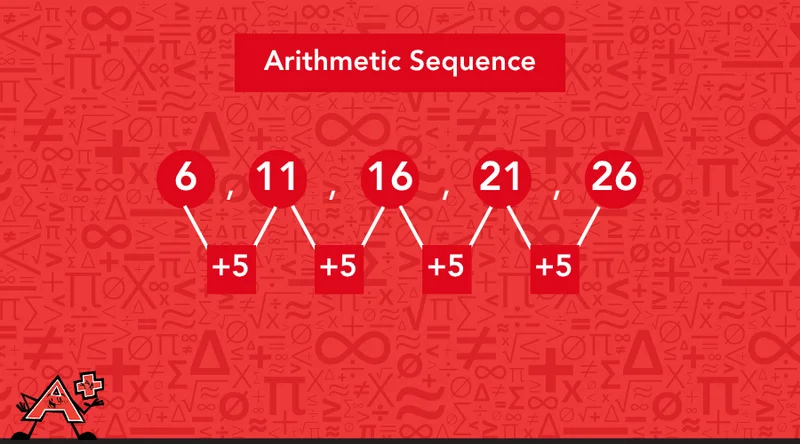
Example 1: 6, 11, 16, 21, 26...
First, we check if the sequence is going up or down, and in our case it is going up, which means we are either adding or multiplying.
-
We can see that the numbers are climbing at a steady pace, and that constant growth signals addition.
-
Next up, we figure out the difference between each term by using the opposite operation. From each number, we subtract the number before. The result is 5.
-
Our rule here is: add 5 each time.
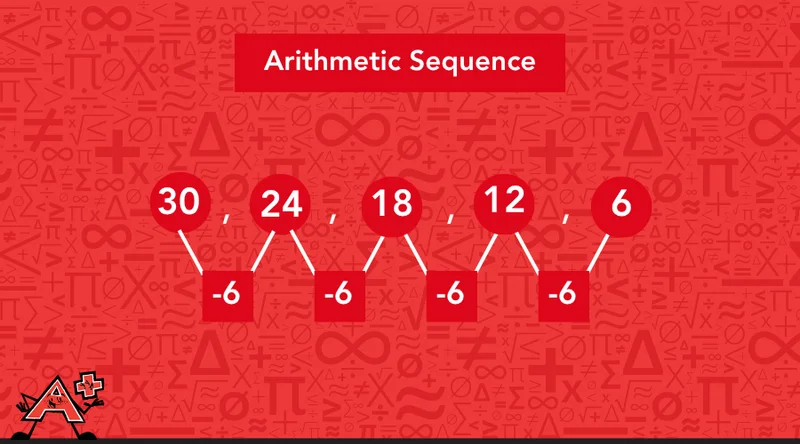
Example 2: 30, 24, 18, 12, ...
As the sequence is going down, we know we are looking at a pattern that involves subtraction or division.
-
The numbers are decreasing steadily, so the operation is subtraction.
-
Check the difference between terms: 30 - 24 = 6, 24 - 18 = 6, 18 - 12 = 6, 12 - 6 = 6.
-
The rule is: subtract 6 each time.
📕 You May Also Like: What Are Arithmetic Sequences in Math? A Complete Overview
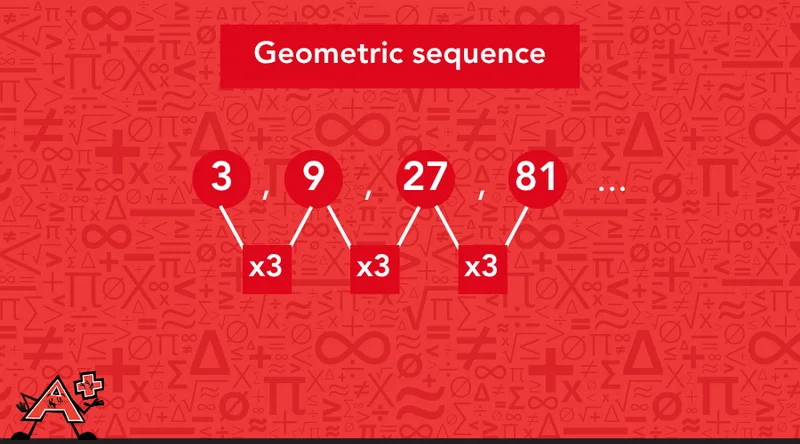
Example 3: 3, 9, 27, 81, ...
After we’ve established that the sequence is going up, it is easier to pin down the operation and identify the rule.
-
Take a closer look at how the numbers are behaving. They are growing very fast, which points us towards multiplication, not addition.
-
To measure the ratio, we divide each term by the one before it. The result is always three.
-
We are ready to identify the rule: multiply by 3 each time.
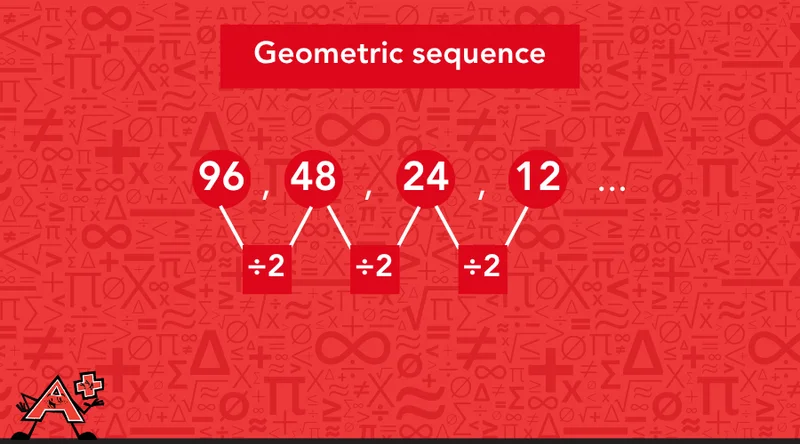
Example 4: 96, 48, 24, 12, ...
This sequence is going down, so we need to see if the operation is division or subtraction.
-
The numbers are shrinking at a very rapid pace, which points to division.
-
To check the ratio, divide each term by the one before it: 48 ÷ 96 = 0.5 (or \(\Large\frac{1}{2}\)), 24 ÷ 48 = 0.5 (or \(\Large\frac{1}{2}\)), and 12 ÷ 24 = 0.5 (or \(\Large\frac{1}{2}\)). We’re dividing the numbers by 2.
-
Alternatively, divide each term by the subsequent one to find the scale factor: 96 ÷ 48 = 2, 48 ÷ 24 = 2, and 24 ÷ 12 = 2.
-
We see that the rule is to divide by 2 each time.
How To Extend Number Patterns
After we identify the rule, extending a number pattern simply means applying that rule step-by-step to find the next terms in the sequence.
Take the sequence 7, 13, 19, 25.
-
We follow the rule identification process to confirm the difference between terms; in this case, it’s: add 6 each time.
-
After that, we extend forward: 25 plus 6 gives us 31, 31 plus 6 gives us 37, 37 plus 6 gives us 43. We can verify any of them by checking that the difference stays at 6.
Geometric sequences are trickier to extend because the numbers grow fast.
Let’s analyze the sequence 5, 15, 45, 135.
-
For this sequence the operation is multiplication, and the rule is: we multiply by 3 each time.
-
Extending it gives us 405, then 1,215, then 3,645.
📕 You May Also Like: How Playing with Patterns Boosts Your Child’s Math Skills
Over to You: Can You Identify and Extend These Patterns?
It’s your turn to work through some number pattern problems. Try to find the rule for each one, and then state the next three terms in the sequence.
Problem 1: 6, 11, 16, 21, 26…
Problem 2: 80, 72, 64, 56, 48…
Problem 3: 4, 12, 36, 108, 324…
Problem 4: 512, 256, 128, 64, 32…
After you’ve solved the problems, check the answers at the end of our article.

Mathnasium tutors help students develop lasting skills and boost their confidence in math in a fun and engaging learning environment.
How Mathnasium Helps Students Master Any Math Concept
Mathnasium is a math-only learning center dedicated to helping K–12 students excel in math.
We work with students at all skill levels, whether they are looking to fill in knowledge gaps, keep up with their curriculum demands, or take on more advanced coursework.
Our proprietary teaching approach, the Mathnasium Method™, is designed around each student's needs and learning style to help them learn and master math. Our approach includes:
-
Assessment and Personalized Learning Plans: Every Mathnasium journey starts with a diagnostic assessment, where we find out your child’s current skills and knowledge gaps. From there, we build a personalized learning plan that’s perfectly aligned with their goals. Whether they need to work on some foundational math concepts or seek help in building fluency with math topics such as number patterns and sequences, there is a path for everyone!
-
Teaching for Understanding: In our sessions, we meet the student where they are and use natural language and a mix of verbal, visual, mental, tactile, and written techniques to make each concept land in the right way.
-
Problem-Solving and Critical Thinking: We make sure students try to work through problems independently. Our tutors are there to offer a guiding hand when needed and explain the how and the why behind every concept and solution. This way, students build problem-solving and critical thinking skills they need to truly succeed.
-
An Engaging and Fun Learning Environment: Our sessions are fun and built to entice students to want to learn even more. Every progress is celebrated and rewarded, which makes their confidence grow exponentially as they advance to higher grades and more difficult topics.
Families see real impact even beyond classroom success:
-
94% of parents report an improvement in their child's math skills and understanding
-
93% of parents report their child's improved attitude toward math after attending Mathnasium
-
90% of students saw an improvement in their school grades
With over 1,100 learning centers across North America, there is likely a Mathnasium nearby.
Mathnasium of Steiner Ranch is a trusted center for families in several Austin communities: Steiner, Four Points, River Place, Grandview Hills, and Canyon Creek.
If your child needs help understanding how number patterns work and how to identify them, we are here to help.
📅 Schedule a Free Assessment at Mathnasium of Steiner Ranch
Not near Austin, TX?
📍 Find a Mathnasium Learning Center Near You
Pssst! Check Your Answers Here
If you’ve given our exercises a try, find your answers below.
Problem 1: The rule is to add 5 each time, and the next three terms are 31, 36, and 41.
Problem 2: We need to subtract 8 each time, and the next terms in this sequence are 40, 32, and 24.
Problem 3: Our rule is to multiply by 3 each time. The next three terms are 972, 2,916, and 8,748.
Problem 4: In this sequence, we divide by 2 each time, and the next three terms are 16, 8, 4.


 (512) 246-6284