Middle school math introduces new symbols and concepts. For years, math was about numbers and operation signs, like: 5 + 3 or 12 × 4. Then, as students transition into prealgebra, letters like x, y, and z suddenly start invading the page.
Our tutors at Mathnasium know that a student who was confident with standard arithmetic can suddenly feel lost when such mysterious letters start showing up. If your child is feeling unsure about what algebraic expressions are and how to use them, they are simply encountering a new mathematical language.
Today, we'll answer common questions about algebraic expressions, break down their different components, and show you how to work with them step by step.

What Do We Mean by an Algebraic Expression?
An algebraic expression is a mathematical phrase that combines numbers, variables, and operation symbols. Think of it like a fragment of a sentence. It represents a value, but it does not give a final fixed answer yet because one piece of the puzzle is still unknown.
One of the most common mix-ups we see in early algebra is confusing an expression with an equation. To clear up the confusion, let's look at each one separately.
-
An algebraic expression, such as 3x + 7, does not contain an equal sign. It represents a value that can change depending on what number replaces the variable. We work with expressions by simplifying them or replacing the variables with numbers.
-
An algebraic equation, such as 3x + 7 = 22, does contain an equal sign. It states that two quantities are equal, and your job is to find the value that makes the statement true.
When students mix up expressions and equations, the equal sign is usually the first place to look.
📕 You May Also Like: What Is an Expression in Math? A Beginner-Friendly Guide
Algebraic Expressions in Real Life
At Mathnasium, we like to build from the concrete before moving to the abstract. Here are two real-world situations we may run into, and the expression each one produces:
-
Gaming console savings: A student already has $15 saved and puts away $8 every week. If w represents the number of weeks, the expression becomes 8w + 15.
-
School notebooks purchase: Each notebook costs $3, and there is a one-time supply fee of $2. If n represents the number of notebooks, the expression becomes 3n +2.
In both examples, the variable tracks the quantity that changes. The numbers stay the same because they represent fixed parts of the situation.
📕 You May Also Like: Math for Life: Why Math Skills Matter Beyond School
Components of an Algebraic Expression
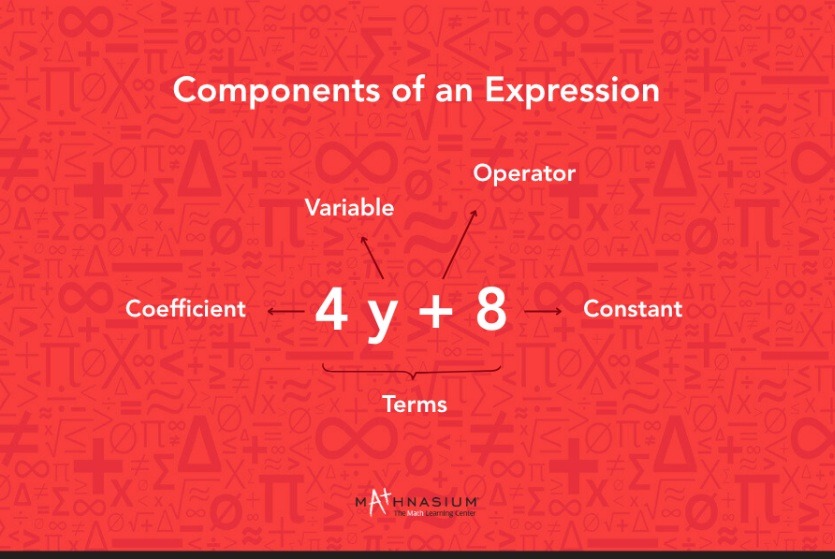
Our tutors will use the expression 8w + 15 from the savings example because it makes each component easy to spot. Let's break it down piece by piece:
-
Variable: The letter in the expression. In 8w + 15, the variable is w. It stands for the number of weeks, which can change.
-
Coefficient: The number we place directly in front of the variable. In 8w + 15, the coefficient is 8. It tells us how many times we multiply the variable. 8w means 8 times whatever "w" turns out to be.
-
Constant: The standalone number with no variable attached. In 8w + 15, the constant is 15. Its value never changes regardless of what w is.
-
Term: Each individual piece of the expression, separated by a plus or minus sign. 8w + 15 has two terms: 8w and 15.
Notice how the explanations now connect back to the savings example instead of becoming dictionary definitions.
We use this same build-from-parts approach in every session. Here is a short video showing how Mathnasium instructors guide the process:
📕 You May Also Like: How to Simplify Algebraic Expressions: A Step-by-Step Guide
Types of Algebraic Expressions
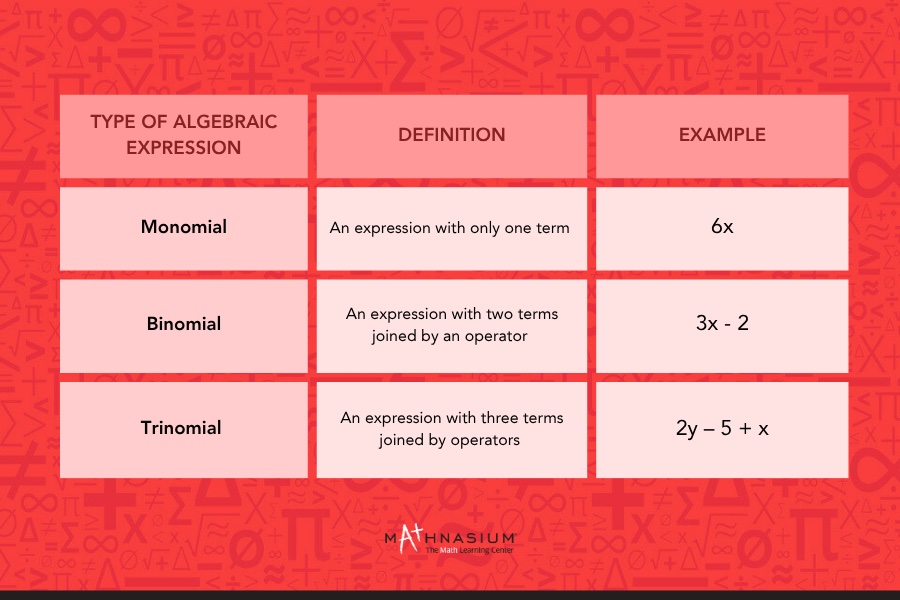
The number of terms in an expression determines its classification. A one-term expression is a monomial, a two-term expression is a binomial, and a three-term expression is a trinomial.
All three belong to the broader family of polynomials.
By the time students learn the word polynomial in later units, they have often already worked with monomials, binomials, and trinomials.
📕 You May Also Like: What Is a Polynomial? Everything You Need to Know
How to Use Algebraic Expressions
In 6th and 7th-grade math, our tutors work with students on three core skills when it comes to algebraic expressions.
1. Translating a Word Problem into an Expression
When we translate a word problem, we turn a written description into an algebraic expression.
Tutor Tip: Look for trigger words before writing anything down. "
Per," "each," and "every" signal
multiplication. "Total," "combined," and "
sum" signal
addition. "
Less than" and "decreased by" signal
subtraction. A fixed amount that does not change with the variable is your constant.
Here is how it works in practice. Let’s say a student earns 5 points for every question answered correctly and loses 2 points at the start for a late submission.
The word "every" tells us that the number of correct answers should be multiplied by 5. The 2-point deduction remains the same no matter how many questions the student answers, so it becomes a constant.
The solution is the expression 5q − 2, where q represents the number of correct answers.
2. Evaluating an Expression
To evaluate an expression, we replace the variable with a known number and then perform the necessary calculations.
Tutor Tip: Always
substitute before you calculate. Write the number in place of the variable first, then follow the order of operations. Multiplication goes before addition.
Let's evaluate 8x + 15 when x = 4:
The expression equals 47 when x = 4.
3. Simplifying an Expression
When we simplify an expression, we combine like terms to make the expression easier to work with. Like terms share the same variable, while numbers without variables combine with other constants.
Tutor Tip: Sort before you simplify. Group all the variable terms together first, then group the constants. It makes the combining step much harder to go wrong.
Let's simplify 3x + 5 + 2x - 2:
Both expressions represent the same quantity, but 5x + 3 is now easier to work with.
📕 You May Also Like: What Does “to Evaluate” Mean in Math? A Simple Guide & Examples
Avoid Common Mistakes with Algebraic Expressions
Most errors with algebraic expressions fall into a handful of predictable categories:
-
Treating a variable as an object rather than a number. A variable like “a” does not stand for apples, but for the number of apples. The distinction sometimes causes consistent errors when we start evaluating and simplifying. The variable always represents a quantity.
-
Reading a coefficient as a digit instead of a multiplier. When a student sees 5x and substitutes x = 3, the answer is 15, not 53. A coefficient directly touching a variable always means multiplication. Writing it out as 5 × 3 helps make it concrete until the habit is automatic.
-
Dropping the sign that belongs to a term. In the expression 7x - 4 + 2x, the minus sign belongs to 4. Students who separate terms without carrying the sign will get wrong answers when simplifying. The sign travels with the term that follows it.
Most mistakes with algebraic expressions come from overlooking small details rather than misunderstanding the entire concept.
📕 You May Also Like: 5 Effective Tips for Students Struggling with Algebraic Expressions
FAQs About Algebraic Expressions
When we first start working with algebraic expressions, a few common questions tend to come up. Let's answer them.
1. When Do Students First Learn Algebraic Expressions in Virginia?
Virginia's Standards of Learning introduce algebraic expressions formally in Grade 6. Students in Prince William County, including those at Mathnasium of Dale City, begin working with variables and expressions as part of their transition into middle school mathematics.
2. Can an Algebraic Expression Have More than One Variable?
Yes. An expression like 3x + 2y contains two variables. Each one represents a different unknown quantity. Students encounter multi-variable expressions in later algebra units.
3. Can an Algebraic Expression Equal Zero?
Yes. An algebraic expression can evaluate to zero if the value substituted for the variable makes the result equal zero. For example, x − 5 evaluates to zero when x = 5.
📕 You May Also Like: How to Make Sure Your Child Is Ready for Algebra

At Mathnasium, we help students connect mathematical symbols to real situations, making algebraic expressions easier to understand and use.
How Mathnasium Helps Students Master Any Math Topic
Mathnasium is a math-only learning center dedicated to helping K-12 students of all skill levels excel in math.
No two students arrive with the same mathematical experience. Some are strengthening foundational skills, while others are ready to extend their thinking and tackle more complex ideas. Whatever their needs and goals are, we make sure they leave our center with a deep and lasting understanding of math.
We build that understanding through the Mathnasium Method™, our proprietary teaching approach. Here is what our approach includes:
-
Assessment and Personalized Learning Plans: Each student starts with a diagnostic assessment that identifies current skills, strengths, and gaps. From those findings, we build a personalized learning plan tailored to their goals, whether that means mastering foundational skills or moving into more advanced algebraic thinking.
-
Teaching for Understanding: Our specially trained tutors use natural language and a mix of verbal, visual, mental, tactile, and written techniques so each concept lands before we move forward.
-
Problem-Solving and Critical Thinking: We allow time for productive struggle so students can rely on their own reasoning. When we step in, we make sure to show both the how and the why behind the answer. Over time, this helps students build their own problem-solving skills and critical thinking tools.
-
An Engaging and Fun Learning Environment: Sessions include games, earned rewards, and consistent celebration of progress. Students build confidence alongside fluency, and many develop a more positive relationship with math over time.
The results speak for themselves:
-
94% of parents report improvement in their child's math skills and understanding
-
93% of parents report an improved attitude toward math after attending Mathnasium
-
90% of students saw improvement in their school grades
With over 1,100 learning centers across North America, there is likely a Mathnasium close to you.
Families across Dale City, Montclair, Quantico, Potomac Mills, Woodbridge, Dumfries, and Triangle trust Mathnasium of Dale City to help their children build lasting math confidence.
If algebraic expressions or any other math concept is giving your child trouble, our team is ready to help.
📅 Schedule a Free Assessment at Mathnasium of Dale City
Not near Dale City?
📍 Find a Mathnasium Learning Center Near You


 (703) 436-2526