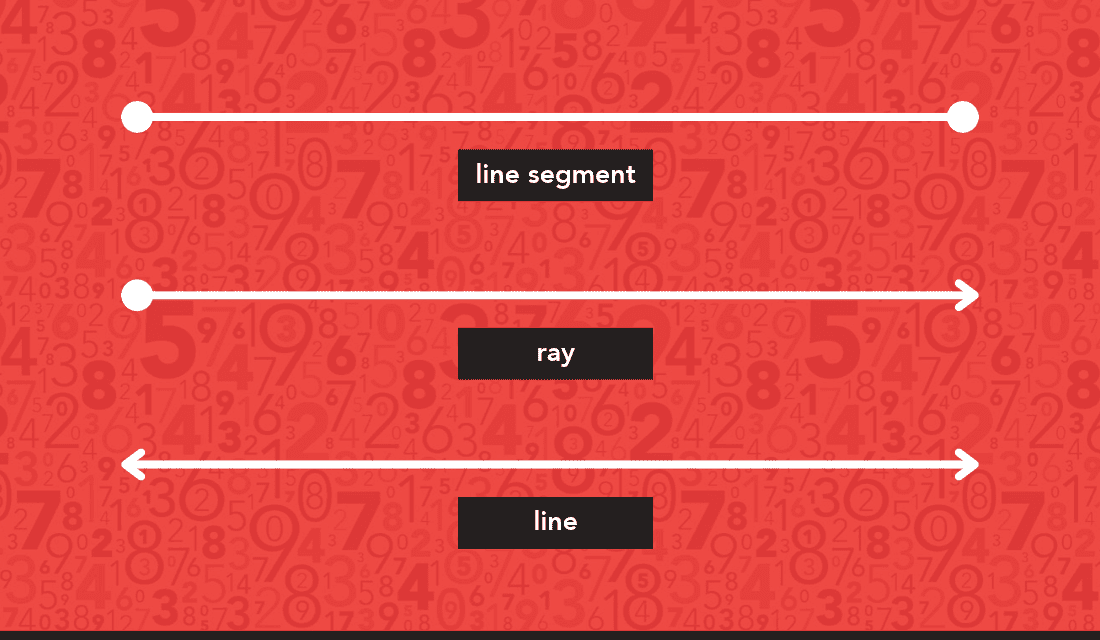
Rays and line segments are terms students typically learn in the third grade, often in the same lessons.
That overlap is exactly why the two get mixed up so easily.
Today, the Mathnasium team explains what a ray is, what a line segment is, and how the two compare, including how to name each one correctly and spot the difference in a diagram.
Along the way, you'll find examples and a quick practice quiz.

What Is a Ray in Math?
A ray in math is a part of a line that starts at one fixed point and goes on forever in one direction.
A laser pointer is a good way to picture it. Turn one on, and the beam has a clear starting point in your hand, but no matter how far away the wall is, the light keeps traveling toward it in a straight, unbroken line.
That is how a ray works the same way on paper.
It has one endpoint, then an arrow showing it continues without limit.
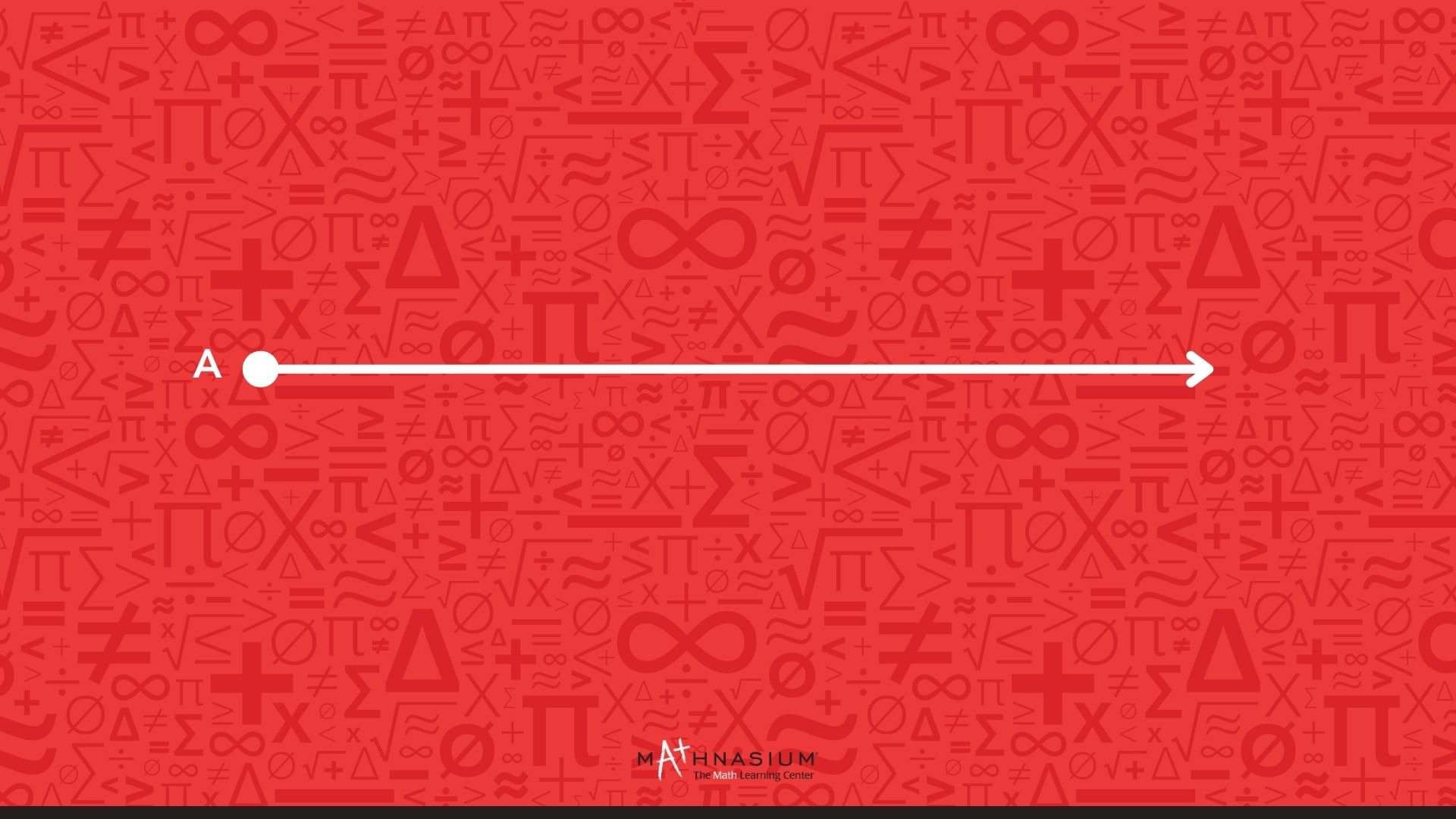
When labeling a ray, we always put the starting point first, followed by another point on its path, with a tiny arrow drawn over both letters to show where it's heading.
For example, a ray beginning at point A and running through point B is written as ray AB→.

We write ray AB→ beginning at A, and then travelling through B and beyond.
In the same way, ray BA→ would describe a ray starting at B and heading the opposite way through A.
That is why reversing the letters describes a completely different ray.

What Is a Line Segment?
A line segment is a straight path with a clear start and a clear stop, marked by two fixed endpoints.
Unlike lines and rays, a line segment has a fixed, finite length that we can actually measure.
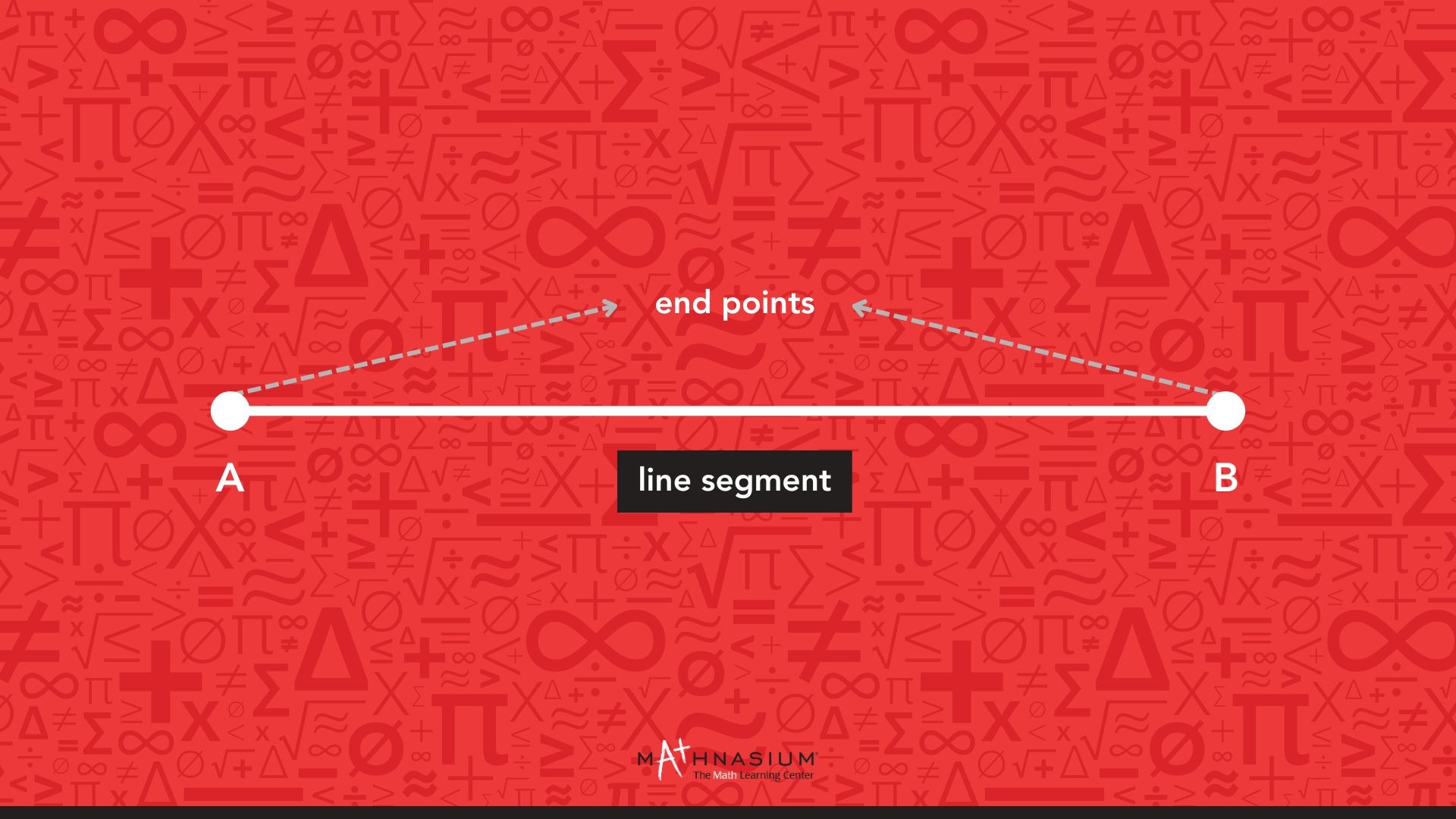
Think of a line segment like the straight edge of a ruler, a book, or a picture frame. All have two distinct ends, so it doesn't extend forever in either direction.
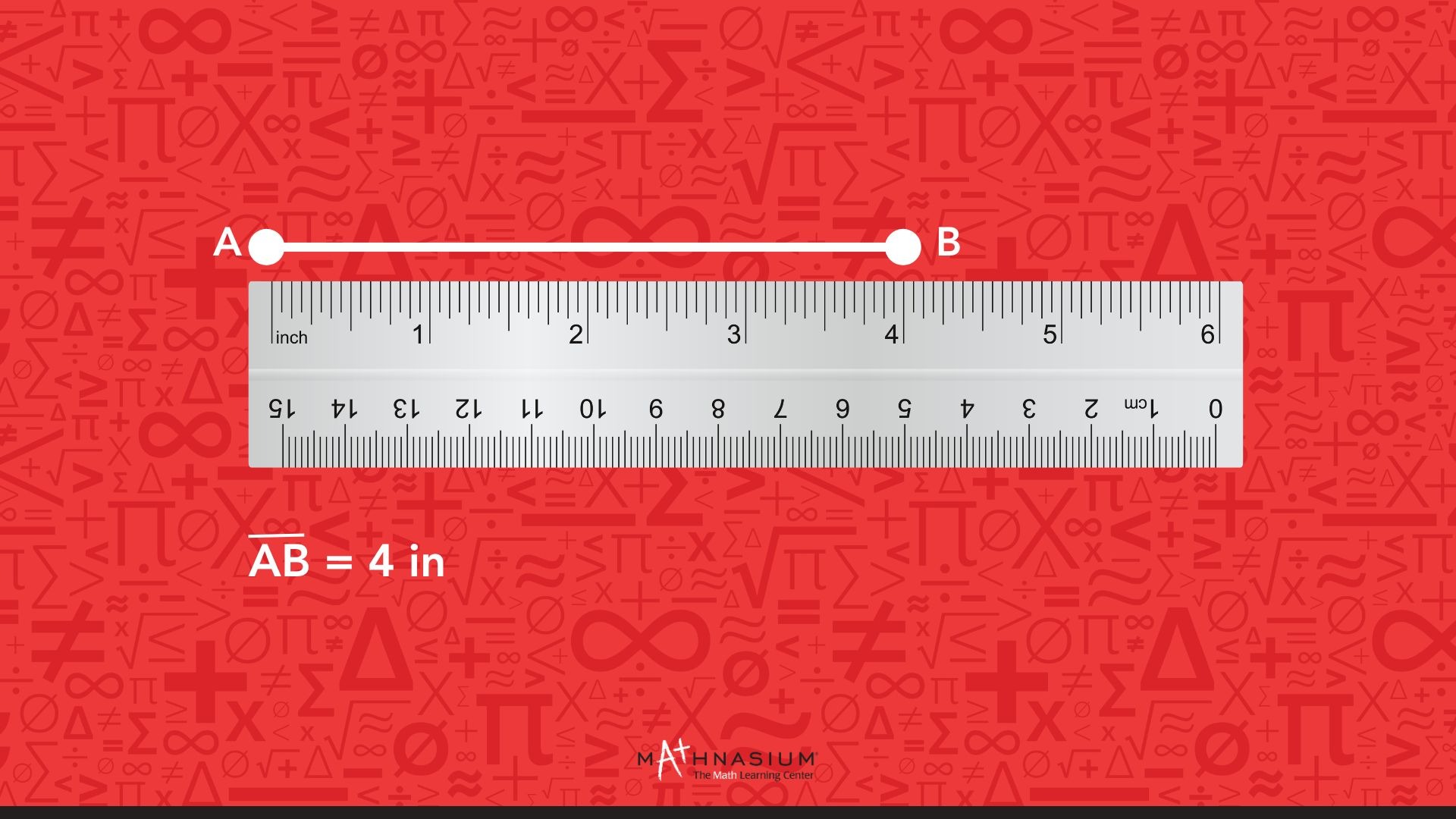
We name segments using both endpoints with a small bar drawn over the letters. A segment connecting point A and point B is written as segment AB.
Unlike a ray, the order of the letters doesn't change what the segment is. Segment AB and segment BA describe the exact same path, just read from opposite ends, since a segment doesn't travel in a single direction the way a ray does.
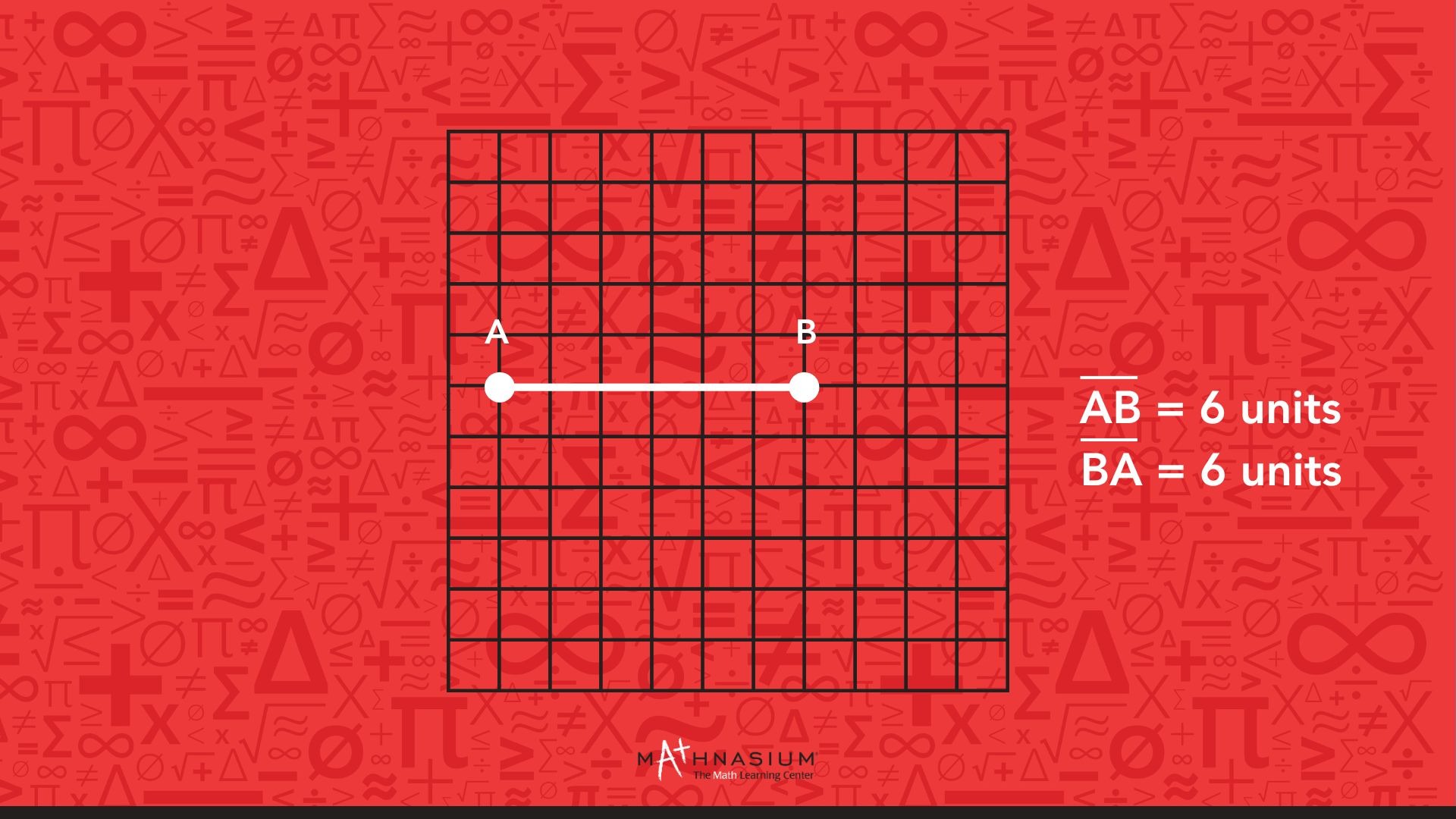
That fixed length is what makes line segments so useful in geometry. Because we can measure a segment, it becomes the building block for finding perimeter, distance, and the side lengths needed to construct shapes.
Ray vs. Line Segment: Most Important Differences
The biggest difference between a ray and a line segment is that a ray goes on forever in one direction, while a segment stops at both ends.
That single difference in length shapes everything else about how the two are written, named, and measured.
|
Ray |
Line Segment |
| Endpoints |
One |
Two |
| Length |
Infinite |
Fixed and measurable |
| Notation |
Arrow over the letters (ray AB→) |
Bar over the letters (segment AB) |
| Does order matter? |
Yes, the endpoint comes first. |
No, either order works. |
If we understand each piece on its own, it is much easier to recognize how they combine into the geometry students see later on.
📕 You May Also Like: What Is a Line Segment? A Complete & Kid-Friendly Guide
Test Your Knowledge
Ready to put these definitions to work?
Try the questions below, then check your answers underneath.
1. Which of these is the correct definition of a ray?
-
A straight path with one endpoint that extends forever in a single direction
-
A straight path that goes on forever in both directions
-
A straight path between two endpoints with a fixed length
-
A curved path with no endpoints
2. Which of the following is best described as a line segment rather than a ray?
-
A flashlight beam
-
Sunlight streaming through a window
-
The edge of a ruler
-
A laser pointer's beam
3. How would you correctly name a ray that starts at point M and passes through point N?
-
Ray NM→
-
Ray MN→
-
Segment MN
-
Line MN
4. Ray PQ and ray QP are:
-
The exact same ray
-
Two different rays with different starting points
-
Both line segments
-
Impossible to name
5. A line segment has:
-
No endpoints
-
One endpoint
-
Two endpoints
-
Three endpoints
6. Which of these can be measured?
-
A ray
-
A line
-
A line segment
-
None of the above
If this assessment feels challenging, structured support at Mathnasium can help your child build confidence and strengthen the skills they need.
📕 You May Also Like: How to Track Your Child's Math Progress in Grades 1-8
 Mathnasium instructors help students build strong math foundations, close learning gaps, and develop the confidence to take on new challenges.
How Mathnasium Helps Students Learn and Master Any Math Concept
Mathnasium is a math-only learning center dedicated to helping K-12 students of all skill levels learn and master math.
To help students build a deep understanding of any math concept, including rays and line segments, we rely on our proprietary teaching approach, the Mathnasium Method™, designed around individual student needs and learning styles.
Each student begins their Mathnasium journey with a diagnostic assessment that gives us a clear picture of their current skill level, learning goals, and learning style. From there, we build a personalized learning plan that targets exactly what each student needs.
Our specially trained instructors follow that plan closely, delivering face-to-face instruction in a caring and fun small-group environment.
During sessions, we draw on a mix of verbal, visual, mental, tactile, and written techniques so students can approach concepts from multiple angles and truly make sense of what they're learning.
When students get stuck on a concept, we break it down into manageable steps and work through both the how and the why. In time, that approach builds the critical thinking and problem-solving skills students carry with them into every area of math and beyond.
We build fun into how we work, making sessions game-based and hands-on, celebrating progress at every step, and watching confidence grow alongside skill.
The results speak for themselves:
-
94% of parents report an improvement in their child's math skills and understanding
-
93% of parents report their child's improved attitude toward math after attending Mathnasium
-
90% of students saw an improvement in their school grades
With over 1,100 learning centers across North America, there's likely a Mathnasium near you.
For families in and around Richmond, VA, Mathnasium of Tuckahoe brings our proven approach to local students. Families trust our center to help students build lasting math skills and confidence.
Start by scheduling a free diagnostic assessment with us. Our team will use it to create your student's personalized plan for math mastery.
📅 Schedule a Free Assessment at Mathnasium of Tuckahoe
Not near Tuckahoe?
📍 Find a Mathnasium Learning Center Near You
Psst! Check Your Quiz Answers Here
Here's how Mathnasium instructors would walk through each answer, so a missed question turns into an aha moment instead of just a wrong mark.
1. Answer: A. A ray has a single fixed endpoint and travels forever in one direction. Answer B describes a full line, and answer C describes a segment.
2. Answer: C. The edge of a ruler has two fixed ends, which makes it a segment. Flashlight beams, sunlight, and laser pointers all start at one point and keep going, which makes them better comparisons for a ray.
3. Answer: B. A ray is named starting with its endpoint, so a ray beginning at M and passing through N is written as ray MN→.
4. Answer: B. Ray PQ starts at P and travels through Q, while ray QP→ starts at Q and travels through P. Reversing the letters changes where the ray begins, so these are two different rays.
5. Answer: C. A line segment has two fixed endpoints, which is also what gives it a measurable length.
6. Answer: C. Only a line segment has a fixed length that can be measured. Rays and lines both extend forever, so there's no total length to measure.


 (804) 282-3805