Can any three side lengths form a triangle? If you grab three sticks measuring 2, 3, and 10 inches, you'll quickly find that no matter how you angle them, they won't meet to close the shape.
For a triangle to actually exist, its sides have to follow a geometric rule called the triangle inequality theorem.
Whether you're new to the concept or just looking to sharpen your geometry skills, Mathnasium tutors have your back. Today, we'll cover what the theorem means, a single-comparison shortcut to test any three lengths, the edge case of degenerate triangles, and how to find the range of a missing third side.

What Is the Triangle Inequality Theorem?
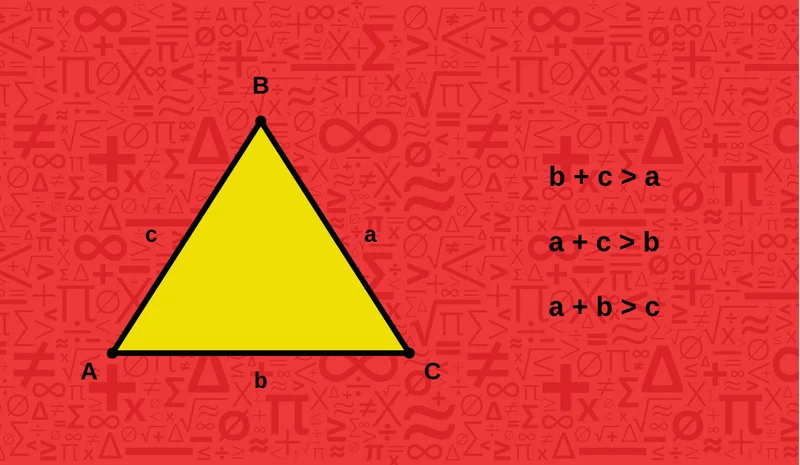
The triangle inequality theorem says that three side lengths only form a triangle when each pair of sides adds up to more than the remaining side. For side lengths a, b, and c, we need all three conditions to hold at once:
-
a + b > c
-
a + c > b
-
b + c > a
If even one of those fails, the shape falls apart. We also use strict inequalities here, not "greater than or equal to," because an actual triangle needs actual area inside it instead of a flat line.
Why does this work?
Two short sides swinging up to meet a longer third side can't stretch far enough to reach each other, no matter how we angle them. The third side stays open, and the triangle never closes.
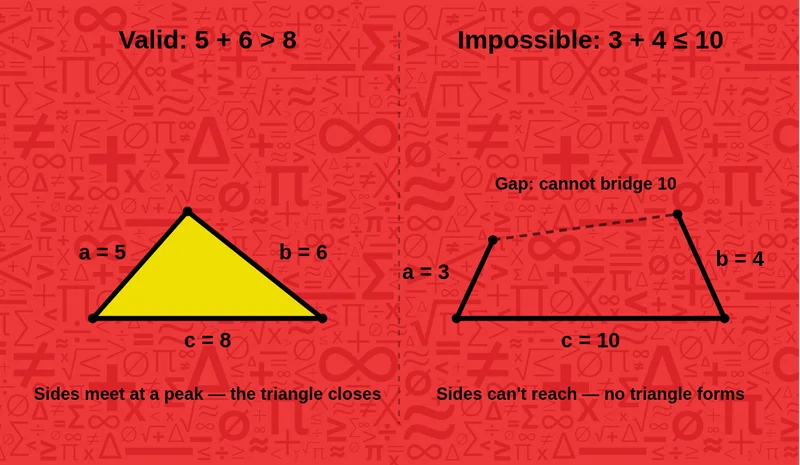
We can run this check before solving a homework problem, sketching a construction, or working through a proof. This check confirms whether a set of measurements can form a triangle before we build anything else on top of it.
We can always check all three inequalities, but a faster way exists. We'll walk through that next.

How to Test Any Three Side Lengths Without Checking All Three Inequalities
One comparison tells us whether three side lengths form a triangle. This shortcut checks the same three conditions from a single step instead of three, and that is that we add the two smallest lengths together and compare that sum to the largest length.
Here's how we apply it:
-
Order the three lengths from smallest to largest.
-
Add the two smaller lengths together.
-
Compare that sum to the largest length.
This single comparison covers us because the largest side already beats either of the two smaller sides on its own. The two smaller sides working together are what decide the outcome.
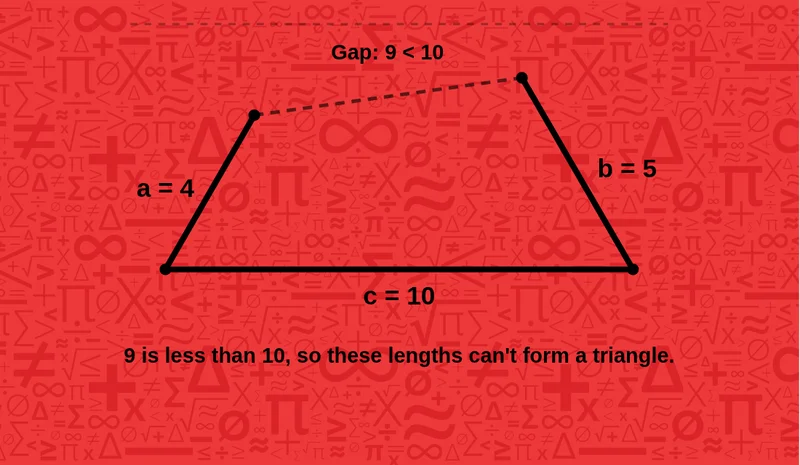
Let's test it with 4, 5, and 10:
-
We order the lengths from smallest to largest: 4, 5, and 10.
-
We add the two smaller lengths together: 4 + 5 = 9.
-
We compare that sum to the largest length: 9 < 10.
Since 9 falls short of 10, the two smaller sides can't stretch far enough to meet the third side. These three lengths can't form a triangle.
The two shortest sides are always racing to beat the longest one. We just need to see who wins.
📕 You May Also Like: Types of Triangles for Grades 4–8: A Complete Guide
What Is a Degenerate Triangle?
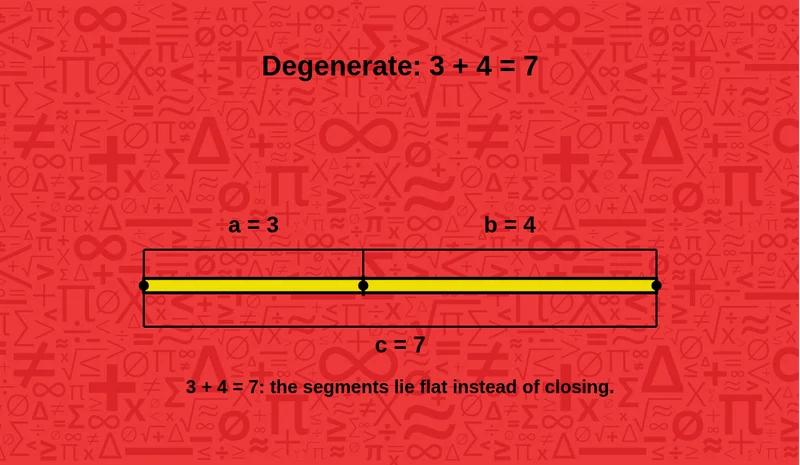
A degenerate triangle happens when the two smaller sides add up to exactly the third side. The shape collapses flat instead of closing into an actual triangle, and most geometry courses count it as invalid.
The two smaller sides reach exactly far enough to touch the third side's endpoint, but they never lift into a peak. Every point lands on the same straight line. This situation extends the first check we ran.
Let's test 3, 4, and 7:
-
We order the lengths from smallest to largest: 3, 4, and 7.
-
We add the two smaller lengths together: 3 + 4 = 7.
-
We compare that sum to the largest length: 7 = 7.
The two smaller sides add up to exactly the third side instead of exceeding it, so the shape collapses flat with zero area. A shape with zero area has no interior, so it fails the basic definition of a triangle even though the three lengths look valid at first glance.
Tests can feature questions built around this exact trap. We always check for a strictly greater sum, never "greater than or equal to." Swap the two, and we mark an invalid set of lengths as valid on a question designed to catch exactly that mistake.
📕 You May Also Like: What Is Inequality in Math? Everything You Need to Know
How to Find the Range of a Missing Third Side
The missing side of a triangle has to fall somewhere between the difference and the sum of the two known sides.
For known sides a and b, we write that as |a − b| < x < a + b, where x is the missing side.
How to Find the Upper and Lower Bound
We get both bounds from the same rule we've been using all along, just applied in two directions:
-
Upper bound: we need the missing side to stay smaller than the sum of the other two sides.
-
Lower bound: we need the missing side to stay larger than the difference between the other two sides. If it's too small, the two known sides collapse it flat the same way they did in the degenerate case.
Let's test this with two known sides, 5 and 12. What range keeps a triangle intact?
We plug both values into the inequality: |12 − 5| < x < 12 + 5, which we simplify to 7 < x < 17.
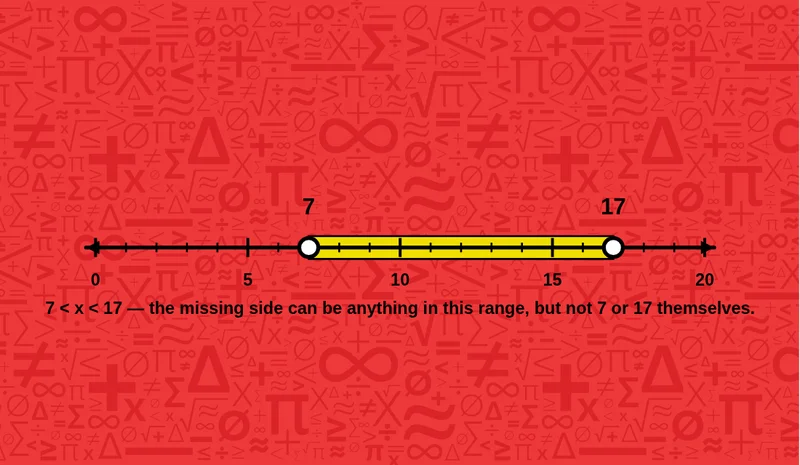
We can rule out both endpoints right away. If we set the missing side to exactly 7 or exactly 17, we collapse the triangle flat, the same degenerate case we tested with 3, 4, and 7 earlier. We need the missing side to land strictly between those two numbers, not on them.
We run into this range test constantly in geometry problems that ask us to pick possible side lengths from a list of choices, so checking the sum and difference in our head saves time on a test.
📕 You May Also Like: 7 Places the Pythagorean Theorem Shows Up in Real Life
Your Turn: Practice the Triangle Inequality Theorem
Try these three problems on your own. Use the examples we just walked through, then check your answers at the end of this guide.
-
Problem 1: Do the side lengths 6, 8, and 9 form a triangle?
-
Problem 2: Do the side lengths 5, 9, and 14 form a triangle?
-
Problem 3: Two sides of a triangle measure 6 and 10. What range of values can the third side take?
FAQs About the Triangle Inequality Theorem
A few points trip students up as they get comfortable with the triangle inequality theorem. Here's what to know.
1. What grade do students typically learn the triangle inequality theorem?
Most students first encounter the triangle inequality theorem in seventh- or eighth-grade geometry, and it resurfaces in high school geometry courses and again during test prep for the SAT® and ACT®. Students who build a solid grasp of the rule early carry that same reasoning into related topics like the Pythagorean Theorem and coordinate geometry.
2. Does the triangle inequality theorem show up on the SAT® or ACT®?
Yes, both exams test the triangle inequality theorem, usually inside a word problem that asks students to identify valid side lengths or find the range of a missing side. Our test prep sessions cover this exact skill, so students walk into test day already comfortable with the single-comparison shortcut.
3. Where does the triangle inequality theorem show up outside of geometry class?
Anyone designing a support beam, planning a delivery route, or checking whether a structure will hold its shape relies on the same rule students use to test three side lengths in class. Architects, engineers, and route planners all lean on this logic to confirm a triangle forms a stable shape rather than collapsing into a flat line.

Mathnasium tutors use personalized learning plans and interactive teaching techniques to help students learn and master any math concept.
How Mathnasium Helps Students Master Geometry (And Any Other Math Topic)
Mathnasium is a math-only learning center dedicated to helping K–12 students of all skill levels excel in math.
Whether students need support to rebuild geometry foundations, master specific concepts like the triangle inequality theorem, or advance to more complex topics like proofs and trigonometry, we are here to support them.
Our proprietary teaching approach, the Mathnasium Method™, is designed around each student's needs and learning style to help them learn and master math. Our approach includes:
-
Assessment and Personalized Learning Plans: Each student begins their Mathnasium journey with a diagnostic assessment that identifies current skills, strengths, and gaps. From those findings, we build a personalized learning plan tailored to their goals.
-
Teaching for Understanding: Our specially trained tutors use natural language and a mix of verbal, visual, mental, tactile, and written techniques so each concept lands before we move forward.
-
Problem-Solving and Critical Thinking: We give students time to work through problems independently. That productive struggle helps them learn to trust their own reasoning. When we do step in, we explain both the how and the why behind each answer, so students build problem-solving and critical thinking skills they can use in math and beyond.
-
An Engaging and Fun Learning Environment: Sessions include games, earned rewards, and consistent celebration of progress. Students build confidence alongside fluency, and many develop a more positive relationship with math.
We hear from parents and students alike that the progress shows up quickly:
-
94% of parents report improvement in their child's math skills and understanding
-
93% of parents report an improved attitude toward math after attending Mathnasium
-
90% of students saw improvement in their school grades
With over 1,100 learning centers across North America, there is likely a Mathnasium close to you.
Families in and around West Houston trust Mathnasium of West Houston to help their children build lasting confidence in math at every level.
If the triangle inequality theorem or any other math concept is giving your child trouble, our team is ready to help.
📅 Schedule a Free Assessment at Mathnasium of West Houston
Not near West Houston?
📍 Find a Mathnasium Learning Center Near You
Pssst! Check Your Answers Here
Worked through the three problems above? Check your answers below.
We add the two smaller sides: 6 + 8 = 14
14 > 9
Yes, these lengths form a triangle.
We add the two smaller sides: 5 + 9 = 14
14 = 14
No, these lengths form a degenerate triangle, not a real one.
We plug both values into the inequality: |10 − 6| < x < 10 + 6
4 < x < 16


 (281) 465-4990