High school geometry is one of the most common reasons students turn to Mathnasium for math support. That’s no surprise. To move from standard arithmetic and algebra into working with visual diagrams, writing formal proofs, and figuring out which theorem to use is not a small change.
Even students who breezily sailed through earlier math classes often find themselves struggling to adjust.
Today, our education specialists will explain why geometry can feel challenging and where students may get stuck. As a Mathnasium center serving Calabasas families, we’ll also share tips that may help local students build geometry understanding and confidence.
1. Getting the Answer Is Only Part of the Work
In earlier math classes, students get used to questions like “What does x equal?” They still need to show their work, but they usually have a clear numerical answer to work toward.
In geometry, they are often asked to show why something must be true, even when the problem statement has already told them the final outcome.
Yes, you may have guessed it. We’re talking about proofs.
For students in Calabasas, formal proofs are part of the Las Virgenes Unified School District’s geometry course, which is offered across grades 9–12. The exact year a student takes it depends on their math pathway, so it isn't a challenge everyone encounters at the exact same age.
For example, students might be asked to:
-
Show that two triangles have exactly the same shape and size using information about their sides and angles, not just because they look identical on the page.
-
Explain why two angles must be equal using established facts about parallel lines, rather than grabbing a protractor to measure them.
The examples we’ve listed reflect core topics in the district’s geometry curriculum, including triangle congruence, parallel lines, and formal deductive reasoning.
The challenge for many students is that recognizing a mathematical truth and proving it are entirely different tasks.
A student might look at a diagram and instantly think, “Those angles are equal,” but then immediately wonder, “How do I actually start writing this down?” They have to identify which geometric facts are available, choose a rule that connects those facts, and put their reasoning in an order that someone else can logically follow.
That’s why “show your work” looks so different in geometry. Instead of recording the calculations that led to an answer, students are building a step-by-step argument for why a conclusion must be true.
Tip 1: Say It Before You Write It
To help learners adjust to this way of thinking, our tutors suggest talking through the reasoning before writing a formal proof. Start with what the problem tells you, identify what you need to prove, and explain how a familiar rule might connect the two.
Students can practice with these three prompts.
-
“The problem tells me…” Write down the given facts and mark them on the diagram.
-
“I need to show…” State exactly what the problem asks you to prove.
-
“I can use this rule because…” Name a definition or theorem that applies to the facts you have—not just to how the diagram looks.
For example, suppose a problem tells a student that two sides of a triangle are equal and asks them to prove that the opposite angles are equal. They might explain it aloud like this.
“These two sides are equal, so this is an isosceles triangle. The base angles of an isosceles triangle are equal, so the angles opposite those sides must be equal.”
Then they can turn that explanation into the statements and reasons required by the assignment.
Their aim should be to understand the connection between each fact and the next, rather than memorize a sequence of lines.
📕 You May Also Like: How to Write Geometric Proofs: A Beginner’s Guide With Examples
2. Students Must Make Sense of Spatial and Visual Relationships
Sometimes, a student knows a geometry rule backward and forward, but still looks at the diagram and thinks, “Where am I supposed to use it?” Before they can even begin solving the problem, they have to make sense of the picture.
This challenge routinely shows up during units on triangle congruence and similarity, parallel lines, or area and volume, all core topics included in LVUSD’s geometry course.
For example, a high schooler may need to:
-
In triangle congruence: Pick out two overlapping triangles and recognize that they share a common side.
-
With parallel lines: Identify which angles correspond when a transversal line cuts across them.
-
In area problems: Find a triangle’s true height even when the shape is tilted rather than resting neatly on a horizontal base.
The tricky part is that a familiar concept can suddenly become unrecognizable when the visual context changes.
In other words, a student might easily follow an example where two triangles are drawn separately, yet feel completely stuck when those same triangles overlap. Or they may know the formula for area by heart, but mistake a slanted side for the height.
Unfamiliar orientations are a hurdle in geometric reasoning our tutors see quite often.
When a single diagram is crowded with shapes, lines, and labels, students can easily feel like they have to figure everything out all at once. The sticking point isn't always a failure to remember a rule. Often, it’s simply finding the exact piece of the picture where that rule applies.
Tip 2: Take the Diagram Apart
When a geometry diagram feels overwhelming, encourage your student to focus on just the shapes named in the question.
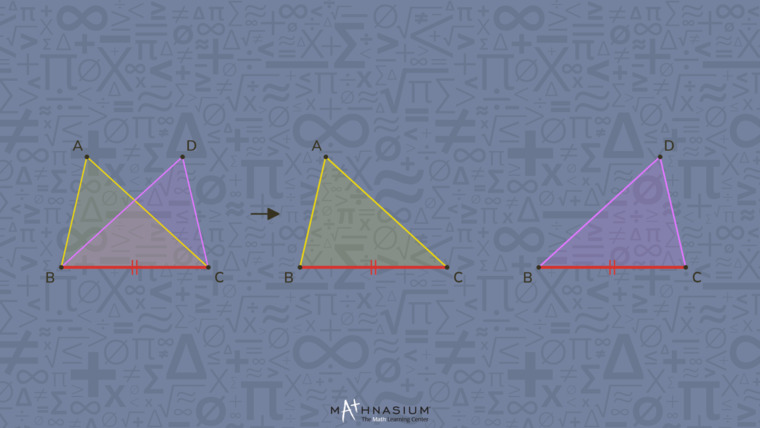
For overlapping triangles, tracing or redrawing each triangle separately can make shared sides and angles much easier to identify. This is a strategy used specifically in instruction on overlapping-triangle proofs.
You can guide them through this with a few simple steps:
-
Have them trace one triangle in one color and the second in a different color.
-
Ask them to sketch the triangles side-by-side, keeping the original vertex labels and copying over the given side and angle markings.
-
Ask, “Do these triangles share a side or an angle?” and help them locate that exact part in both sketches.
For example, triangles ABC and DCB both rely on side BC. Once the student draws the triangles separately, they can mark BC on each sketch and visually recognize that it is the same segment, rather than two different sides that just happen to look equal.
You don’t have to jump straight to asking, “Which theorem should you use?” Instead, start with, “Can you show me the two triangles we’re comparing?” That keeps your support focused on the immediate obstacle: making sense of the picture before trying to figure out what to do with it.
📕 You May Also Like: What Are Similar Triangles?

3. Algebra Is Still Essential, Now Within Geometric Problems
Geometry might ask students to think in a brand-new way, but it certainly doesn't leave algebra behind. In fact, teens still rely on algebra every step of the way, whether they're finding a missing measurement or working with shapes on a coordinate grid.
We can think of it as a team effort. The geometry helps them figure out which relationship to use, and the algebra helps them calculate the final answer.
For example, your student might run into tasks like these:
-
Finding missing angles when their measures are written as algebraic expressions, such as 2x + 10 and 3x - 5.
-
Setting up and solving proportions to find an unknown side length in similar triangles.
-
Using the Pythagorean theorem to find a missing side, which means working comfortably with squares and square roots.
-
Calculating slopes and distances between points to explore a shape’s properties on a coordinate grid.
This can feel especially tricky when earlier algebra skills are still a bit shaky. A student might do all the hard work of recognizing that two angles are equal, write down the equation 2x + 10 = 3x - 5, and then hit a roadblock while trying to solve for x.
So, what looks like a struggle with geometry may really be an algebra learning gap showing up in a new setting.
Revisit the Algebra Geometry Builds On
We encourage students to revisit the specific algebra skills they’ll actually use in geometry. There’s no need to rehash an entire previous course.
The ideal starting points are equations, proportions, powers, and roots because they directly support everyday work with angle measures, similar figures, and the Pythagorean theorem.
To make that review feel targeted and meaningful, look at where your student naturally gets stuck in their geometry homework, and then practice just that matching skill:
-
Solving equations: If they can easily set up an equation for missing angles but struggle to solve it, practice equations like 2x + 10 = 3x - 5. Have them explain why each step and operation keeps both sides of the equation balanced.
-
Substituting values: After finding x, practice putting that value back into the original expression. In the example above, x = 15, but an angle labeled 2x + 10 actually measures 40°, not 15°.
-
Working with proportions: If similar-triangle problems are causing frustration, review equivalent ratios and equations like \(\Large\frac{3}{5}\) = \(\Large\frac{x}{20}\). Ask what multiplication connects 5 to 20, and how that same relationship helps find x.
-
Using squares and square roots: For right-triangle problems, check that students feel confident about the difference between x2 and 2x, and review how to move smoothly from x2 = 49 to a side length of 7.
📕 You May Also Like: 5 Gaps that Derail High School Math Success
 Each Mathnasium student follows a personalized learning plan built around their own skills and gaps.
How Mathnasium of Calabasas Helps Students Excel in Geometry
Mathnasium of Calabasas is a math-only learning center serving Calabasas and surrounding communities and is part of a worldwide network of over 1,200 Mathnasium locations.
We help local students of all skill levels build confidence and excel in math. Whether a student needs to rebuild skills from Algebra 1, keep up with geometry homework, or tackle proofs and advanced concepts, we meet them right where they are.
Instead of relying on a one-size-fits-all curriculum, we personalize every student’s journey through the Mathnasium Method™, our proprietary teaching approach designed to build true understanding.
To help students master geometry, our approach focuses on:
-
Assessment and Personalized Learning Plans: Each student begins with a diagnostic assessment that identifies current skills, strengths, and knowledge gaps. From those findings, we build a personalized learning plan tailored to their goals. If the stall point sits in reasoning, diagram reading, or the algebra underneath, the plan starts there.
-
Teaching for Understanding: Our specially trained tutors use natural language and a mix of verbal, visual, mental, tactile, and written techniques. We build toward formulas and do not start from them, so your child understands why a relationship is true before using it.
-
Problem-Solving and Critical Thinking: We give students time to work through problems independently, then a tutor checks the work as it happens and explains both the how and the why behind each answer. Students build problem-solving and critical thinking skills they can use in math and beyond. Homework help is also built into each session once the day’s plan topics are done.
-
An Engaging and Fun Learning Environment: Sessions include games, earned rewards, and consistent celebration of progress. Students build confidence alongside fluency.
Our approach brings measurable results:
-
94% of parents report an improvement in their child’s math skills and understanding
-
93% of parents report their child’s improved attitude toward math after attending Mathnasium
-
90% of students saw an improvement in their school grades
Whether your student is looking to catch up, keep up, or get ahead in math, our team is ready to assist.
Start by scheduling a free diagnostic assessment with our center. We will use it to create a learning plan customized to your child’s needs and set them on the best path to math mastery.
📅 Schedule a Free Assessment at Mathnasium of Calabasas
Not near Calabasas?
📍 Find a Mathnasium Learning Center Near You


 (818) 741-2880