In geometry, the word “similar” carries a precise mathematical definition rather than a vague description.
It can feel like a guessing game to determine whether two geometric shapes are similar, especially when shapes are flipped, rotated, or overlapping inside a larger triangle. Many of us can spot two triangles that look alike, but proving that they are truly similar takes a bit more work.
Today, our tutors will walk you through what similar triangles are and explain the three theorems that prove triangle similarity.

What Are Similar Triangles?
In geometry, similar triangles are triangles that have the exact same shape as one another, even though they may be different in size, position, or rotation.
For two triangles to be mathematically "similar," they must satisfy two strict conditions:
Imagine we take a triangle and zoom in or out on it as we do to a picture on a phone. We can see it change size, but its angles and shape will stay the same. Even if we rotate it or move it, it will still be the same triangle.
Let's look at how this works with two triangles that are similar △ABC and △DEF:
-
△ABC has side lengths of AB = 3 inches, AC = 4 inches, and BC = 5 inches.
-
△DEF has side lengths of DE = 6 inches, DF = 8 inches, and EF = 10 inches.
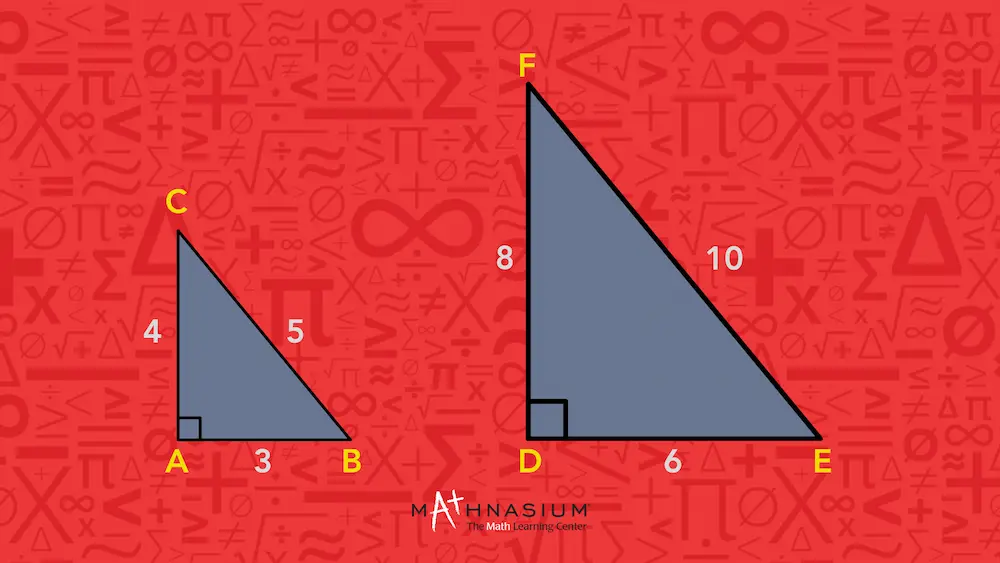
If we measure the inside corners of both triangles with a protractor, we would find that their corresponding angles are identical:
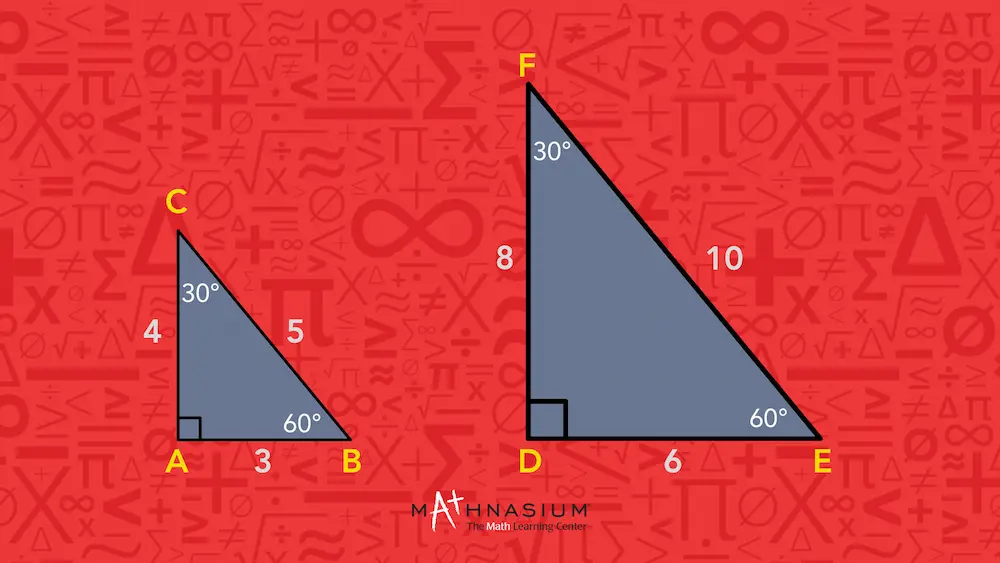
Now, let's look at their sides. If we divide the sides of the larger triangle by the matching sides of the smaller triangle, the math looks like this:
-
Short sides: \(\Large\frac{DE}{AB} = \Large\frac{6}{3} = 2\)
-
Medium sides: \(\Large\frac{DF}{AC} = \Large\frac{8}{4} = 2\)
-
Long sides (hypotenuse): \(\Large\frac{EF}{BC} = \Large\frac{10}{5} = 2\)
We can see that the sides are completely proportional with a scale factor of 2. This tells us that even though triangle DEF is twice the size of triangle ABC, they both have the exact same shape.
In math notation, to write that two triangles are similar, we use the symbol ~.
So, for our two similar triangles, we can write:
△ABC ~ △DEF

How Do We Prove Two Triangles Are Similar?
To prove that triangles are similar, we could check every single angle and every single side. That method works, but it requires a lot of measuring. Fortunately, we do not need all six checks to prove similarity.
Instead, we can prove it by satisfying any one of these three standard criteria:
-
AA (Angle-Angle): Two pairs of angles are equal.
-
SSS (Side-Side-Side): All three pairs of sides are proportional.
-
SAS (Side-Angle-Side): Two pairs of sides are proportional, and the angle between them is equal.
If two triangles pass any one of these tests, they are similar.
Let’s take a closer look at each one.
1. Angle-Angle (AA) Similarity Theorem of a Triangle
The AA criterion says that if two pairs of corresponding angles in two triangles are equal, the triangles are similar.
Why are two angles enough?
The interior angles of any triangle always add up to 180°, so once two angles match, the third must match also. With all three angles fixed, the sides will always be proportional.
We can picture this by drawing three lines that cross each other to form a triangle. The direction of each line sets the angles. If we slide one line closer or farther away without turning it, the triangle gets bigger or smaller, but its angles stay the same.
This means that every new triangle we create this way will be similar to the original.
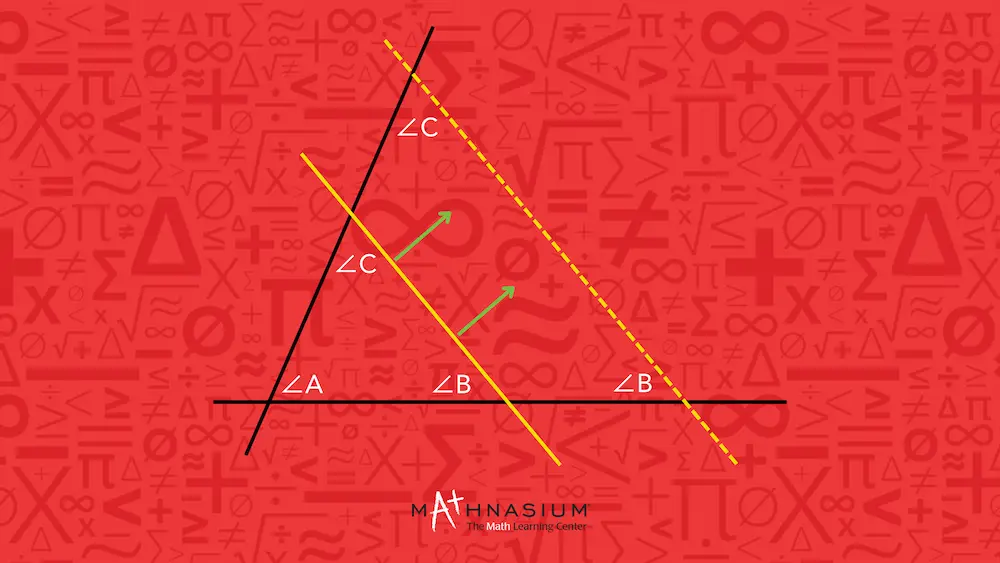
Now, let’s look at two examples of how to use AA Similarity Theorem to prove triangles are similar.
Example 1
△ABC has a right angle at A and ∠B = 40°. △DEF has a right angle at D and ∠F = 50°. Are they similar?
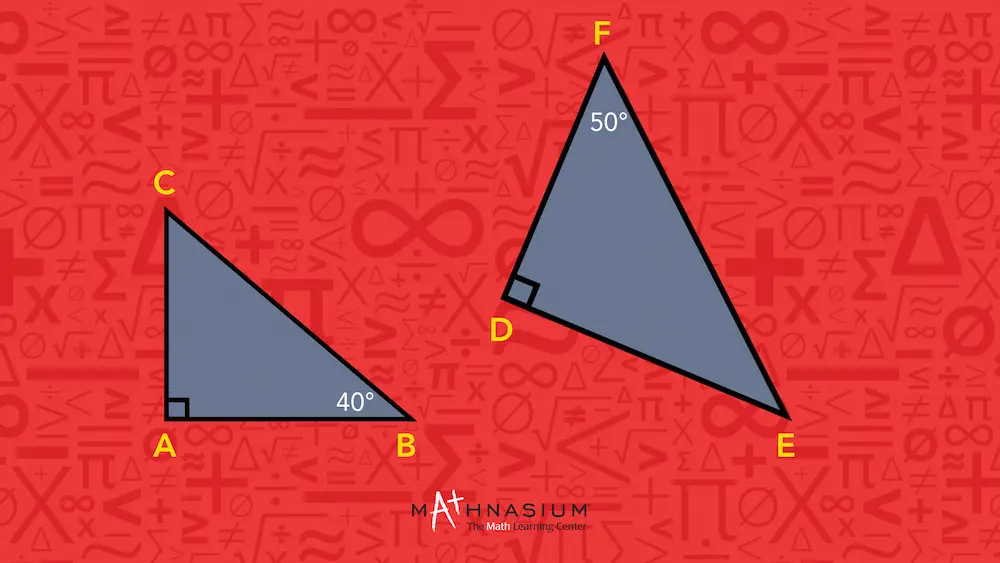
We start by looking for matching angles.
∠A and ∠D are both right angles, so ∠A = ∠D = 90°. That gives us our first pair.
We can find ∠C by subtracting the two known angles of △ABC from 180°:
∠C = 180° - (∠A + ∠B)
∠C = 180° - (90° + 40°)
∠C = 180° - 130°
∠C = 50°
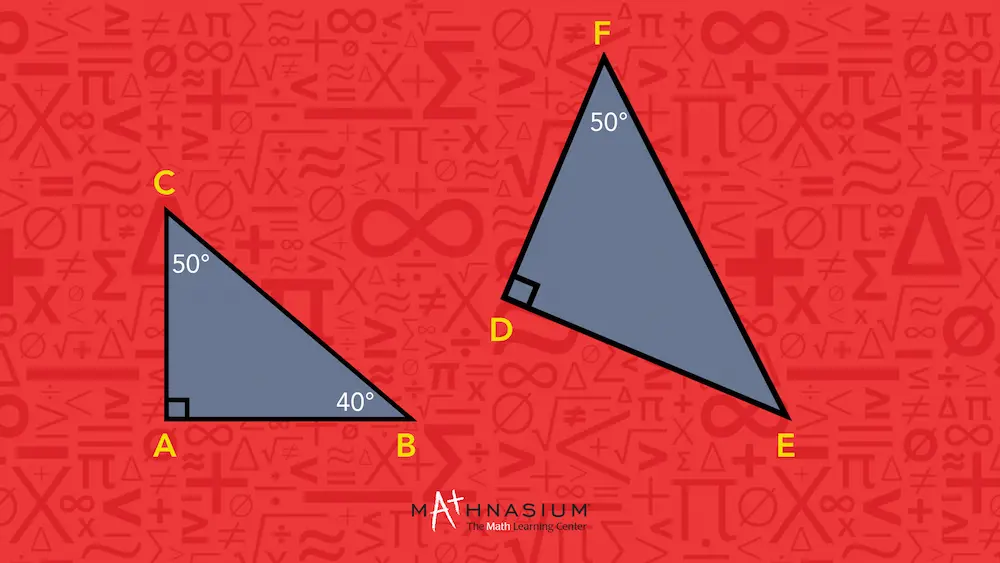
Since angle F is also 50°, angle C and angle F are equal.
Now we have two pairs of equal angles, which proves that these triangles are similar:
-
∠A = ∠D = 90°
-
∠C = ∠F = 50°
By the AA criterion, △ABC ~ △DEF.
Example 2
The most common place we use AA is a triangle with a line drawn across it, parallel to one of its sides.
Say △ABC has a line DE drawn across it. The line DE is parallel to side BC. So how do we prove that △ABC is similar to △ADE without any angle measurements?
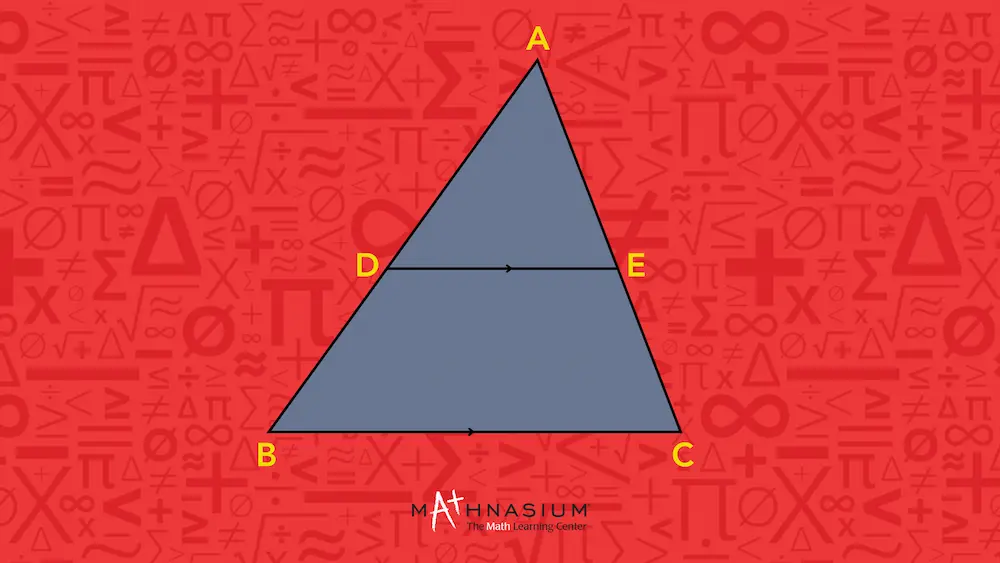
We need to look for relationships built into the shape itself to find our two pairs.
The small triangle △ADE and the large triangle △ABC share the same angle at the top, so we can conclude that ∠A = ∠A.
When a line cuts across two parallel lines, it creates matching corresponding angles.
In our diagram here, DE is parallel to BC. The side BC acts as a transversal or a cutting line. This tells us that the angles ∠B and ∠D are the same.
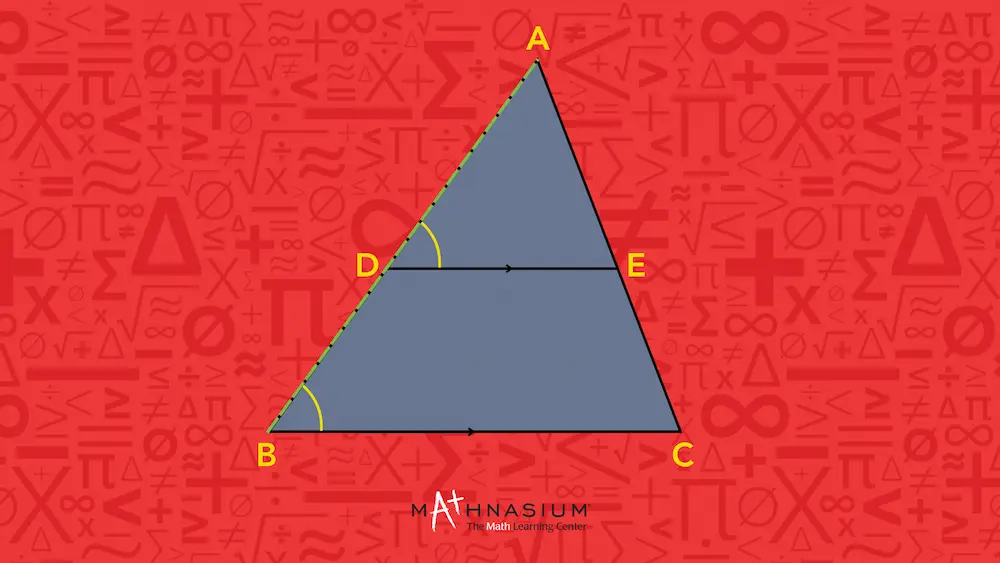
Which means we got our two matching pairs of angles:
Even without a single number on the page, we have found two pairs of equal angles.
Therefore, by AA, △ABC ~ △ADE.
📕 You May Also Like: Triangle Angle Sum and Exterior Angle Theorems Explained
2. Side-Side-Side (SSS) Similarity Theorem of a Triangle
The SSS criterion says that if all three pairs of corresponding sides in two triangles are proportional, the triangles are similar.
Here is how we check it:
-
Put the sides of each triangle in order, from shortest to longest.
-
Divide each side of the larger triangle by its matching side in the smaller one.
-
If all three answers are the same, the triangles are similar.
Let’s put this to a test.
△ABC has sides of 5 inches, 12 inches, and 13 inches. △DEF has sides of 15 inches, 36 inches, and 39 inches. Are they similar?
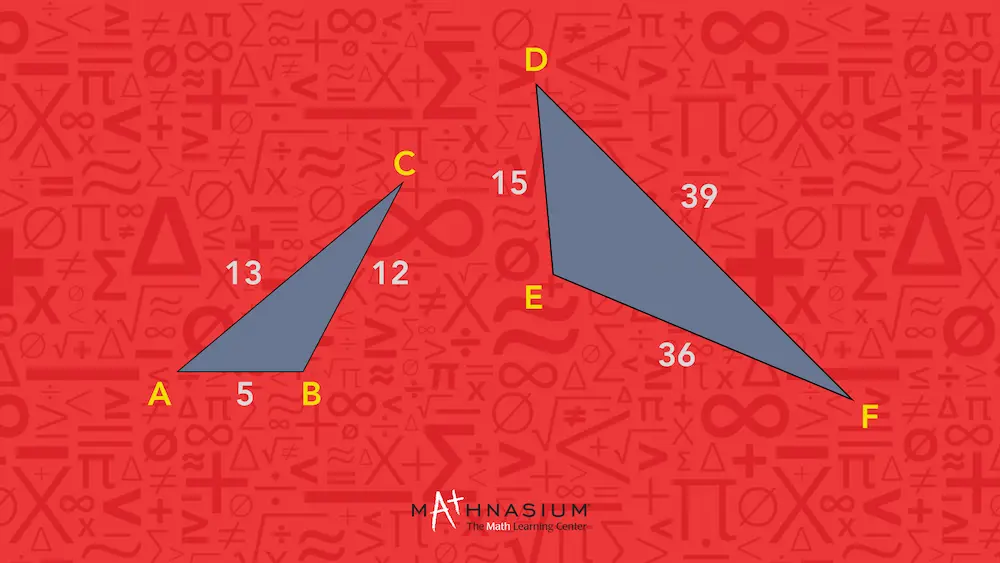
To check if they are, we need to match the sides of both triangles from shortest to longest and divide.
-
Short sides: \(\Large\frac{15}{5} = 3\)
-
Medium sides: \(\Large\frac{36}{12} = 3\)
-
Long sides: \(\Large\frac{39}{13} = 3\)
All three ratios are 3, so the sides are proportional, which proves the triangles are similar.
By SSS, △ABC ~ △DEF.
📕 You May Also Like: Can Any Three Sides Form a Triangle? The Triangle Inequality Theorem
3. Side-Angle-Side (SAS) Similarity Theorem of a Triangle
The SAS Similarity Theorem says that if two pairs of corresponding sides in two triangles are proportional and the angle between those sides is equal, the triangles are similar.
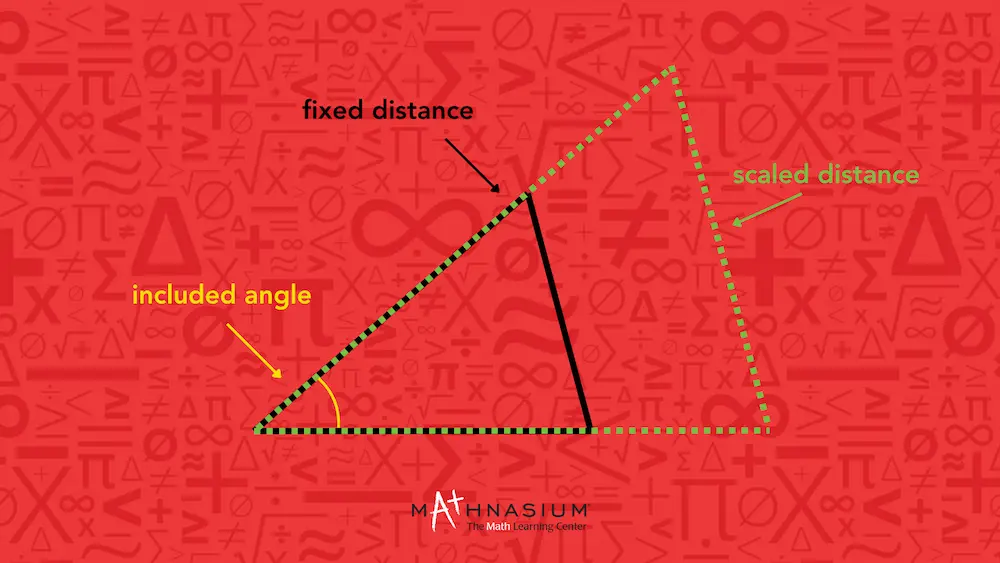
The angle between two sides is called an included angle and it acts like a hinge. It fixes the exact distance between the outer ends of those sides, which determines the third side and the remaining angles.
When we scale the two sides by the same amount while keeping the included angle unchanged, the whole triangle scales right along with them.
△ABC has AB = 4 inches, BC = 6 inches, and the ∠B = 40°. △DEF has DF = 10 inches, FG = 15 inches, and the ∠F = 40°. Are they similar?
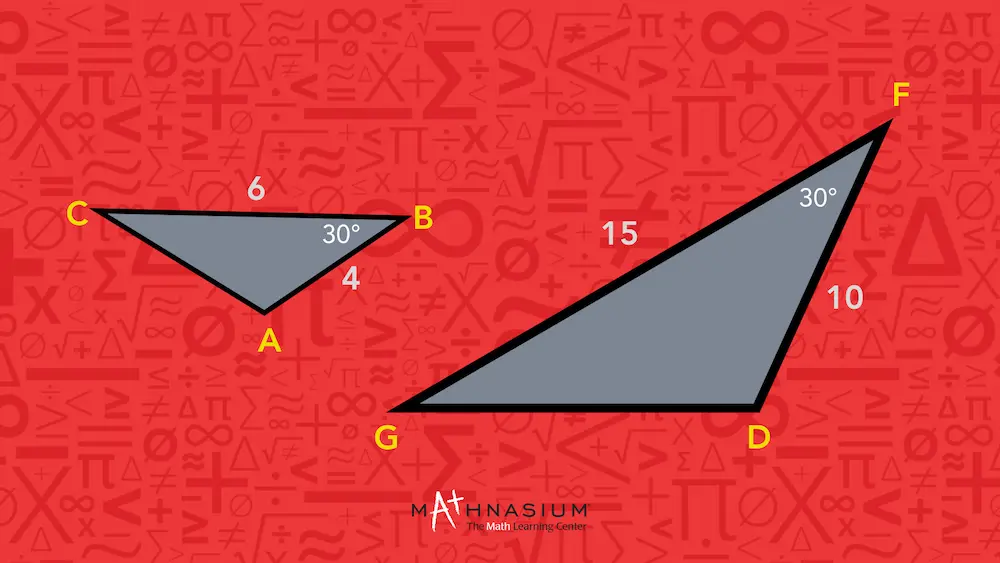
The first thing we need to check here are the angles we have included.
They are! Because angle B and angle F both measure 40° and sit directly between our known side pairs, we have matching included angles.
Then we can check the ratios of the matching sides that surround the included angles:
Both pairs of sides share a scale factor of 2.5, meaning they are completely proportional. Since their included angles are also equal (∠A = ∠D = 40°), the triangles satisfy the SAS condition.
Therefore, △ABC ~ △DEF
📕 You May Also Like: Why Are Vertical Angles Always Equal? A Deep Dive

Mathnasium uses personalized learning plans and interactive teaching techniques to help students prove and understand math concepts with confidence.
How Mathnasium Helps Students Master Geometry (and Any Math Concept)
Mathnasium is a math-only learning center empowering K-12 students of all skill levels to learn and master math.
When students come to us for support, whether they are building foundational geometry skills or getting ready for proofs and trigonometry, we teach for deep, lasting understanding.
We do this through the Mathnasium Method™, our proprietary teaching approach designed around each student’s needs and goals.
Here is how it works:
-
Diagnostic Assessment and Personalized Learning Plans: Every student begins with a diagnostic assessment, a relaxed interaction that shows us their strengths and knowledge gaps. From those insights, we build a personalized learning plan tailored to their needs and goals.
-
Teaching for Understanding: Our specially trained tutors follow that plan closely, delivering face-to-face instruction in a supportive environment. We use plain, everyday language and a mix of verbal, visual, mental, tactile, and written techniques so concepts like similar triangles truly make sense.
-
Problem-Solving and Critical Thinking: When a student gets stuck, we break the problem into manageable parts and guide them through both the how and the why. In time, this builds the problem-solving skills and critical thinking tools they can use in math and beyond.
-
A Fun and Encouraging Environment: Our activities are often game-based, and students earn rewards along the way. We track their progress and celebrate every win, so confidence grows with every session.
Families see measurable results:
-
94% of parents report an improvement in their child’s math skills and understanding
-
93% of parents report an improved attitude toward math after attending Mathnasium
-
90% of students saw an improvement in their school grades
With over 1,200 learning centers across North America, there is likely a Mathnasium close to you.
For families in and around The Woodlands, TX, Mathnasium of The Woodlands is a trusted local center with years of experience helping students build confidence in geometry and every math concept that follows.
Whether your child needs to catch up, keep up, or get ahead in math, our team is happy to help.
📅 Schedule a Free Diagnostic Assessment at Mathnasium of The Woodlands
Not near The Woodlands?
📍 Find a Mathnasium Learning Center Near You


 (281) 465-4990