Grades 3 through 6 are by no means a single chapter in math. In fact, they stretch across the later elementary years and into the start of middle school. Still, one thing ties this stage together: the progressive shift from hands-on, visual learning to increasingly abstract thinking.
During these years, students move from using objects and diagrams to represent ideas to solving problems with numbers, symbols, and variables alone. And in our work with thousands of families at Mathnasium, we’ve seen this is where math often starts to feel “hard.” It doesn’t have so much to do with what students are learning, but with how they’re expected to process it.
With that in mind, our Mathnasium instructors are breaking down what actually changes during this stage, why so many students struggle in the transition, and what parents can do early, before frustration builds.
What’s Really Changing in Grades 3 Through 6
Between third and sixth grade, students gradually change how they approach math. While the progression isn’t immediate, the thinking required follows a steady path, from tangible models to visual representations to symbolic reasoning.
Educators often describe this using the Concrete–Representational–Abstract (CRA) framework, which helps explain what students are experiencing beneath the surface of their assignments.
The framework lays out the progression clearly, and these stages show how students typically move from concrete understanding to abstract reasoning.
-
Concrete (Grade 3): Students rely on physical tools such as base ten blocks, fraction tiles, or counters to make sense of math. These materials give them something they can see and handle as they explore operations, place value, and early problem solving.
-
Representational (Grades 4–5): As students grow more comfortable, their work shifts to drawings and other visual models. Number lines, bar models, area sketches, and diagrams stand in for the physical tools they used earlier. These visuals help them extend what they know while developing more flexible reasoning.
-
Abstract (Around Grade 6): By the time students reach sixth grade, math is presented mostly through numbers, symbols, and written expressions. Equations replace pictures. Variables appear. The visual and physical supports fade, and students are expected to rely on symbolic thinking to solve multi-step problems.
📕 You May Also Like: Common Middle School Math Struggles & How to Bridge the Gaps
Why So Many Students Struggle During This Stage
Even confident learners can lose footing when math becomes less about what they can see and more about what they must reason through.
In our centers, we see the same patterns repeat as students move through the CRA progression. The challenges usually fall into a few clear categories.
A. Moving into abstraction before they’re ready
Some students are introduced to symbolic work too early.
When they are asked to solve problems with variables or multi-step equations before they’ve built a solid visual or concrete understanding, the ideas feel disconnected and hard to follow.
B. Weak number sense that slows everything down
Fluency with basic facts, place value, and mental math supports nearly every topic students meet in Grades 3–6.
When these skills are uncertain, students struggle to manage fractions, decimals, or multi-step problems because their attention shifts to the mechanics rather than the reasoning.
📕 You May Also Like: What Is Number Sense & Why It Matters in Early Math Education
C. Following steps without real understanding
We often meet students who can recite procedures but cannot explain why those procedures work.
That pattern usually holds in the earliest grades, but it breaks quickly once math becomes more flexible and symbolic. A small change in the problem can leave them without a path forward.
D. Anxiety when visual supports disappear
As students move away from pictures, models, or diagrams, some begin to doubt their abilities. They feel unsure about what a problem is asking, which leads to hesitation, avoidance, or frustration long before a grade reveals that something is off.
📕 You May Also Like: Understanding Math Anxiety and How to Overcome It
E. Not enough practice with support at the right level
Students need guided practice as they move from concrete tools to drawings and then to abstract symbols.
When that practice is limited, the transition feels abrupt, and students lose confidence in their ability to interpret the work.

With support that fits your child’s needs and learning style, math becomes something they can work through, not something to fear.
What Parents Can Do Before the Frustration Builds
The move from concrete to abstract thinking can feel challenging at times, and families often look for ways to keep math manageable during this stretch. While no single strategy fixes everything, certain habits make a meaningful difference in how clearly students see new ideas.
The actions below are ones our Mathnasium instructors rely on to strengthen understanding and support steady progress.
1. Using visual tools, even if homework doesn't
Bar models, number lines, fraction strips, arrays, and quick sketches help students see what a problem represents. These visuals keep ideas grounded and give students a bridge between hands-on learning and symbolic work.
A simple example is a typical fourth-grade fraction comparison problem, such as:
Which is greater, \(\Large\frac{3}{4}\) or \(\Large\frac{2}{3}\)?
If you draw two bars of equal length and divide one into four parts and the other into three, the comparison becomes clear long before the symbolic reasoning does.
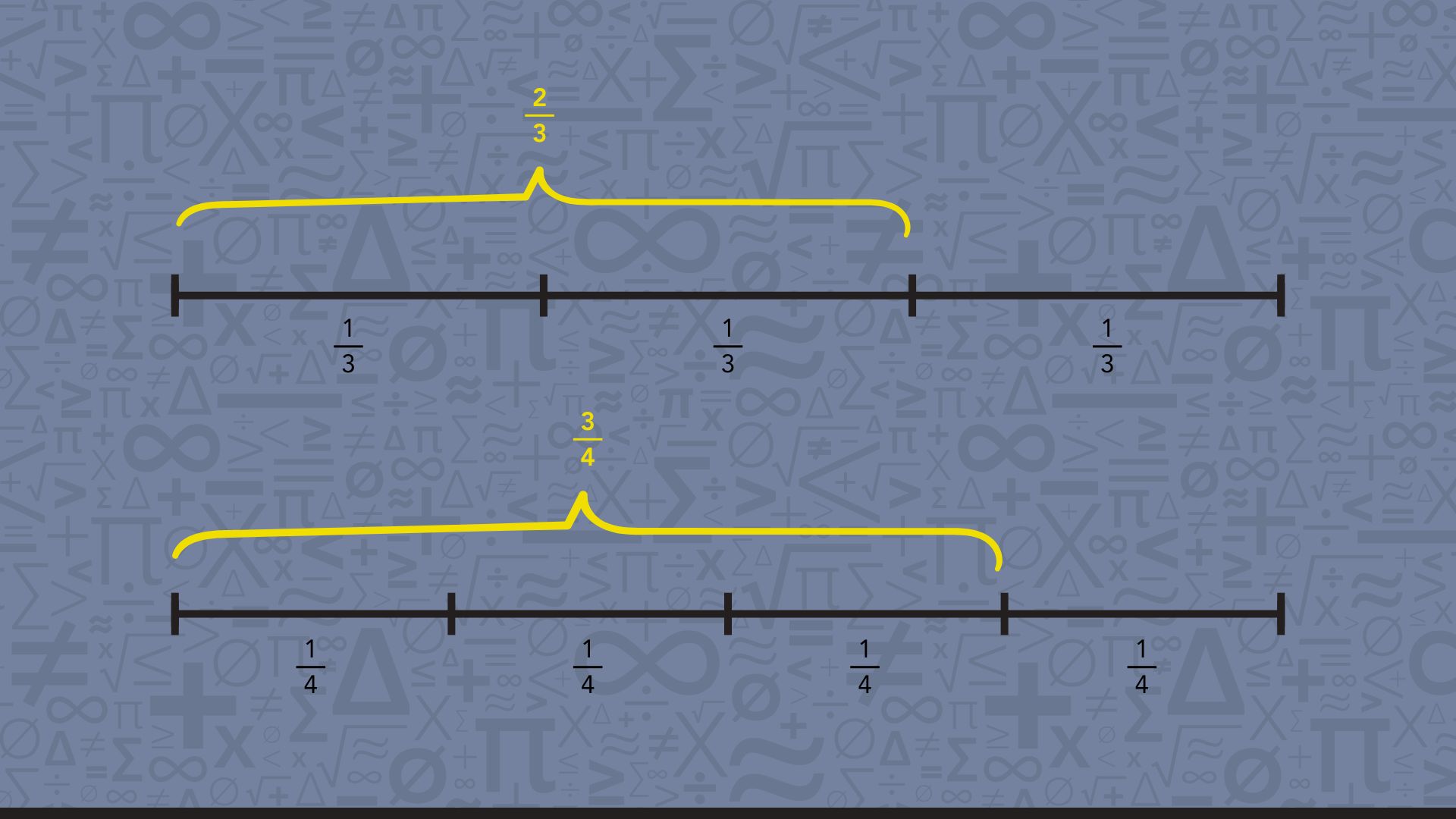
The drawing supports understanding while your child grows more comfortable with the abstract steps.
📕 You May Also Like: How to Use Math Manipulatives Effectively at Home
2. Build mental math strength through everyday routines
Simple number play builds fluency and steady confidence. Rounding prices while shopping, estimating time during daily activities, or breaking numbers apart during quick challenges helps students manage new concepts with less cognitive strain.
You might ask a fifth grader to solve 38 + 47 by first breaking it into 30 + 40 and 8 + 7, which helps them see the structure of the problem before calculating the total.
3. Ask your child to explain or show their thinking
Talking through a problem or asking them to sketch their approach reveals how your child is processing the work. It encourages clearer reasoning and helps you see where support is needed.
A small whiteboard at home works well because it lets students sketch ideas freely and adjust their steps without feeling locked into a final answer.
Say you were helping a third grader with a word problem like:
“There are 14 apples in a basket. A store adds 8 more apples. Later, 6 apples are sold. How many are left?”
Ask your child to show how they make sense of the story. Some students draw quick bars or circles to organize the information, while others write each step separately. Their explanation reveals whether they understand the sequence of actions, not just the final number.
4. Watch for frustration, not just grades
Parents often look to report cards for clarity, yet the earliest signs of struggle usually show up long before grades change. You might notice your child putting off assignments, rushing through familiar tasks, or growing tense the moment math comes out of the backpack.
These small signals matter. They tell you that something in the work isn’t connecting and that a bit of support now can prevent a much tougher stretch later.
5. Track small wins each week
Choose one idea to revisit regularly. This might be a fraction comparison, a multiplication fact set, or a type of word problem.
Small, steady check-ins help your child see their own progress in a way that day-to-day homework often hides.
When kids notice they’re getting stronger, even in seemingly trivial moments, they feel more willing to stick with the harder work.
Carol Dweck’s research on growth mindset highlights this exact idea: confidence grows when students can see effort turning into improvement.
📕 You May Also Like: 6 Activities to Strengthen Your Child’s Math Problem-Solving Skills
When Outside Support Makes the Difference
By the time students enter middle school, teachers expect them to work comfortably with abstract ideas. If that foundation isn’t fully in place, the work can feel heavier than it should, and gaps begin to widen.
Thoughtful math support helps by meeting students at the level where their understanding is strongest. In our experience, the right guidance can:
-
Strengthen earlier skills through concrete or visual methods when abstraction feels unclear
-
Build math fluency so students have the confidence to focus on reasoning instead of the mechanics
-
Support flexible thinking by giving students multiple ways to approach a problem
-
Break the cycle of struggle and frustration that can grow into math avoidance
-
Create steady momentum before anxiety becomes a barrier to learning

With support that fits your child’s needs, math becomes something they can work through, not something to fear.
How Mathnasium Helps Students Thrive During This Transition
At our centers, we work with a wide range of students in Grades 3 through 6. Some arrive already confident and looking for more challenge. Others come in because the move toward more abstract math has made the work feel confusing or unpredictable.
Whether the issue is gaps in number sense, shaky fluency, or difficulty shifting from pictures to symbols, we take time to understand each child’s starting point.
Whatever their needs are, the Mathnasium Method™ is designed to meet them where they are and guide them toward a true understanding of math.
Everything begins with our diagnostic assessment. This step is more than an evaluation. It gives us a clear picture of a student’s strengths, areas that need attention, and how they learn best. Some students rely heavily on visuals. Others prefer verbal explanations or hands-on models. Understanding these preferences helps us teach in a way that feels natural to them.
With these insights, we create a personalized learning plan.
-
For a third grader, this might include building confidence with equal groups or early fractions.
-
A fourth grader may need support connecting visual models to written methods.
-
Fifth and sixth graders often benefit from improving fraction reasoning or developing comfort with early variables and multi-step problems.
Once the plan is in place, our instructors work with students face to face in a supportive setting. We help them make sense of what they are learning, not just complete the next assignment.
When a student understands both the how and the why behind a concept, they become more confident and ready to take on new challenges.
We also believe that math is easier to absorb when it feels approachable. Many sessions include hands-on activities, math games, and rewards to keep motivation steady. These moments make the learning experience positive and help students stay engaged.
Families often tell us that their children leave sessions standing taller and feeling more sure of themselves. The results reflect that experience:
-
94% of parents report an improvement in their child's math skills and understanding
-
93% of parents report an improved attitude towards math after attending Mathnasium
-
90% of students saw an improvement in their school grades
If your child needs to catch up, keep up, or get ahead, your local Mathnasium center can help. We begin with a diagnostic assessment and put them on a personalized path to math mastery.


 (303) 995-3826
 (303) 995-3826